
The belief that residency interview schedules are some kind of sacred, fixed, pre-rigged artifact is wrong.
Programs absolutely manipulate interview timing and order. They just are not doing it in the simplistic, conspiratorial way applicants like to tell each other on Reddit. And you have far more influence over your interview timing than most people realize—just not always in the way you think.
Let’s rip this apart properly.
The myth: “Everything is fixed and political before invites even go out”
The popular story goes like this: programs secretly rank everyone before interviews, give the best applicants the earliest dates, stick “courtesy interviews” into the last days, and you are basically done the moment you get your date.
Reality is messier. And more boring.
Here’s what actually tends to happen inside many programs (I’ve watched this play out across IM, EM, psych, and a couple of surgical services):
- They screen. Sometimes roughly.
- They pick a pool to invite—usually 1.3–2.5× the number of spots on the rank list they intend to build.
- They open interview slots. Often all at once. Sometimes in waves.
- The most anxious and organized applicants grab the earliest dates.
- Only after the actual interview season do they seriously finalize a rank list.
Are there programs that “pre-tier” their list and then nudge stronger applicants toward certain days or interviewers? Sure. But the idea that “if you got a late date you were low tier from the start” is mostly projection and rumor, not data.
Let’s separate three questions people constantly mix up:
- Are interview days/slots themselves pre-rigged by the program?
- Does early vs late date change your chances of matching?
- How much can you actually change where and when you interview?
Those are different issues. And the evidence is not what most people think.
What programs really rig (and what they do not)
They do not “rig” interview schedules the way applicants imagine: assigning each candidate a secret value and then tying that to a date with mathematical precision.
They do rig structure, exposure, and sometimes interviewer assignments.
I’ve seen this pattern repeatedly:
“VIP” applicants (super high Step, couples match with desired co-applicant, home med students they love, URiM applicants they really want to recruit) get:
- Paired with PD and APD in the morning
- Extra time with program leadership
- Key residents who are good at selling the program
“Probably fine but not a top priority” applicants:
- Mixed randomly with core faculty and residents
- Standard format, no extra red carpet
“We’re being polite” interviews (pressure from dean, alumni, faculty relative, etc.):
- Sometimes stacked into one day
- Sometimes given less persuasive interviewers, or scheduled with people who are… let’s say “not the program’s closers”
Is this universal? No. Is it common enough to matter? Yes.
But that’s different from the calendar itself being a score.
Most program directors will tell you—when they’re being honest over coffee, not on the record—that they do not want late-season interviews to be garbage. Because:
- Last-minute cancellations are real.
- Visa issues fall through.
- Couples match chain-reactions knock people off lists.
- Chair pressures them about some applicant in February.
They need viable candidates all the way through.
So what’s actually getting pre-rigged isn’t “January 12 = bad applicant” but “we’re going to be deliberate about who meets whom, and make sure top priority people get premium exposure.”
And you are not powerless in that game.
Early vs late interviews: does the date itself matter?
Everyone loves this question. People will argue in circles about “recency bias” vs “halo of early enthusiasm.”
Instead of mythology, let’s look at what we actually have.
Formal data are limited, but we know a few things from surveys of program directors (NRMP Program Director Survey) and internal reviews at larger programs:
- Programs typically interview over 4–8 weeks.
- Rank lists are almost never finalized until the end of interview season.
- A big chunk of programs review all applicants again at the end, side by side, before submitting.
Subjectively, there are three real effects:
Calibration early in the season.
The first 1–2 days often serve as a barometer. I’ve heard this exact phrase more than once:
“We realized after the first interview day we were over-scoring everyone.”
Translation: early people sometimes benefit from inflation… or get wiped out by unrealistic standards that later get relaxed. It cuts both ways.Fatigue late in the season.
Interviewer burnout is real. By day 8 or 10, some faculty are phoning it in. That can hurt you if your file needs an advocate or a spark.Recency bias near rank time.
When they’re staring at two mid-tier but solid candidates—one from week 1 and one from last week—the newer one is easier to remember. That does matter for marginal differences. Not for obvious superstars or obvious no’s.
So does date matter? Slightly. But not like people think.
Early vs mid vs late rarely flips a strong candidate into a non-ranked candidate or vice versa. It mostly matters at the middle of the pack, where a memorable interaction or extra exposure can nudge you up 5–10 places.
To put this in perspective:
](https://cdn.residencyadvisor.com/images/articles_svg/chart-relative-impact-of-factors-on-residency-rank-posit-9943.svg "Relative Impact of Factors on Residency Rank Position (Approximate)")
| Category | Value |
|---|---|
| Application strength | 40 |
| Interview performance | 30 |
| Fit/rapport | 20 |
| Interview timing | 7 |
| [Thank-you/follow-up](https://residencyadvisor.com/resources/residency-interview-prep/are-thank-you-notes-after-residency-interviews-still-necessary) | 3 |
The timing of your interview is not irrelevant. But it is not even close to the main levers.
What is actually fixed—and what you cannot change
There are parts of this process you will never touch, no matter how many “polite emails” you send.

Programs lock in a lot of structure months before you ever see an invite:
- Interview days (e.g., “Thursdays in November and December”)
- Faculty availability and which days PD/APD are present
- Group orientations, tours, resident panel blocks
- How many candidates per day
Some also pre-block:
- “Leadership-heavy days” where PD + multiple APDs attend
- “Resident-focused days” where they showcase culture
- “Virtual backup days” for weather or emergencies
You do not get to redesign that. You can’t turn a resident-heavy day into a PD-intense day by asking nicely.
You also cannot usually:
- Turn a waitlist spot into an immediate offer at a highly competitive program just by saying “this is my top choice.”
- Move yourself to a day that’s already overbooked “because flights are cheaper.” Coordinators have seen that 1,000 times. They don’t care.
There’s also a quiet truth applicants ignore: some programs do cluster lower priority applicants toward days with more junior/interim faculty, or days the PD won’t be around. They’ll never tell you that. You’ll just notice you never met the PD while others did.
Can you fix that? Often, no. Sometimes, yes—if you play it right.
Where you actually have leverage
You can’t rewrite their calendar. But you can influence your position within their limited universe of options far more than most applicants do.
Let’s talk about the real levers.
1. How quickly you respond to interview offers
This one is almost embarrassingly basic. But it changes outcomes.
When invitations drop, early birds grab:
- Days with full leadership presence
- Days before holiday chaos
- Days when resident social events are better attended
- Less overbooked interviewers with more time/energy
You snooze, you get:
- Leftover dates with key people missing
- Friday afternoon time slots with checked-out faculty
- Squeezed sessions added after others cancel
Some programs try to randomize or throttle invites. Many do not. For them, this is first-come, first-served. There is no conspiracy. Just a speed game.
If you’re in the thick of ERAS season, you should have:
- Push notifications or filters so interview invites do not sit in your inbox for 8 hours.
- A template response ready so you can reply in seconds.
- A rough pre-plan with your calendar so you can choose dates fast.
The difference between answering in 15 minutes vs 12 hours is often the difference between “PD + APD both present” and “PD at a conference.”
2. How you phrase schedule-change requests
There is a right and wrong way to ask for a different date.
If you write:
“I have a conflict that day, can I move to an earlier date?”
you sound like everyone else.
If you write something like:
“Thank you very much for the invitation. I’m extremely interested in [Program]. I’m currently scheduled for [X date], but I would be grateful if you could let me know if any slots open on [specific dates]—I’ll be in town then for another interview at [nearby city], and could combine trips.”
You’re doing three things:
- Keeping the door open without being demanding.
- Giving them concrete windows to work with.
- Signaling genuine interest in their program (coordinators and PDs notice that).
No, this doesn’t magically re-rig their schedule. But when cancellations happen—and they always do—you’re now on the short list of people they think of for movement.
Contrast two applicants I watched at the same mid-tier IM program:
- Applicant A: accepted a random late January date, never emailed.
- Applicant B: accepted a December date, then sent a short, polite note about being very interested, with a line about flexibility if anything earlier opened.
Cancellations hit. Who got the earlier slot with full leadership there? Applicant B. Not because of “rigging,” but because her name was in the coordinator’s head and her email made re-scheduling low-effort.
3. Signaling serious interest (selectively)
Programs hate being “backup plans.” The more competitive the specialty, the more allergic they are to the vibe of “you’re #15 on my list, but I need a place to land.”
If there is a program you truly care about, you can increase your exposure and sometimes tweak scheduling by:
- Having your home PD or a mentor send a short advocacy email.
- Explicitly but carefully stating strong interest when you reply to the invite.
- Indicating you would be highly likely to rank them highly (without saying “I’ll rank you #1” unless you mean it, which is a separate ethical mess).
I’ve seen applicants moved off waitlists or shifted onto better dates after a PD email that said, essentially, “This student is legitimately prioritizing your program.”
This doesn’t work everywhere. But when it works, it’s because you’re influencing priority, not the calendar itself.
How much does within-day schedule matter?
Another myth: “If I’m first interview of the day, I’m the sacrificial warm-up. If I’m last, they’re tired and done.”
Faculty bias here is real, but weaker than people think. Interviewers are not seeing 50 people. They’re seeing maybe 4–8. That’s manageable.
There are patterns I’ve heard from faculty:
- Some like earlier slots because they’re fresher.
- Some like later ones because they’ve “calibrated” after a few.
- Some genuinely don’t remember who was at what time once they’re writing their notes.
You usually can’t choose 8:00 vs 10:30 anyway. That granularity is out of your hands. And it’s just not a major determinant of ranking compared to whether your story lands and whether you show you’ll be easy to work with at 3 a.m.
If you have a legitimate conflict (religious observance, time zone disaster, disability-related fatigue issues), you can ask for a different time, but don’t turn this into a +/– 10 points on your imaginary match score. It is noise.
What the data and behavior patterns actually say
Let’s pull this together in a more concrete comparison.
| Factor | Rough Influence on Final Rank | How Much You Can Influence It |
|---|---|---|
| Overall application strength | Very high | Mostly fixed by interview season |
| Interview performance | Very high | High – prep and practice matter |
| Perceived fit with residents/faculty | High | High – authenticity and insight |
| Exposure to leadership (PD/APD) | Moderate | Moderate – via timing and advocacy |
| Exact interview date (early vs late) | Low–moderate | Low – limited control |
One more angle: applicant behavior across the season.
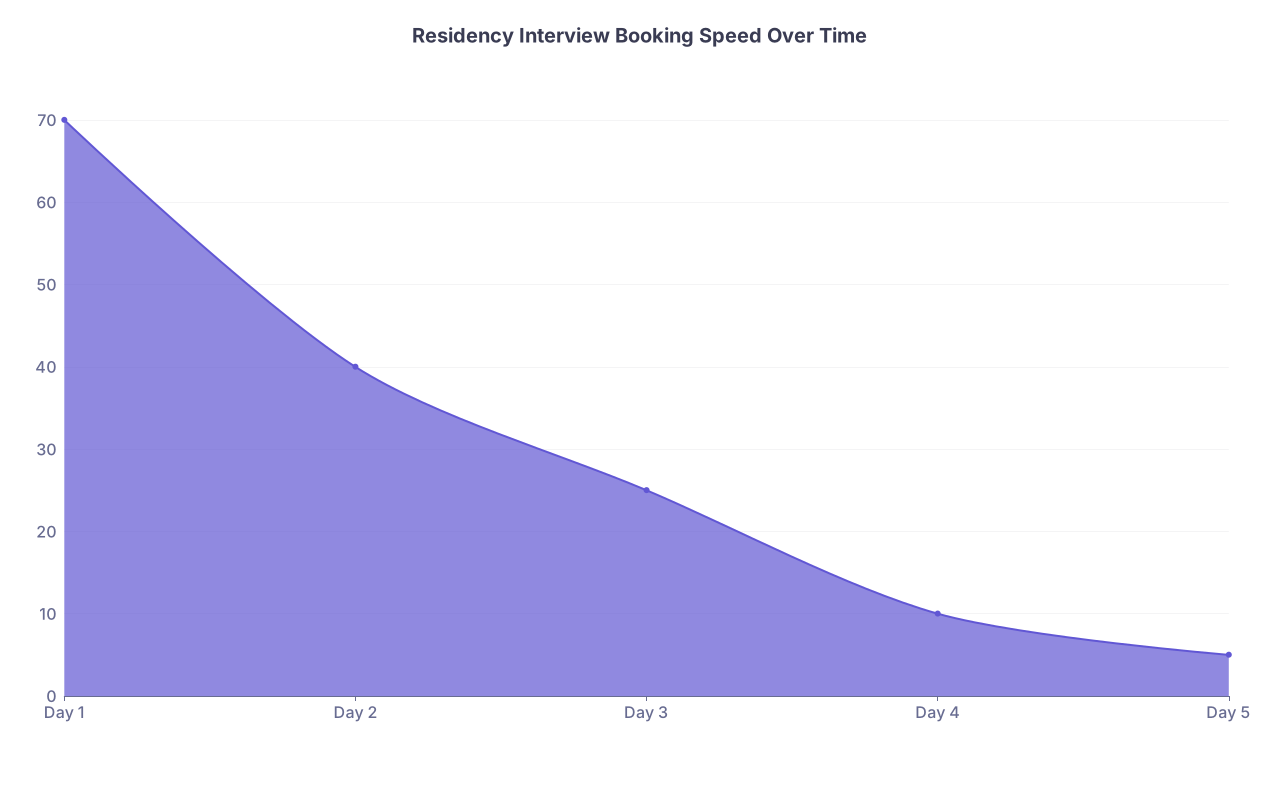
| Category | Value |
|---|---|
| Day 1 | 70 |
| Day 2 | 40 |
| Day 3 | 25 |
| Day 4 | 10 |
| Day 5 | 5 |
Most prime spots disappear in the first 24–48 hours. That is not because those people were ranked higher before invites; it’s because they were sitting on email, nervous and prepared.
That’s not rigging. That’s just selection pressure on organization and urgency.
How to stop obsessing over “rigging” and focus on leverage
If you spend your emotional bandwidth trying to decode whether your January 10 interview means you’re “mid-tier” for a program, you’re missing the point.
You should be spending that energy on:
- Actually preparing for the questions that matter.
- Understanding the program’s genuine pain points so your answers resonate.
- Showing you’ll make residents’ lives easier, not harder.
- Following up appropriately so they remember you for substance, not schedule drama.
If you want to influence things meaningfully:
- Respond to invites fast.
- Be specific and respectful in any request to change dates.
- Use real advocacy sparingly but strategically.
- Show up prepared enough that a faculty member says in the meeting, “I really liked that one.”

| Step | Description |
|---|---|
| Step 1 | Interview Invite |
| Step 2 | Better date options |
| Step 3 | Limited leftover slots |
| Step 4 | Meet key faculty |
| Step 5 | Standard exposure |
| Step 6 | Stronger advocacy in ranking meeting |
| Step 7 | Respond Quickly? |
That’s where the game is won or lost. Not in getting yourself from January 18 to January 5.
The bottom line: what’s rigged, what’s not, and what you can do
To close this without fluff:
Residency interview structures are pre-designed and sometimes strategically skewed, but individual interview dates are not a secret pre-rank score. Timing has some effect, but nowhere near as much as applicants claim.
You can influence your interview timing and exposure—mainly by responding quickly to invites, making targeted and respectful scheduling requests, and using advocacy from mentors—but you cannot rewrite a program’s calendar or politics.
The real “rigging” that matters is how you perform and how you’re perceived in context. Strong preparation, clear stories, and being someone residents actually want to work with will move you far more than shuffling dates on a calendar ever will.