
How many people do you think will have actually read your ERAS file before you log into that Zoom interview? One attending? The whole committee? Or nobody beyond a 10-second skim of your Step score?
Let me ruin the comforting fantasy first: a shocking number of interviews are done by people who have barely looked at your application. Or looked at one tiny part of it and nothing else.
But that does not mean your application “doesn’t matter” once you have an interview. That’s another lazy myth.
Let’s split the myths from what PDs and faculty actually do, based on survey data, real program workflows, and what people say when they forget there’s a med student in earshot.
The Core Myth: “Once You Have an Interview, They’ve Read Everything”
You’ve heard this one in a dozen forms:
- “If they invite you, they already like you.”
- “They wouldn’t waste time interviewing someone they don’t know.”
- “Everyone on the panel will have studied your file.”
No. No. And absolutely not.
Here’s the reality: the “program” is not one brain. It’s a collection of humans with different levels of investment, time, and preparation.
Let’s break the players down.
Who actually reads your application?
In most mid-to-large programs, there are usually three layers:
Screeners / file reviewers
Often the PD, APDs, a “selection committee,” and sometimes chief residents. They decide who gets an interview.Coordinators / admin staff
They know your name, your interview date, your photo, and whether you sent that damn Step 2 score. They do not care about your gap year in global health, but they know if your file is “complete.”Interviewers (faculty, residents, sometimes PD/APDs)
These are the people you’re actually talking to on interview day. Their level of preparation is wildly variable.
Here’s the uncomfortable truth: the people who decided to invite you are not always the same people who interview you. And even when they are, they often have not re-read your entire file.
What the Data and Surveys Actually Show
Let’s anchor this in something more than hallway gossip.
Several NRMP and specialty-specific surveys give us recurring patterns:
- PDs and selection committees rely heavily on a few key data points to decide who to invite: board scores, MSPE, clerkship performance, sometimes research and letters.
- Once the interview is offered, the full file is inconsistently reviewed by the interviewers themselves.
We do not have perfect, standardized data on “percent of interviewers who fully read each ERAS file,” because nobody wants to put that in writing. But we do have consistent patterns from PD panels, program workshops, and behind-closed-doors comments.
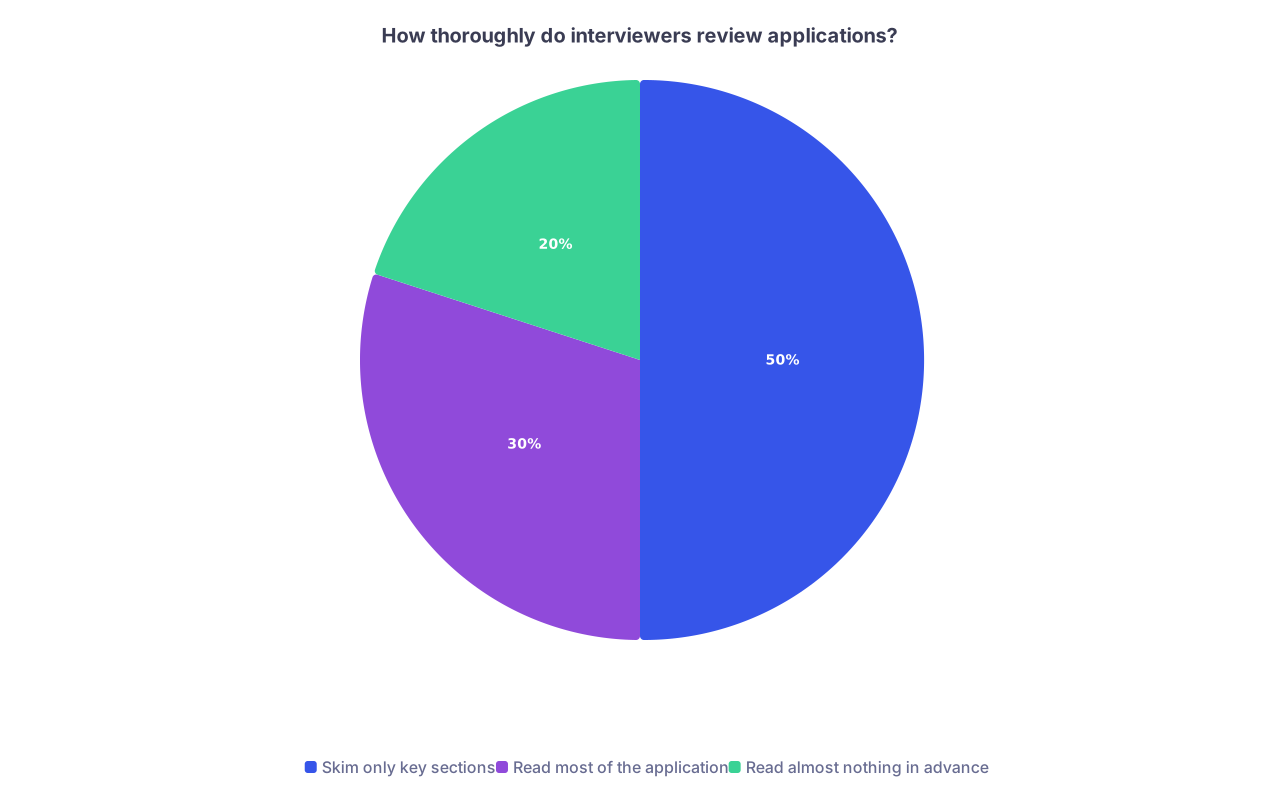
Typical distribution I’ve seen (and heard PDs half-admit on webinars):
| Category | Value |
|---|---|
| Skim only key sections | 50 |
| Read most of the application | 30 |
| Read almost nothing in advance | 20 |
Is that precise? No. Is it directionally honest? Yes.
The bottom line: full, careful, pre-interview reads are not the norm for every interviewer. The PD and a couple of APDs may know your file inside out. A random faculty interviewer on a busy OR week? Very unlikely.
Why Many Interviewers Don’t Read Your Full Application
Not because they’re evil. Because the system is absurd.
Look at the math. A typical categorical IM program:
- 800–2,500 applications received
- 400–800 actually reviewed by someone
- 100–200 interviewed
- Each applicant gets 3–6 interviews within the program
Now multiply that by faculty.
If you’re expecting Dr. Cardiology-Attending to sit down and read fifteen 30–50 page ERAS packets on a post-call evening, you’re imagining a universe in which burnout doesn’t exist.
Here’s what actually happens in very real programs:
- The night before interviews, a PDF packet goes out with 1–2 page summaries: demographics, med school, USMLE, red flags, quick notes. Sometimes that’s all interviewers see.
- Some programs include your personal statement; others don’t bother attaching it to the summary.
- Programs with higher volume (IM, FM, EM, some prelims) are much more likely to rely on summaries and quick skims.
- Smaller, competitive programs (derm, rad onc, some surgical subs) are more likely to have faculty who read more deeply—because volume is lower and stakes feel higher.
So when you walk into that Zoom room:
- One interviewer might know your full story, including that gap year and the nonprofit you started.
- Another might only know: “US grad, Step 245, AOA, strong letter, interested in cards.”
- A resident interviewer might know literally nothing except your name and where you’re from.
You can’t control which one you get.
What PDs Actually Care About Before vs During the Interview
This is where people get confused. They think “application importance” is one thing. It’s not. It splits into phases.
Pre-interview: your application is a filter.
During/post-interview: your application becomes context and tie-breaker.
Let’s map that out.
| Phase | Primary Function of Application | Who Engages Most |
|---|---|---|
| Screening | Filter and risk assessment | PD/APDs/committee |
| Interview Day | Context and conversation fuel | Some interviewers |
| Rank Meeting | Evidence to justify gut feelings | Committee/PD |
During screening
The file is king. That myth is true here.
- The PD and selection committee will absolutely look at your metrics, MSPE, letters, and red flags.
- The personal statement? Sometimes. Usually for borderline or unusual candidates, or to explain gaps.
- Research and extracurriculars are often evaluated in a quick “is this substantial or fluff?” way.
They’re not reading every line of every activity. They’re scanning for signals and landmines.
On interview day
The file turns into a buffet. Interviewers pick and choose what to glance at:
- Some start with your personal statement intro and one or two experiences.
- Others go straight to research or scores.
- Some don’t open your file until you’re already in the room and they’re stalling with “So tell me about yourself.”
Does this variability hurt you? Only if you prep like everyone has memorized your ERAS.
Myths That Actually Hurt Your Interview Performance
Let me go after the big three myths that cause real damage.
Myth 1: “They’ve read everything, so I don’t need to repeat my application”
This is how people sabotage themselves.
They think:
“I already wrote about my volunteer work / research / gap year extensively. I shouldn’t bore them by repeating it.”
Then the interviewer, who has skimmed nothing but the first page of their CV, hears a vague answer like:
“I’ve done a lot of community work that’s been meaningful to me.”
Meaningless. It floats in empty space.
You must assume: your interviewer either hasn’t read, or doesn’t remember, most of your file.
Your job is to bring key parts to life like they’re hearing it for the first time. Because many are.
You’re not being repetitive. You’re doing the basic work of storytelling.
Myth 2: “Once you have an interview, the file doesn’t matter anymore”
This is what applicants tell each other so they can stop caring about their ERAS after October.
Here’s how it really goes in many programs:
- After each interview day, interviewers submit numerical scores and/or free-text comments.
- Then there’s a rank meeting. They pull up your name on a giant spreadsheet.
- PD asks: “Remind me, what was their Step 2? Any issues on MSPE? Any failures? Anything special?”
- People re-open your file. Quickly. Targeted.
Those details absolutely sway decisions for borderline candidates.
A very common pattern:
- Two applicants interviewed similarly well.
- One has a strong upward trend, real leadership, and consistent narrative in their file.
- The other has a vague story, scattered experiences, and a lukewarm letter.
Who moves up the list? It’s usually not mysterious.
Your file remains an anchor. It just functions differently at each stage.
Myth 3: “If they ask about X, they must have read my whole file”
No. Often they just latched onto the one thing that caught their eye in the 20 seconds they were scrolling.
I’ve heard this in faculty rooms more times than I can count:
- “I didn’t have time to read his stuff, so I’ll just ask about this Haiti trip.”
- “She did oncology research—perfect, I’ll talk about that.”
- “I see they’re from [your hometown]; I’ll start there.”
One interesting hook and suddenly the conversation looks “personalized.” Behind the curtain, it was a scramble.
Do not overinterpret targeted questions as evidence of deep reading. It’s often just triage.
How to Prepare When You Know Many PDs Don’t Fully Read
Here’s the part you can actually control. Not the laziness of some interviewers. Your preparation.
You’re operating in an environment where:
- Some people know your file well.
- Some know almost nothing.
- You can’t tell who’s who.
So you prepare for the worst-case: assume minimal familiarity.
1. Build a tight, spoken version of your application
You need a verbal “ERAS in 3 minutes” that hits:
- Where you’re from and where you trained
- Major themes of your experiences (not a laundry list)
- Your “why this specialty” in 1–2 sentences
- One distinct thing that makes you memorable
If your answer to “Tell me about yourself” takes 7 minutes and covers 14 activities, you’ve already lost most interviewers.
2. Know your own file cold – including the stuff you forgot
Interviewers love to pull something random from page 6:
- “Tell me about that free clinic you did in M1.”
- “What did you actually do on that quality improvement project?”
- “I see you had a leave of absence—what happened?”
You cannot stumble on your own history. Spend one evening reading your ERAS like a stranger, and for each entry be able to say:
- What you did
- What you learned
- What changed because of it (you or the system)
If you can’t do that for an activity, it shouldn’t have been in there. But you’re past that now, so at least be fluent.
3. Prepare “anchor stories” that connect across multiple parts of your file
Here’s what sophisticated candidates do: they pick a few core stories that can answer multiple types of questions.
For example, one longitudinal research project:
- “Tell me about a challenge you faced.”
- “What’s an example of working on a team?”
- “A time something didn’t go as planned?”
- “How have you shown persistence?”
You’re not inventing. You’re re-using. That way, even if interviewers didn’t read, you’re drawing from things they could verify in your file if they looked later.
How Programs Actually Move You on the Rank List
You might think: “Fine, some interviewers don’t read before. But surely at the final rank meeting they know my file well.”
Sometimes yes. Often, no.
Here’s a simplified version of the actual process used in many programs:

| Step | Description |
|---|---|
| Step 1 | Applications Received |
| Step 2 | Screening by PD/Committee |
| Step 3 | Interview Offers Sent |
| Step 4 | Interview Day Scores & Comments |
| Step 5 | Preliminary Rank List |
| Step 6 | Rank Meeting Review |
| Step 7 | Final Rank List |
What matters at each step:
- Screening: Your file is king.
- Interview day: Your interpersonal performance is king; file is supporting actor.
- Rank meeting: It’s a knife fight between gut impressions and file details.
I’ve watched this live:
- “She was fantastic on interview day.”
“Agreed. Any concerns in her MSPE?”
“No, all high passes/honors, great comments.”
“Okay, bump her up.”
Or:
- “He seemed a bit rigid.”
“Yeah, plus his letters were fine but not glowing.”
“We can move him down a tier.”
They’re not re-reading your personal statement word for word. They are dipping back into your file to justify moving you up or down relative to others.
The One Group That Almost Always Reads More: PDs and APDs
Let me at least give you one reassuring point: PDs and many APDs actually do know your application reasonably well.
Why?
- They designed (or signed off on) the screening process.
- They often read your file when deciding to invite you.
- They’re usually the ones leading the rank meeting discussion later.
So when you’re talking to the PD:
- Expect more specific, grounded questions.
- Expect them to catch inconsistencies.
- Expect them to remember your “story” more than a random faculty interviewer.
Residents? Hit or miss, but often low prep.
Random faculty? Very hit or miss.
PD/APDs? Much more likely to have real familiarity.
So do not wing those PD interviews. They’re the ones who actually tie your interview performance back to your file in the final decisions.
What This All Means For You
Let me strip this down to the practical takeaways.
Do not assume anyone has truly read your whole application before talking to you.
Prepare to re-introduce key parts of your story clearly and concisely, without sounding surprised when they have no idea what you wrote.Your file keeps mattering after the interview—but in a different way.
It becomes ammunition for or against you in rank meetings, especially when your interview performance is similar to others. Consistency between what you say and what you wrote is non-negotiable.The people with the most power (PD/APDs) are the most likely to know your file.
Treat those interviews as high-stakes conversations with someone who actually remembers your narrative, your red flags, and your strengths.
The myth is comforting: “They know you; just be yourself.”
The reality is harsher and more useful: they barely know you, they’re busy, and you have 15–30 minutes to make your file come alive.
Prepare for that world—the real one—and you’ll do better than the people still believing the brochure version.