
Why ‘Be Yourself’ Is Incomplete Residency Interview Advice
What actually happens if you walk into residency interviews having only been told, “Relax and be yourself”?
You already know the answer. I’ve seen it in real time. The applicant who’s “just being themselves” starts rambling about a toxic attending, overshares about burnout, gives 5‑minute answers, forgets to mention anything specific about the program, and walks out thinking, “That felt authentic.” Then they’re shocked when the interview‑to‑rank rate is terrible.
“Be yourself” isn’t wrong. It’s just lazy, incomplete advice that ignores how residency selection really works.
You’re not going on a date. You’re interviewing for a multi‑hundred‑thousand‑dollar training spot where people are trying to predict: Will this person be safe, functional at 3 a.m., workable in a team, and not make our lives miserable?
Let’s dismantle the myth and replace it with something that actually works.
The Problem With “Be Yourself” in Residency Interviews
Here’s the core issue: interviewers aren’t choosing “who you are.” They’re choosing the version of you they can infer in limited time, under structured constraints, filtered through their biases and the program’s needs.
“Be yourself” completely ignores that.
Residency interviews usually have:
- 20–30 minutes per interviewer
- Recycled questions
- Tired faculty and chiefs doing 8–10 interviews in a row
- A rank meeting where you become a set of impressions and a few notes
You are not being evaluated in a vacuum. You are compared, side‑by‑side, with dozens of other applicants whose board scores, grades, and experiences are often roughly similar.
In that environment, “be yourself” leads to predictable failure modes:
Unstructured, rambling answers
The authentic internal monologue of a tired MS4 is not linear. If you haven’t practiced, your answer to “Tell me about yourself” easily turns into a five‑minute life story that never once hits what programs actually care about: clinical performance, work ethic, team fit, growth.Emotional oversharing framed as “vulnerability”
I’ve watched applicants talk candidly about ongoing depression with no clear treatment or stability, or describe current feelings of resentment toward medicine. That may be deeply honest. It also reliably gets flagged as risk in rank meetings.No strategic tailoring
Being “yourself” without context means you give the same answers at a community program with heavy service needs and at a research‑heavy academic center. Then you wonder why you “clicked” with some and not others.
None of this is about being fake. It’s about understanding the game you’re playing.
What the Data Actually Shows About Interviews
Let’s cut through vibes and look at how interviews function in the match.
Survey data from NRMP Program Director reports over the years shows the same pattern: once you’re invited, your interview performance and interpersonal skills often outrank USMLE scores in importance for the rank list.
Programs obviously screen with numbers. But when they sit down to rank, they talk about:
- “Seemed easy to work with”
- “Red flag — talked badly about prior program”
- “Strong team orientation”
- “Weak communication skills”
- “Didn’t really answer questions”
You won’t see those phrases in ERAS. They show up in the committee room.
And here’s the part “be yourself” advice skips: interview ratings are not random. They’re strikingly consistent when multiple interviewers see the same applicant. That means people are picking up on patterns: clarity, coherence, insight, professionalism, and yes, basic social awareness.
So if your “authentic” mode includes:
- Long, disorganized answers
- Defensive explanations for weak spots
- Vague interest in the specialty
- Zero specific knowledge about the program
…it isn’t authentic vs. fake. It’s effective vs. ineffective.
Authenticity vs Performance: You’re Doing Both
You’re not at an acting audition. But you are performing.
Every attending who interviews you has done this themselves. They didn’t walk into their own interviews in scrubs, tell stories with real patient names, and rant about annoying classmates “because that’s who I am.” They prepared stories. They chose which version of themselves to highlight.
The real skill you need is this:
Be a true version of yourself, curated for the professional context you’re entering.
Think of it like this: you’re still you in clinic, in the OR, at M&M, and at home. But the way you talk, the level of detail, and what you emphasize changes based on setting. No one calls that “fake.” It’s just being socially competent.
Residency interviews are the same. They require:
- Content authenticity – the stories and motivations are real. No invented research, no inflated roles, no fake “passion.”
- Context discipline – you choose which stories, which details, and which angles highlight that you’re a safe bet and a good fit.
Where people get burned is when someone told them: “Don’t overprepare, just be yourself.” Then they walk into the highest‑stakes professional conversation of their life with less preparation than they used for Step 1.
What Programs Are Actually Looking For When You Talk
Strip away the fluff and here’s what most interviewers are trying to answer about you in 20–30 minutes:
- Are you going to be safe with patients?
- Are you going to be a pain to work with?
- Do you have insight into your own strengths/weaknesses?
- Will you show up, work hard, and not crumble under stress?
- Do you actually want this program, or are we just interview #14?
Most of the common questions are just different ways of probing those same issues.

“Tell me about a conflict on a team” is not a vibe check. It’s:
- Can you describe a situation clearly?
- Do you see your own role in it?
- Do you resolve things or escalate them?
- Do you blame others, or do you own your part?
If your version of “being yourself” is telling an unfiltered story where you come out the hero and your co‑resident or attending is obviously the villain, that gets noticed. And not in the way you think.
What works far better — and is still honest — is a structured, reflective answer where:
- The facts are real.
- Your emotions are real.
- Your responsibility is acknowledged.
- Your learning is explicit.
That’s authenticity with judgment. That’s what they want to see.
How “Be Yourself” Fails on Common Questions
Let’s walk through a few high‑yield areas where this advice leads applicants off a cliff.
1. “Tell me about yourself”
Unprepared + “be yourself” leads to:
“I grew up in X, I’ve always loved science, my parents are both in healthcare, I did some research in med school and really enjoyed it, and I like to stay active and hang out with friends outside of school…”
You’ve said nothing.
A better approach isn’t fake. It’s focused:
- 1–2 sentences of origin that tie into your current identity
- 2–3 sentences on how you show up clinically and on teams
- 1–2 sentences linking that to why you fit this specialty/program style
Same person. Same life. Different curation.
2. Discussing weaknesses or failures
“Be yourself” often turns into:
“I’m a perfectionist.”
Or
“I just care too much.”
Which every interviewer has heard 300 times and doesn’t believe.
Or you swing the other way:
“I’ve always struggled with time management, I procrastinate, and honestly I was really burned out and disengaged for a while during third year.”
That’s probably emotionally honest. It’s also a liability if you stop there.
Honest but effective sounds like:
- A real weakness or failure, with specifics
- Evidence that you’ve already changed behavior
- A concrete system or strategy you now use
You’re not hiding the flaw. You’re showing you’re trainable and not static.
3. “Why this specialty?” / “Why this program?”
Here’s where “be yourself” tends to produce platitudes.
“I like continuity of care and procedures.”
“I want a strong clinical foundation.”
“I’ve always loved working with underserved patients.”
Those might all be true. They’re also generic enough to paste into anyone’s file.
Being yourself with brains means:
- You anchor your motivation in a few specific experiences.
- You can describe what energized you on the rotation in concrete terms.
- You know something unique and specific about the program that fits who you are.
That’s still “you.” It’s just you who bothered to do the homework.
The Part That Should Be “Be Yourself”
There are things where pretending will hurt you more than help you.
You should be:
- Honest about whether you like high‑acuity chaos or prefer methodical, longitudinal care.
- Honest about needing a supportive culture vs. being fine in a more “old school” environment.
- Honest about whether you actually want to do research, or you just think you’re supposed to.
Because the worst‑case scenario is not “I didn’t match at my dream name‑brand program.” It’s “I matched at a place whose culture and demands are absolutely wrong for me because I auditioned to be someone I’m not.”
Where authenticity protects you:
- In your questions to residents and faculty.
- In how you describe what you want from training.
- In how you rank programs.
You can be strategic in the interview and brutally honest with yourself during your rank list. That’s the right division of labor.

| Step | Description |
|---|---|
| Step 1 | Self-Assessment |
| Step 2 | Research Programs |
| Step 3 | Draft Stories |
| Step 4 | Mock Interviews |
| Step 5 | Refine Answers |
| Step 6 | Interview Day |
| Step 7 | Post-Interview Notes |
| Step 8 | Rank List Decisions |
How to Prep Without Becoming a Robot
The fear behind “I’ll just be myself” is usually: “If I prepare, I’ll sound scripted and fake.”
That happens when people memorize sentences. Don’t do that.
Prepare at the level of stories and structure, not word‑for‑word scripts.
You want:
- 6–8 core stories: a conflict, a failure, a leadership moment, a patient that changed you, a time you received hard feedback, something you’re proud of, etc.
- Each story mapped to a simple framework (context → challenge → what you did → what you learned).
- A clear through‑line about why this specialty, why this program type, and what you bring.
Then you practice — out loud — until it no longer sounds like you’re reading from a teleprompter in your head.

You’ll notice something important happens when you do that:
- You feel freer in the room because you’re not constructing answers from scratch.
- You can actually listen to the interviewer and adapt, instead of panicking.
- Your real personality comes through more, not less, because the scaffolding is already built.
This is exactly what strong residents do in real life: they prepare for presentations and tough conversations, but how they deliver them is very much “them.”
The Hidden Variable: Fit Is Bidirectional
One more myth: that the only goal is to make programs like you.
If all you hear is “be yourself,” you’re missing the other half: you are also evaluating them. And you can’t do that if you walk in unprepared, default to autopilot answers, and ask generic questions because you’re “going with the flow.”
The people who end up happier in residency usually:
- Present a professional, thoughtful version of themselves in interviews.
- Ask pointed, honest questions about schedule, culture, teaching, autonomy, and how the program handled previous crises (COVID, service changes, resident complaints).
- Compare what they were told on interview day with what residents say privately and what their gut tells them.
That requires a clear sense of your own priorities. And it requires not trying to “sell” yourself so hard that you ignore obvious red flags.
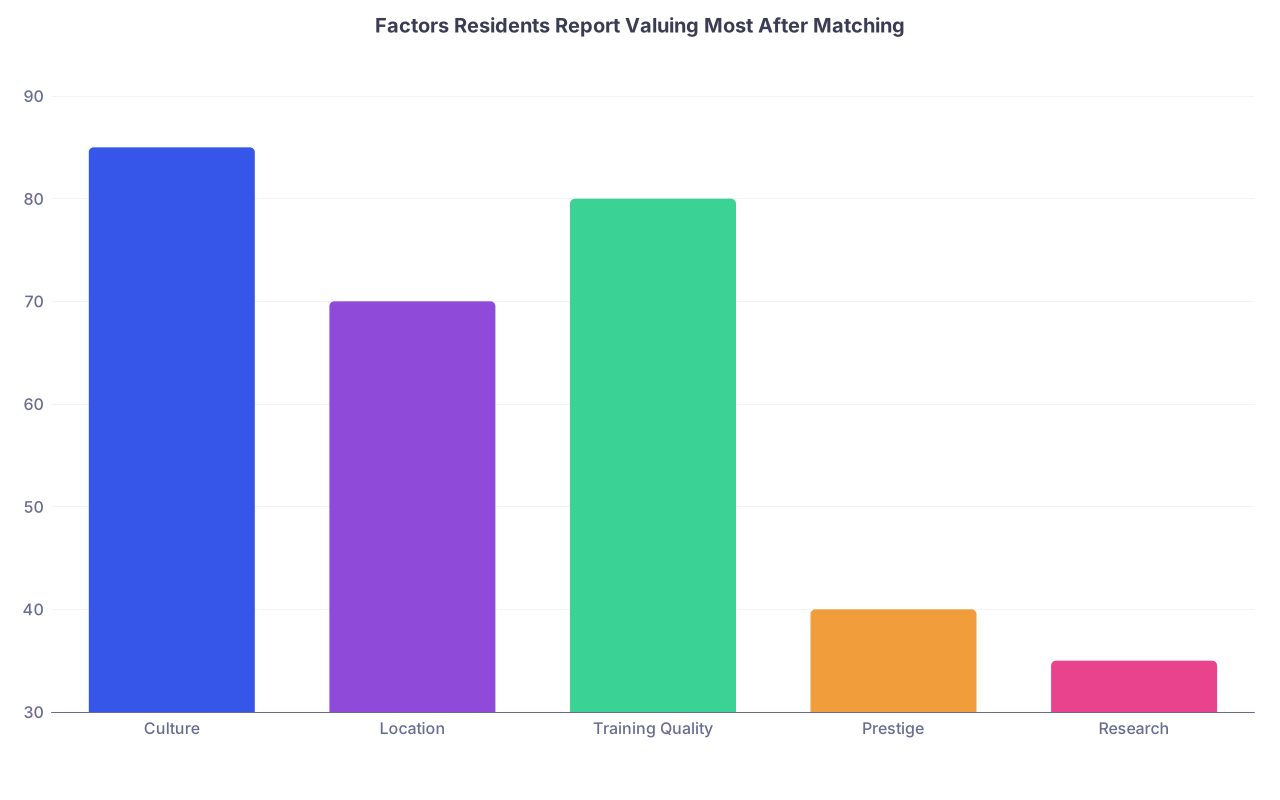
| Category | Value |
|---|---|
| Culture | 85 |
| Location | 70 |
| Training Quality | 80 |
| Prestige | 40 |
| Research | 35 |
Plenty of residents later admit they ranked for name or pressure, not for authentic fit. And they regret it. Not because the program was evil. Because it was wrong for who they actually are day‑to‑day.
Being honest with yourself about what you need from a program will do more for your long‑term career and sanity than any perfectly polished answer ever will.
So What Do You Do With “Be Yourself” Now?
Don’t throw it out. Just demote it.
Treat “be yourself” as:
- A reminder not to lie, not to inflate, not to invent.
- A guardrail against mimicking some imaginary ideal resident that doesn’t exist.
- A cue to let your actual energy, humor, and curiosity show once the basics are handled.
Layer on top of it:
- Serious preparation
- Story selection
- Structured answers
- Program‑specific insight
- Real self‑reflection about what you want
Then you walk into that interview not as “raw, unfiltered me,” and not as “stiff, scripted applicant,” but as something much more powerful: the version of yourself you’d want as a co‑resident at 2:00 a.m.

Quick Reality Check: Incomplete vs Wrong
Let me be precise.
“Be yourself” isn’t wrong. If you force yourself into some fake persona to chase prestige, you’ll either be miserable or exposed.
What’s wrong is pretending that authenticity alone is enough in a high‑stakes, competitive, professional selection process.
You would never tell a surgeon: “Don’t bother with a game plan, just be yourself in the OR.”
You wouldn’t tell a resident presenting at M&M: “Don’t structure it, just speak from the heart.”
Same principle.
Interviews are part performance, part assessment, part mutual evaluation. You owe it to yourself to show programs who you actually are — at your best, not at your most unfiltered.
Bottom Line
Three points, and then you can go back to practicing answers:
- “Be yourself” is incomplete advice. You need authenticity plus structure, preparation, and judgment.
- Programs are screening for safety, teamwork, insight, and fit; your stories and behavior in interviews either prove or undermine that, regardless of how “real” you feel.
- The goal is not to be fake; it’s to present the version of yourself you’d trust at 3 a.m. on call — and to use interviews to honestly decide where that version of you will thrive.