
Charisma does not beat credentials in residency interviews. But charisma absolutely decides outcomes when credentials are similar. And that’s the part most applicants get wrong.
People love clean stories: “PDs only care about scores and class rank” or “If you’re charming enough, you can overcome anything.” Both are fantasy. Residency selection is a numbers-gate plus a people-judgment. You cannot skip the gate. But once you’re past it, you’re being judged as a future colleague, not a Step score.
Let’s dismantle the myths and look at how this actually plays out.
What Programs Really Rank First: Data, Not Vibes
I am going to start with the least sexy part: numbers and checkboxes.
The National Resident Matching Program (NRMP) publishes the Program Director (PD) Survey. It is not perfect, but it’s miles better than Reddit gossip. When PDs are asked which factors are “very important” in deciding who to interview and how to rank them, charisma is not listed. Because they do not call it that.
They call it things like:
- “Interactions with faculty during interview and visit”
- “Interpersonal skills”
- “Perceived commitment to specialty”
- “Professionalism and ethics”
Those are charisma’s grown‑up cousins.
Now, zoom out. For interviews offers, the heavy hitters are:
- USMLE/COMLEX scores
- Fails or repeats
- Clerkship grades
- Class rank / AOA
- Dean’s letter / MSPE and letters of recommendation
- Past professionalism concerns
If your objective record is way below a program’s usual range, no amount of charm on interview day will fix it. You simply will not get in the door.
But once you are in the interview pool, the picture changes.
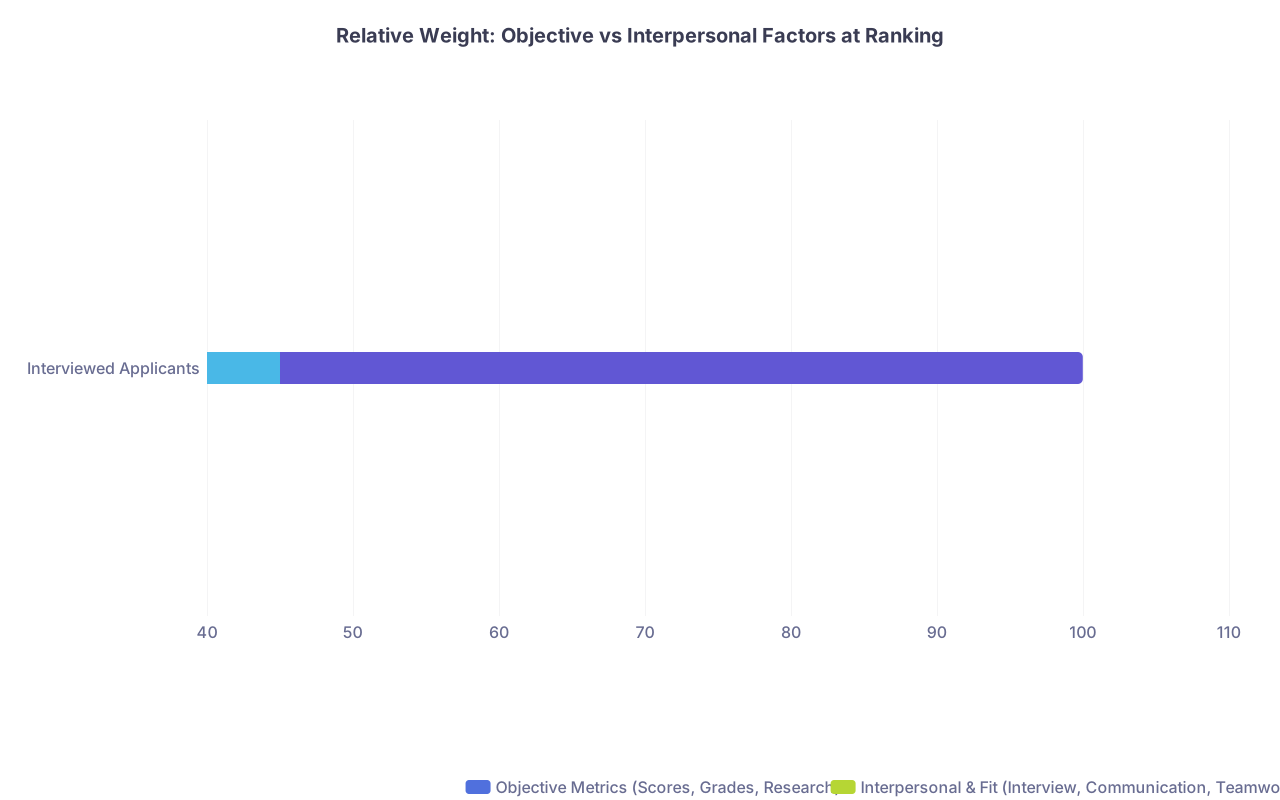
| Category | Objective Metrics (Scores, Grades, Research) | Interpersonal & Fit (Interview, Communication, Teamwork) |
|---|---|---|
| Interviewed Applicants | 45 | 55 |
Across multiple PD surveys, “interview performance” consistently shows up as the single most important factor in rank list decisions. Not scores. Not research. Not your three first‑author papers in a journal no one actually reads.
So no, charisma does not “beat” credentials. Credentials get you the invite. Then the interpersonal side quietly becomes more important than most applicants want to admit.
The Charisma Myth: What It Is and Why It Screws You
When students say “charisma,” they usually mean some mystical personality trait: being funny, extroverted, instantly likable. The idea is: some people just “have it” and the rest of us are doomed to be “nice but forgettable.”
That belief is worse than wrong. It’s paralyzing.
I’ve sat on interview days where the supposedly “charismatic” applicant tanked because they overperformed — jokes that landed flat, slick answers that felt rehearsed, a weird sales‑pitch vibe. Meanwhile, the quiet, clear, thoughtful applicant who actually listened to questions and responded like a human? Shot up the rank list.
Program faculty are not talent show judges. They are asking one question:
“Do I want to take sign-out from this person at 2 a.m. for three years?”
“Charisma” in that context looks very different from what social media sells you.
It looks like:
- You answer questions directly and clearly.
- You show you actually care about the specialty and patients.
- You demonstrate you can own mistakes and learn.
- You are easy to talk to.
- You do not come off as defensive, arrogant, or weirdly robotic.
If you want a useful definition: in residency interviews, charisma is applied interpersonal competence under stress.
Not being the funniest. Not having the biggest personality. Being the person the team trusts.
Where Credentials Stop Helping You
Here’s the uncomfortable truth: past a certain threshold, your numbers blur together.
I’ve watched rank list meetings where people say things like:
- “Remind me, was she the 252 or the 259?”
- “He was the one with the family medicine paper, right? Or was that the other guy from Michigan?”
Nobody cares that your Step 2 is 8 points higher than the next person’s if you both cleared the bar.
What they do remember:
- “She was the one who talked about that sepsis QI project and then asked really sharp questions about our ICU rotation.”
- “He was the guy who kept interrupting people on the group lunch. Hard pass.”
- “That applicant from a DO school — everyone loved talking with her. She’d fit here.”
That’s the real battlefield.
Think of it this way: below-threshold credentials can get you screened out. Above-threshold credentials mainly stop others from doubting you. That’s it. They don’t charm anyone, they just silence concern.
From there, your behavior in interviews drives ranking much more than another line on your CV.

What Interviewers Actually React To: Real-world Patterns
I’ve watched faculty fill out score sheets mid‑interview. Here’s the pattern that repeats.
The applicant with “perfect” credentials but stiff, overly rehearsed answers gets comments like:
- “Strong CV, but felt scripted.”
- “Hard to gauge personality.”
- “Not sure about fit.”
The applicant with solid but not superstar credentials plus excellent interpersonal behavior gets:
- “Great team fit.”
- “Would be happy to work with her.”
- “Smart, humble, teachable.”
And when push comes to shove, committees will absolutely move an “average-strong on paper but great in person” applicant above a “stellar on paper but awkward/unpleasant” one. I’ve seen top‑5 med school names with 260+ Steps get dragged down because people flat-out did not want them as colleagues.
This is not theoretical. It’s how the discussions sound.
So Does Charisma Beat Credentials? The Honest Algorithm
Let’s strip the rhetoric and make this brutally clear.
| Stage | Credentials Weight | Charisma / Interpersonal Weight | Reality Check |
|---|---|---|---|
| Who gets interviews | Very High | Low | Scores, grades, red flags dominate. |
| Pre-interview shortlist | High | Medium | Letters & MSPE hint at interpersonal skills. |
| Interview day impressions | Medium | Very High | You are judged as a future colleague. |
| Final rank list ordering | Moderate | Very High | Fit, communication, and professionalism often tip the scale. |
Charisma never rescues you from catastrophic metrics (multiple failures, professionalism violations, wildly below-range scores). Programs are too risk‑averse for that.
But among the large subset of interviewees who all “look good on paper,” interpersonal performance is often the dominant factor.
The question is not “Does charisma beat credentials?”
The real question is: “Once you have enough credentials to sit in the chair, do you know how to act like someone they want in the program?”
Most applicants spend years building the first part and maybe two weeks fumbling around with the second.
That’s the strategic mistake.
The Trainable Parts: You Can’t Fake It, But You Can Build It
Let me kill another myth: “You’re either charismatic or you’re not.”
No. What you are either doing or not doing is practicing specific, observable behaviors that interviewers like.
Those behaviors are highly trainable. I’ve watched quiet, anxious M4s turn into high-impact interviewees in a month. Not because their personality changed, but because their habits under pressure changed.
You are not trying to become a TED Talk speaker. You’re trying to:
- Communicate clearly under low-to-moderate stress
- Show insight into your own experiences
- Demonstrate authentic interest in this specialty and this program
- Behave like someone who will not be a nightmare on call
That’s it. You can absolutely practice that.
The three levers that matter most
If you want the 80/20 version of “interview charisma,” it comes down to three levers:
- Clarity – Do I understand what you’re saying, and are you actually answering the question?
- Warmth – Do you seem like a decent human I could talk to in a workroom?
- Ownership – When you discuss challenges or screw-ups, do you own your role and show learning, or do you dodge and blame?
High-clarity, moderate-warmth, high-ownership beats “slick but vague” every single time.
What this looks like in practice
Let’s say you get a standard question: “Tell me about a conflict you had on a team.”
The low-charisma, over-scripted version:
“During my third-year surgery rotation, there was a miscommunication with a nurse about a dressing change. I clarified expectations and in the end the patient received excellent care. I learned the importance of communication and teamwork.”
Zero details. Zero ownership. Just buzzwords. Interviewers have heard this exact answer hundreds of times.
The high-interpersonal-competence version:
“On my surgery rotation, I was covering four post-op patients and one of them had borderline vitals. I’d asked the nurse to page me if his BP dropped below X. Later that evening, I realized his pressure had been trending down for over an hour and I hadn’t been called.
Initially I was frustrated and felt like ‘Why didn’t she follow what I said?’ But when we talked, it turned out I hadn’t been clear — I’d buried that request in a long list at a crazy time.
I apologized for sounding accusatory in my first message, and we agreed on a simpler parameter and a written note in the chart. I walked away realizing that when things are busy, I need to be explicit and check for understanding, not just give a rapid-fire list and assume it stuck.”
That answer shows clarity, warmth, and ownership. No theatrics. No sales job. Just someone who sounds like a functional human.
That’s interview “charisma” that actually moves the needle.
The Dark Side: When Charisma Hurts You
There’s another nuance the “charisma fixes everything” crowd ignores: overdoing it backfires.
Programs are on alert for:
- The overly smooth applicant who feels like they’re running a script
- The attention hog in group settings who dominates lunch or resident Q&A
- The applicant who turns every answer into a brag reel, never reflecting, never vulnerable
I’ve watched committees tank applicants with comments like:
- “He’s good in a vacuum but will be toxic in a team.”
- “She talked over two residents at lunch. No thanks.”
- “Feels like a politician.”
So even if you’re naturally extroverted, dialing it back and showing more listening, more curiosity, is often what actually makes you “charismatic” in this specific context.
Residency isn’t a sales job. It’s a team sport where emotional self-awareness matters.

| Step | Description |
|---|---|
| Step 1 | Applicant Pool |
| Step 2 | Screened Out |
| Step 3 | Interview Invite |
| Step 4 | Interview Performance |
| Step 5 | Ranked Low or Not Ranked |
| Step 6 | Ranked Highly |
| Step 7 | Meets Objective Threshold? |
| Step 8 | Interpersonal & Fit Strong? |
How to Prepare Like Someone Who Understands Reality
You’re in the “HOW TO PREPARE FOR RESIDENCY INTERVIEWS” phase, so let me be practical and blunt.
If your application is already submitted, you are not raising your Step score, clerkship grades, or adding real research impact. That game is over.
The leverage now is:
- Tightening your stories so they are specific, reflective, and clear
- Practicing speaking under time pressure until you sound like yourself, not a robot
- Learning how to show warmth and interest without faking or forcing it
- Asking better questions on interview day that signal genuine engagement
You do not need 40 mock interviews. You need a small number of brutally honest ones, recorded, with real feedback:
- “You never actually answered the question here.”
- “You rambled for three minutes; trim this.”
- “You sound like you’re reading your personal statement out loud.”
Fix those three problems and you will outperform many applicants with “better” CVs.
Because they are still hiding behind their credentials. And you’ll be the one sitting across from the PD, sounding like an actual future colleague.
Key points:
- Charisma does not replace credentials, but among interviewees above the threshold, interpersonal performance often matters more than small differences in scores or publications.
- What programs reward is not flashy charm; it is clear communication, warmth, and ownership — all of which are specific, trainable behaviors.
- If your application is already in, your highest-yield prep is not more lines on your CV, but becoming the person interviewers can picture taking sign‑out from at 2 a.m. for the next three years.