
You do not need 100 practice interviews. You probably do not even need 20. The “more is always better” mentality around residency interview prep is wasting your time and, in some cases, making you worse.
Let’s strip the superstition out of this and look at what actually moves the needle.
The Practice Interview Myth
Here’s the script I hear every year:
“I did 30+ mock interviews with friends, my school’s career office, mentors, and an online service. I’m still anxious. Should I do more?”
More reps feel productive. You’re “working on interviews.” But uncontrolled repetition without feedback and targeted change is just rehearsal of your bad habits.
Communication research is very clear on this: improvement is driven by deliberate practice, not raw hours. Think:
- Specific skills
- Clear feedback
- Focused repetition
- Reflection and adjustment
Endless generic Zoom “So tell me about yourself” sessions with your roommate do not meet that bar.
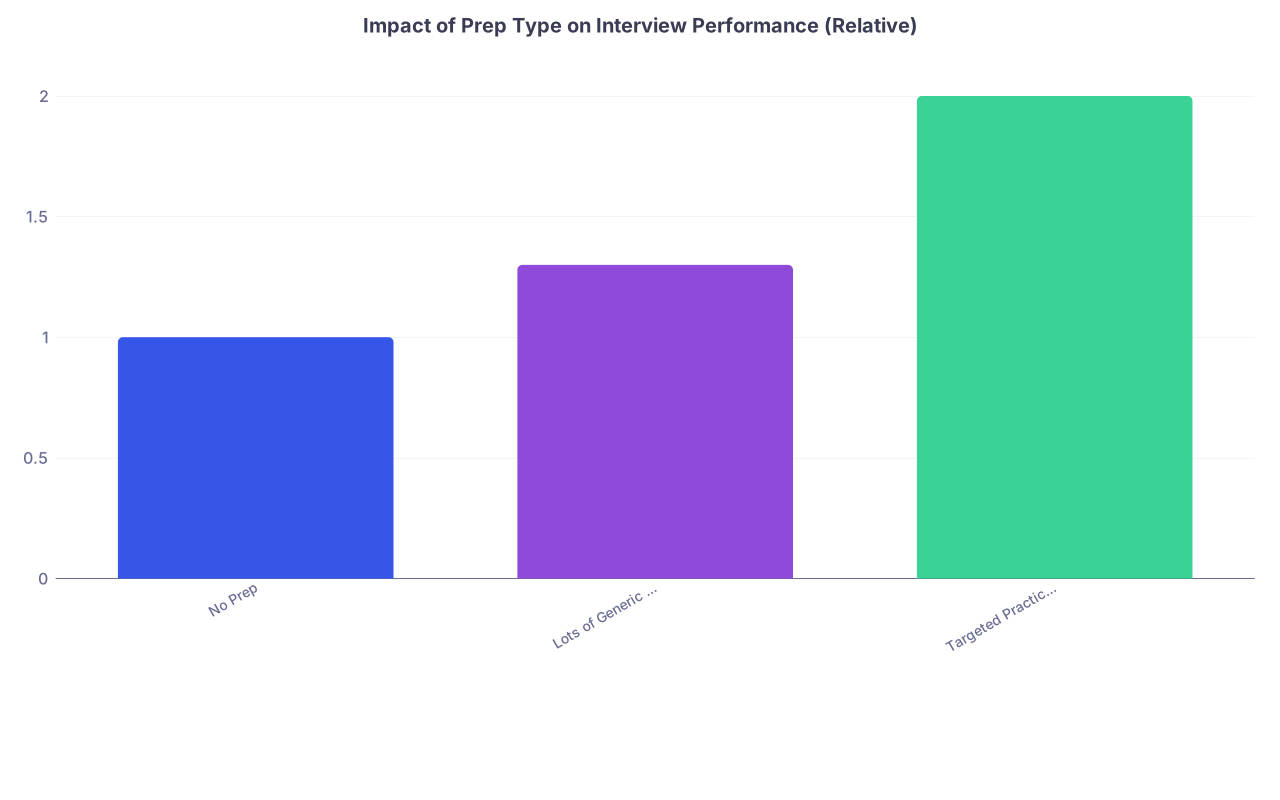
| Category | Value |
|---|---|
| No Prep | 1 |
| Lots of Generic Mocks | 1.3 |
| Targeted Practice + Feedback | 2 |
That 2x effect for targeted practice isn’t a made-up number. It’s consistent with what we see in studies of OSCE performance, public speaking training, and structured communication coaching. The pattern is the same: random repetition gives small gains; structured, feedback-driven practice gives large ones.
What Actually Predicts Residency Interview Performance
Forget the folklore. Interview performance tends to correlate with a handful of concrete factors. None of them require 100 mock sessions.
1. Clarity of Story, Not Number of Rehearsals
Programs are trying to answer three basic questions:
- Who are you?
- Why this specialty and this program?
- Are you safe and sane to work with at 2 a.m.?
If you cannot answer those cleanly, no amount of polished body language will rescue you.
The applicants who interview well usually have:
- A coherent, non-rambling “who I am” narrative (60–90 seconds, not a life autobiography)
- A believable, grounded specialty story (including at least one real turning point or “this solidified it for me” moment)
- Concrete evidence of being a good team member and learner (specific examples, not adjectives)
I’ve watched people go from “meh” to “strong” in three sessions just by tightening those three pieces. No extra personality, no performance coaching. Just clarity.
2. Behavioral Question Skills, Not Memorized Answers
The data from selection research is brutal: unstructured interviews are noisy, and generic questions like “What are your strengths?” are terrible predictors of performance. That is why many programs are shifting toward behavioral and structured questions.
These are the “Tell me about a time when…” questions.
They’re not testing whether you’ve memorized the perfect “weakness.” They’re testing how you think and reflect under mild pressure.
The skill is not to memorize 40 model answers. It is to:
- Recognize behavior-type questions on the fly
- Map them to a small set of prepared stories
- Present those stories in a clean, logical format (STAR, PAR, whatever acronym you like)
You can learn that mapping and structure in a handful of real practice runs. You don’t need 100.
3. Emotional Regulation Under Pressure
Here’s the dirty secret people avoid because it isn’t marketable: a lot of “interview prep” is actually just anxiety management in disguise.
Applicants who choke usually know what they want to say. They just cannot access it in the moment because:
- Their heart rate is 130
- Their working memory is gone
- They’re busy monitoring themselves instead of listening
You do not fix that by stacking more unstructured mock interviews on top. You fix it by:
- Lowering novelty (doing a few realistic mocks that truly simulate the experience)
- Developing a pre-interview routine to control arousal (breathing, scripting first lines, etc.)
- Accepting imperfection rather than chasing a “flawless” performance
Anxiety follows an inverted-U curve for performance. Too little and you sound flat. Too much and you lock up. Your goal is to sit on the peak of that curve—not stay up until 2 a.m. running your 19th “Tell me about yourself” with your stressed co-applicant.

| Step | Description |
|---|---|
| Step 1 | Clarify Story |
| Step 2 | Build Story Bank |
| Step 3 | 3-5 Targeted Mocks |
| Step 4 | Review Feedback & Adjust |
| Step 5 | Refine Behavioral Answers |
| Step 6 | Simulate 1-2 Real Interview Days |
| Step 7 | Light Maintenance Practice Only |
How Many Practice Interviews Do You Actually Need?
Let me be specific.
Assuming you’re not starting from scratch in English or with severe social anxiety, most applicants land in this range:
| Baseline Comfort Level | Recommended Structured Mocks |
|---|---|
| Very anxious / poor communication | 6–10 |
| Average / a bit rusty | 3–6 |
| Confident communicator already | 2–4 |
That is total, not per program.
Once you get beyond ~8–10 well-structured sessions, you hit diminishing returns hard. After that, the problem is almost never “not enough reps.” It is “no one is forcing you to change anything.”
The 3 Types of Practice That Actually Help
You do not need 100 random mocks. You do need a small number of specific ones, each serving a different function.
1. Diagnostic Session (1–2 interviews)
Do this first. No script. No over-prep. Record it if you can.
You want to surface the raw problems:
- Do you ramble?
- Do you freeze on “Why this program?” or “Why this specialty?”
- Are your examples vague and generic?
- Do you sound bored or robotic?
Then you pause and fix those issues. Not “everything.”
2. Skill-Building Sessions (2–5 interviews)
This is where deliberate practice actually happens. These should be:
- Focused: e.g., “today we’re fixing behavioral answers and structure,” not “general interview”
- Repetitive: you re-answer the same question two or three times in one session, each time incorporating feedback
- Honest: your partner or coach tells you plainly what did not land
Example I’ve seen repeatedly:
Applicant’s first answer to “Tell me about a time you made a mistake” is a vague story, 4 minutes long, with no clear resolution.
By the third attempt in the same 30-minute block, using STAR and trimming filler, it becomes a crisp 90–120 second answer with a clear “here is what changed in my behavior” ending.
That improvement took 3 iterations, not 30 separate “full mock interviews” over weeks.
3. Simulation Sessions (1–2 interviews)
Later in the season, you want to run the play under realistic conditions:
- Full-length interview (30–60 minutes) by someone who does not know you well
- Realistic mix of questions, including at least one curveball
- Hard cutoff times, no pausing to “coach” mid-stream
- Detailed debrief after, not during
These help for one reason: they reduce novelty. When the real day comes, you feel like you’ve “been here before.”
That is very different from the endless low-stakes chats people label as “mock interviews.”
What You Should Actually Spend Time On
The worst part about the “100 interviews” myth? It sucks time away from the things that truly improve how you come across.
Here’s where your energy is better spent.
1. Build a Tight “Story Bank”
Your story bank is a short list of detailed, real experiences you can repurpose for many questions. Not 50. Something like 8–12 good ones.
You want stories that show:
- Conflict or challenge
- A decision you made
- Something you actually did
- A clear outcome
- What you learned and changed
For example, one story about a near-miss you caught on rounds can be used for:
- “Tell me about a mistake.”
- “Tell me about a time you advocated for a patient.”
- “Tell me about a time you dealt with a difficult team dynamic.”
That’s leverage. Most “cram every possible question” guides ignore this and leave you spread thin.
2. Script Openings, Not Entire Answers
Fully memorized answers sound fake within three sentences. Faculty hear it immediately.
What works better: scripted first 1–2 lines for key questions, then speaking naturally.
For example:
“Tell me about yourself.”
First line: “I’m a [background—e.g., first-gen college student / former engineer / musician] who ended up in medicine because I’ve always gravitated toward solving complex problems with people, not just spreadsheets.”“Why this specialty?”
First line: “I didn’t come into medical school set on [specialty]. What pulled me in were a few specific patients and the kind of team culture I saw on those rotations.”
That opening buys you time and sets a clear direction. Then you can pull from your story bank.
3. Master 4–5 High-Yield Behaviors
Programs consistently care about a small set of behaviors:
- Communication and clarity
- Self-awareness and ability to reflect
- Teamwork and dealing with conflict
- Handling mistakes and feedback
- Motivation / genuine interest in their program
Every answer you give is a chance to show one or more of these explicitly. Not “I’m a team player” fluff. Concrete stuff like:
- “So I set up quick huddles with the night team to clean up handoff friction.”
- “After that, I changed how I…”
- “I realized my initial reaction was defensive, so I went back and asked for more feedback the next day.”
You do not need 100 mocks to practice those lines. You need a few sessions where someone stops you and says, “You said ‘teamwork’ three times but never described a single action. Try again.”
Why Over-Practicing Can Make You Worse
Here’s the part people do not like hearing.
Excessive mock interviews can actively damage performance.
I’ve seen three patterns:
Over-rehearsal → canned answers. You sound like you’re reading an internal teleprompter. Many faculty will quietly dock you for it, especially in fields that care about authenticity (FM, IM, psych, peds).
Hyper-self-monitoring. After the 40th mock, you’re thinking about hand gestures, eye contact, filler words, smiling frequency, posture—and not actually listening to the question. That kills spontaneity.
Burnout and resentment. By interview #15 of the real season, the people who hyper-prepared often sound bored and flat because they’re sick of hearing themselves. Ironically, they often did best in the earliest interviews.
The goal isn’t to industrialize yourself into a perfect interviewing machine. It’s to be a clear, thoughtful, reasonably relaxed version of yourself, reliably.
That takes focused work. Not endless volume.
A Simple, Evidence-Consistent Plan
If you want something concrete, here’s a sane outline that matches what communication research and years of actual results suggest.
Weeks before your first interview:
- Build your story bank (8–12 stories).
- Script first lines for 6–8 obvious questions.
- Do 1–2 diagnostic mocks, record and review.
Then:
- Schedule 2–5 skill-focused sessions over 2–3 weeks, each with a different emphasis (behavioral questions, “why this specialty,” conflict/mistake questions, program-specific answers).
- After each, write down: 2–3 answers to keep, 2–3 answers to change. Actually revise them.
Closer to season:
- Do 1–2 full simulations with someone who can push you a bit.
- Stop major changes a few days before real interviews. Just review stories and first lines.
Once you’re in the thick of interview season, you do maintenance, not more building. Light review, maybe a short warm-up the day before. Not “I need another 3-hour mock.”
That’s what high-performing applicants are actually doing, whether they call it that or not.
Years from now, you will not care how many practice interviews you logged in a spreadsheet. You’ll care whether you showed up as a clear, honest version of yourself—and whether you learned to focus on the few things that truly changed the outcome, instead of chasing volume for its own sake.