
“Never mention your weaknesses in interviews” is terrible residency advice.
You’ve probably heard this from a classmate, a nervous chief, or that one overconfident attending: “Never admit weaknesses. Just spin everything positive.”
That might work in a college club interview. In residency? It makes you look fake, unsafe, or both.
Programs are not looking for flawless people. They are looking for residents who:
- Know where they screw up,
- Course-correct fast,
- And do not hide problems until they turn into incident reports.
Let me be very clear:
You absolutely should talk about weaknesses in residency interviews.
You just need to do it intelligently—and never the way premed Reddit told you to.
What programs are actually screening for
Residency interviews are not personality contests. They are risk assessments.
Attendings and PDs are asking themselves three questions the entire day:
- Will this person be safe with patients?
- Will this person be a nightmare to supervise, or can they take feedback?
- If they struggle, will they tell us early or hide it until it explodes?
Well-handled discussion of weakness ticks all three boxes in your favor.
You know what raises red flags?
- “My biggest weakness? I care too much.”
- “I’m just a perfectionist.”
- Or the candidate who, when asked for a weakness, gives a 3–minute TED talk on how they have basically none.
Faculty have heard this nonsense hundreds of times. They assume one of two things:
- You lack insight, or
- You’re deliberately hiding something.
Neither helps you match.
Programs do not expect you to be fully formed on July 1. They do expect you to be coachable. The NRMP Program Director Survey has been boringly consistent for years:
Things like “professionalism,” “interactions with faculty,” “interview performance,” and “perceived commitment to specialty” sit at the top. Faking strength and dodging honest self-assessment screws all of those.
The real problem isn’t “mentioning weaknesses.” It’s how most people do it.
There are three classic disasters I keep seeing:
The catastrophic weakness
You pick something so serious it calls your basic safety into question:- “I have trouble speaking up when I see something wrong in patient care.”
- “I’m not great at following up on labs unless someone reminds me.”
- “I tend to procrastinate documentation.”
Those are not “weaknesses.” Those are adverse events waiting to happen. Interviewers cannot un-hear this.
The obvious fake
You try to be clever:- “I work too hard.”
- “I care too much about my patients.”
- “I’m just such a perfectionist it slows me down.”
Everyone knows you got this from a blog post your uncle sent you. You look rehearsed and inauthentic. Programs don’t trust rehearsed and inauthentic.
The confession with no arc
You give a real weakness, but no trajectory:- “I’m bad at time management.” Full stop.
- “I get overwhelmed on busy days.” Shrug.
- “Sometimes I get defensive with feedback.” And…nothing.
All the interviewer hears is: “This is still a live problem with no evidence it’s getting better.”
The problem is not honesty. The problem is unstructured, context-free honesty.
The formula that actually works
If you want to talk about weaknesses without self-sabotage, you need three elements:
- Scoped weakness – Real, but not disqualifying.
- Concrete example – When did it show up? What happened?
- Documented growth – What you changed, and what it looks like now.
Think of it as: Pattern → Example → Intervention → Current state.
Here’s a generic structure you can adapt:
“One area I’ve had to work on is X.
During Y, it showed up as Z. That created [specific consequence].
I realized it was a problem when [feedback/data]. Since then I’ve done A, B, and C.
Now, in [current setting], it looks like [tangible improvement], and I’m still doing [ongoing habit] to keep it in check.”
Notice what that does:
- You own the weakness.
- You show that feedback lands.
- You give proof that you can change behavior, not just say “I’ll try harder.”
Programs care far more about that pattern than about what the weakness actually is.
What kinds of weaknesses are “safe” to mention?
Not every weakness is interview-safe. Some undermine the core of being a resident; others are workable growth areas.
Here’s a quick comparison.
| Safer Weakness Themes | High-Risk / Avoid Themes |
|---|---|
| Time/priority management (improved) | Chronic lateness / missing shifts |
| Delegation / over-helping peers | Poor teamwork / frequent conflict |
| Over-preparing / slow to trust judgment | Major decision paralysis in emergencies |
| Asking for help a bit late (fixed) | Not speaking up about safety issues |
| Discomfort with public speaking | Poor communication with patients |
| Initial difficulty with EMR workflow (resolved) | Recurrent documentation errors / sloppiness |
You want:
- Something that was once a real friction point,
- That you’ve actually worked on,
- And is now under reasonable control.
You do not want:
- Anything hinting at dishonesty, lack of reliability, or patient safety risk. Those are auto–“no”s.
Concrete examples: weak vs strong answers
Let’s walk through a few.
Weak answer (fake strength)
“My biggest weakness is that I’m just a perfectionist. I always triple-check everything and sometimes work too hard.”
This tells the interviewer nothing. It sounds like you Googled “good weaknesses for interviews.”
Stronger version (real but controlled)
“Earlier in medical school, I struggled with over-preparing at the expense of efficiency.
On my medicine clerkship, my notes were detailed but too long; I routinely stayed 1–2 hours after sign-out to finish documentation.
My senior pointed it out and suggested focusing on what actually changed management.
Since then I’ve created templates for common presentations, I pre-chart, and I ask my attending what they want to see in the note. On my sub-I, my notes were on time and I was consistently leaving with the team, and my evaluations specifically mentioned ‘concise documentation.’
I still tend to prepare thoroughly, but it’s now within the time limits of a busy service.”
Same raw trait—perfectionism—but now it’s:
- Contextualized,
- Quantified (1–2 hours late; now leaving with team),
- Linked to feedback and change.
That’s what programs like to hear.
But what about the “strength disguised as weakness” trick?
That trick is the reason many PDs roll their eyes at this question.
They’re not asking to hear how secretly awesome you are. They’re asking whether:
- You have self-awareness,
- You’ve responded to critical feedback,
- You can talk about imperfection without unraveling.
I’ve sat in debriefs where faculty literally said:
- “He couldn’t name a single weakness. I don’t want to be the first person to tell him he’s wrong at 3 am.”
- “She gave that weird ‘I care too much’ answer. Felt rehearsed; I didn’t trust anything after that.”
The data lines up with this attitude. The NRMP surveys consistently show that interview performance and interpersonal skills are among the top factors for ranking. Those are fundamentally about being a believable, reflective human, not an invincible brand.
So ditch the “my weakness is actually my strength” gimmick. It insults the interviewer’s intelligence and wastes your chance to show growth.
How honest is too honest?
There is a line. You do not need to turn the interview into a therapy session.
Red flag zones:
- Unmanaged mental health/substance issues without a clear pattern of treatment and stability.
- Academic or professionalism sanctions you haven’t contextualized and grown from.
- Ongoing problems that are still derailing you right now.
If you must discuss something serious—like a leave of absence, remediation, or probation—you treat it similarly:
- Brief context,
- Clear ownership,
- Concrete steps taken,
- Evidence of sustained improvement.
But for the standard “weakness” question? Stay in the lane of professional habits and learning style. This is not the place to unpack your childhood.
Why avoiding weaknesses can actually cost you a spot
Let’s connect this to how ranking decisions actually happen.
After interview day, programs sit in a room and go applicant by applicant. The conversation sounds like:
- “Great letters, but I couldn’t get a read on them. Everything was super polished.”
- “She talked honestly about struggling with time management on ICU and then how she fixed it—it felt real. I trust her more.”
- “He dodged every question that wasn’t flattering. I worry he’ll hide problems on the wards.”
By refusing to discuss any real weakness:
- You blend into the mass of forgettable “perfect” applicants.
- You miss a clear opportunity to demonstrate maturity.
- You sometimes trigger direct suspicion: What are they hiding?
Ironically, the people who try hardest to appear flawless often come off the most untrustworthy. Programs know you’re not perfect. They just want to know whether you’ll tell them when something is going wrong.
How to pick your weakness strategically
Here’s a quick, no–nonsense way to select something smart.
Scan your evals and MSPE
Look for patterns: “could be more concise,” “overly detailed notes,” “sometimes slow to ask for help,” “initially quiet with the team but warmed up.” Those are gold. They’re real, but fixable.Ask one trusted attending or senior
“If you had to describe one growth area for me, what would it be?”
Whatever they say is likely how an interviewer will perceive you too.Apply three filters
- Not safety-threatening,
- Not directly contradicting your chosen specialty’s core identity (e.g., “I hate procedures” for surgery),
- Something you’ve clearly improved in the last 6–12 months.
Prepare one primary and one backup weakness
Occasionally you’ll get asked a second time in a different flavor (“What would your friends say you struggle with?”). Have a second, smaller weakness ready—same structure, shorter story.
Practice like a human, not a robot
Do mock interviews. But if your answer sounds like it came from ChatGPT Prompt #3, delete it.
Test it against these questions:
- Could I reasonably say this to a chief resident and not sound ridiculous?
- Do I actually have a real example where this showed up?
- Can I point to something measurable that changed?
If you cannot, your answer is fake. Interviewers will feel that instantly.
Here’s a litmus test: when you say your weakness out loud, do you feel just a little exposed—but not panicked? That’s usually the right zone. Safe, but honest.
A quick visual: how interviewers respond
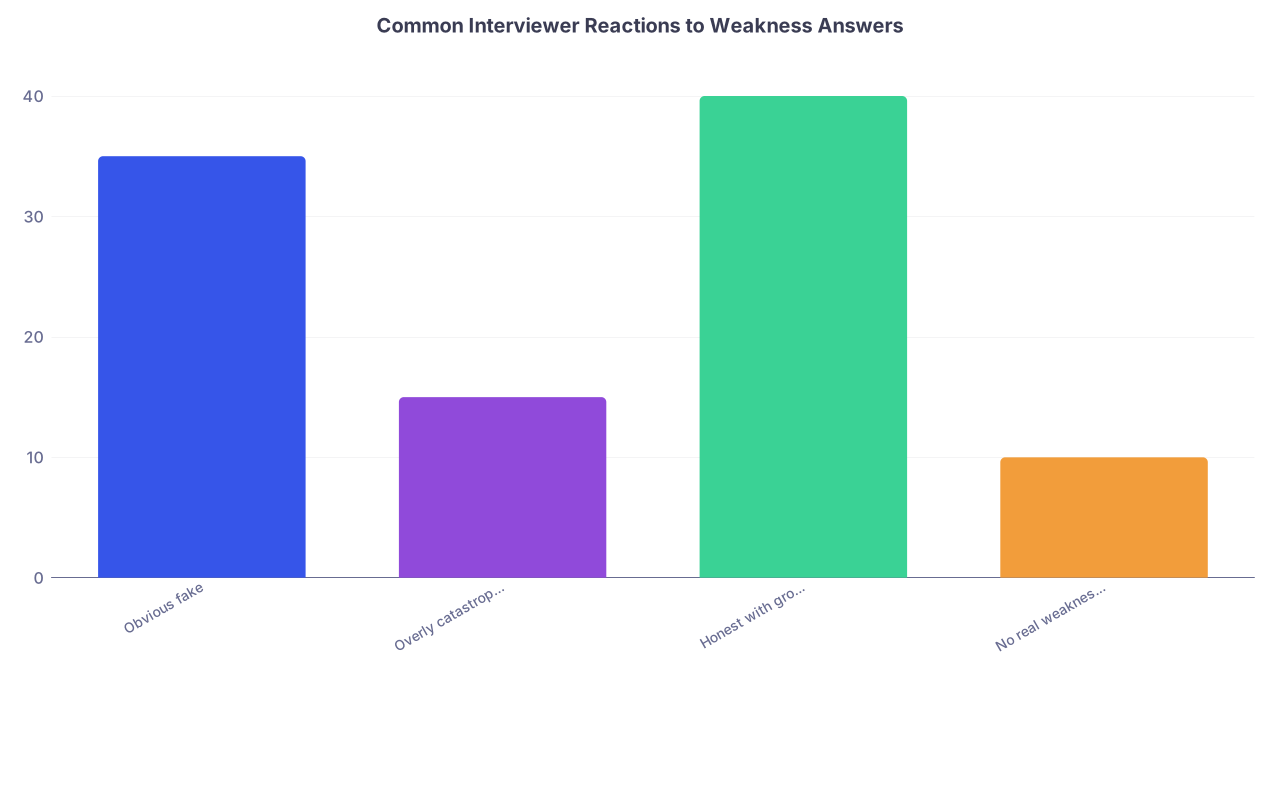
| Category | Value |
|---|---|
| Obvious fake | 35 |
| Overly catastrophic | 15 |
| Honest with growth | 40 |
| No real weakness given | 10 |
No, this is not from a randomized trial. But it matches what multiple PDs and interviewers report anecdotally:
“Honest with growth” is the most positively received.
“Obvious fake” is depressingly common—and forgettable.
Example scripts you can steal and adapt
Tailor these to your life or don’t bother. But use the structure.
Example 1 – Time management on busy services
“A growth area for me has been managing time on very high-volume services. On my first medicine rotation, I’d spend too long on prerounds and notes, and I was always a bit behind on seeing my last patient.
My senior pointed out that my data gathering was thorough but not sustainable. I started pre-charting the night before and using a one-page checklist for prerounds.
By my sub-I, I was consistently done prerounding by sign-out, and my attending commented that I ‘handled a heavy census efficiently.’ I still double-check that I’m allocating time based on which patients are actually sickest, but I’m in a much better place than a year ago.”
Example 2 – Asking for help earlier
“Earlier in training I sometimes waited too long to ask for help, because I didn’t want to bother residents with questions I felt I ‘should’ know.
On my surgery rotation, I spent too long struggling with a consent in Spanish with Google Translate instead of immediately asking the interpreter and my senior for guidance. It got done, but it was inefficient and could have been unsafe.
Since then, I’ve made a rule for myself: if I’m stuck for more than 5 minutes on something that affects patient care, I loop someone in. My evaluations since then have mentioned ‘appropriately seeks help’ rather than ‘hesitant,’ which is what I want to maintain in residency.”
Both of these show:
- Real weakness,
- Specific instance,
- Concrete change,
- Current status.
That’s the target.
When you should not answer directly
Very occasionally, the “weakness” question is phrased badly:
- “Tell me your three biggest flaws.”
- “What’s something your friends don’t like about you?”
You still do not refuse to answer. You just control the scope.
Pick one professional growth area, answer it with the structure above, and then pivot politely:
“The main growth area I’ve been focused on is X, for the reasons I mentioned. I’m sure there are plenty of other quirks my friends could list, but that’s the one I’ve been actively working on in the clinical setting.”
You’ve answered honestly without turning it into amateur psychoanalysis.
The bottom line
Stop listening to people who tell you to hide your weaknesses. They’re optimizing for imaginary perfection, not real-world selection.
Key points:
You should talk about weaknesses—carefully. Real, non–safety-threatening weaknesses paired with clear evidence of growth make you look mature, coachable, and trustworthy.
Structure beats spin. Pattern → Specific example → Intervention → Current state is far more powerful than any “my weakness is I work too hard” cliché.
Programs are selecting for self-awareness, not flawlessness. Showing you can recognize and fix your own blind spots is one of the strongest signals you can send in a residency interview.
Stop pretending you’re perfect. Show them you’re improving. That’s who they actually want to hire.