
Residency interviews are not graded like board exams, and program directors are not hunting for perfect answers. They’re hunting for problems.
Let me be blunt: most applicants massively overestimate how “polished” their answers need to be and underestimate how much leeway PDs give for awkwardness, nerves, and imperfection. You’re not losing a spot because you paused for five seconds before answering “Tell me about yourself.” You’re losing it—if you lose it—because you raise real red flags: arrogance, lack of insight, dishonesty, or being painful to work with.
Let’s kill the myth of the perfect residency interview answer and talk about what PDs actually see, accept, and care about.
The Interview Is a Screen for Red Flags, Not a Search for Perfection
Most applicants imagine the interview as a point-based system: +2 if you mentioned the program’s mission, -1 if you rambled, +3 if you tied in research. That’s not how it works on the other side of the table.
What actually happens: PDs and faculty walk out of a 20–30 minute interview and give you a gestalt rating. Some variation of:
- Definitely rank high
- Solid, will rank
- Neutral / maybe
- Probably not
- Hard no
And the bar for “solid, will rank” is not perfection. It’s “I could see this person on my team and not hate my life.”
Here’s what programs reliably care about, based on NRMP Program Director Survey data and what I’ve heard repeatedly in rank meetings:
- Will you be safe with patients?
- Will you show up and do the work without constant drama?
- Can you function on a team without alienating everyone?
- Do you seem coachable, honest, and realistic about residency?
None of those require smooth, TED-Talk-level answers. They require consistent signals that you’re not a problem.
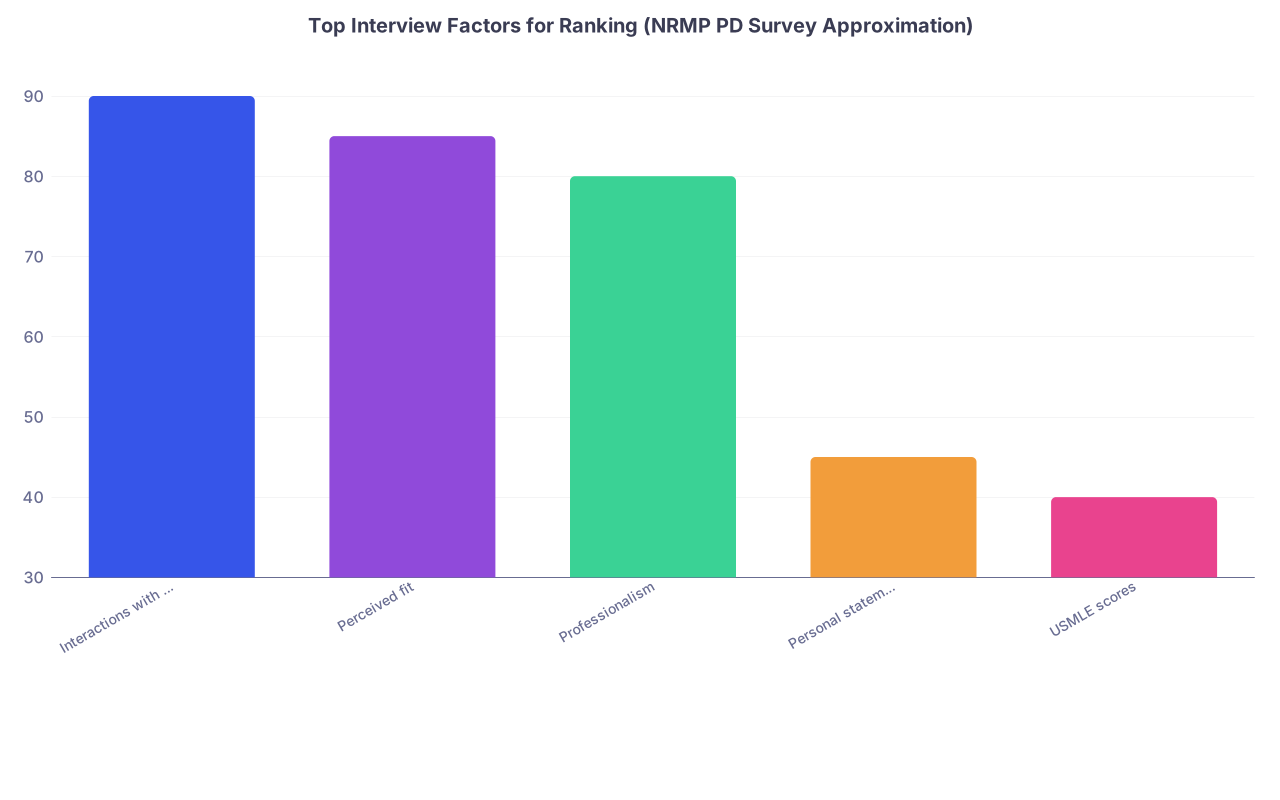
| Category | Value |
|---|---|
| Interactions with faculty | 90 |
| Perceived fit | 85 |
| Professionalism | 80 |
| Personal statement | 45 |
| USMLE scores | 40 |
Programs consistently rate interview interactions, “fit,” and professionalism way above elegant phrasing. And yes, “fit” is fuzzy—but we’ll unpack what it really means.
What “Normal” Actually Looks Like in Residency Interviews
You think everyone else is walking in there with flawless, rehearsed, cinematic responses. They’re not.
I’ve sat in on interview days where:
- Half the applicants said “uh” every other sentence. No one cared.
- Several forgot a project detail and had to correct themselves mid-answer.
- One person completely blanked for 10 seconds, said, “Sorry—interview brain. Let me restart,” and then gave a solid answer. That applicant matched.
Most interviews are filled with:
- Slightly repetitive answers
- Stories that are a bit too long
- Mildly disorganized timelines
- People clearly nervous
And those applicants still get ranked. Because PDs are not grading style; they’re screening for risk.
What’s not normal—and actually problematic:
- Snapping at a question or looking visibly annoyed
- Blaming everyone else for your failures (“My medical school wasn’t supportive, my evals were unfair…”)
- Inconsistent stories: what you say conflicts with your application
- Coming off as disinterested, distracted, or entitled
No one is writing down, “Candidate used ‘like’ 7 times—do not rank.”
They do write down, “Seemed defensive about low Step 1—kept blaming system,” or “Talked over faculty repeatedly.”
Common Questions: What You Think Needs to Be Perfect vs What PDs Accept as Normal
Let’s go through the big, terrifying “you must nail this” questions and reframe what’s actually acceptable.
“Tell Me About Yourself”
Myth: You need a perfectly concise, beautifully structured 60–90 second elevator pitch tying your life story to their program’s mission.
Reality: PDs want to know if you can talk like a normal human and give a coherent overview of who you are.
PDs accept as normal:
- A 2–3 minute answer as long as it’s not rambling into every childhood detail
- Some jumps in timeline (“Fast forward to med school where I…”)
- Slight awkwardness at the start (“Sure, um, so I’m originally from…”)
They care about:
- Can you summarize key themes about yourself without chaos?
- Are you grounded? Or are you trying to be performative and slick?
- Does your story roughly match your application?
Bad versions are not the ones that are boring. Bad versions are:
- Overly rehearsed, robotic, “I was born with a passion for cardiology”
- Arrogant: “I’ve always been the top student”
- Wildly off-topic: 5 minutes of family drama and zero about you as a physician
“Why This Specialty?”
Myth: You need a transcendent, soul-stirring origin story that proves you were anatomically destined to be a neurologist.
Reality: Most PDs are totally fine with “I liked multiple things, but this is where I found myself most engaged and fulfilled.”
What’s normal:
- Mixed motives: “I like procedures, I like continuity, I like the patient population”
- Admitting you considered other fields before landing on this one
- A fairly generic story as long as it’s honest and not copy-pasted from Reddit templates
What gets noticed—in a bad way:
- Obvious pandering: saying you love continuity of care in EM, or saying you “can’t live without the OR” in pediatrics
- Inconsistent story: personal statement screams “I want academic research,” but in person you say, “I don’t really care about research, honestly”
- Extremes: “I only applied to this because lifestyle is best” or “I want the most competitive thing possible”
PDs are comfortable with answers like: “I liked internal medicine for its complexity, I enjoy thinking through diagnostic puzzles, and I see myself working with medically complex patients long term. My best clinical experiences were on wards and in clinic with IM teams.”
Not magical. Just coherent.
“What Are Your Weaknesses?”
This one really exposes who has been over-coached.
Myth: There exists a “right” weakness—something fake enough to impress them but real enough to sound humble.
Reality: PDs can smell canned, fake weaknesses from a mile away. “I care too much” or “I work too hard” makes you look inauthentic or poorly advised.
What PDs accept as normal:
- A real, bounded weakness you’ve thought about
- Concrete steps you’re taking to manage or improve
- Some vulnerability—without turning it into a therapy session
Totally acceptable answers sound like:
- “I can be slow with documentation because I’m very detail-oriented, so I’ve had to learn strategies to be more efficient, like templating and prioritizing key elements first.”
- “I tend to overcommit to projects because I like saying yes, so I’ve been practicing setting clearer limits and checking my bandwidth before I agree.”
What worries them:
- No weaknesses (“I can’t really think of any major ones”) → lacks insight
- Weaknesses that are core to residency function: “I hate asking for help,” “I’m often late,” “I don’t handle stress well”
- Disorganized mess: weakness with zero reflection or improvement
What “Fit” Really Means (And What It Doesn’t)
“Fit” gets weaponized as this mystical, unmeasurable factor that you can’t control. That’s lazy thinking.
When faculty say “they weren’t a good fit,” they usually mean one of a few concrete things:
- They couldn’t see you working with their residents
- Your goals and the program’s vibe were mismatched
- You seemed either too rigid or too checked-out for their environment
For example:
- A very research-heavy applicant, clearly chasing an R01 trajectory, telling a community program with minimal research that they want 80% protected time. Not a fit.
- An applicant visibly uncomfortable with underserved, high-acuity populations interviewing at a safety-net program. Not a fit.
- A laidback, humble, slightly nervous applicant at a big-name “prestige” program with a hyper-competitive resident culture. Might get overshadowed by louder personalities.
Notice what’s not on that list: minor awkwardness, imperfect phrasing, or needing a second to think before answering.
You don’t need to morph into what you think they want. You need to be consistent with who you actually are, and let the genuine mismatch programs self-select out. You’re not marrying them after the first date.
The Line Between “Normal Nerves” and Real Red Flags
Everyone is nervous. PDs know this. But there are two types of “nerves” from the other side of the table.
Accepted as normal:
- Shaky voice at the beginning that settles over time
- Occasional loss of train of thought, followed by a reset
- Saying “Sorry, I’m a little nervous” once, then carrying on
- Slightly stiff small talk
Concern-raising:
- So disorganized and anxious that answers are incoherent start to finish
- Breaking down emotionally at relatively standard questions
- Reacting with visible anger, frustration, or hostility when challenged
- Over-apologizing every other sentence, radiating zero confidence
You do not get downgraded for being a bit stiff at 8:00 a.m. Zoom interview #9 of the season. You do get downgraded if your anxiety makes people think, “How will this person handle nights on call when things go south?”
What PDs Actually Remember After 12 Interviews in a Day
Here’s an uncomfortable truth: for many applicants, the faculty don’t remember your exact words 2 hours later. They remember:
- A couple of stories that stood out
- A few emotional anchors (kind, intense, defensive, funny, rigid, genuine)
- Whether you felt like someone they’d want next to them at 2 a.m.
Programs don’t rank “perfect answer” people higher. They rank:
- People who seemed sane and safe
- People who showed enough self-awareness to learn and improve
- People who didn’t set off subtle alarm bells
You’re not being scored on a rubric of 10-point answers. You’re being categorized into: reassuring, neutral, or risky.

| Step | Description |
|---|---|
| Step 1 | Interview Starts |
| Step 2 | Hard No / Low Rank |
| Step 3 | Low Rank |
| Step 4 | Rank Higher |
| Step 5 | Middle of List |
| Step 6 | Any major red flags? |
| Step 7 | Seem safe & workable? |
| Step 8 | Any strong positives? |
Notice the missing box: “Did they answer every question perfectly?”
The Real Mistakes That Cost You – And They’re Not About Polish
You want to worry about something? Worry about these, not whether you should have used the word “resilient” or “grit.”
Patterns that do hurt you:
- Never taking ownership: every problem in your story is someone else’s fault
- Being vague or evasive when asked direct questions (e.g., about a leave, a failure, a low grade)
- Trash-talking your med school, classmates, or prior institutions
- Showing zero curiosity about the program—no questions, no engagement
- Inconsistent values: saying you care about underserved care but openly chasing only prestige-heavy, non-safety-net programs
| Area | Normal/Accepted | Problematic/Red Flag |
|---|---|---|
| Nerves | Mild shakiness, a few pauses | Incoherent, meltdown, hostility under stress |
| Answer content | Slightly generic but honest | Contradictory, evasive, obviously fake |
| Weaknesses | Real but managed, concrete improvement steps | No weaknesses, or core-function weaknesses |
| Fit questions | Mixed reasons, realistic goals | Pandering, extreme lifestyle/ego focus |
| Interactions | Polite, slightly awkward | Condescending, argumentative, checked-out |
How to Prepare Without Chasing Perfection
You still need to prepare. But stop aiming for script perfection and start aiming for signal clarity.
Here’s what actually helps:
- Know your own application cold. If it’s in ERAS, you should be able to talk about it for 1–2 minutes without confusion.
- Have 3–5 concrete stories ready: a conflict, a failure, a proud moment, a challenge, a time you received constructive feedback.
- Practice out loud—but not to memorize lines. Practice so you’re comfortable hitting the main points without spiraling.
- Decide in advance: How do I want to come across? Curious? Humble? Hardworking? Then answer in a way consistent with that, not in a way that chases what you think they want.
And when you inevitably give an answer you don’t love? Let it go. Interviewers forget your wording way faster than you do.
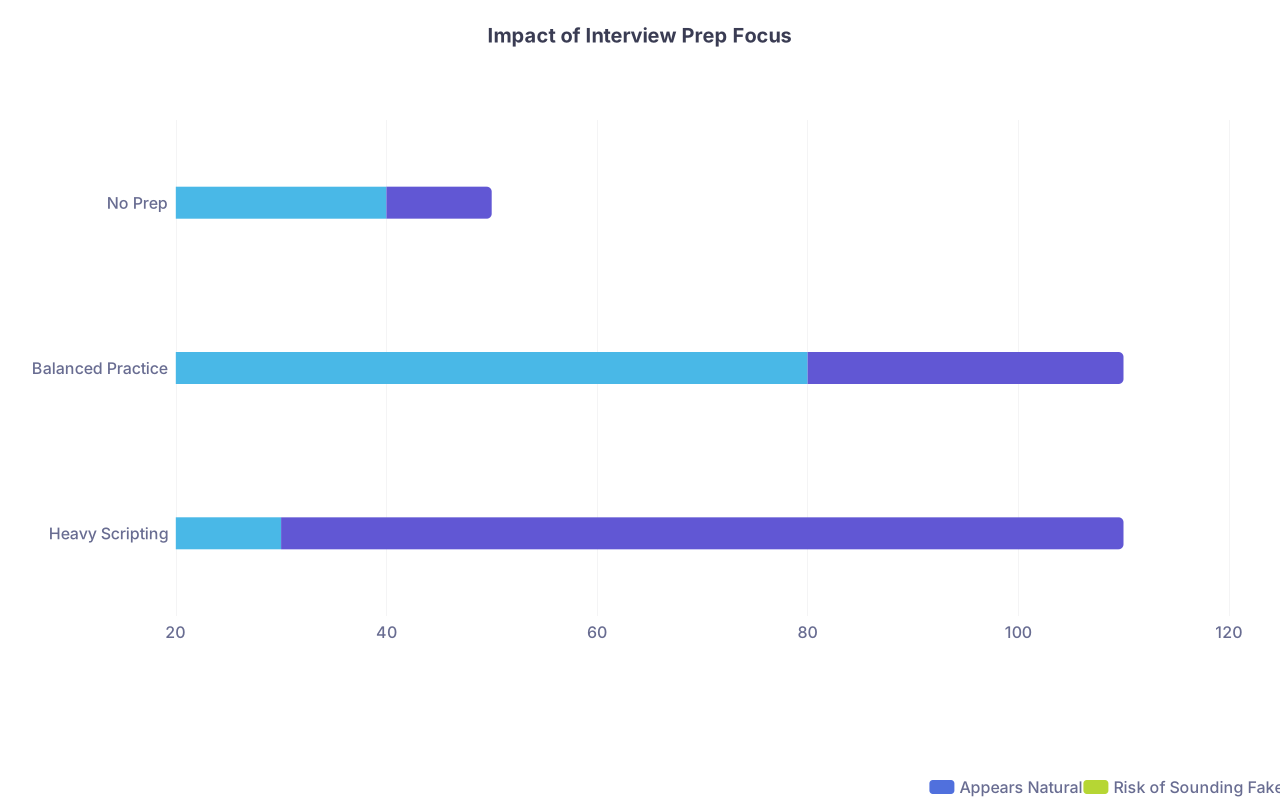
| Category | Appears Natural | Risk of Sounding Fake |
|---|---|---|
| Heavy Scripting | 30 | 80 |
| Balanced Practice | 80 | 30 |
| No Prep | 40 | 10 |
Zoom Interviews: Imperfection Is the Default
One more myth to kill: that virtual interviews require even more perfection. Actually, the bar is lower in some ways.
I’ve seen:
- Awkward camera angles
- Pets walking in the background
- Glitchy audio requiring a repeat of the question
- People talking slightly over each other because of lag
PDs are used to this. They adapt. What frustrates them isn’t technical imperfection—it’s lack of basic effort:
- Obviously taking the call from bed
- Terrible lighting when it would’ve taken 2 minutes to fix
- Multitasking vibes—eyes clearly darting to email or phone
You’re allowed normal human/tech glitches. You’re not allowed to look like you don’t care.

What PDs Actually Accept as Normal – The Bottom Line
Strip away the mythology and the online anxiety spiral, and here’s where we land.
PDs broadly accept as normal:
- Mild nerves, imperfect phrasing, and slightly generic answers
- Admitting uncertainty, as long as you’re honest and thoughtful
- Not having a tragic backstory or a heroic turning point for every question
They do not accept:
- Dishonesty, defensiveness, arrogance, or obvious lack of insight
- Inability to own mistakes or discuss challenges like an adult
- Behavior that suggests you’ll be miserable—or make others miserable—during residency

Core Takeaways
- Interviews are red-flag screens, not auditions for a “perfect answer” trophy. Safe, honest, and workable beats polished and fake every time.
- Normal includes nerves, pauses, and non-magical stories. What hurts you is dishonesty, blame-shifting, arrogance, or obvious mismatch.
- Stop chasing perfect wording. Start making sure your stories, values, and goals line up—and that you come across as the kind of person others can survive call with.