
“Do you have any questions for us?” – Are you really doomed if you say no?
You’ve heard it a hundred times: “Always have questions at the end. Never say you don’t have any. It looks terrible.”
So now you’re on your fifth interview of the week, brain-fried, you’ve already asked three different attendings and two residents the same questions, and the PD finishes with: “What questions do you have for me?”
And you’ve got…nothing.
Are you actually tanking your chances if you say, “No, I think you’ve answered everything”? Or is that yet another residency-application myth that’s been repeated so often people stopped checking if it’s true?
Let’s dismantle this.
The myth: “No questions = you’re not interested”
The dogma goes like this:
Good candidates ask questions.
Great candidates ask insightful questions.
Only disengaged or unprepared applicants say, “No questions.”
Reality is messier.
Most programs are not doing some mystical psychoanalysis of how many questions you ask. They’re reading signals. Interest, preparation, personality, red flags. And that final Q&A is just one small data point, usually at the end of a long day where they’ve already formed a pretty solid opinion of you.
Here’s the part people miss:
Program directors and faculty complain far more about bad questions than about no questions.
I’ve sat in post-interview debriefs where faculty said things like:
- “He kept asking stuff that was on the website.”
- “She clearly hadn’t read our schedule.”
- “Those questions felt like a script from Reddit.”
I have almost never heard:
- “She said she didn’t have questions, so I ranked her lower.”
What actually hurts you is what your lack of questions represents in context:
- If you’ve seemed disengaged all day, camera off on Zoom socials, no interaction with residents, and you also have no questions? Yeah, that can confirm “not interested.”
- If you’ve been attentive, engaged, asking good questions all day to multiple people, and at the end you say, “Honestly, everything’s been really clear and helpful — I don’t have anything else right now”? That usually doesn’t hurt you at all.
So the myth isn’t “questions matter.” They do.
The myth is “not asking a question at the final moment always looks bad.” It doesn’t. Context carries more weight than the final 30 seconds.
What program directors actually care about (not what Reddit says)
Most applicants wildly overestimate how heavily that last “Do you have any questions for us?” weighs in their evaluation.
Let’s be blunt. Here’s what really drives your rank at most places:
| Factor | Typical Impact on Rank |
|---|---|
| Interview performance overall | Very High |
| Fit with program culture | Very High |
| Letters & reputation of your school/rotations | High |
| Step/COMLEX & transcript | Moderate–High |
| Perceived interest in program | Moderate |
| Your last 2 minutes of questions | Low |
Does that last part matter at all? Sometimes. Usually as a tie-breaker or soft confirmation.
To make this less abstract, here’s how this plays out in real meetings:
Candidate A: sharp clinically, clear communicator, good rapport with residents, clearly researched the program, asked thoughtful questions in earlier sessions, and at the PD interview says, “I think you’ve actually covered everything I was going to ask.”
Reaction: “Strong candidate, very interested, good fit.” No one cares they didn’t squeeze in one more question.Candidate B: average answers, vague on why they want that specialty, hasn’t engaged much, doesn’t know basic facts about the program, and then says, “No, no questions.”
Reaction: “Probably not that interested,” but that’s based on the whole package, not just the last line.
There’s also data-adjacent reality: surveys of PDs (NRMP Program Director Survey) repeatedly show that “interview day interactions and interpersonal skills” outrank everything else non-academic. “Asks brilliant questions at the end” doesn’t even appear as a category.
What does show up? Demonstrated interest in the program, perceived commitment, and professionalism. Those are patterns, not one moment.
When “no questions” really does hurt you
Context. Always context. There are situations where having nothing to ask is a problem. Not because of the silence itself, but what it reveals.
1. You clearly have not done any homework
If earlier you asked, “What EMR do you use?” when it’s on the website. Or “Do residents do continuity clinic?” when the clinic schedule was in your interview packet. Then at the end you also say you have no questions?
That reads as:
I didn’t bother to prepare. I’m just cycling through interviews.
Programs don’t like ranking tourists.
2. You look like you’re interviewing them for status only
Some applicants give off a vibe: “I’m just here to collect a name-brand backup.”
If you say nothing that connects you to this program, never show curiosity about how people actually train there, and end with “No questions,” it reinforces that you’re not actually gauging fit — you’re just prestige-shopping.
If your entire interaction feels like that, yes, “no questions” becomes one more brick in the wall labeled “Will rank us low → may not match here → why waste a high rank spot?”
3. You just had a terrible interview and missed a chance to recover
If the interview itself was awkward — you rambled, got flustered, or gave a weak answer to “Why this program?” — the closing Q&A is your last chance to show some clarity and thoughtfulness.
A well-aimed question can sometimes rescue the impression:
“Can you tell me about a recent change you’ve made based on resident feedback?”
…then listen, respond meaningfully, show that you actually care how residents are treated.
If, after a rough interview, you also pass on questions, you’re walking out without trying to repair anything.
When not having questions is completely fine (and sometimes better)
Now the part no one on Instagram wants to admit: there are situations where forcing a question is worse than saying you’re satisfied.
1. The “fake deep” question problem
Faculty roll their eyes at this more than you think. You can practically hear the script:
- “What qualities do you look for in your ideal resident?”
- “Where do you see the program in five years?”
- “What makes your program unique?”
These are page 1 of every “Top 20 Questions to Ask Programs” blog.
They rarely tell you anything you couldn’t have guessed. And when you sound like you’re reading from a mental checklist, you look coached, not curious.
In that case? Saying, honestly and succinctly:
“I’ve actually been able to ask residents and faculty about the main things I was wondering. I don’t have anything else specific right now.”
…is less fake, less annoying, and probably scores you more respect.
2. You already got your real questions answered earlier
On a well-run interview day, you might have asked:
- Call structure and night float to residents
- Fellowship match outcomes to the PD
- Wellness resources to the chief
- Autonomy vs supervision balance to attendings
By the time your last interviewer asks for questions, you’re genuinely done. That’s not bad. That’s efficient.
You can acknowledge that without sounding disengaged:
“I had a few questions earlier about fellowships and call structure that the residents and Dr. X answered really thoroughly. I don’t have anything additional at this point — it’s been very clear.”
That signals two things loudly:
You actually asked questions. You listened. You integrated the answers.
3. It’s the fifth time someone’s asked you if you have questions — on Zoom
Virtual interview days love repetition. You’ll hear “Any questions for me?” from:
- PGY-1
- PGY-3
- Chief
- APD
- PD
If you keep asking the same generic thing five times, residents talk about it in the debrief. It gets noticed. Not in a good way.
Sometimes the correct move is:
“Most of my questions have already been answered today. I really appreciate how open everyone’s been.”
That’s fine. That doesn’t hurt you.
How to “say no” without sounding disengaged
If you truly do not have a good question, don’t manufacture one just to fill air. But don’t just shrug and say, “Nope.”
Here’s a better, structured way to decline:
- Acknowledge you’ve gotten information.
- Express genuine appreciation.
- Leave the door open (implicitly or explicitly).
Example versions you can steal:
“Honestly, my questions about operative volume and fellowships were answered really clearly earlier. I don’t have anything else right now — this has been very helpful.”
“I came in wondering about X and Y, and between talking with the residents and hearing your overview, I feel like I have a good sense of the program. I don’t have any other questions at the moment.”
“Nothing specific right now — I’ve gotten a very clear picture of the culture and training here. Thank you for taking the time to walk me through everything.”
That doesn’t sound disinterested. It sounds like you were paying attention.
A smarter approach: plan fewer but better questions
Instead of obsessing about always having a question, focus on having meaningful questions — and asking them to the right people.
You don’t need 20 questions. You need 4–6 good ones, targeted.
Think in buckets:
- For residents: “What’s something the website makes look great that’s actually just mediocre?”
- For chiefs: “When residents struggle here, what do they usually struggle with?”
- For PD/APD: “What change are you most proud of making in the last few years?”
- For anyone: “If you could change one thing about this program but can’t, what would it be?”
You can spread those out across the day. By the time you get to the last interview, it’s perfectly reasonable to say you’ve already had your questions answered.
To show you how this can play across a day, here’s a sample “question distribution” that doesn’t require inventing something at the very end:
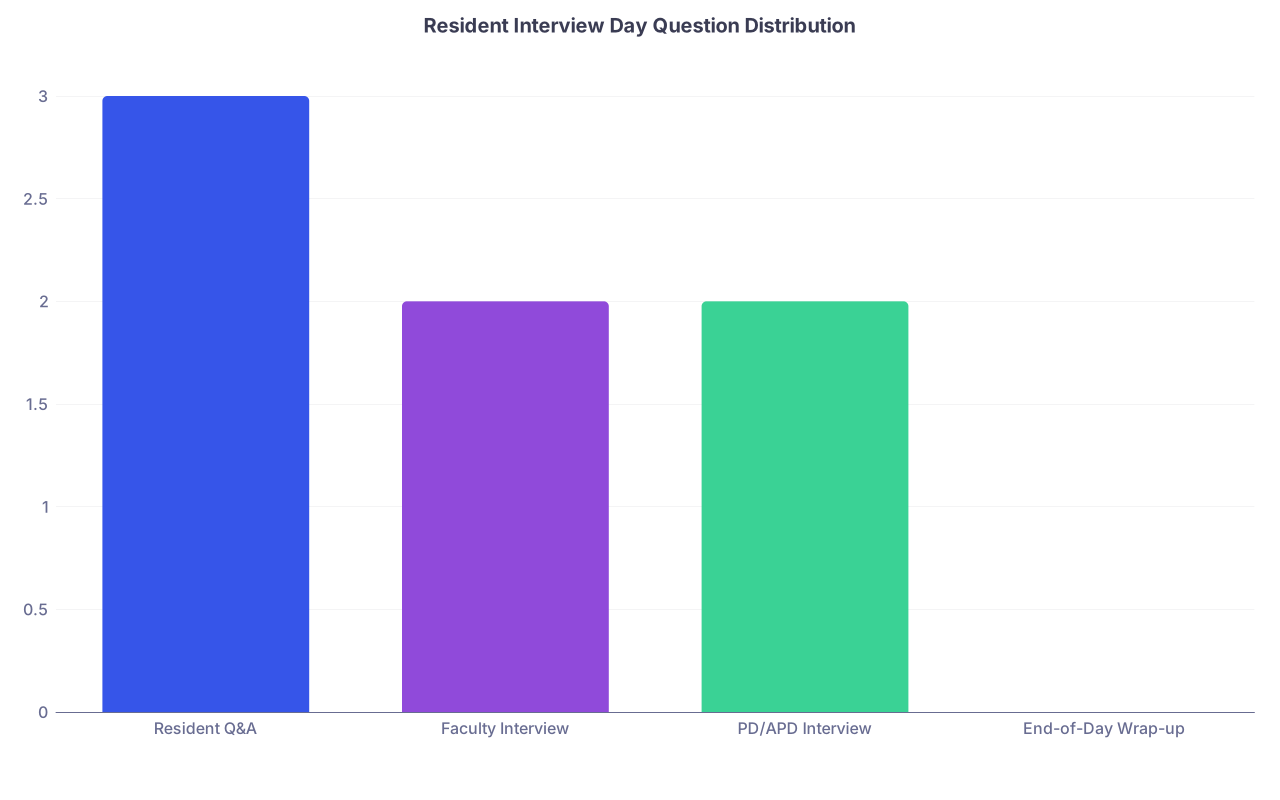
| Category | Value |
|---|---|
| Resident Q&A | 3 |
| Faculty Interview | 2 |
| PD/APD Interview | 2 |
| End-of-Day Wrap-up | 0 |
Notice the 0 at the end. That’s not an automatic red flag if the earlier interactions were strong.
One place where you should almost always ask something
There is one scenario where I rarely recommend “no questions”: your only direct conversation with the program director, if it’s early in the day and your first/only chance at a one-on-one.
That’s not about box-checking. That’s about making use of limited access to the person who shapes the culture.
The trick: one or two pointed, program-specific questions that show you’ve actually looked them up.
- “I saw you recently expanded the ICU rotation — what was the reasoning behind that change?”
- “I noticed your residents match into both academic and community jobs. How intentional is that balance in your training design?”
Not: “What are you looking for in a resident?” They’ve heard that 300 times. It tells them nothing about you.
If you used that time well, then later, in a brief second faculty interview, saying “My questions have already been covered” is no problem.
How this looks from the program side
Let me flip it around and show you approximately how this feels on their scoring side.
Imagine a mental checklist faculty run after talking to you:
| Dimension | What They’re Asking Themselves |
|---|---|
| Clinical reasoning | Will this person be safe and teachable? |
| Professionalism | Would I trust this person with patients at 2am? |
| Fit | Will they mesh with our residents? |
| Interest level | Do they seem to actually want to be here? |
| Question quality | Did their questions feel genuine and thoughtful? |
“Question quality” barely gets its own category. And even there, note the word: quality. Not quantity. Not “did they always have one more for me.”
Someone who asked good questions earlier and none at the end? Usually logged as: “Engaged, prepared.”
Someone who asked eight bland or repetitive questions just to never say “no questions”? Logged as: “Over-rehearsed / not listening / fishing for something.”
Programs are not timing you on how long you can keep talking.
Virtual vs. in-person: does it change?
Slightly.
Online, silence feels more awkward. People overcompensate. Candidates panic and throw out something like, “So, uh, how’s the city?” to fill dead air.
Faculty know you’re on Zoom. They know you’re doing 10–15 of these. They are not expecting a TED Talk every time they ask for questions.
If anything, on virtual days, concise and honest wins even more:
“I think everything’s been very clear — I don’t have anything else specific right now. I really appreciate everyone taking time today.”
That’s clean. Professional. Done.
So, does not having questions at the end always look bad?
No. That’s the myth.
What matters is:
- The pattern of your engagement during the whole day, not the last 30 seconds.
- Whether you asked thoughtful, targeted questions at some point — resident lounge, faculty interviews, PD session.
- How you frame it if you genuinely have nothing left to ask.
If you’ve been present, prepared, and curious throughout, saying at the end, “I don’t have any other questions — this has been really clear” will not sink you.
If you’ve coasted through on autopilot and also have no questions, then yes, it looks bad. But the problem isn’t that sentence. It’s everything before it.