
The common advice about interview questions is backwards. Asking more questions does not automatically make you look more interested. Often, it makes you look unprepared, anxious, or performative.
You’ve probably heard some version of this: “Always have lots of questions. Programs want to see your curiosity. Never say you don’t have any questions.” This gets repeated so often on Reddit, in prep courses, and by well-meaning deans that applicants start treating “number of questions” as a metric of success.
Programs don’t.
I’ve sat in on post-interview debriefs where faculty literally rolled their eyes about the third “What’s your board pass rate?” question of the day. I’ve heard, “She had 10 questions and none of them showed she understood our program,” right before that same applicant was ranked low. Quantity didn’t help her. It hurt.
Let’s dismantle the myth properly.
What Programs Actually Notice During Your Questions
Programs are not counting how many questions you ask. They’re inferring three things:
- How you think.
- How you prepared.
- How you might be as a resident to teach and work with.
There’s limited but consistent data on what interviewers care about. NRMP’s “Program Director Survey” (which you should actually read instead of just quoting) repeatedly shows that “interactions with faculty during the interview and visit,” “interactions with residents,” and “perceived interest in program” are high-ranked factors.
Notice what’s missing: “Number of questions asked.”
“Perceived interest” is not measured by volume. It’s measured by relevance and authenticity. Faculty pay attention to whether your questions:
- Build on what they just told you.
- Show you actually read their website / program info.
- Are specific to them, not copy-pasted across 25 interviews.
- Reveal that your values match theirs (or at least that you know what their values are).
A single, sharp, program-specific question will do more for your “interest” than five generic filler questions. I’ve literally heard, “He didn’t have many questions, but the one he asked showed he’d really looked into us.” That applicant was ranked high.
More is not better. Better is better.
The “Question Bombardment” Trap
There’s a point where more questions stops looking like interest and starts looking like insecurity.
You’ve seen this person on interview day:
- They open their padfolio and start reading a list of 12 pre-written questions… without any reference to what was just discussed.
- They ask things clearly answered on the website: call schedule, board pass rate, number of residents per class.
- They interrupt natural conversation flow just to “squeeze in a few more questions.”
That doesn’t read as “interested.” That reads as “checking boxes” or “trying too hard.”
Here’s how faculty often interpret over-questioning (I’ve heard these verbatim in debriefs):
- “They seemed like they’d need a lot of hand-holding.”
- “It felt like they were interrogating us, not having a conversation.”
- “I couldn’t tell what they actually cared about. Just question after question.”
- “They ran out of time because they kept asking tiny logistical questions.”
Programs are trying to learn: Can we work with you at 3 a.m. on a bad call night? Are you intellectually alive? Are you sane to be around? Not: How many questions did you prepare?
If your questions derail the flow, eat the whole interview, or feel like a checklist, you’re not scoring “interest points.” You’re burning social capital.
What the Data and Real-World Patterns Actually Show
No, there isn’t a randomized controlled trial of “ask 0 vs 2 vs 10 questions” in residency interviews. But there are patterns supported by survey data and what PDs and faculty actually say publicly and privately.
Let’s line up the myth against reality.
| Belief | Reality |
|---|---|
| More questions = more interest | Thoughtful, specific questions = more interest |
| Never say you have no questions | It’s fine to have few or no questions if conversation was thorough |
| Any question is better than none | Bad, generic questions hurt more than silence |
| Programs track how many questions you ask | They care about conversation quality, not question count |
| You should ask the same list at every program | Recycled questions signal laziness or lack of genuine fit |
Program directors consistently emphasize “fit” and “genuine interest.” Genuine interest is usually obvious from:
- How you talk about their patient population, curriculum structure, location, or culture.
- Whether your questions connect your goals to what they offer.
- Whether you pick up on what they repeatedly highlight (e.g., QI, global health, underserved work).
There’s also a time budget. Your 20–30 minute interview is not meant to be 10 minutes of them, 20 minutes of you “demonstrating interest” via interrogation. The better interviews feel like a back-and-forth, where your questions arise naturally from the conversation.
When I’ve seen rank committees debate borderline applicants, “They had a lot of questions” almost never comes up. But “They seemed really engaged when we talked about X” or “She clearly did her homework about our Y track” does.
When Asking Fewer Questions Makes You Look Stronger
Here’s the part nobody tells you: sometimes having fewer questions actually makes you look more prepared and decisive.
Three very real scenarios:
- The faculty member already answered almost everything you care about in the normal back-and-forth. You listened well, clarified once or twice, and now you’re basically satisfied.
- You did deep pre-interview research. You read the website, resident bios, case logs, call structure, supplemental info. You don’t need to waste time on basics.
- You’ve already asked your key questions to residents earlier in the day (that’s who you should ask most lifestyle/logistics questions anyway), so you want to use faculty time for bigger-picture discussion.
In those situations, forcing yourself to ask yet another “So what do you like most about this program?” does not signal interest. It signals that you read a blog post saying “never say you don’t have questions.”
A confident, honest response can sound like this:
“Honestly, between the pre-interview dinner and what you’ve described, you’ve hit most of what I was curious about. The biggest things I care about were X and Y, and you addressed those really clearly.”
That reads as: prepared, focused, not needy. No one is docking you for that.
If you want to tack on one targeted question, fine. But you do not need to invent three more just to fill airtime.
So What Should You Do With Questions?
This is the part where people usually pivot to generic lists: “Ask about mentorship, research, and wellness.” I’m not going to do that. You can Google those, and most of them are terrible and vague anyway.
You need a strategy, not a script.
Think of questions as tools to accomplish 3 things:
- Signal genuine fit.
- Gather decision-making data you can’t get online.
- Show you’re actually listening.
1. Signal genuine fit
A good question makes clear: “I understand who you are as a program. Here’s how that intersects with what I want.”
Weak: “Do you have research opportunities?”
Better: “I saw your residents published several QI projects in sepsis care over the last few years. For someone who’s interested in system-level QI but not a PhD-level research career, how structured is support for those projects?”
You just told them:
- You looked them up.
- You care about QI, not generic “research.”
- You’re realistic about your desired level of involvement.
That’s how you show interest.
2. Get info that actually matters
Calling this out bluntly: if your question could be answered by 45 seconds on their website, do not ask it. That includes “Do you have a night float system?” “How many electives?” “What’s your board pass rate?”
You’re a fourth-year medical student. You can find a rotation schedule.
Use questions for things that are 1) nuanced, 2) culture-dependent, or 3) politically sensitive enough not to be fully described online:
- How do struggling residents get supported?
- How are conflicts between residents and faculty usually handled?
- When you think about residents who thrive here versus those who struggle, what differences do you see?
- How did the program respond to [COVID / wellness issues / major event] in a way that changed the culture?
You’re not trying to hit a “curiosity quota.” You’re trying to figure out: Will I be happy and not burned out here? Can I become the physician I want to be?
3. Show that you listen
The most underrated move: derive your questions from what they just told you.
Faculty: “We’ve been expanding our addiction medicine rotation and now have a dedicated clinic in the VA.”
You: “You mentioned the new addiction medicine rotation at the VA. For someone interested in primary care with a strong addiction component, how much continuity do residents get with that patient population over three years?”
That is interest. And it didn’t require a long pre-written list. Just attention.
Where to Ask What: Faculty vs Residents
Misplaced questions are a subtle, but common mistake. You ask the right question to the wrong person and look a bit out of touch.
Here’s the reality: residents are often more honest about workload, culture, and “hidden curriculum.” Faculty are better for high-level structure, educational philosophy, and niche opportunities (fellowships, leadership, research in a specific area).
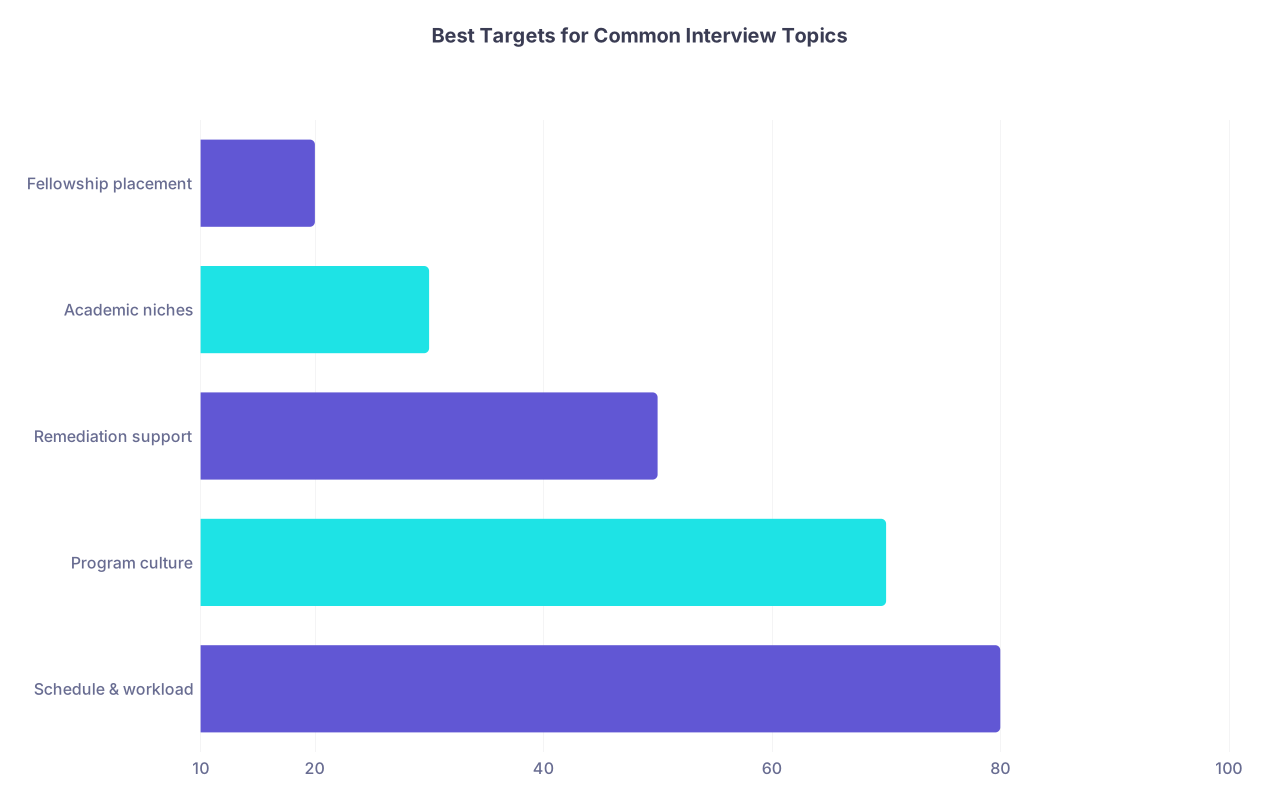
| Category | Value |
|---|---|
| Schedule & workload | 80 |
| Program culture | 70 |
| Remediation support | 50 |
| Academic niches | 30 |
| Fellowship placement | 20 |
Think of those numbers as “% of the time residents are the better primary source.” Not literal data, but very close to how this plays out:
- Schedule & workload: mostly residents.
- Culture: mostly residents, sometimes faculty.
- Remediation and support: both, but wording differs. Residents will tell you how it feels; faculty will give the formal process.
- Academic niches and leadership opportunities: mostly faculty.
- Fellowship placement specifics: faculty and PD, not random PGY-2 at dinner.
So no, you don’t need to pepper every faculty with “How’s the call schedule?” You will get a better, more honest answer from the people actually suffering through it.
How Many Questions is “Enough”?
Here’s the contrarian answer: there is no “correct” number. There’s only “Did your questions help or hurt you?”
That said, based on patterns I’ve seen and what PDs describe, a sane baseline per interaction:
- 0–2 questions per 20–30 minute faculty interview, if the conversation is otherwise rich and interactive.
- 2–4 questions in resident-only sessions, where the goal is mostly your fact-finding and vibe-checking.
- A few more informal questions at pre-interview dinners / socials, spread naturally across the event.
But these are descriptions, not prescriptions. You’re not failing if you only ask one excellent, context-aware question in a faculty interview—especially if you’ve already had a deep, back-and-forth conversation.
If you leave an entire day having asked literally no one anything… then yes, that looks weird. Programs will wonder if you’re disengaged, passive, or just treating them like a backup. But that’s about zero, not about not hitting some arbitrary “five questions per person” rule.
The Red-Flag Question Types
There are a few categories of questions that reliably backfire, regardless of how “interested” you’re trying to seem.
Easily Google-able facts
“How many residents are in each class?” “Do you have an ICU rotation?” They know you did not do basic homework.Questions that sound like threats
“How often do residents go above 80 hours?” “Do people get in trouble if they log their hours accurately?” Your concern is valid, but the framing matters. Ask residents first. Ask faculty in more neutral, process-oriented language if needed.Questions that center your convenience above patient care or teamwork
“How often do people get their preferred vacation weeks?” “Can I moonlight a lot?” These are not inherently bad topics, but if they’re your first or only questions, that reads poorly.Questions you clearly don’t care about
When you ask something just because someone told you it “sounds good,” interviewers can tell. If you zone out during the answer, they definitely can tell.
A Simple, Non-Gimmicky Prep Approach
Skip the 30-question master list. Do this instead:
- Before each interview, spend 20–30 minutes really reading the program’s site, the resident bios, and any recent news / publications tied to the program.
- Jot down 3–5 things that genuinely matter to you: type of patients, teaching style, fellowship outcomes, research in a specific area, community engagement, call structure in a specific year, etc.
- For each of those, write 1–2 good questions that:
- Reference something specific to that program, and
- Could not be answered by basic web-search.
- Then forget about the number and focus on having a real conversation. Use your list as a backup, not a script.
If you walk out of an interview having used only two questions from that list because the rest got answered naturally in conversation? That’s a win, not a failure.

| Step | Description |
|---|---|
| Step 1 | Start Interview |
| Step 2 | Ask 1-2 targeted questions |
| Step 3 | Ask 1-2 clarifying questions |
| Step 4 | Honestly say they answered your main concerns |
| Step 5 | Return to conversation |
| Step 6 | Did they cover your key topics? |
| Step 7 | Any genuine gaps left? |
FAQ (Exactly 5 Questions)
1. Will not asking any questions at all hurt me?
If you go an entire interview day—faculty plus residents—without asking a single meaningful question, yes, that usually looks bad. It suggests disengagement or that you do not care about how you’ll actually spend three or more years of your life. But not asking a question in a single faculty interview, especially when they’ve thoroughly covered your concerns, is not fatal if the rest of the day shows engagement and fit.
2. Is it okay to reuse the same questions across programs?
Reusing themes is fine. Copy-pasting generic questions is lazy. Asking every program “How’s your mentorship?” tells them nothing about you. Instead, anchor questions to something specific you saw about that program. You can still be probing for the same underlying issue (mentorship, autonomy, etc.) in each place; just tailor the wrapper.
3. What if they ask, “Do you have any questions for us?” and my mind goes blank?
This happens. Have at least one “emergency” question you genuinely care about that you can ask anywhere, such as: “When you think of a resident who really thrives here, what are they like?” It’s broad, but still meaningful. If you truly feel everything is answered, you can say: “You’ve covered my main questions about X and Y. I don’t have anything else pressing right now,” without apologizing for it.
4. Can asking hard or critical questions hurt my ranking?
Tone and timing matter more than topic. Asking about how they support struggling residents, deal with conflict, or handle wellness is normal and reasonable. If you sound adversarial, accusatory, or obsessed with edge cases, you can absolutely come off as high-maintenance. Frame it as curiosity about processes and culture, not as cross-examination.
5. Do virtual interviews change how many questions I should ask?
Virtual interviews amplify fatigue—for you and for them. Rambling or over-questioning lands even worse on Zoom than in person. Your strategy doesn’t really change: a few sharp, tailored questions that show you did your homework and listened carefully are more powerful than filling every silence. Respect the time, keep answers and questions tight, and focus on actual connection, not hitting a question quota.
Key points: Asking more questions does not equal more interest. Thoughtful, specific, context-aware questions do. And sometimes, the most impressive move is not to manufacture “interest” with quantity, but to show you’re prepared, discerning, and able to have a real conversation rather than a scripted performance.