
You sent a thoughtful thank-you note after your residency interview. Three days later, a one-line reply lands in your inbox: Thanks again for your interest! No warmth. No hint. No next step.
Now you're stuck. Was that polite? Was that a polite rejection? Should you write back? How soon?
Here's the honest answer: a "thanks only" reply usually means nothing actionable. It's a courtesy, not a verdict. But how you respond to it can quietly shape how a program remembers you. So instead of spiraling, you need a timeline. A real one, with decision points, not feelings.
Let me walk you through what to do in the next 1-2 weeks, day by day.
Day 0-1: Read the Message, Pause, and Categorize the Response
Don't reply right away. Don't reread it six times. Read it once. Then read it once more the next morning with fresh eyes.
You're trying to classify it into one of three buckets:
- Polite acknowledgment. Generic. Could be a template. Thanks for your interest in our program! This is the most common reply and carries the least signal.
- Vague encouragement. Slightly warmer. Maybe they mentioned a specific part of the interview. We enjoyed learning about your interest in global health. Could go either way.
- Explicit non-committal language. "We'll be in touch," "We appreciate your patience," "Updates to come." Neutral but at least it acknowledges the process is ongoing.
Write down the date, the sender, and the time. If you have a tracking spreadsheet for interviews, log it now. You'll thank yourself later when you're juggling 15 programs and can't remember who replied to what.
The only reasons to reply within the first 24 hours are logistical: you forgot to include something, you sent the thank-you to the wrong person, or there's an unanswered action item from the interview day itself. Otherwise, let it sit.
Days 2-4: Decide Whether You Need a Second Touchpoint
Here's the test I use with every applicant I advise: before you send anything, ask whether the email helps them in one of three ways.
- Know you better. Did something new happen, like a publication, a rotation update, or a conference presentation, that genuinely adds to what they already learned about you?
- Remember you better. Did something specific from the interview day stick with you, a mentor's research, a unique case, something personal that deserves a small callback?
- Evaluate fit better. Did you leave an interview with a question you didn't get to answer, something they explicitly asked you to follow up on, or a thread you can pull on?
If none of those apply, you don't send the message. Period.

The worst thing you can do after a generic "thanks" is respond with another generic message. "Just wanted to reiterate my strong interest!" Read that back to yourself. It's noise. Program directors get dozens of those a week, and they blur together.
If you do have something real to share, keep it tight. No monologues. No emotional confessions about how much you loved the program. Just the update, and out.
Days 5-7: Choose the Right Follow-Up Format and Draft It
Email is almost always the right channel. Use the interview day contact if you have a direct address, otherwise the program coordinator.
Skip portal messages unless that's the established communication channel for that program. Don't DM faculty on Twitter. Don't slide into a resident's Instagram DMs asking if they think you'll match there.
When you draft, structure it in four clean parts:
- Greeting. Use the name they signed with. If it was the program director, use Dr. [Last Name]. If it was a coordinator, use their first name if they signed that way.
- One-sentence update or thank-you. Pick one. Either share the new piece of information, or thank them for a specific moment from the interview. Not both.
- One sentence on fit or interest. Why this program, in one line, without sounding rehearsed.
- Closing that leaves room. Don't ask a question. Don't request an update. End with something like, "Looking forward to hearing from the team as decisions progress."
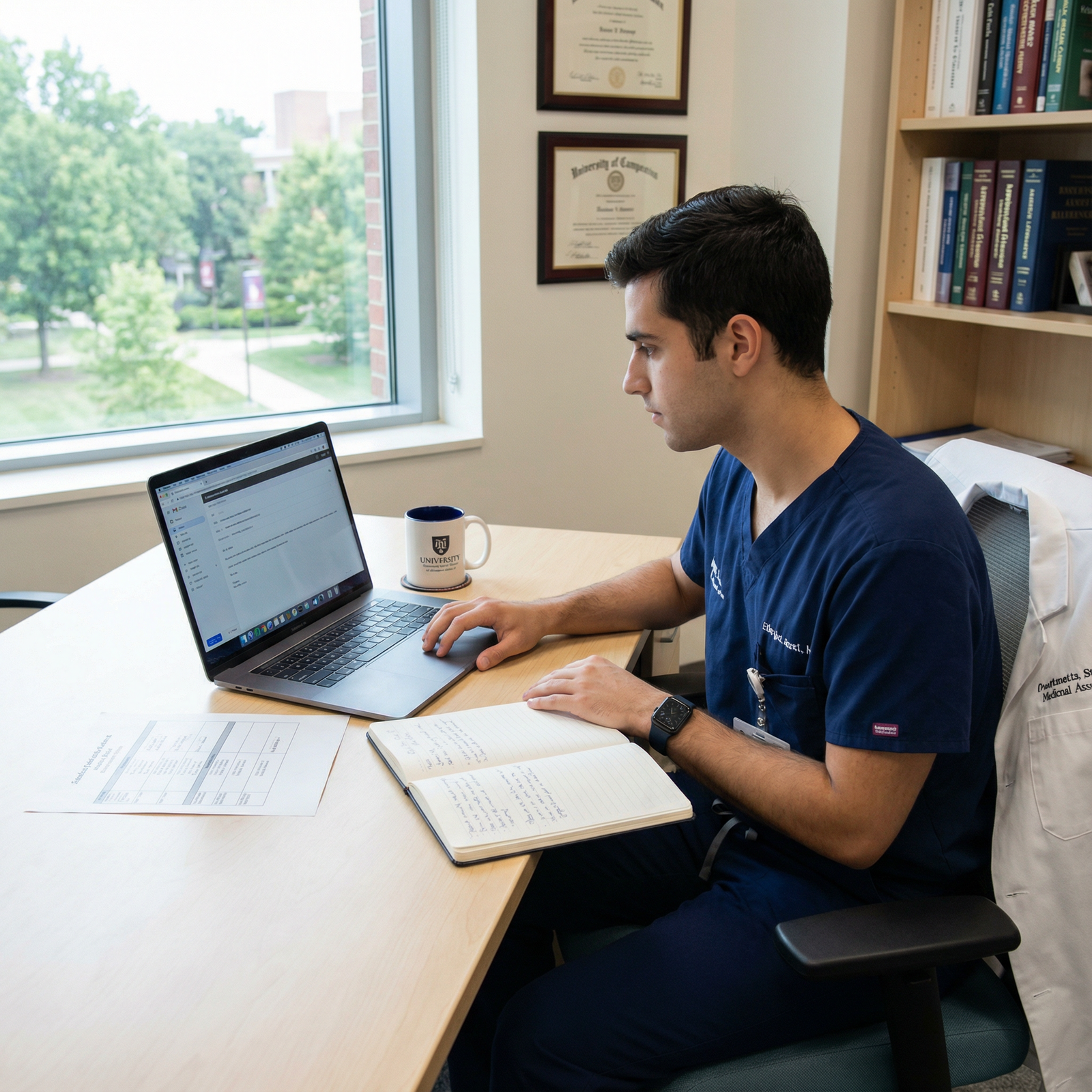
Tone matters here. Confident. Courteous. Concise. Never apologetic. Never overly eager. Never repetitive of your thank-you note.
Here's a working example of what I'd consider the right shape:
Subject: Following Up, Research Update
Dr. Martinez,
I wanted to share that our team's abstract on pediatric sepsis protocols was accepted for presentation at PAS next month, which connects closely to the quality improvement work your team described during the interview.
Still very interested in your program and looking forward to updates as the cycle progresses.
Best, [Your Name]
That's 60 words. It works.
Days 8-10: Send the Follow-Up Only If It Earns Its Place
At this point you should send the follow-up if you have a legitimate update, a previously promised piece of information, or a strong reason to re-engage.
Otherwise, you don't.
Keep the message under 150-200 words. Avoid asking, 'Do you have any updates?' unless that question is tied to a real deadline or process issue.
If the program already signaled a timeline, align with it rather than creating a separate, self-imposed schedule.
The biggest mistake I see at this stage is applicants treating silence as a personal problem to solve. It's not. Silence usually means the program is busy, the rank list meeting hasn't happened, or they simply haven't gotten to your file yet. Your job is to be useful, not loud.
If you don't have a real reason to write, write nothing. Silence is a complete strategy.
Days 11-14: Wait, Track, and Stop Chasing
By day 11, the active follow-up window is closing. If you've sent one thoughtful message and heard nothing back, you don't send another. You especially don't send a third.
Here's what you do instead:
- Log everything. Date sent. Recipient. Subject line. Outcome. Two minutes of documentation now saves you from accidentally emailing the same program director twice with two different versions of the same sentiment.
- Redirect your energy. Other interviews. Rank list strategy. Letter of intent for your actual top program. Reading up on programs you haven't heard back from yet.
- Stop checking your inbox for that specific thread. It won't change anything. Open it once a day, not once an hour.
If a program wanted you to know something, they'd tell you. Most programs operate on internal timelines that have nothing to do with when you last emailed.
Use the Timeline, Not the Anxiety
A one-line "thanks" reply feels like a clue. It isn't. It's noise dressed up as feedback.
The applicants who match well aren't the ones who send the most emails. They're the ones who send the right emails, at the right time, with something worth saying. A structured 1-2 week timeline gives you exactly that: a way to be responsive without being reactive, present without being desperate.
Save this guide. Pull it up the next time a short reply lands in your inbox. Follow the day-by-day checkpoints. And when you hit day 14 with no response, walk away clean and put that energy somewhere it actually counts.
The match rewards clarity. So does your follow-up.

Key Takeaways:
- A "thanks only" reply is not a verdict. It's a signal to follow a structured timeline and avoid impulsive outreach.
- The best follow-up is brief, relevant, and timed to add value, not to extract reassurance.