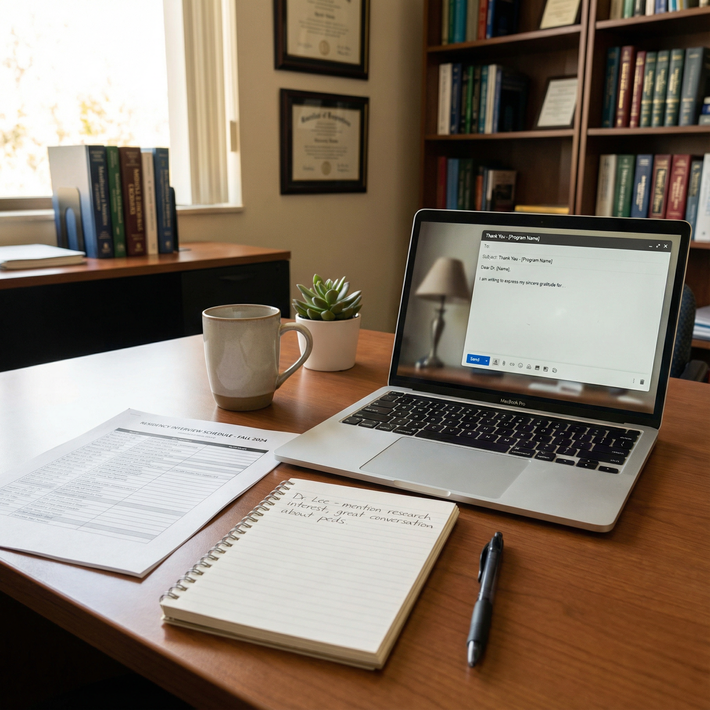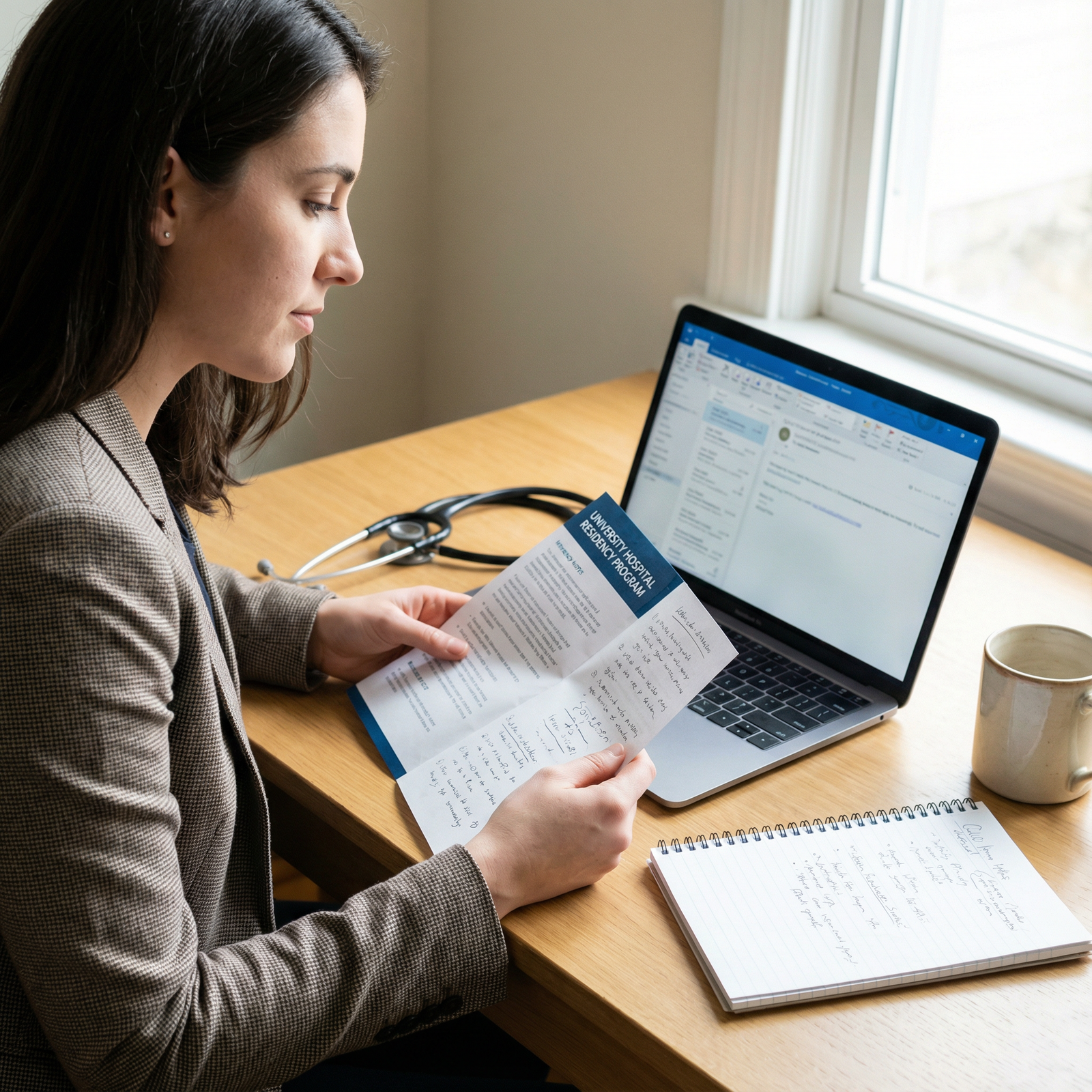
It's 7:18 p.m. You just got back to the hotel after a full day of residency interviews. Your name tag is still in your pocket, your brain is fried, and ERAS is glaring at you from your laptop screen. You know you should send thank‑you emails. You are not sure if you should fire them off tonight, wait until tomorrow morning, or batch them at the end of the week.
Here is the reality: programs are reading notes, coordinators are quietly judging your timing and tone, and other applicants are hitting “send” while you debate.
At this point, you need a timeline. Not vibes. Not crowd-sourced Reddit opinions. A concrete, hour‑by‑hour plan for day‑of vs. next‑day thank‑you emails.
Let’s walk it from 24 hours before the interview through 72 hours after.
T‑24 HOURS TO INTERVIEW: SET YOURSELF UP
At this stage you are not writing anything. You are preparing so that “day‑of vs. next‑day” becomes a strategic choice, not a panic decision.
The day before the interview
At this point you should:
- Create a simple thank‑you template file (Word, Google Doc, or Notes).
- Decide your default rule:
- My recommendation: faculty and PD notes = sent within 24 hours, usually next‑morning;
residents and group sessions = within 48 hours or not at all if the program explicitly discourages follow‑up.
- My recommendation: faculty and PD notes = sent within 24 hours, usually next‑morning;
- Clarify program expectations:
- Re‑read the pre‑interview email. Some programs now say, “No thank‑you notes needed or desired.” They actually mean it. Ignoring that is a bad look.
- If they are neutral, you are free to send.
Draft 2–3 skeleton templates you can quickly customize:
- Program Director / Chair skeleton
- Faculty interviewer skeleton
- Resident / fellow skeleton
Do not overcomplicate this. You want a 4–6 sentence structure that you can fill with specifics later.
Example skeleton (faculty):
- Line 1: Thank you + specific role
- Line 2: One specific thing from your conversation
- Line 3: One program detail that fits you
- Line 4: Signal continued interest
- Line 5: Simple closing
This prep saves you 20–30 minutes on a day when you are mentally cooked.
INTERVIEW DAY: REAL‑TIME NOTES AND DECISION POINTS
Now it is interview morning.
You are not sending anything yet. You are collecting ammunition.
During the interview day
At this point you should:
Keep a running note on your phone or paper:
- One bullet for each interviewer: topic you discussed, anything they seemed passionate about, any personal overlap (hometown, research niche, fellowship interest).
- One bullet about the program: something you genuinely liked that is not in every brochure (the night float structure, simulation curriculum, program director’s accessibility, etc.).
Confirm contact info:
- Check the schedule for emails.
- If emails are not listed, ask the coordinator once (not 5 times):
- “Will we have contact information for faculty in case we want to send a brief thank‑you?”
You are also watching the clock.
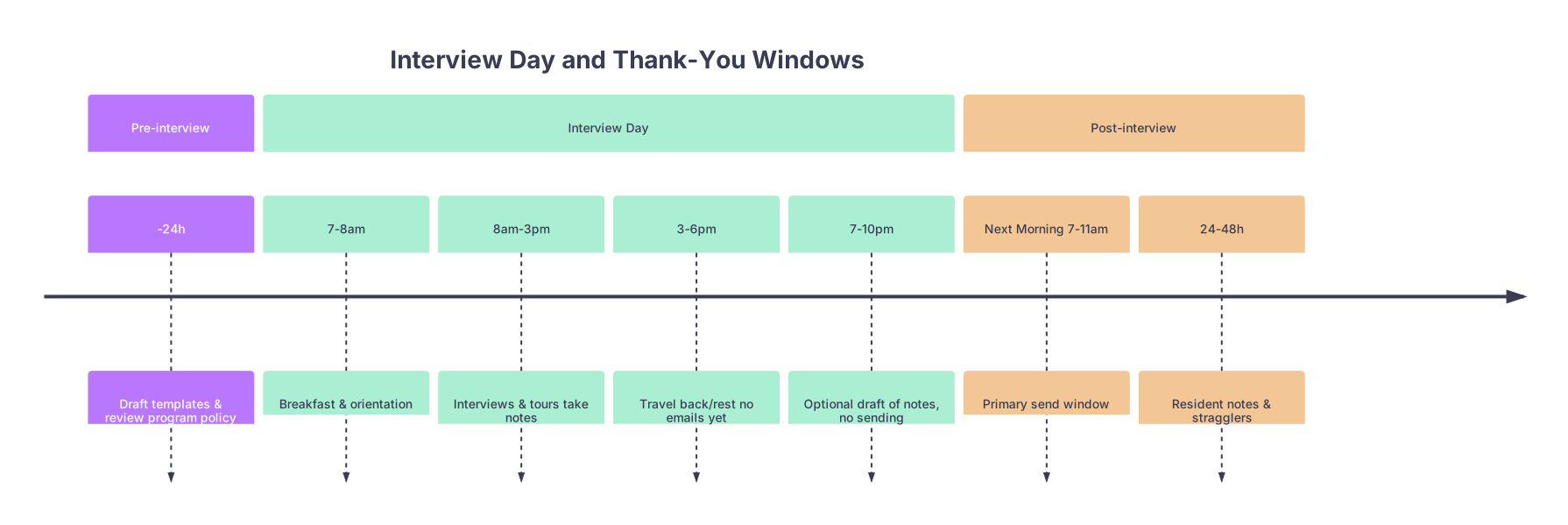
| Period | Event |
|---|---|
| Pre-interview - -24h | Draft templates & review program policy |
| Interview Day - 7-8am | Breakfast & orientation |
| Interview Day - 8am-3pm | Interviews & tours take notes |
| Interview Day - 3-6pm | Travel back/rest no emails yet |
| Interview Day - 7-10pm | Optional draft of notes, no sending |
| Post-interview - Next Morning 7-11am | Primary send window |
| Post-interview - 24-48h | Resident notes & stragglers |
The “Should I send tonight?” trap
Here is where people mess up. It is 6–9 p.m. You are tired, a little wired, and you start thinking:
“If I send tonight, I’ll look super interested.”
No. You will look rushed if the email is sloppy, generic, or full of errors. Night‑of emails are fine only if you:
- Had a short day.
- Are genuinely still sharp.
- Can write something that does not sound like you copy‑pasted it for ten programs.
For most people, draft at night, send in the morning is safer and more professional.
T+0–12 HOURS: NIGHT‑OF STRATEGY
You finished interviews. You are back home or in a hotel. This is the “day‑of vs. next‑day” decision window.
0–4 hours after the interview (late afternoon / early evening)
At this point you should:
- Decompress for at least 30–60 minutes.
- Then spend 20–30 minutes dumping details into your note file while they are fresh:
- Specific cases you discussed.
- Systems issues the faculty brought up.
- Residents’ offhand comments (“Our PD is very responsive on email,” “We never pre‑round alone intern year,” etc.).
This is raw material for personalization. No sending yet.
4–8 hours after the interview (evening)
Decide which of the following applies.
Scenario A: You had 2–3 interviews, still clear‑headed
You can:
- Draft and send high‑quality emails same day to:
- Program Director.
- Any faculty you had long, substantive conversations with.
- Keep them short and specific. No emotional essays.
Use night‑of sending if:
- You flew out early and will be in transit all next day.
- You have two more interviews back‑to‑back and tomorrow morning will be chaos.
Scenario B: Full interview day, completely drained
In this case:
- Draft only. Do not send.
- Use your templates, drop in:
- 1 concrete thing from the conversation.
- 1 concrete thing about the program you liked.
- Save them, close the laptop, and sleep.
You will edit with a clearer brain in the morning.
T+12–24 HOURS: THE PRIME WINDOW (NEXT MORNING)
This is the ideal time for most thank‑you emails. You are still fresh enough to remember people. Faculty and program leadership are back at their desks.
Morning after the interview (usually 7–11 a.m. program local time)
At this point you should:
Re‑read your drafts
- Fix typos. Tighten sentences.
- Make sure you did not paste the wrong program name. This happens more than you think.
Decide who actually gets a note Prioritize:
- Program Director
- Associate Program Director(s) who interviewed you
- Any faculty who spent >15 minutes in a substantive one‑on‑one
- Occasionally the chief resident who ran the day (if particularly helpful)
Optional:
- Individual residents from the social or group sessions, especially if:
- They share a strong interest (your exact fellowship goal, unique research, nontraditional path).
- They specifically invited follow‑up questions.
Send your primary emails in one block
Target sending between 8–10 a.m. in the program’s time zone. You look timely, not desperate.
Recommended pattern:
- 1 email to the PD.
- 1 to each key faculty interviewer.
- Possibly 1 grouped note to a couple of residents (“Dear Dr. Smith and Dr. Jones,” is fine for fellows/residents if you had a joint interview.)
Here is where “day‑of vs. next‑day” shows its real difference:
- Day‑of tends to feel more emotional, less polished, rarely necessary.
- Next‑day morning feels professional, intentional, and is early enough that your name is still circulating while they debrief.
T+24–48 HOURS: RESIDENTS, MISSED CONTACTS, CLEANUP
By now the core work is done. You are in the “optional but nice” territory.
24–36 hours after the interview
At this point you should:
Decide on resident follow‑ups:
- If you had a resident mentor assigned, a 3–4 sentence thank‑you is appropriate.
- If you spent a full pre‑interview dinner with someone who really helped clarify the program, send a note.
- If your only interaction was a large Zoom social and you barely spoke, you can skip. Or send one short note to the group via the coordinator.
Catch any people you missed:
- Faculty who were not on your original email list but turned out to be important (e.g., site director or research mentor you actually want to work with).
- The program coordinator, especially if:
- They helped rearrange your flights.
- They found a last‑minute slot for you.
- There were technical problems they fixed on the fly.
36–48 hours after the interview
This is your last reasonable window for anything that still looks timely.
- After 48 hours, notes start to feel like an afterthought.
- The only exception is if you sincerely did not get contact information until later.
DAY‑OF VS. NEXT‑DAY: WHEN EACH IS BETTER
Here is the comparison laid out cleanly.
| Timing | Best For | Pros | Cons |
|---|---|---|---|
| Day-of | Short interview days, few notes | Shows enthusiasm, details fresh | Higher typo risk, can feel rushed |
| Same-night | Traveling next day, tight schedule | Checked off before chaos starts | You are tired, judgment is worse |
| Next-morning | Most interviews, PD/faculty notes | Professional, polished, timely | Requires planning/time in morning |
| 24–48 hours | Residents, coordinator, missed people | Still acceptable, thoughtful | Slightly less “crisp” in timing |
And yes, there are wrong choices:
- Sending 5 days later and pretending that is normal.
- Sending multiple follow‑ups when they have not responded (they are not going to; this is not a conversation).
- Sending at 1:47 a.m. local time with a rambling paragraph about how much you loved everything. That reads anxious.
WHAT TO SAY: SAMPLE TIMELINES WITH CONTENT
You wanted a practical timeline, so let’s map a real interview day.
Assume: Tuesday interview, 8 a.m. – 3 p.m., central time.
Monday (T‑24h)
At this point you should:
- Build and save your 3 template skeletons.
- Confirm program stance on thank‑yous from any pre‑interview materials.
Tuesday interview (T+0)
- 8 a.m. – 3 p.m.: Take structured notes after each interview block.
- 4–5 p.m.: Travel back, decompress.
- 6–7 p.m.: Transfer rough notes into your master document.
- 7–8 p.m.: Draft emails, do not send:
- PD
- Two faculty interviewers
- One resident you connected with
Wednesday morning (T+24h)
At this point you should:
- 7–8 a.m.: Re‑read drafts, fix obvious errors.
- 8–9 a.m. CT: Hit send on PD + faculty notes.
- Noon CT: If you want, send 1–2 resident notes.
If the interview was Monday instead, you still aim for “next‑day morning,” which lands on Tuesday. You do not wait until Friday “when you have time.”
PROGRAM VARIATION: ADJUSTING THE TIMELINE
Not all programs want or even allow thank‑you notes. Some specify:
- “Please do not send thank‑you notes; they will not affect your ranking.”
- “Direct all communication through the program coordinator.”
- “Group thank‑you to the program email is sufficient.”
Here is how to time things in those scenarios.
If they say “no thank‑you notes”
Believe them. Your “but I really loved you” email will not help.
You can:
- Keep your notes for yourself for later rank list decisions.
- If you truly must send something (e.g., to clarify a critical misunderstanding), keep it extremely transactional, not emotional.
If they allow notes but say they do not affect ranking
They are half‑right. A thank‑you email will not rescue a bad interview. But it:
- Keeps your name in circulation when they sit down to rank.
- Signals basic professionalism.
- Gives you a chance to clarify fit (“I am especially interested in your community psychiatry track…”).
Timing still holds: within 24 hours for key people, within 48 hours for everyone else.
COMMON MISTAKES AND HOW TIMING FIXES THEM
Let me be blunt. I have seen these repeatedly.
Mistake 1: Mass‑sending generic notes seconds after the interview
Timeline version:
- 3:15 p.m. Zoom interview ends.
- 3:18 p.m. All three interviewers get an email:
- “Dear Dr. [Last Name], Thank you so much for…”
They know you copy‑pasted. It feels mechanical.
Fix:
- Wait until that evening or next morning.
- Add 1 specific detail from the conversation.
- Keep sending time between 7–11 a.m. next day.
Mistake 2: Waiting a full week
By then, they have often finished their quick debrief and moved on.
Fix:
- Put a 15‑minute calendar block for the morning after every interview.
- If you are traveling, commit to night‑of sending (but only if you can keep it clean).
Mistake 3: Writing a second “follow‑up thank‑you” later in the season
Do not. That is where applicants drift from professional into needy.
Timeline rule:
- One thank‑you email per interviewer, within 48 hours of your interview.
- Later update / interest emails belong in a different category and, if at all, go to the PD or coordinator closer to rank list time, not the entire faculty panel.
HOW THIS FITS WITH YOUR OVERALL INTERVIEW SEASON
You are not writing one note. You might be writing 40–60.
You need a system that scales.
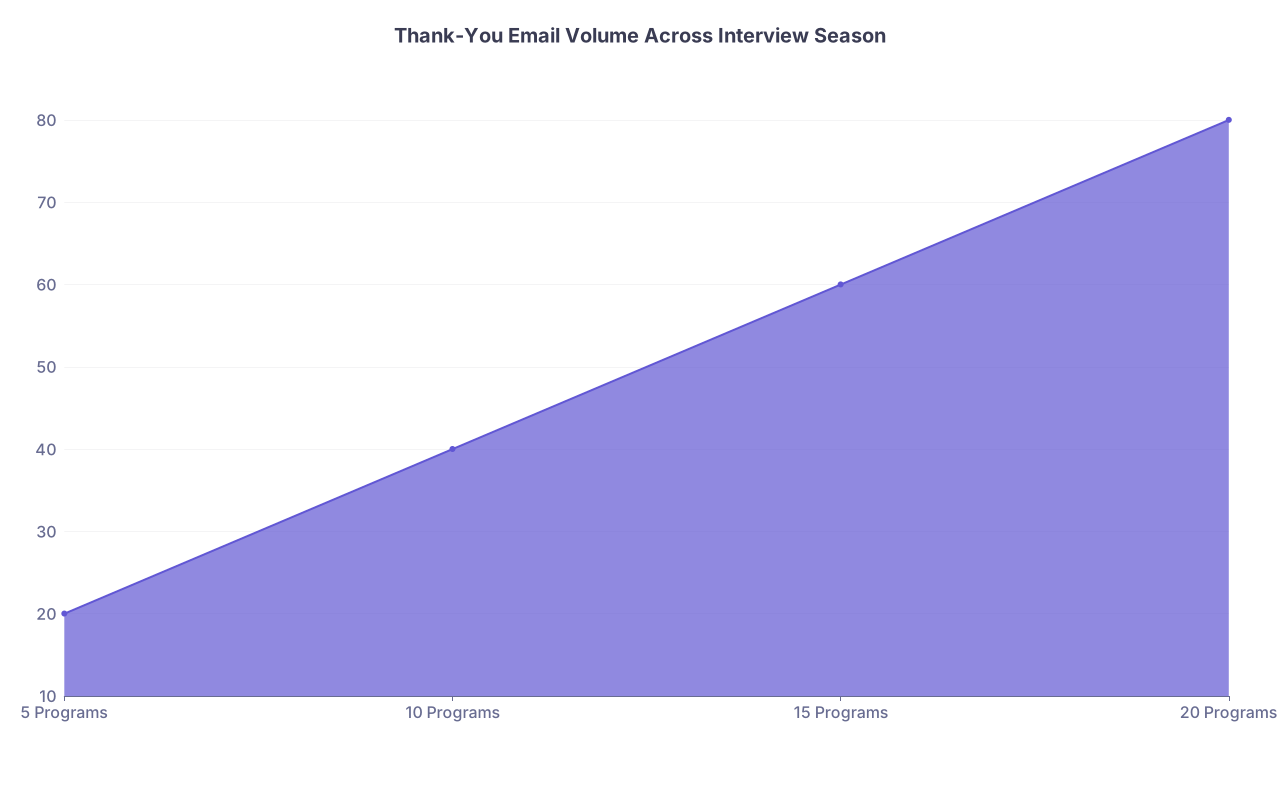
| Category | Value |
|---|---|
| 5 Programs | 20 |
| 10 Programs | 40 |
| 15 Programs | 60 |
| 20 Programs | 80 |
Practical weekly rhythm:
- Night before each interview
- Review your templates.
- Open a new doc labeled:
ProgramName_ThankYous.
- Interview day
- Dump notes into that doc after each conversation block.
- Next morning
- Spend 15–20 minutes finalizing and sending.
- End of each week
- Quick review: make sure you did not skip any program.
This is how you avoid the Saturday nightmare where you realize you never wrote anything to that one program you actually liked.
QUICK CONTENT BLUEPRINT BY TIMING
To tie the timing to what you actually say:
Day‑of (only if you send)
- Tone: Brief, very focused, factual.
- Content:
- One clear “thank you for your time today.”
- One specific reference to something you discussed that day.
- One sentence linking that to your interests.
- Close.
Next‑day morning (default)
- Tone: Still concise, but you can sound more reflective.
- Content:
- Acknowledge the interview “yesterday.”
- Name a program feature you appreciated once you had a night to reflect.
- Tie that to your background or goals.
- Express that you would be happy to train there. No ranking promises, no “top choice” language.
24–48 hours (residents / coordinator)
- Tone: Warm, appreciative, slightly more informal.
- Content:
- Thank them for making the day smoother or sharing honest insights.
- Reference something practical they helped you with (schedule, logistics, candid answers).
VISUAL TIMELINE: FROM INTERVIEW TO LAST ACCEPTABLE THANK-YOU
| Period | Event |
|---|---|
| Pre-interview - -24h | Draft templates & review program policy |
| Interview Day - 7-8am | Breakfast & orientation |
| Interview Day - 8am-3pm | Interviews & tours take notes |
| Interview Day - 3-6pm | Travel back/rest no emails yet |
| Interview Day - 7-10pm | Optional draft of notes, no sending |
| Post-interview - Next Morning 7-11am | Primary send window |
| Post-interview - 24-48h | Resident notes & stragglers |
(Think of the “Last Window” as your hard stop. After that, you are in “late and slightly awkward” territory.)
Key Takeaways
- Default to next‑morning sending. Draft the night of the interview if you want, but send polished thank‑you emails between 7–11 a.m. program local time within 24 hours.
- Use a 48‑hour cutoff. Program director and key faculty: by 24 hours. Residents, coordinators, and anyone you missed: by 48 hours. After that, skip it.
- Quality beats speed. A clean, specific, error‑free thank‑you tomorrow morning beats a generic, typo‑filled one fired off the second your Zoom call ends. Timing matters, but content and professionalism matter more.