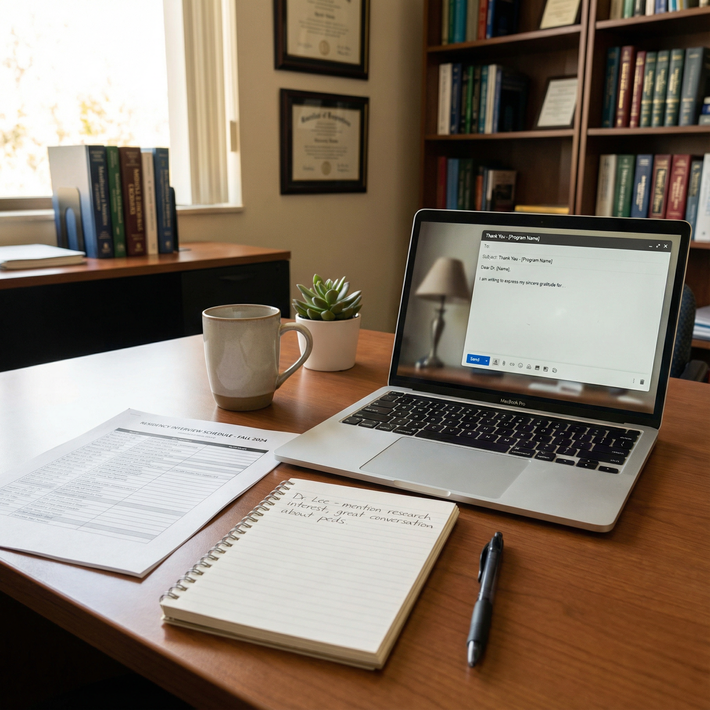
The worst post-interview mistake is not silence. It’s sloppy follow‑up that screams “generic” and “I’m doing this because someone told me I have to.”
You have 72 hours after a residency interview to look sharp, stay memorable, and not cross any NRMP or professionalism lines. That window closes fast.
Below is your hour‑by‑hour, then day‑by‑day playbook: what to send, when to send it, and exact templates you can copy, customize, and fire off without overthinking.
First 2 Hours After the Interview: Capture Before You Forget
At this point you should not be sending anything. You should be capturing everything.
Right after you log off Zoom or leave the hospital:
Within 15–30 minutes
- Open your notes app or a simple doc for that program.
- Write:
- Names (with correct spelling) and roles of everyone you met.
- One specific thing you discussed with each interviewer.
- Any program features that genuinely impressed you.
- Any follow‑up items you promised (sending a manuscript, updated Step 2 score, etc.).
Do this even if you think you’ll remember. You won’t. After your 8th interview, “the PD who mentioned ultrasound curriculum” will blend with “the APD who mentioned ultrasound curriculum.”
Within 1–2 hours
At this point you should:
- Decide: Will you send individual emails to every interviewer, or one consolidated email to the coordinator / PD?
- Academic and mid‑size university programs often expect individual notes (or at least PD + main faculty).
- Huge interview days (10+ interviewers, large panels) are often fine with 2–4 targeted emails.
- Collect:
- Business cards
- Any “contact us if questions” emails from the pre‑interview packet
- Names and emails from the interview day schedule
If you do not have someone’s email, do not spend three hours stalking them on LinkedIn. Use this rule:
- If they were:
- Program Director, Associate Program Director, or your primary interviewer → try to find the email on the program website or via the coordinator.
- Panel member who asked one question → optional, unless you had a particularly strong connection.
Hour 2–12: Draft, Don’t Send Yet
You’re still too emotionally charged right after the interview. That leads to rambling, over‑effusive, or weirdly intense emails. Draft now, send later.
At this point you should:
- Create a separate document for each program with:
- Subject line ideas
- Draft emails
- Bullet notes of what to highlight
Basic Structure of a Strong Residency Thank‑You Email
Think tight, 5–8 sentences max:
- Clear subject line
- Gratitude
- One specific detail from the conversation
- One alignment point (why you fit this program)
- Closing line reaffirming interest (but not ranking)
- Simple professional sign‑off
Template: Standard Thank-You to Faculty Interviewer
Use this for most attendings and APDs.
Subject: Thank you for the interview on [Date]
Dear Dr. [Last Name],
Thank you for taking the time to speak with me during my interview at the [Program Name] [Specialty] residency on [day of week]. I enjoyed our conversation about [specific topic you discussed—e.g., “your approach to mentoring residents through their first ICU rotation”].
Our discussion reinforced how well [Program Name] aligns with what I’m seeking in residency, particularly [1–2 concrete features—e.g., “strong clinical training with graduated autonomy” or “the dedicated ultrasound curriculum and opportunities to teach medical students”]. I would be excited to train in an environment that emphasizes [brief value you both mentioned—e.g., “direct, honest feedback” or “resident well‑being without compromising clinical rigor”].
Thank you again for your time and for sharing more about the program. I appreciate your consideration.
Best regards,
[Your Full Name]
[AAMC ID – optional, but helpful for large programs]
[Medical School]
Save this as a base. Then customize 2–3 lines for each person.
Within 24 Hours: Send the Core Thank‑Yous
This is your primary window. By now, you should have cooled off enough to sound professional but still specific.
Who absolutely gets an email within 24 hours
At this point you should send individual thank‑you emails to:
- Program Director (PD)
- Each 1:1 or 2:1 interviewer who spent ≥15 minutes with you
- Program Coordinator (slightly different template)
- Optional but smart: Chief residents who ran your day and had direct conversations with you
If you interviewed at 10+ programs back‑to‑back, try for same‑day or next‑morning sends. But don’t panic if it pushes toward 36 hours. You’re not blacklisted over timing alone.
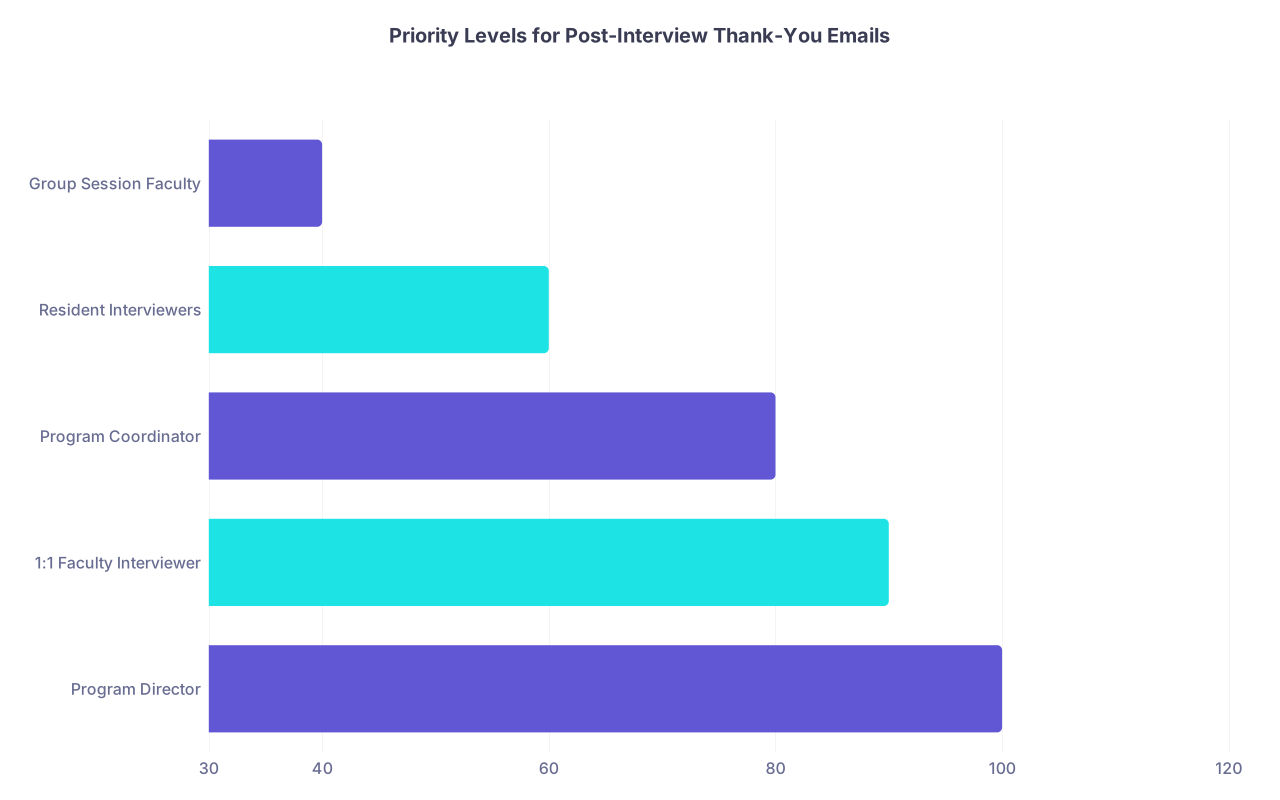
| Category | Value |
|---|---|
| Program Director | 100 |
| 1:1 Faculty Interviewer | 90 |
| Program Coordinator | 80 |
| Resident Interviewers | 60 |
| Group Session Faculty | 40 |
Email to the Program Director (PD)
This one needs a bit more substance. PDs actually do remember great notes.
Subject: Thank you for the opportunity to interview – [Your Name]
Dear Dr. [Last Name],
Thank you for the opportunity to interview for the [Specialty] residency position at [Program Name] on [date]. I appreciated learning more about your vision for the program, especially [specific PD theme—e.g., “developing residents who are both strong clinicians and effective educators” or “balancing community hospital volume with academic resources”].
I was particularly impressed by [1–2 concrete aspects—e.g., “the structured mentorship pairings,” “the robust exposure to underserved populations at [Hospital Name],” or “the flexibility to pursue research in [field] starting in PGY-2”]. Speaking with you and the residents confirmed that [Program Name] would be an excellent fit for my goals in [career direction—e.g., academic cardiology, community hospitalist practice, critical care].
Thank you again for considering my application and for leading such a thoughtful interview day. I would be grateful for the opportunity to join your residency program.
Sincerely,
[Your Full Name]
[Medical School]
AAMC ID: [#######]
Customize that third paragraph heavily. Generic = forgettable.
Email to the Program Coordinator
People skip this. It’s a mistake. Coordinators run the world behind the curtain and PDs listen to them.
Subject: Thank you for coordinating the interview day
Dear [Mr./Ms./Mx./First Name Last Name],
Thank you for organizing the interview day at [Program Name] on [date]. The schedule ran smoothly, and I appreciated how clearly you communicated logistics before and during the visit.
I enjoyed meeting the residents and faculty and learning more about the [Specialty] program. Please extend my thanks to everyone involved in planning the day.
Best regards,
[Your Full Name]
[Medical School]
AAMC ID: [#######]
Short, polite, and respectful. That’s the whole job.
24–48 Hours: Fill the Gaps and Follow Through
By this point, your main thank‑you wave is sent. Now you handle the edge cases and follow‑ups.
At this point you should:
- Send any remaining key thank‑yous (chiefs, informal resident meetings)
- Send promised follow‑up materials
- Clarify any details if they asked you to follow up
Resident Interview Thank‑Yous
Residents may not formally “vote,” but their opinions absolutely get back to leadership.
If you had 3–4 resident meet‑and‑greets in a single Zoom room, it’s excessive to email everyone. Either:
- Email the resident who spent the most time with you, or
- Ask the coordinator for a generic “residents@” address and send one note to the group
Subject: Thank you for sharing your experience at [Program]
Dear Dr. [Last Name]/[First Name if they insisted],
Thank you for taking the time to speak with me during the resident meet‑and‑greet on [date]. I appreciated your candid perspective on [concrete topic—e.g., “night float,” “how interns are supported in the ICU,” “fellowship placement support”].
Hearing about your experiences at [Program Name] strengthened my interest in the program, particularly the culture you described of [specific trait—e.g., “residents looking out for each other on busy days” or “attendings being approachable for real‑time feedback”].
Thank you again for your time and insight.
Best,
[Your Full Name]
If you write to one resident, they’ll usually share with the group anyway.
Sending Promised Materials (Scores, Manuscripts, Updates)
This is not a thank‑you. It’s a follow‑through. Different tone.
If—during the interview—you said, “I’m expecting my Step 2 score next week; I can send an update,” and it arrives within your 72‑hour window, you can combine both.
Subject: Thank you and Step 2 CK update – [Your Name]
Dear Dr. [Last Name],
Thank you again for the opportunity to interview at [Program Name] on [date]. I enjoyed our conversation about [specific topic].
As we discussed, I wanted to share that my Step 2 CK score is now available: [###]. I’ve updated this in ERAS as well.
I remain very interested in [Program Name] and would be excited to train there. Thank you again for your time and consideration.
Sincerely,
[Your Name]
Keep it lean. No apologies if the score is lower than you hoped. You’re sharing data, not confessing.
48–72 Hours: Clean-Up Phase and Special Cases
By 48 hours, the thank‑you train should be done. The last 24 hours are for repairs and edge cases.
If You Forgot a Thank‑You or Found an Email Late
You realize at hour 50 that you never emailed an influential interviewer. Do not ghost them just because the 24‑hour mark passed. Send it.
Subject: Thank you for the interview on [Date]
Dear Dr. [Last Name],
I wanted to thank you for speaking with me during my interview at [Program Name] on [date]. I appreciated learning more about [specific topic] and hearing your perspective on [another specific detail].
Our conversation reinforced my interest in the program, especially [1–2 aspects]. Thank you again for your time and consideration.
Best regards,
[Your Name]
Do not explain the delay unless it’s bizarrely long (weeks). Within 72 hours, you owe no justification.
If You Genuinely Have a Clarifying Question
This is where people go wrong and start fishing for reassurance. Don’t do that.
Acceptable clarifications within 72 hours:
- “You mentioned a dedicated global health track—could you point me to where that’s described?”
- “Could you confirm whether residents are required to complete a research project before graduation?”
Bad clarifications:
- “Where do I stand compared to other applicants?”
- “How many people do you plan to rank ahead of me?”
If you do have a clean, program‑related question, fold it into a thank‑you reply to the coordinator or a resident, not the PD.
Subject: Thank you and quick question about [topic]
Dear [Name],
Thank you again for coordinating the interview day on [date]. I enjoyed meeting everyone and learning more about the program.
I had one quick follow‑up question about [topic]: [1 sentence question]. If there’s a link or document that outlines this, I’d appreciate it.
Best regards,
[Your Name]
Short. Straightforward. No emotional hostage‑taking.
What Not to Do in the First 72 Hours
At this point you should avoid these landmines:
- Do not mention ranking decisions.
- No “I plan to rank you #1” or “You’re my top choice.” NRMP strongly discourages this and programs hate the game.
- Do not send physical letters. They arrive late and look performative.
- Do not copy‑paste the same paragraph into 8 emails and forget to change the program name. I’ve seen this. People remember.
- Do not write essays. Anything longer than 200–250 words is too much.
- Do not send from a sketchy email address (e.g., “drfuture2028@”). Use your school email or a clean professional Gmail.
| Behavior Type | Example |
|---|---|
| Good | 5–8 sentence tailored email to each interviewer |
| Good | Thanking the coordinator by name |
| Borderline | Asking about ranking or competitiveness |
| Bad | Declaring rank order position |
| Bad | Sending a 700-word personal essay |
Visual Timeline: Your 72-Hour Plan
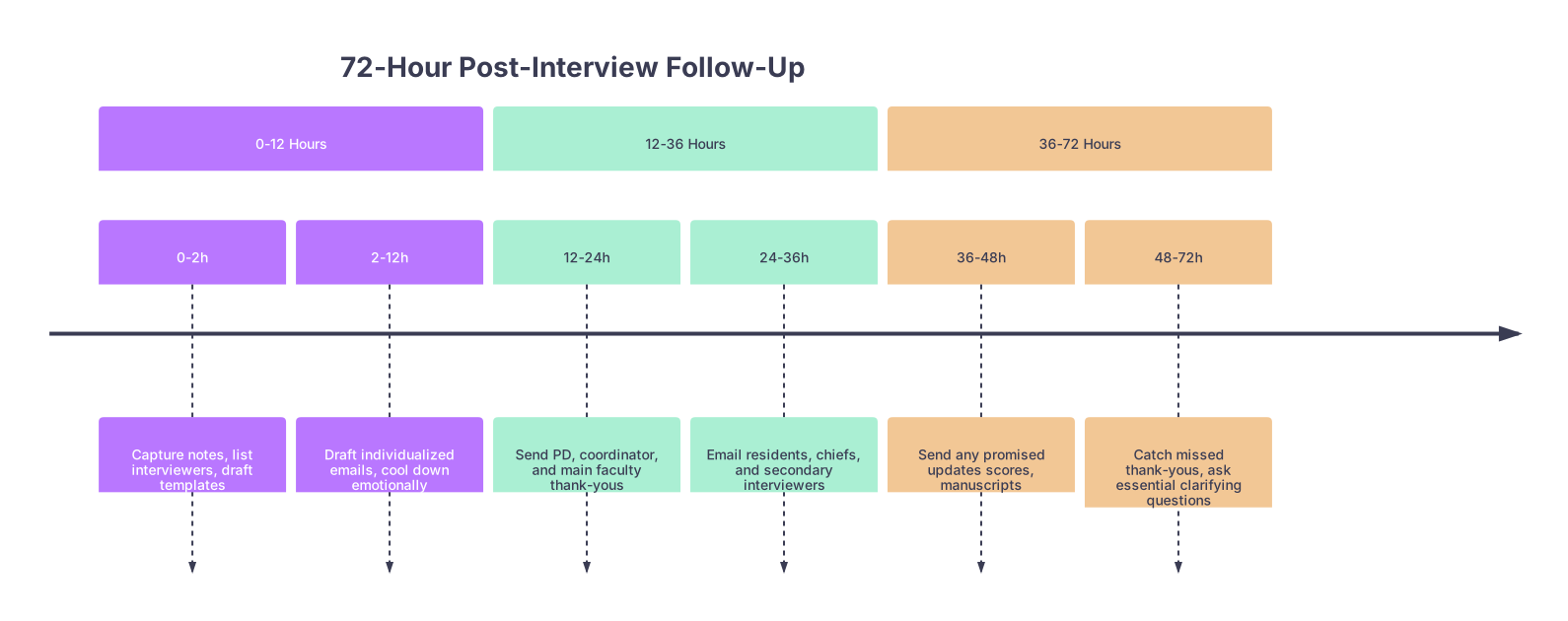
| Period | Event |
|---|---|
| 0-12 Hours - 0-2h | Capture notes, list interviewers, draft templates |
| 0-12 Hours - 2-12h | Draft individualized emails, cool down emotionally |
| 12-36 Hours - 12-24h | Send PD, coordinator, and main faculty thank-yous |
| 12-36 Hours - 24-36h | Email residents, chiefs, and secondary interviewers |
| 36-72 Hours - 36-48h | Send any promised updates scores, manuscripts |
| 36-72 Hours - 48-72h | Catch missed thank-yous, ask essential clarifying questions |
Putting It All Together: A Quick Scenario
To make this real, here’s how it looks in practice for a single interview day.
You interview at City Medical Center Internal Medicine on Monday.
Monday afternoon (0–4 hours post‑interview)
You:
- Dump notes into your “City Med IM” doc:
- Dr. Patel (PD): talked about resident autonomy, safety-net hospital, QI projects.
- Dr. Lee (APD): interested in your QI project; mentioned their hospitalist track.
- Dr. Ramirez (hospitalist faculty): discussed work‑life balance and nights.
- Residents: emphasized strong camaraderie, night float schedule.
- Draft rough emails to PD, APD, faculty, coordinator.
Monday night (4–12 hours)
You:
- Tighten the PD email, customize 2–3 lines for each interviewer.
- Run a fast spell‑check and make sure you didn’t write “University of Metro” in an email about “City Medical Center.” (Happens more than you think.)
Tuesday morning (12–24 hours)
You:
- Send:
- PD email at ~8:30–9:00 am local program time.
- Coordinator email.
- Main interviewer emails.
Tuesday afternoon–evening (24–36 hours)
You:
- Email the chief resident who ran your lunch session, plus 1 resident you connected with.
- If you promised to send an updated CV or manuscript and you already have it, send a brief follow‑up note (“As promised, I’ve attached…”).
Wednesday (36–72 hours)
You:
- Realize you forgot Dr. Ramirez. You find his email on the hospital site and send a concise thank‑you.
- You’re unclear about the research requirement. You email the coordinator with a short “thank you + quick question.”
Done. No drama, no overthinking, and you look like a professional adult who can close the loop.
Final 3 Things to Remember
- Within 24 hours, your core job is simple: brief, specific, and individualized thank‑you emails to PD, key faculty, and the coordinator.
- Within 48 hours, clean up residents and promised follow‑ups; within 72 hours, fix any misses and ask only truly necessary questions.
- Generic, copy‑pasted, or overly intense messages hurt more than silence—keep it short, concrete, and genuinely tied to that program and that conversation.