
The biggest mistake applicants make after residency interviews is sending the right message at the wrong time. Content matters. Timing matters more.
You’re not just “following up.” You’re managing a season-long conversation with programs that runs from the hour your interview ends to the minute rank lists lock. At each point, there are things you should send immediately—and things you should keep in your drafts folder until post-season.
Let’s walk this chronologically, because that’s how program directors actually experience you: not as a single email, but as a timeline of how you handled the months after interview.
Overview Timeline: From Interview Day to Rank List Deadline
First, get the full arc in front of you.
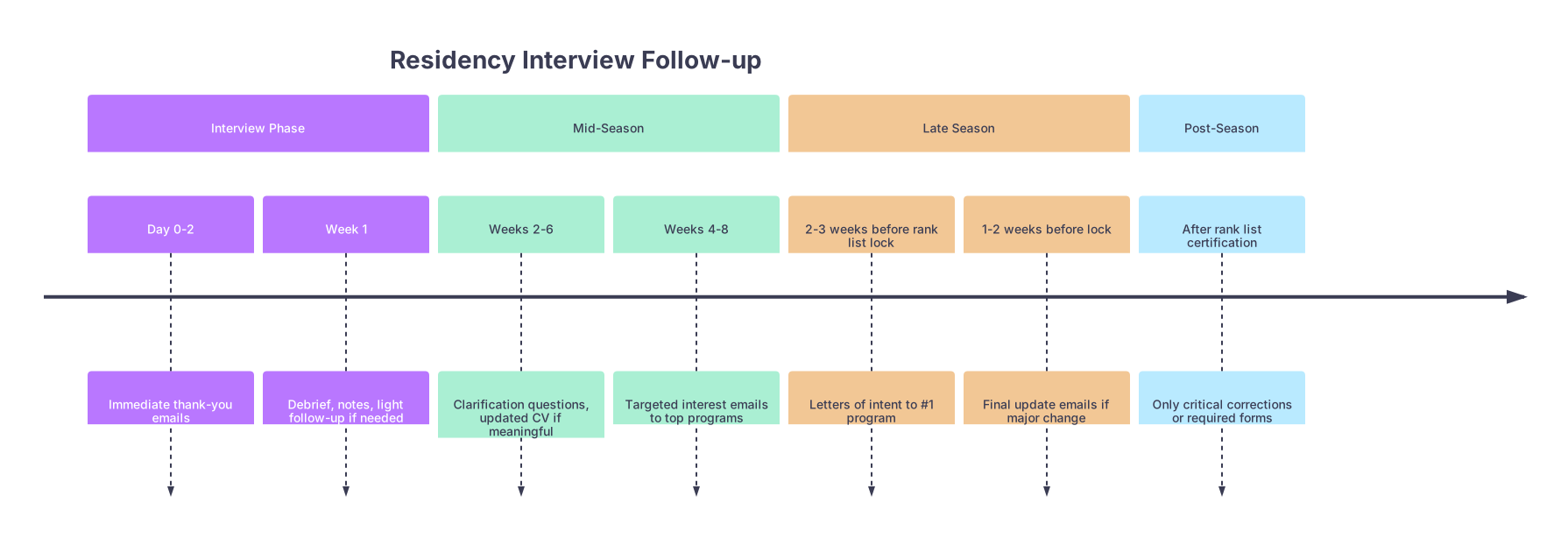
| Period | Event |
|---|---|
| Interview Phase - Day 0-2 | Immediate thank-you emails |
| Interview Phase - Week 1 | Debrief, notes, light follow-up if needed |
| Mid-Season - Weeks 2-6 | Clarification questions, updated CV if meaningful |
| Mid-Season - Weeks 4-8 | Targeted interest emails to top programs |
| Late Season - 2-3 weeks before rank list lock | Letters of intent to #1 program |
| Late Season - 1-2 weeks before lock | Final update emails if major change |
| Post-Season - After rank list certification | Only critical corrections or required forms |
Now we drill into each segment: what to send right away vs. what you deliberately hold.
Immediately After Each Interview (Day 0–2)
At this point you should be focused on one thing: closing the loop professionally and accurately, without overpromising or ranking talk.
Send Immediately (within 24–48 hours)
Each interviewer gets their own email. Not a novel. Not a manifesto. A targeted, clean note.
Core elements:
- Thank them for their time.
- Reference 1–2 specific points from your conversation.
- Reaffirm continued interest (not rank position).
- Keep it under ~150–200 words.
Send:
- To every faculty interviewer
- To chief residents who interviewed you
- Optional: to program coordinator (especially if they helped you with logistics)
- Clarification of factual errors
If you realize you misstated something important—score, research detail, prior degree—correct it now. Waiting makes it weirder.
Example:
- “I realized I misspoke about my Step 2 score—it was 251, not 252. I apologize for the confusion and wanted to correct the record promptly.”
- Uploaded documents requested during the interview
If someone specifically asked: “Please send us your latest abstract” or “Email me that QI poster,” you send it within 24–48 hours.
What you don’t do: attach your whole CV again “just in case.” That’s lazy clutter.
Save for Later (do not send this yet)
- Letters of intent or “you’re my #1” statements
Too early. You don’t know your full landscape yet. Programs know it’s too early too. You’ll sound impulsive or disingenuous.
- Broad “update letters” with no real update
“I remain very interested and wanted to follow up again” without new information? That belongs in the mid-season phase, and even then, only if you have something real to say.
- Requests to move up on their rank list
Obvious, but I’ve seen this. Don’t ask, hint, or nudge about “where I stand” or “how I can improve my ranking.” Dead on arrival.
At this point: thank-you, correction if needed, fulfill any promised materials. That’s it.
Week 1 After Each Interview: Organize, Then Selective Follow-up
The first week after each interview is backstage work. The temptation is to keep emailing. Resist.
At this point you should…
- Document every program while it’s fresh
Create or update a simple tracker immediately:
| Program | Interview Date | Thank-you Sent? | Notes/Highlights | Follow-up Needed? |
|---|---|---|---|---|
| Program A | 11/10 | Yes | Loved QI focus | Ask about call schedule |
| Program B | 11/15 | Yes | Strong med-ed track | Send updated poster if accepted |
| Program C | 11/20 | Yes | Great resident vibe | Consider as top choice |
Then, expand your personal notes:
- What did you like/dislike?
- Any red flags?
- Who seemed to advocate for you?
- Did anyone specifically invite future questions or updates?
- Decide if targeted follow-up is warranted
Send in Week 1 only if:
- An interviewer asked you to keep them posted on a specific thing (match couples’ plans, research outcome, visa situation).
- You have a clarification question directly related to your fit (curriculum track details, call structure, fellowship placements).
These follow-ups should:
- Be concise
- Go to the right person (not blasting the PD + coordinator + half the faculty)
- Not pressure them for reassurances
Save for Later
- Program-specific “you’re in my top group” emails
You don’t know your real rank list yet. Your feelings right after an interview are often distorted by free lunch and a friendly PGY-3.
- Any emotional, “I felt so at home” long letters
Write those for yourself in your notes right now. You’ll need that language in a month. But don’t send it yet.
Mid-Season (Weeks 2–6 After Most Interviews)
By now you’ve done several interviews and have a clearer picture of relative preference. This is where applicants either become strategic—or noisy.
What to Send During Mid-Season
- Substantive CV updates (only if they matter)
Send updates when:
- A first-author paper is accepted or published.
- You win a significant award (departmental, institutional, national).
- You match into AOA or Gold Humanism after ERAS submission.
- You pass and receive a Step 2 score markedly stronger than Step 1.
Here’s the filter: if you wouldn’t add it to your ERAS application as a separate entry, don’t email it as an “update.”
What this email looks like:
- 1–2 short paragraphs
- Bullet format for the actual updates
- Optional one-sentence reaffirmation of interest
Not a letter of intent yet. Think of this as: “You’re a serious contender for my top rank spots, and I want you to know I’m engaged.”
You send this to:
- Programs genuinely near the top of your mental list
- Programs where you’d definitely be thrilled to match
Message structure:
- 1 paragraph: brief thank you + reminder of your interview date/interaction
- 1 paragraph: specific reasons the program aligns with your goals (med-ed track, specific fellowship pipeline, geography for family, etc.)
- 1 line: “Your program remains one of my top choices, and I would be very excited to train there.”
- Couples Match critical updates
If your couples match strategy changes in a way that affects geography or program clustering, it can be appropriate to:
- Let select programs know your partner has applied or interviewed at nearby institutions.
- Clarify that you’re ranking all feasible geographic combinations highly.
This is not mandatory, but occasionally helpful, especially in smaller specialties.
What You Should Save for Late Season
- Your explicit “#1 choice” statement
That belongs closer to rank list deadlines, when your list is final. If you send it now and change your mind later, you’re either lying or stuck.
- Multiple “check-in” emails with no new content
One mid-season update per program—max—unless they explicitly invite more.
Late Season: 2–3 Weeks Before Rank List Deadline
This is where timing really matters. Program rank meetings are happening or about to happen. This is when your communication can make a small difference—if done correctly.
Here’s where you separate “send immediately” from “hold until now.”
At this point you should…
- Finalize your true rank list draft
Before you send a single “you’re my #1” message, sit down and:
- Draft your full rank order list as if ERAS locked today.
- Ask yourself: If I matched at any of the top 3, would I be content? Which one would I regret not ranking #1?
Only once you’re honest with yourself do you start emailing.
- Send ONE true letter of intent—to your actual #1
Not your “#1 for now.” Your real #1.
Your letter of intent should:
- Go to the Program Director (CC coordinator is fine)
- Be 3–6 short paragraphs
- Contain a clear, unambiguous sentence:
“I will be ranking [Program Name] as my number one choice.”
Content to include:
- Specific reasons why: curriculum, residents, city, specific faculty, fellowship pathways.
- How you see yourself contributing: teaching, QI, research, underserved care, etc.
- Optional: brief reminder of who you are (“I interviewed with Dr. X on January 10 and discussed my interest in hospital medicine and QI projects.”)
Do not:
- Send more than one letter of intent (yes, they talk; yes, it backfires).
- Use vague hedging like “among my top programs” in a “letter of intent.” That’s just a bland interest email.
- Send short “strong interest” notes to a few other top programs
For your real #2–#4 (roughly), you can send brief notes of strong interest, as long as you do not lie.
Language that’s honest but strong:
- “Your program is one of my very top choices.”
- “I will be ranking [Program] very highly on my list.”
- “I would be thrilled to match at [Program].”
Keep these to:
- 2–3 short paragraphs max
- No ranking numbers
- No implied promises you can’t keep
What to Hold or Avoid at This Stage
- Any new letter that conflicts with your earlier letter of intent
If you already told a program they’re your #1, you don’t get to change that. Ethically and reputationally, that’s a mess. Programs remember.
- Frantic, last-minute “Just wanted to check in again!” emails
They don’t help. They create noise, not signal.
- Mass emails with generic flattery
Programs can smell copy-paste. If your message could be sent to any of 15 programs, it might as well be sent to none.
1–2 Weeks Before Rank List Lock: Final Updates & Corrections
This window is small and delicate. Send only if there’s a genuine reason.
Appropriate to Send Immediately
- Major new achievement with clear impact
Examples:
- Your randomized controlled trial is accepted to a major journal.
- You receive a national award (e.g., ACP, AAFP, specialty society).
- Something large and relevant that would’ve changed how you presented yourself on interview day.
At this point, your email should:
- Be very short (they’re busy with rank lists).
- Lead with the update.
- Optionally connect it to what you discussed at interview (e.g., med-ed, research).
- Critical correction to your application or status
If something changed that affects your ability to train:
- Visa status shifts.
- You failed Step 2 (yes, this must be disclosed).
- You withdrew from the Match (rare, but then you shouldn’t be emailing programs at all).
These are not optional updates. You send them.
Better to Save or Skip
- Minor poster acceptances at small conferences
Unless the program is extremely research-heavy and this is directly linked to what you pitched, it’s marginal at best this late.
- More restatements of interest with no new content
One strong, properly timed message beats three watered-down reminders.
After Rank Lists Are Certified
Once your rank list is certified and the NRMP lock has passed, your leverage is over. This is the quiet phase.
Appropriate Post-Season Messages
Very few.
- Program-required forms or confirmations
If a program coordinator emails everyone with a logistics request, obviously respond promptly.
- Serious corrections discovered only now
If you realize a major error in your application that has ethical implications, you still have to address it—even if late. Rare, but it happens.
What You Should Not Send Post-Season
- New “I ranked you #1” messages
Too late. List is locked. They can’t change anything. It comes off as uninformed at best.
- Fishing for your status or where you are on their rank list
They can’t tell you, and many are restricted from saying anything meaningful.
- Angry or disappointed messages if you suspect you’re ranked low
Self-explanatory. People move jobs. People remember names.
What Goes When: Quick Reference Chart
Tape this above your desk if you’re deep in interview season.
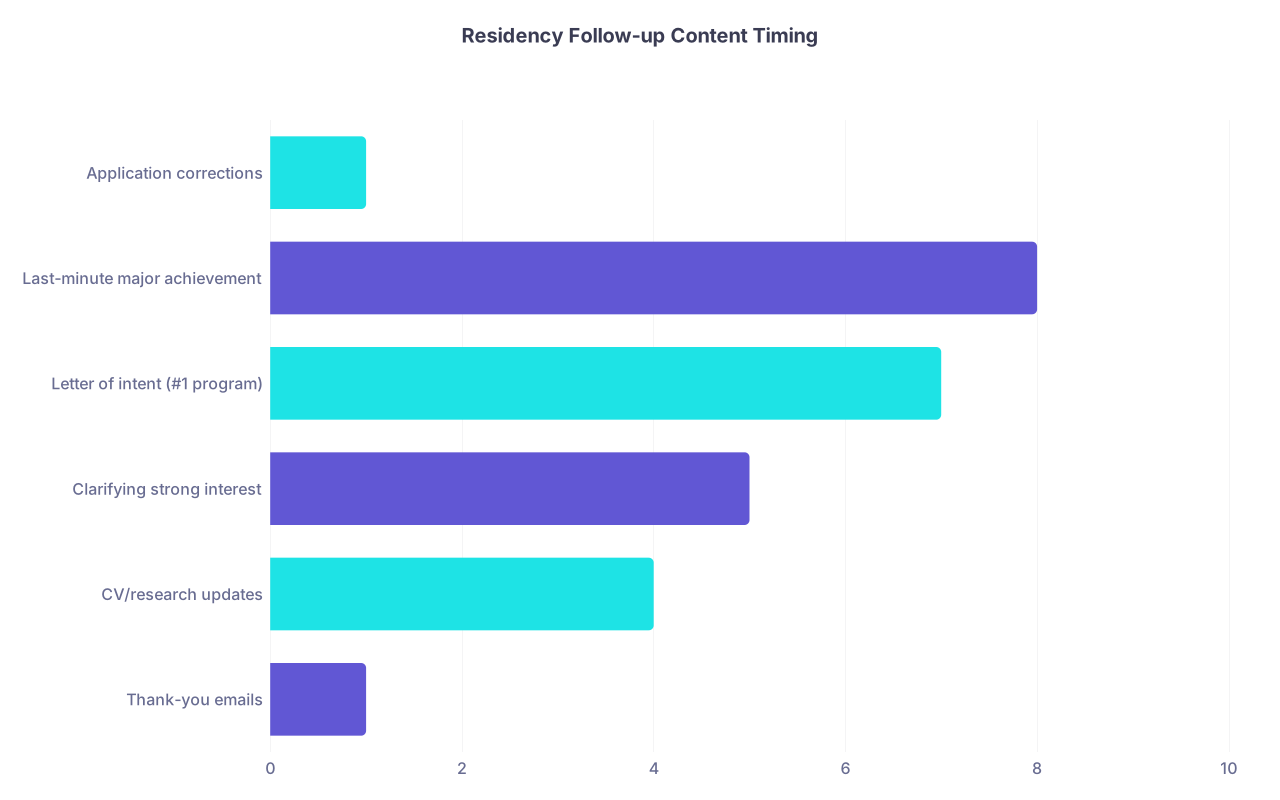
| Category | Value |
|---|---|
| Thank-you emails | 1 |
| CV/research updates | 4 |
| Clarifying strong interest | 5 |
| Letter of intent (#1 program) | 7 |
| Last-minute major achievement | 8 |
| Application corrections | 1 |
Legend (roughly):
- 1 = Immediately/early
- 4–5 = Mid-season
- 7–8 = Late season
How Many Emails Is Too Many?
Let me be blunt: over-emailing is far more common than under-emailing.
A reasonable pattern per program:
- 1 thank-you email (sometimes several individual notes, but same day)
- 0–1 mid-season update (if you really have something to add)
- 0–1 late-season interest/intent email
So for most programs:
- Total: 1–3 contacts after interview. Not 6. Not 10.
If you’re asking, “Should I send another email?” the default answer is no—unless:
- There’s new, meaningful information.
- Or the program explicitly invited ongoing communication.
Putting This Into Action Today
Here’s how to clean up your communication plan right now:
- List every program you’ve already interviewed at.
- For each program, mark which of these you’ve already sent:
- Thank-you
- Update
- Interest note
- Letter of intent
- Identify:
- Your true #1 (letter of intent—when the time is right)
- 2–4 “very high interest” programs (short interest notes later)
- Open your drafts or sent folder. Delete or re-write any message that:
- Says or implies more than one program is #1.
- Adds no new information.
- You wrote out of anxiety, not strategy.
Then, take one concrete action:
Draft (do not send yet) your ideal letter of intent to the program you currently think is #1. Save it. Revisit it in a week when more interviews are done. If it still feels true, you’ll be ready to send it at the right time—when it actually matters.