
At 19:30, the clinical work is finally over. Your pager is quiet. Your team has gone home. You should be eating dinner, exercising, calling your family, or sleeping.
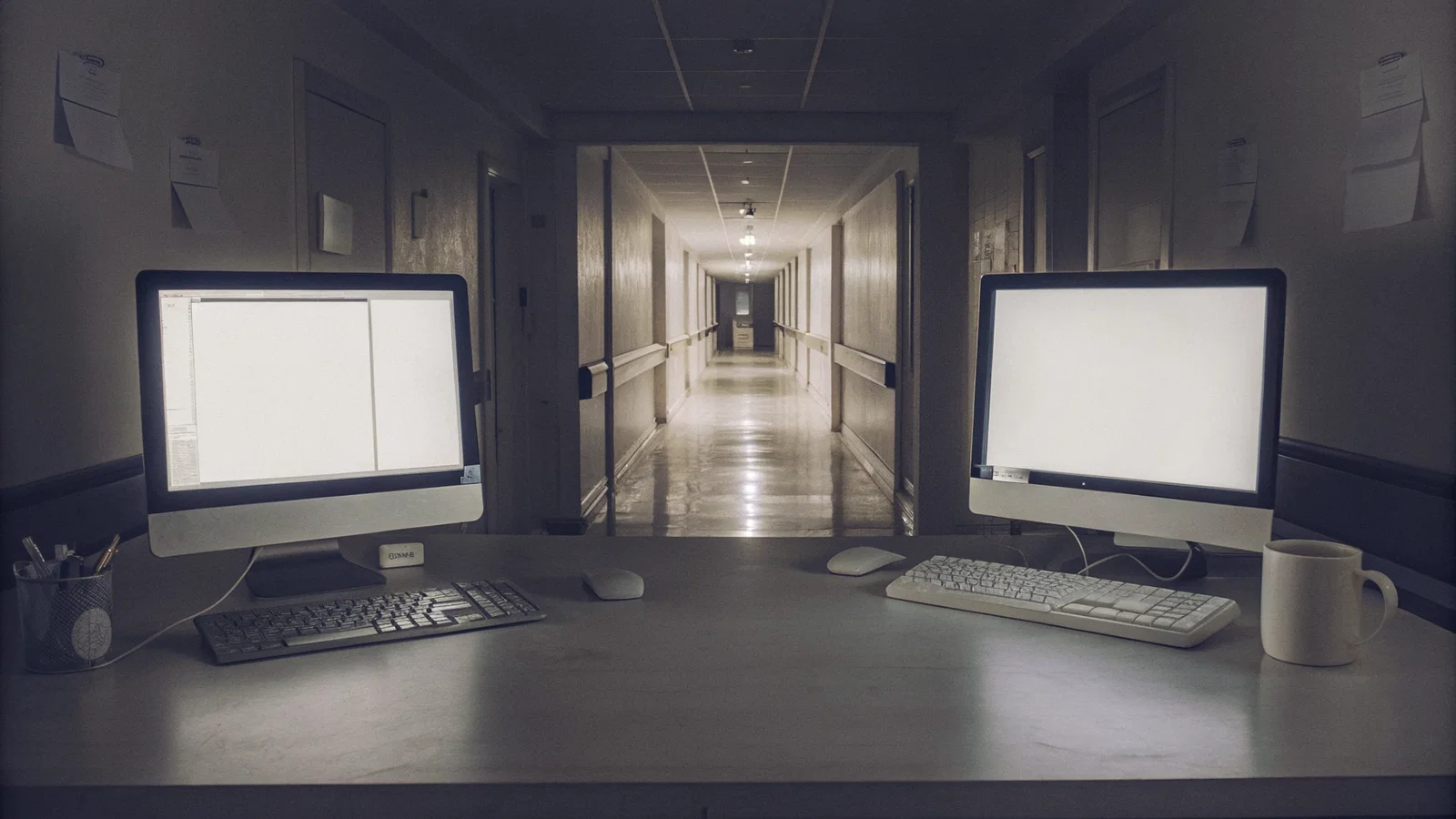
Instead, you are sitting in a dark workroom, staring at an unfinished progress note.
The patient had chest pain. You remember the troponin, the ECG, the reassuring或不 reassuring initial response. You remember the family member who asked whether you were sure everything was fine. You also remember the medication reconciliation, pending labs, consultant recommendations, and the three phone calls you made from the hallway.
Now you must reconstruct the day through a maze of tabs, timestamps, scanned documents, and autofilled fields. One section needs billing language. Another requires an accurate narrative. A third depends on a number you are not certain you saw.
Twenty minutes becomes forty-five. Then the note is still not signed.
This is not a rare breakdown in professionalism. It is a predictable consequence of a broken documentation system. Post-shift charting is not simply paperwork attached to patient care. It is unpaid clinical time governed by a workflow that pushes documentation away from the moment when your clinical reasoning is strongest.
Let me break this down specifically: finishing on time is not mostly about typing faster. It is about changing when, where, and how the information becomes a note.
The 19:30 Reality: Why Post-Shift Charting Is an Epidemic
The resident sitting alone at 19:30 is not lazy. The resident may have worked twelve hours, covered an unexpectedly busy service, handled several admissions, and provided more direct patient care than any other member of the team. Yet the official shift ended, so the system treats the remaining work as invisible.
That disconnect is damaging.
Clinical work is highly context-dependent. During the encounter, you hold the story in working memory: the patient's baseline, the sequence of symptoms, the significance of the examination, your uncertainty, and the rationale for your decisions. That context is richest immediately after the interaction.
Charting hours later forces your brain to perform a retrieval task. You are not merely typing; you are trying to remember what happened, distinguish what you know from what you inferred, and locate a fact in a chart that was never designed as a linear narrative.
The EHR provides timestamps. It does not provide your mental state.
This is why post-shift charting produces a peculiar form of cognitive exhaustion. It feels less like completing a difficult note and more like remembering a difficult note. You scroll through flowsheets, medication lists, laboratory tables, imaging reports, prior notes, and messages. Each tab creates another micro-decision:
- Is this the latest creatinine value?
- Did the consultant recommend antibiotics or merely discuss them?
- Did I actually call the pharmacy, or only intend to?
- Which oxygen saturation should anchor the note?
- Does the note need to mention a family update that was not formally documented?
Small decisions accumulate. By the time you sign, you are mentally spent in exactly the wrong way.
Now place that burden after a long shift. Recovery does not begin at shift end if your brain remains in high-alert mode. Falling asleep becomes harder. Deferred tasks crowd tomorrow morning. The next shift starts with unfinished work and the knowledge that you are already behind.
That creates a brutal loop:
- Documentation is deferred.
- Clinical memory fades.
- Notes take longer to reconstruct.
- The resident stays late.
- Sleep and protected time shrink.
- Fatigue impairs efficiency the next day.
- More documentation is deferred.
The burnout curve steepens here. The problem is not merely that residents work long hours. It is that the least efficient part of the workday often extends beyond the boundary you believed was supposed to end.
I have seen interns apologize for leaving while notes remained open, as though clocking out with unfinished documentation were a character flaw. It is not. It is a systems failure wearing the costume of individual responsibility.
Anatomy of Inefficiency: Where Your Documentation Time Actually Goes
A three-minute clinical update should not become a twenty-five-minute note. Yet it often does.
Here is how that happens.
First, the resident opens the note and searches for the patient in the wrong location. Then the wrong tab. Then the correct tab, only to find several note types that appear nearly identical. The note itself contains a history section that duplicates information already captured elsewhere. The physical examination template includes ten elements when the relevant encounter requires two. Medication reconciliation lists every home medication, every inpatient medication, and several discontinued orders, although the actual decision-making involved only two changes.
The mouse, or trackpad, moves through menus that appear to require half a second each. Selecting a diagnosis. Selecting a synonym. Selecting laterality. Selecting a laterality again after accidentally selecting bilateral. Choosing between "denies" and "no." Opening a pop-up, closing it, reopening the previous section.
You can estimate the true cost:
- 12 seconds per unnecessary menu decision
- 40 unnecessary decisions: roughly eight minutes
- Three minutes of repeated data verification: approximately eleven minutes total
- Two minutes spent deciding where a fact belongs: thirteen minutes
- Nine minutes of reconstructing context: twenty-two minutes
This is how a "quick note" becomes an epic.
The chart is illustrative, but the pattern is familiar: direct patient care occupies only a fraction of the workday, while EHR work consumes a disproportionate share. In some services, documentation, inbox messages, orders, and results review are counted as "charting," making the true administrative footprint even larger.
The most damaging waste is duplicate entry. If you type a full history, repeat it in the assessment, summarize it again in the plan, and then re-document the same facts during sign-out, you have created four chances to introduce an error. You have also converted a clear narrative into a maze of repetition.
Then there is defensive documentation.
Residents are taught that if it was not written, it did not happen. That is not entirely wrong, but it has been twisted into a simplistic mandate to document every possible complication, every fleeting concern, every phone call, every differential that briefly passed through the mind. The result is often bloated prose that obscures the actual reasoning rather than protecting it.
Clear clinical reasoning is what matters. A note that states the problem, the relevant data, the assessment, and the plan is far more defensible than a paragraph of vague anxiety.
Bad documentation sounds like this:
Patient remains somewhat tachycardic. Continue to monitor closely. Discussed with consultant. Awaiting further labs. No acute issues at this time. Will follow up.
That note is long but weak. It gives a reviewer no clear account of what changed, what the leading diagnosis was, or what would trigger escalation.
A stronger note is concise and specific:
Heart rate remains 112-118 despite 500 mL crystalloid. No chest pain, hypotension, focal neurologic deficit, or evidence of hypoxemia. Bedside ultrasound shows no obvious pericardial effusion. Concern remains for occult bleeding or another cause of persistent tachycardia; requesting repeat hemoglobin and reassessing volume status. If unchanged and hemodynamically stable, will request cardiology input regarding earlier ECG.
Same encounter. Better documentation. Better patient care. Shorter chart time.
The Real-Time Documentation Framework: Shifting Left
"Shifting left" means moving documentation earlier in the clinical workflow, closer to the information source and the patient encounter.
This is the central intervention. Stop treating the note as paperwork performed after seeing the patient. Treat it as clinical communication completed while the encounter is still alive.
A resident using real-time documentation might briefly summarize the history while standing at the bedside, type three or four key bullets, complete a focused assessment and plan, and sign the note before moving to the next patient.
That is not a summary of what ideal workflow experts suggest. It is the practical workflow that works.
1. Pull before you enter the room
Before the bedside encounter, review only what you need:
- Active problems
- Recent vital signs and relevant trends
- Key laboratory results
- Medication changes
- Pending studies
- Consultant recommendations
- The previous note's assessment and plan
The goal is not to become an expert on every datum in the chart. That is impossible and mostly wasteful. The goal is to identify the questions you need to answer before meeting the patient.
A simple pre-round template can help:
- Primary reason for admission
- Three active problems
- Current trajectory
- Outstanding tests
- Specific questions for bedside
- Possible discharge or escalation threshold
If a patient has been admitted with heart failure, do not reread the entire chart while walking to the room. Look at the recent trend, current weight, relevant medication changes, and the last plan. Then go.
2. Start the note before leaving the bedside
The hardest part is often not typing. It is allowing yourself to begin before you feel fully certain.
Use the uncertainty itself as part of the note. A useful structure is:
- Problem: Acute kidney injury in a patient with decompensated heart failure
- Evidence: Creatinine increased from 1.4 to 2.1; urine output reduced; clinically euvolemic
- Assessment: Likely cardiorenal physiology; unclear contribution from possible nephrotoxin exposure
- Plan: Stop NSAID, continue diuresis with close monitoring, repeat renal panel in six hours, threshold for further evaluation
You do not need a polished prose narrative before you leave the room. You need accurate bullets.
Voice dictation can help, but only if you have tested it in your environment. Background noise, unusual terms, medication names, and privacy concerns can turn a two-minute dictation into a five-minute correction session. The best tool is the one that captures facts accurately with minimal cleanup.
3. Preserve eye contact and patient engagement
Real-time documentation does not mean staring at a screen while conducting the entire interview. That damages rapport and reduces the quality of history-taking.
A better sequence is:
- Start the note or use a brief mobile checklist.
- Ask the patient an open question.
- Put the device away for the emotionally and clinically important parts.
- After the history, capture the essential facts while the examination findings are fresh.
- Move to a workstation to complete the assessment and plan.
The goal is not continuous screen use. The goal is to avoid leaving the encounter with only your memory.
4. Use students and scribes as force multipliers
Medical students and scribes can dramatically improve real-time data capture, but only if their roles are explicit.
Do not hand a student a vague task such as, "Help with the note." A student needs structure:
- Gather the history of present illness using the attending's approved template.
- Record the complete medication list and identify discrepancies.
- Enter vitals and laboratory values into prepared fields.
- Document the family history and social history.
- Draft the assessment and plan for the resident's revision.
- Track outstanding results and orders.
The resident retains responsibility for diagnosis, interpretation, and final authorization. The student should not silently invent certainty or copy forward inaccurate information.
A strong handoff at the end of a shift might sound like this:
"I have completed the admission note through the first paragraph of the plan. The medication reconciliation is not finished. I need you to confirm whether the last CT was actually from today and add the final contingency plan. Please do not sign anything until I have reviewed the medication list."
Specificity prevents hidden work. It also prevents a senior resident from assuming, incorrectly, that "the note is mostly done" means the note is ready to sign.
Template Engineering: Building High-Yield, Compliant EHR Macros
A smart phrase should reduce repetition without reducing meaning. Most resident templates become bloated because nobody audits them.
They grow like this:
- A useful phrase is added during a busy shift.
- The phrase duplicates another phrase.
- A billing requirement is pasted into the template.
- An old institutional requirement remains after the policy changes.
- Someone adds a paragraph "just in case."
- Two years later, the note opens with forty-seven lines before the clinician can customize it.
The result is an electronic form masquerading as a note.
Start with an audit.
Audit the current template in three passes
Pass one: Remove redundancy.
Compare your progress-note template with your admission and discharge templates. Identify repeated sections:
- Demographics already prominent elsewhere
- Allergies repeatedly entered in every note
- Full medication lists copied into every narrative
- Restating the problem list in three separate locations
- Repeating the physical examination in both the note and the discharge summary
Pass two: Remove obsolete requirements.
Check current institutional and billing guidance. A template should reflect today's requirements, not the accumulated fears of everyone who has edited it since the EHR was implemented.
If you are uncertain whether a specific element is required, ask your program's documentation or billing support team. Do not preserve a paragraph because it feels safer. "Everyone has always done it" is not evidence.
Pass three: Identify the clinically useful core.
A progress note usually needs:
- One-line reason for the current encounter
- Interval history
- Relevant examination
- Brief review of pertinent data
- Assessment
- Plan
- Attestation and required elements
Everything else should justify its existence.
Build modular systems
Do not use one enormous template for every patient. Create a small family of note types.
Stable follow-up module
For a straightforward progress visit:
- One-line interval history
- Focused examination
- Assessment and plan
- Required attestations
Complex admission module
For high-acuity admissions, add:
- Problem-oriented summary
- Medication reconciliation
- Relevant diagnostic data
- Risk and disposition planning
- Pending studies and follow-up ownership
Procedure or procedure-focused module
Include:
- Indication
- Consent
- Pre-procedure status
- Procedure details
- Findings
- Complications
- Post-procedure plan
Narrow task module
For a limited issue such as a wound check or a single symptom review:
- Specific complaint
- Relevant interval history
- Focused examination
- Targeted assessment and plan
The less the template asks you to think about, the more attention you can direct toward the patient.
Use smart phrases with controlled variables
A good macro:
- Fills a predictable section quickly
- Preserves decision-relevant details
- Minimizes duplicated language
- Is short enough to remain readable
- Allows easy customization
A weak macro:
- Fills half the note with generic prose
- Contains contradictory instructions
- Requires extensive editing
- Hides what actually happened behind boilerplate
Build phrases around stable clinical patterns, not individual patient facts. For example, a phrase for an uncomplicated hypertension follow-up might include placeholders for blood pressure, adherence, symptoms, examination, and plan.
Avoid a giant "normal admission" macro that assumes the patient is stable, the examination is normal, and no risks exist. It will be wrong often enough to create more work.
Protect cognitive bandwidth
Every unnecessary word in a template occupies attention. The resident must still interpret it, ensure it is accurate, and decide whether to modify it. Over time, bloated templates train the mind to skim rather than reason.
Billing compliance and cognitive minimalism are not enemies. Good documentation supports both by making the important content visible. A concise, accurate note with explicit reasoning is more useful to a coder, a covering physician, and a patient than a long note full of generic reassurance.
Hard-Stopping the Day: Psychological and Operational Boundaries
A hard stop is a fixed time after which you leave the hospital, even if tasks remain. That sounds harsh. It is also one of the most effective tools a resident can use to force better workflow.
Without a hard stop, every task can expand to fill the evening. There is always one more note, one more inbox message, one more "quick call." The day never determines when the work ends; the work determines when you end.
With a hard stop, the workflow must adapt.
Choose a time that protects something nonnegotiable: dinner, exercise, sleep, family, worship, medical appointments, or simply the rest of your life. Then use it as an operational constraint.
The distinction between "leaving on time" and "finishing every task on time" matters. You should not falsify documentation, leave an unstable patient unreassessed, or sign a note containing unverified information. But you can refuse to let an inefficient chart become an indefinite hostage.
The solution is triage and escalation, not silent perfectionism.
At a designated checkpoint, such as 17:30 or 18:00, review remaining work:
- Complete immediately: Safety-critical notes, urgent results, time-sensitive orders, sick patients, active discharges
- Delegate appropriately: Messages, routine data entry, selected documentation tasks
- Escalate transparently: Unfinished work that affects continuity or patient safety
- Document transparently: A clear handoff identifying what remains and who owns it
Master concise, bulletproof handoffs
A "bulletproof handoff" is not merely short. It is complete enough for another clinician to act safely without reconstructing your entire thought process.
Use this structure:
Situation
- "Mr. Alvarez is a 58-year-old admitted with pneumonia and alcohol withdrawal."
- "He is day two of antibiotics and needs a withdrawal plan reviewed."
Background
- "Ceftriaxone started yesterday. No fever since 06:00."
- "CIWA observations trending down; last score was 8."
- "The note is drafted through the assessment but the medication reconciliation is incomplete."
Assessment
- "Resolving pneumonia without current hypoxia."
- "Alcohol withdrawal improving but not yet resolved."
Recommendation or next step
- "Continue current antibiotic plan pending cultures."
- "Please verify the thiamine order and complete the discharge medication reconciliation."
- "If CIWA remains above threshold overnight, notify the covering team for medication adjustment."
Outstanding ownership
- "I will update the plan after the 18:00 labs return. Resident to resident, verbalized and documented."
Now the incoming resident knows what can wait, what cannot, and where the documentation remains incomplete.
The common mistake is giving a reassuring but vague handoff:
"Everything is fine. Just finish the note."
That transfers anxiety without transferring information.
Use the end-of-shift period deliberately
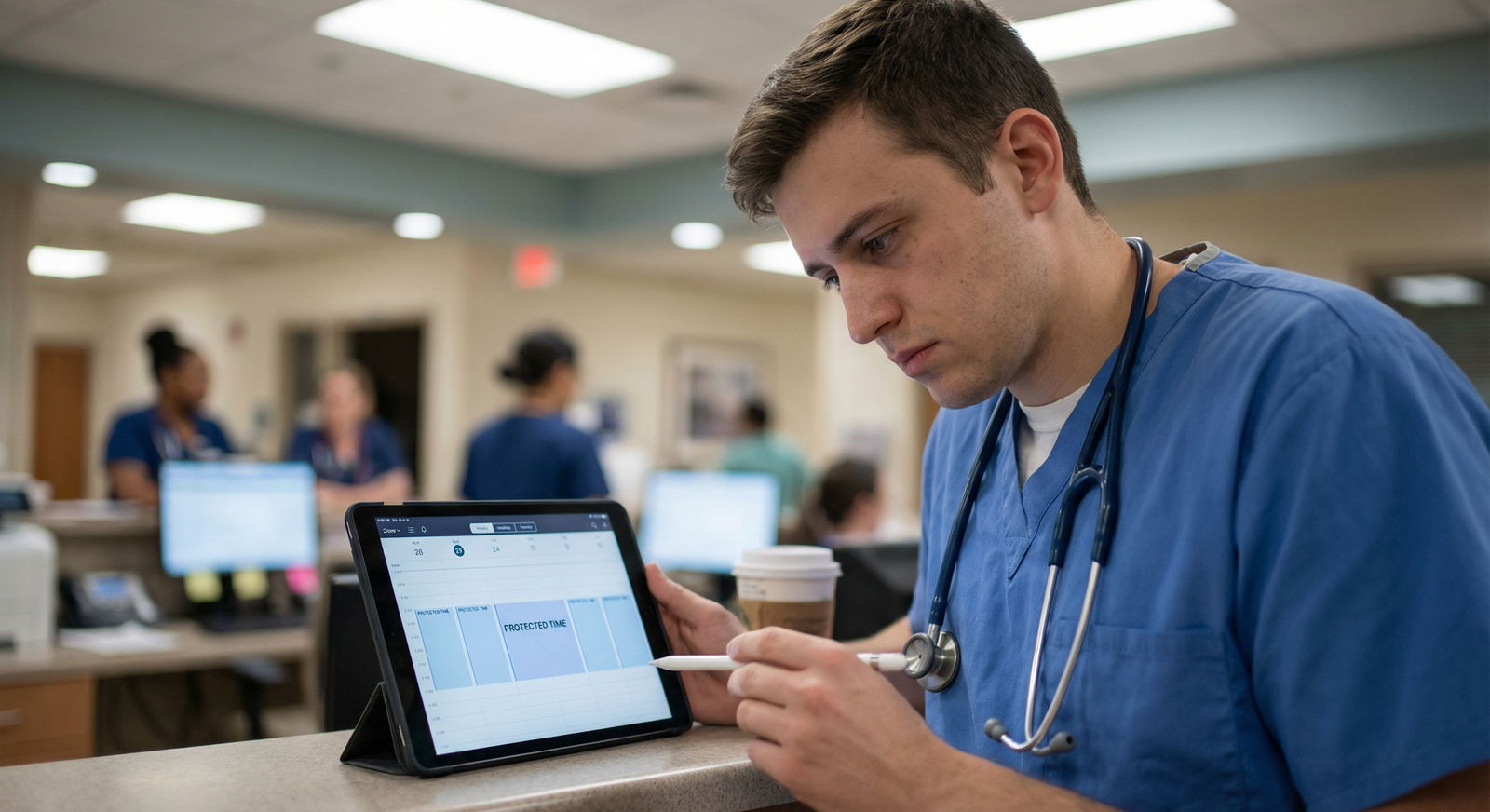
If your program permits a short, protected charting block, use it as a deadline-driven session rather than an open-ended work period.
A practical block might look like this:
- First 20 minutes: Complete notes for patients still on the service
- Next 10 minutes: Review and sign results and orders
- Next 10 minutes: Update handoffs and communicate outstanding tasks
- Final 5 minutes: Confirm the next team knows what is pending
Turn off nonessential notifications if your workflow allows it. Close unrelated tabs. Work from a prioritized list rather than opening patients in random order.
A resident who expects to leave at 18:30 designs a different note template than one who expects to remain until completion. That is not motivational fluff. It changes behavior in concrete ways:
- Shorter note bodies
- Fewer duplicate sections
- More delegation
- Earlier identification of incomplete work
- Better handoffs
- Less unfinished-chart anxiety
Protect recovery as part of clinical safety
A hard stop is not selfish. It is a patient-safety strategy.
Sleep-deprived residents make errors, miss trends, communicate less clearly, and experience impaired judgment. The resident who stays until midnight to complete poorly organized notes may appear dedicated while increasing the likelihood of mistakes in the next shift.
There is also a longer-term benefit. Documentation habits formed in residency follow you into attending practice. If you learn to build concise notes, delegate intelligently, use templates deliberately, and communicate unfinished work clearly, you carry those skills into practice.
The alternative is grim: years of late sign-outs, inbox backlog, fragmented notes, and the persistent sense that medicine is an endless administrative trap.
Mastering documentation efficiency early is not just about getting home earlier. It is about preserving your identity, attention, and clinical reasoning for years.
The Practical Implementation Plan
Start small. Do not attempt to redesign the entire EHR on your first night.
Week one: Measure the damage
Track twenty workdays:
- Actual sign-out time
- Minutes spent charting after the clinical shift
- Most common reasons for late notes
- Number of duplicate note sections
- Number of unfinished notes at handoff
You cannot improve a vague feeling of "the chart is impossible." Identify the actual friction points.
Week two: Create one focused template
Choose the note type you write most often. Remove redundant sections. Shorten the default language. Test it on low-risk encounters before using it for complex admissions.
Week three: Move one task closer to the bedside
Begin with one behavior: write the assessment and plan before leaving the patient's vicinity. Or dictate three key bullets immediately after the encounter. Measure whether sign-out time changes.
Week four: Build the handoff checkpoint
Set a 20-minute endpoint at the end of each shift. Review every open task, assign ownership, and communicate uncertainty explicitly.
Month two: Audit and delegate
Review your dot phrases, messages, and remaining work habits. Bring recurring inefficiencies to your program leadership with specific data. Documentation problems improve when framed as operational problems rather than complaints about laziness.
The goal is not to perform administrative work flawlessly at all hours. The goal is to create a system where clinical thinking, documentation, and communication support one another.
Key Takeaways
- Post-shift charting is usually a symptom of fragmented workflows, not simply excessive clinical volume.
- Clinical memory decays rapidly; notes created closer to the bedside are faster, clearer, and less error-prone.
- Modular smart phrases and focused templates can reduce charting time substantially when they remove duplication rather than merely abbreviate prose.
- Defensive over-documentation does not create stronger protection. Clear, concise clinical reasoning and accurate communication do.
- A hard stop is an operational tool. It forces workflow redesign, delegation, prioritization, and better handoffs.
- Finishing on time is a skill. It begins in residency and compounds into better attending practice, safer patient care, and a more sustainable career.
The resident who leaves at 19:30 does not owe the hospital two hours of invisible labor. The chart should fit inside the clinical day, not consume the evening in exchange for a promise that tomorrow will be better. Build the workflow around the encounter, engineer the template around the thought, and defend the boundary around your recovery. That is how you finish on time without compromising the patient, or yourself.