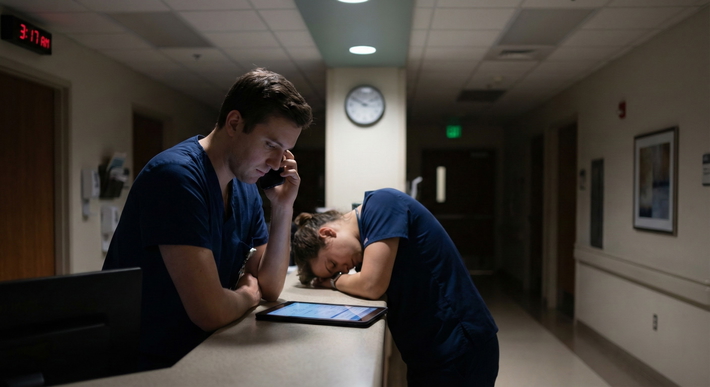
Copy-forward is the intern's quietest time sink. You drag yesterday's HPI forward, paste in the med list, tweak the assessment, sign the note. Then something is wrong with the date. Then the problem list didn't reconcile. Then the attending flags a med interaction at 6:40 p.m. You reopen the note. You sign it again. Now you are forty minutes behind on three other notes, and the spiral has started.
The data shows this pattern in nearly every residency program that has bothered to measure it. Internal medicine programs report rework rates between 25% and 60% of copied sections per note. Time-to-completion after sign-out routinely stretches to 45-90 minutes. Most interns absorb this as personal failure. It is not. It is a process defect, and process defects respond to measurement. This article lays out a system to count rework, attribute it to the right cause, and reduce it with proof.
Why Copy-Forward Rework Creates a Post-Shift Charting Spiral (and What the Data Usually Shows)
Copy-forward rework is what happens when a clinician returns to a copied section (HPI, Assessment/Plan, problem list, med list) to correct missing updates, incorrect clinical status, or required edits after the note was already signed or marked complete. It is not the same as a normal progress note update. Normal updates reflect new clinical reality. Rework reflects a defect in the previous note.
The downstream impact is predictable. A documentation gap at 2 p.m. becomes a correction at 6 p.m., which becomes a late signing, which becomes an angry inbox message at 7 a.m. the next morning, which forces the intern to reopen yesterday's note, which delays today's notes, which compounds. Programs that have tracked this report that 60-80% of post-shift charting backlogs originate from copy-forward defects in the prior 24 hours. Not from call admissions. Not from new consults. From the notes that were already "done."
The intern-relevant metrics matter most here:
- Time-to-first-complete note: minutes from patient encounter to signed, accurate note
- Percentage of notes with changes from copy-forward sections: the rework rate
- Rework incidents per 8-hour shift: how often you reopen, edit, and re-sign
Set the analytic mindset early. If you can count it, you can reduce it. Establish baseline numbers before you touch the workflow. Otherwise every "improvement" you claim is anecdote.
Operational Definitions: Turn Copy-Forward Rework into Measurable Events
Vague definitions produce useless data. You need a coding dictionary that survives disagreement between reviewers.
Build a short list of rework codes:
- SectionEdited, any copied text section is manually modified
- ProblemListAdjusted, problem list is added to, removed from, or reordered
- MedicationReconciled, meds changed, discontinued, or doses corrected
- DateTimeMismatch, timestamps, dates of service, or authorship fields corrected
- ClinicalStatusReverted, copied status (stable, improving, worsening) was wrong and required correction
- AllergyUpdated, allergy entry required fix
- AttendingRequestedEdit, specific attending-level correction after sign-out
Then map rework by scope. Three categories:
- Metadata edits: dates, times, signatures (low clinical risk, high annoyance)
- Clinical content edits: symptoms, exam findings, assessment items (moderate risk)
- Safety-critical edits: medications, allergies, active diagnoses (high risk)
The critical distinction: planned updates versus true rework. If the note was supposed to reflect new clinical status (a new fever, a new imaging result), the edit is expected and should not count as rework. If the copied content was wrong or obsolete the moment it was copied, that is rework.
Set a threshold. Count a rework incident when one or more copy-forward sections requires clinician modification to be accurate or compliant. Document the threshold. Anyone reviewing the data later should reach the same conclusion on the same note.
Metric System: Choose 3-5 Core Numbers That Predict the Charting Spiral
Do not build a dashboard with 30 metrics. You will ignore it. Pick the minimum viable set and stick with it.
Recommended core metrics:
- Copy-Forward Change Rate (%): percentage of copied sections edited per note
- Rework Incidents per Note: average number of rework events per signed note
- Time-to-Note-Completion (minutes): minutes from shift end to note signature
- Late/Incomplete Follow-up Items (%): percentage of notes missing required elements at first sign
- Safety-Critical Edit Rate (%): percentage of notes requiring meds, allergies, or problem list correction after first sign
These five metrics cover effort (time), frequency (incidents), and safety risk. They replace the vague "I feel buried" with defensible numbers.
Baseline discipline matters. Capture one to two weeks of data before any intervention. Without baseline, you cannot prove a change worked. Run charts (a simple line graph of weekly values over time) are the right tool. They show trend, seasonality, and outliers. They do not overstate significance the way a single before/after comparison does.
Track denominators. If your service volume drops 40% during a holiday week, your raw rework count will drop too. That is not improvement. Always express rework as a rate (per note, per copied section) and keep a denominator log.
Collection Workflow: How an Intern Can Capture Data Without Disrupting Care
The data system fails if it takes five minutes per note. You will stop logging. Build a 30-60 second capture.
Quick post-note log fields:
- Note type (admission, daily progress, discharge)
- Copied sections count
- Edited sections count
- Rework codes selected (multi-select from dictionary)
- Minutes to completion
Capture at two anchors: during the shift transition (right after handoff) and after the note is signed. Two anchors kill hindsight bias. The transition log captures what you planned to change. The post-sign log captures what actually required a reopen.
If universal capture is unrealistic, sample. Twenty to thirty notes per week per service is enough to detect a 20% change. Stratify by note type (admission vs daily vs discharge) and patient complexity (census, comorbidity index). A flat sample skews toward the easiest notes.
Quality control: one primary reviewer plus periodic double-coding. Ten percent overlap, coded independently, reconciled against the dictionary. Target interrater agreement above 85%. If you cannot hit that, your dictionary needs work before your data does.
Interpreting the Numbers: Root-Cause Analysis to Target the Right Fix
Numbers without interpretation are decoration. Break down where rework concentrates.
Slice by section. The data from most internal medicine services shows Assessment/Plan and the medication list driving the largest share of rework, followed by HPI and problem list. If your breakdown matches that pattern, your intervention should target those sections first.
Slice by patient complexity. Long-stay patients with active comorbidities generate disproportionate rework. If your rework rate per note is high but stable across complexity, you have a template problem. If it spikes on complex patients, you have a workflow timing problem (you are copying forward before new data lands).
Slice by workflow timing. Notes drafted at 3 p.m. have different rework profiles than notes drafted at 7 p.m. Track when the note was started, when it was signed, and how many reopens occurred.
Comparative diagnostics:
- High Copy-Forward Change Rate + unchanged Time-to-Completion = edits are expected updates, not true rework
- High Copy-Forward Change Rate + high Time-to-Completion = accuracy/compliance failure, prioritize fixes
- Low Copy-Forward Change Rate + high Safety-Critical Edit Rate = template is fine, but meds/allergies handling is broken
Look at the outlier notes. Identify the top decile of rework incidents and read them. Most systemic problems hide in a handful of notes per week. Template misuse, missing orders, unclear ownership at sign-out: all show up as outlier patterns.
Interventions: Practical Changes Interns Can Implement Immediately (Then Measure)
Do not redesign the EHR. Do not propose a six-month QI project. Start with one targeted change.
The Copy-Forward Accuracy Pass: a structured, one-minute-per-section checklist before signing.
- Verify date, time of service, and authorship fields
- Confirm meds and allergies against current orders
- Confirm problem list against active issues
- Confirm clinical status reflects today's data
- Only then refine A/P
Template guardrails reduce accidental rework. Remove or minimize auto-copied fields that change daily unless they are forced fields. Problem list review and med reconciliation should require a deliberate click, not be silently inherited.
Shift handoff alignment matters more than most interns realize. Ask for a "delta list" at sign-out: what changed for each patient since you last wrote a note. Without it, you scan the entire chart to find the three things that changed. With it, you update three things and move on.
After one week, compare metrics pre/post using the same run chart. If the data shows meaningful movement (typically a 15-25% drop in rework incidents per note), keep the change. If not, the intervention was wrong, not the measurement.
Prompt: Flat-lay editorial photograph of laminated checklist cards labeled 'Copy-Forward Accuracy Pass' arranged over a printed note template diagram, subtle icons representing medication reconciliation and date verification, soft overhead lighting, clean clinical desk background, no real EHR branding, slightly moody color grading
Implementation Plan (4 Weeks): Baseline, Target, Improve, Sustain
A four-week arc is enough to prove the system works without burning out the team.
- Week 1, Baseline. Collect on one or two services consistently. Verify the coding dictionary with a small double-coding sample. Compute initial dashboard values and denominators. Do not intervene.
- Week 2, Targeted change. Implement one intervention (accuracy pass plus delta list at handoff is the highest-yield starter). Keep data capture identical to Week 1 so attribution is clean.
- Week 3, Refine. Use the root-cause breakdown to focus on the top rework category or the highest outlier notes. One new adjustment, not three.
- Week 4, Sustain. Train a buddy for ongoing data capture. Lock in monthly sampling (20-30 notes per service per month) to prevent regression. Document the workflow so the next intern inherits a system, not a guess.
Summary: How to Stop the Spiral with Measurement Discipline
Rework is not a personal failure. It is a measurable process outcome tied to copy-forward accuracy, workflow timing, and safety-critical content edits. The intern who tracks it wins back hours per week. The intern who just tries harder does not.
Track a small metric set with clear denominators. Compare against baseline with run charts. Use root-cause breakdown by note section and outlier notes to target specific fixes instead of vague exhortations. The data will tell you what to change, and the data will tell you whether your change worked.
Key Takeaways
- Define copy-forward rework as specific, codeable events. Track it with denominators (per note, per copied section) so improvements are real, not illusions.
- Use a minimal dashboard: change rate, rework incidents, time-to-completion, late/incomplete items, safety-critical edits. Compare against baseline with run charts.
- Target interventions to the biggest rework contributors (often meds/problem list and assessment validity). Measure weekly. Stop the spiral with proof, not hope.