

The standard intern advice about “just push through the fatigue” stops working in your 30s.
If you’re an older intern, your body will not cooperate with the same abuse a 24‑year‑old can get away with. And pretending otherwise is how people in your age bracket end up making mistakes, burning out, or quietly quitting on the career they spent a decade building.
Let’s treat this like what it is: a physiology problem plus a logistics problem, not a “you’re weak” problem.
You’re not broken. You’re just in a different operating system. Here’s how to run it.
1. Accept the Reality: You Don’t Bounce Back the Same
First, I want you to stop comparing yourself to the 26‑year‑old co‑intern who sleeps 3 hours, crushes CrossFit at 5 a.m., and still looks fresh on rounds.
Your variables are different:
- You’ve probably had a normal job schedule before this.
- You might have kids, a mortgage, maybe aging parents.
- Your baseline sleep debt is often higher.
- Your circadian rhythm is more rigid in your 30s+ than in your early 20s.
On top of that, residency is built around the assumption that everyone is in their mid‑20s with minimal life obligations. That’s just… wrong for you.
So step one: stop grading yourself on a 25‑year‑old curve.
You need a different rulebook. Specifically focused on three things:
- Controlling the type of fatigue (physical, cognitive, emotional).
- Building micro‑recovery into the workday, not just days off.
- Designing your off‑hours around realistic energy, not fantasy productivity.
We’ll go through each in actual scenarios you’ll hit this year.
2. Shift Work in Your 30s: How to Survive Nights Without Destroying Your Week
Older interns tend to get hammered by nights more than younger ones. The “I feel drunk” sensation after back‑to‑back nights? That’s your brain telling you it’s not playing this game like it used to.
You’re not going to fully “adjust” to nights. But you can stop making it worse.
A. The 3 Shifts You Must Plan Differently
Let’s talk about the three time zones that kill older interns:
- The day before your first night
- The post‑call morning or post‑night shift
- The flip back to days
Here’s a simple pattern that works far better in your 30s than the usual “just nap if you can” nonsense.

| Step | Description |
|---|---|
| Step 1 | Regular Day Schedule |
| Step 2 | Pre Night Day |
| Step 3 | Short nap 1-2 pm |
| Step 4 | Sleep 3-4 hr 2-6 pm |
| Step 5 | First Night Shift |
| Step 6 | Post Night Sleep Block 3-5 hr |
| Step 7 | Short Evening Nap or Early Bed |
| Step 8 | Flip Back to Days |
| Step 9 | Working that day? |
1. The day before your first night
If you’re working a normal day before nights:
- Don’t try to “bank” 10 hours the night before. You won’t sleep that long, you’ll just stress.
- Aim for:
- Normal sleep the night before (6–8 hours if you can).
- Short nap 1–2 hours between 1–4 p.m. the day you start nights.
- Use caffeine only after you wake from that nap, not before.
If you’re off the day before nights:
- Sleep normal overnight.
- Stay up in the morning.
- Take a 3–4 hour nap from ~2–6 p.m. Treat it like your “fake night.”
- Start your first night shift around 50–70% charged, not wrecked.
2. After the night shift (or 28‑hr call)
Do not go home at 10 a.m., drink coffee, “just finish a couple things,” and then crash at 2 p.m. for 7 hours. That’s how you stay jet‑lagged for days.
Instead:
- Goal: 3–5 hours of anchored sleep, then wake up.
- Example: off at 9 a.m., asleep by 10, alarm at 1–2 p.m.
- Get sunlight when you wake up.
- Light food, hydrate.
- If you’re going back for another night:
- Take another 90‑minute nap early evening (6–8 p.m.).
- If your nights are done:
- Force yourself to stay awake after that first block.
- No naps after 4–5 p.m.
- Go to bed 9–10 p.m., even if you’re a bit wired. You’ll wake up closer to normal.
Is this perfect? No. But in your 30s, two shorter, strategic sleeps beat one giant crash that wrecks your circadian rhythm.
3. The flip back to days
On your last night:
- Limit your post‑shift sleep to 2–3 hours max.
- Set an alarm. You will hate your life when it goes off. Get up anyway.
- Stay awake through the afternoon and evening.
- Use caffeine only before 2–3 p.m.
- Sleep 9–10 p.m. at home, even if you lie there for a bit.
The 24–36 hours around transitions are brutal, but this pattern makes your week survivable instead of destroyed.
3. Fatigue Management on the Floor: What to Do During the Actual Shift
You cannot control census. You can control how you spend the small gaps.
Older interns often waste their few recovery opportunities because they’re trying to look “hard‑working” instead of “effective.”
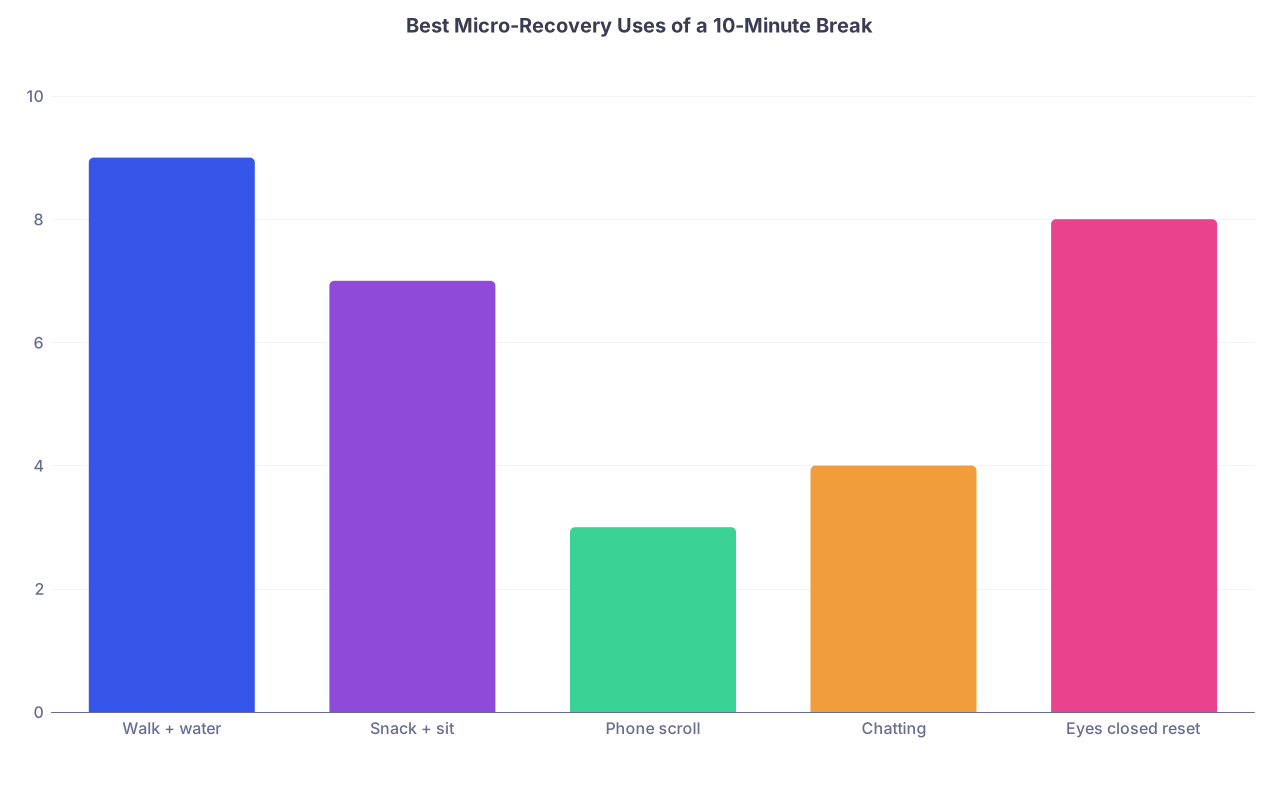
A. The 5–10 minute rule
Every time you have 5–10 minutes not doing something critical, you choose between 3 things:
- Stare at your phone.
- Chat aimlessly at the workroom.
- Perform a small, intentional recharge.
I’m very biased toward #3. Use those crumbs of time better than everyone else.
Here’s how.
| Category | Value |
|---|---|
| Walk + water | 9 |
| Snack + sit | 7 |
| Phone scroll | 3 |
| Chatting | 4 |
| Eyes closed reset | 8 |
Practical micro‑recharges that actually work when you’re older:
- Walk a loop and hydrate. Go up one floor by stairs, down the hall, back. 4–5 minutes. Drink water on the way.
- Sit and close your eyes. Set a 3‑minute timer on your phone. Sit, feet on floor, close eyes, 4–5 slow breaths. That’s it.
- Eat something that isn’t sugar. Small handful of nuts, cheese stick, yogurt, half a sandwich. You’re trying to avoid the glucose/insulin rollercoaster.
- Stretch your back and neck. 1–2 minutes. Shoulders back, chin tuck, gentle twist both directions. This is not “wellness.” This is error prevention.
You will feel silly at first. You will care less after you realize by 3 a.m. you’re still forming coherent thoughts while your 25‑year‑old colleague is vibrating on Monster and gummy worms.
B. Caffeine strategy for 30s+ interns
Caffeine is not the enemy. Reckless caffeine is.
For older bodies, you need to think in timing and dose, not just “more coffee.”
Rules that work well:
- Set a hard cutoff time:
- On days: no caffeine after ~2–3 p.m.
- On nights: no caffeine after ~3–4 hours before planned post‑shift sleep.
- Use small, frequent doses over one giant hit.
- Half a cup of coffee or half an energy drink every 2–3 hours is usually better than 3 cups at 6 a.m.
- Avoid mixing caffeine + no food + high stress. That’s the palpitations, shaky hands, irritable-on-rounds combo.
If your heart is pounding on rounds, your hands are a little tremulous, and you feel “wired but stupid,” you’ve overshot the caffeine. Next shift, cut the dose in half and front‑load more before noon / early shift.
4. The Home Side: Sleep, Family, and Not Losing Your Mind
This is where older interns get nailed harder than anyone else.
You’re not going home to microwave ramen, Xbox, and silence. You’re going home to:
- A partner who has their own job.
- Possibly a toddler who does not care that you were on nights.
- Bills, housework, and maybe elder care.
You need pre‑negotiated rules with the people at home. Not “winging it.”
A. Negotiate “do not disturb” blocks in advance
Before you start residency (or as soon as you can), sit down with your partner/family and say something like:
“On post‑call days, I need one protected block of 3–4 hours where I’m not available except for emergencies. Let’s pick when that can be and what counts as an emergency.”
You’re not asking permission. You’re designing survival.
Pick a consistent block:
- Example: 10 a.m.–2 p.m. sleep after call.
- Or: 2–6 p.m. nap before nights.
Then structure around it:
- White noise machine.
- Eye mask / blackout curtains.
- Phone on Do Not Disturb with emergency overrides only.
If you have kids, coordinate childcare swaps:
- Your partner takes mornings, you take evenings after that sleep block.
- Or a grandparent / sitter covers your critical sleep window.
You cannot just “fit in” sleep somewhere between daycare pickup, dishes, and laundry. That fantasy kills older interns faster than any trauma code.
B. Accept that home productivity will drop. On purpose.
You’re not going to be the same spouse/parent/friend you were last year. You’ll get some of that back later. For now, you triage.
Use a mental system like this:
- Must do personally: basic hygiene, minimum house safety (pay rent, no spoiled food everywhere), actual emergencies with kids/partner.
- Can be outsourced or lowered standard: laundry folding, home cooking 5 nights a week, lawn care, deep cleaning.
- Can be paused: hobbies that require high energy, non‑essential social obligations, perfectionist projects at home.
If you’re in your 30s with some income history, consider buying back time ruthlessly:
- Grocery delivery instead of in‑person shopping.
- Cleaning service once a month or every other month.
- Meal prep service for 2–3 dinners a week.
People think this is a luxury. It is not. It’s how you keep yourself from breaking down when your baseline recovery is slower.
5. Body Maintenance: The “Exercise” Conversation Needs to Change
You are not training for a marathon this year. Or if you are, you’re making your life unnecessarily hard.
Your body’s priorities as an older intern:
- Don’t get injured.
- Maintain enough baseline strength and mobility to do the job.
- Use movement to improve sleep and mood, not sabotage them.
A. Redefine “working out” for intern year
On 80‑hour weeks, “3 heavy lifts and 3 runs” is fantasy unless you’re superhuman.
Think like this instead:
- Floor weeks / Ward months:
- Goal: 20–30 minutes of light‑to‑moderate movement 3 times a week.
- This can be:
- Brisk walk around hospital + stairs.
- 20 minutes of bodyweight work at home (squats, push‑ups, planks).
- Clinic / lighter rotations:
- You can bump intensity a bit.
- Just avoid late‑evening intense workouts that crush your sleep.
If you’re in your 30s and deconditioned, start comically small:
- 10 minutes of walking after shift.
- 5 minutes of morning mobility.
Consistency beats intensity. You’re not impressing anyone in the resident gym at 11 p.m. if you can’t think straight on rounds.
B. Pain is a warning, not a challenge
Knee pain when running, back spasms, chronic neck tension from bending over charts—this shows up more in older interns.
Do not self‑bully with “I’m just being soft.” That’s residency culture talking.
If something keeps hurting:
- Switch to lower impact (stationary bike, walking, light weights).
- Do 5 minutes of stretching every post‑shift:
- Hip flexors, hamstrings, low back, neck.
- If it persists for weeks, use your health insurance and see someone. Yes, even as a resident. You’re allowed.
6. Cognitive Fatigue: Preventing “Stupid Mistakes” When You’re Tired
What older interns fear most isn’t just feeling tired. It’s feeling like their brain is slower or foggier, like they “used to be sharp” and now they’re dropping things.
Some of that is sleep debt. Some is fixable process.
A. Use checklists and offloading without shame
Your memory at 3 a.m. on night 4 is not a reliable system. Stop treating it like one.
Things to externalize:
- Sickest patients to follow up on.
- Key overnight labs and imaging to recheck.
- Pending consults.
- One‑time tasks you promised someone you’d do “later.”
Use a single system:
- A small pocket notebook.
- Or one dedicated note in the EMR if your system allows.
- Or a notes app on your phone (password protected, no PHI).
Structure one page per shift:
- “TO CHECK BEFORE SIGN OUT”
- “PENDING CALLS/ORDERS”
- “FOLLOW‑UPS FOR TOMORROW ME”
And yes, physically cross things off. It sounds basic. It saves you when your brain is oatmeal.
B. Have a low‑ego trigger phrase with seniors
When you’re older, asking for help can feel like admitting you “should have known better by now.” That’s nonsense. The stakes are too high.
Decide on a simple phrase you’ll use when your fatigue is real:
“Hey, I’m pretty tired and want to make sure I’m not missing something. Can we quickly run through this plan?”
Or:
“My brain is a little slow right now—can I talk this through out loud?”
Most decent seniors will respect that. The occasional jerk who mocks it is advertising their own poor judgment.
7. Social Comparison and Ego: Letting Go of the 25‑Year‑Old Fantasy
This part is more psychological but it drives your behavior with fatigue.
Older interns often:
- Feel behind their peers in “timeline.”
- Expect themselves to be more resilient because they “had more time to prepare.”
- Get frustrated when their body doesn’t cooperate.
You can make this year much less miserable by dropping a couple of bad scripts.
A. Stop chasing the “perfect intern” profile
The imaginary ideal:
- Always early.
- Always extra notes done.
- Always knows the literature.
- Still runs, cooks, calls family, keeps a spotless apartment.
If you try to do that in your 30s with extra life responsibilities, you’ll end up half‑assing everything and hating yourself.
Instead, define your non‑negotiables:
Maybe:
- “I will not compromise on patient safety.”
- “I will protect 3–4 core sleep blocks a week.”
- “I will be present with my kids for one anchored chunk of time weekly.”
- “I will move my body at least 3 times a week.”
Everything else—perfect notes, heroic social life, Instagram vacations—drops in priority.
B. Choose your comparison group wisely
Comparing your fatigue to:
- The childless 26‑year‑old co‑intern with no commute?
- The PGY‑3 who’s already adapted to the schedule?
- The fantasy version of yourself from M2?
Useless.
Compare to something more honest:
- “Am I handling this month better than last month?”
- “Did I make fewer sleep‑deprived mistakes than last rotation?”
- “Am I recovering faster after nights than I did in July?”
That’s what progress looks like at this stage.
8. Concrete Weekly Template for an Older Intern
Let me give you something very practical to steal and modify.
Say you’re on a heavy ward month:
- 6 days a week
- Q4 call or similar long shifts
Here’s a skeleton that actually works in your 30s.
| Day Type | Sleep Target | Movement Goal | Non-Work Priority |
|---|---|---|---|
| Regular Day | 6–7 hours | 20-min walk | One small home task |
| Pre-Call Day | 6–7 hours | Light stretch | Prep food/clothes |
| Call Day | Naps only | None required | Survive safely |
| Post-Call Day | 3–5 hrs block + early bed | 10-min stretch | Zero chores |
| Day Off | 8–9 hours | Optional real workout | One meaningful social/family block |
Then layer in:
- One real conversation with someone who isn’t in medicine weekly (phone or in person).
- One mindless decompression block (TV, games, reading junk, whatever) guilt‑free.
- Absolutely no expectation of being “on top of everything.” Ever.
Is this glamorous? No. Is it survivable? Yes. And survivable is a win in intern year when you’re in your 30s+.
9. When Fatigue Stops Being Normal and Starts Being Dangerous
You will be tired. That’s baked into residency. But there’s a line where “normal intern tired” shifts into “this is wrecking my health.”
Red flags that you’re over that line:
- You feel sleepy while driving regularly, even on non‑call days.
- You can’t fall asleep even when exhausted, for days at a time.
- You’re snapping at patients or teammates constantly and it’s not your baseline.
- You’re getting sick repeatedly (every minor virus wipes you out).
- You start having fleeting thoughts like, “If I got into a minor car accident, at least I’d get some rest.”
If you’re here, you do not need to “be tougher.” You need backup.
That might mean:
- Talking to your PD or chief about a brutal rotation + your specific situation (age, kids, health).
- Seeing occupational health or your own doctor about sleep, anxiety, or depression.
- Looking at whether your schedule is actually violating work hour rules.
You are not the first 35‑year‑old intern whose body is sending up flares. The people who survive are the ones who respond to the flares instead of ignoring them.
10. The Bottom Line: You’re Not Failing. You’re Running Different Hardware.
If you’re an older intern, managing fatigue is not about “trying harder.” It’s about playing a different game.
Three things to keep at the front of your mind:
- Plan your fatigue, don’t just endure it. Pre‑night naps, structured post‑call sleep, micro‑breaks at work, and negotiated do‑not‑disturb blocks at home will save you.
- Lower the bar in the right places. Outsource, simplify home life, re‑define “exercise,” and stop chasing the 25‑year‑old’s version of productivity.
- Use systems, not memory. Checklists, small routines, and frank communication with seniors beat sheer willpower every time, especially when your brain is tired.
You’re not weaker than your younger co‑interns. You’re just operating with more constraints and a body that demands a bit more respect. Treat it accordingly, and you can get through this year intact instead of running yourself into the ground.


