
The fear that “I can’t finish my notes on time” will ruin your career is wildly overblown—and also not completely irrational.
Both things are true.
You’re not crazy for panicking about this. And no, it doesn’t automatically mean you’re unsafe, incompetent, or not “cut out” for residency.
Let’s untangle which parts of this fear are real problems, which parts are residency being objectively unreasonable, and what you should actually change first before you burn out, get labeled “the slow intern,” or start fantasizing about disappearing into a non-clinical job in month three.
When Late Notes Really Start to Matter
There’s “I’m slow but surviving,” and then there’s “something is breaking and people are quietly talking about me.”
You’re probably asking the scary question in your head: At what point does this become a “performance concern” and not just me struggling like everyone else?
Here’s the line I’ve seen over and over.
Trouble that’s annoying but usually survivable:
- Your notes are done, but you’re consistently finishing after sign-out.
- You bring work home and spend 1–2 hours nightly finishing charts.
- You get occasional “hey, try to get these done earlier” comments from seniors.
- You feel behind all day but patients are actually seen, plans are made, discharges happen.
Trouble that starts raising quiet red flags:
- Multiple days per week with notes still unsigned the next morning.
- Attending or PD sends an email/EPIC message specifically about documentation timeliness.
- Nursing or consultants can’t find your plans because your notes aren’t in.
- Discharge summaries are so delayed they’re affecting follow-up or billing.
Serious, this-might-go-on-your-eval territory:
- You’re routinely leaving entire days undocumented until days later.
- You’re getting formal feedback like “documentation delays are impacting patient care/workflow.”
- Other residents are covering your notes because you can’t keep up.
- You’ve had a “we’re concerned” meeting with PD/APD that includes phrases like “safety,” “liability,” or “professionalism.”
Most residents feeling like they’re drowning with notes are in the first category but convinced they’re in the last. Your brain goes straight to “I’m going to fail residency” while your seniors are just thinking, “Yeah, they’re an overwhelmed PGY-1.”
So, when should you actually worry?
You should start to worry—meaning take targeted, serious action—if any of these are true for more than 2 weeks in a row:
- Notes regularly unfinished by the next morning
- More than 20 unsigned encounters piling up
- You’re staying >2 hours past your co-residents on most shifts
- You’ve been directly told this is a problem more than once
If it’s not at that level yet, it’s a problem to solve, not a career-ending catastrophe. There’s a big difference.
The Truth They Don’t Say Out Loud About Notes in Residency
There’s a lie baked into residency culture:
“If you just worked harder or were more efficient, you’d finish on time.”
That’s not always true. Sometimes the system is literally unworkable. I’ve seen:
- Med wards with 18 patients per intern and 2 discharges a day expected.
- EMR systems that need 40 clicks to admit one patient.
- Attendings who want detailed daily notes and exhaustive discharge summaries and separate procedure notes, all before noon rounds.
So if you’re thinking, “I’m trying and failing; therefore I’m broken,” pause. It might be:
- Bad workflow design
- Unreasonable documentation expectations
- A culture where everyone quietly takes notes home but pretends they don’t
But here’s the painful part:
Even if the system is unfair, you are the one who gets the evaluation. The EMR doesn’t. The service doesn’t. You do.
So we play the game.
The question is: how do you survive it without losing your mind?
The Most Dangerous Mistakes Residents Make About Notes
Let me be blunt. There are a few ways to handle this that will absolutely backfire, even though they’re very tempting.
Waiting until “I have time” to write perfect notes.
That time never comes. You’ll keep telling yourself you’ll catch up after rounds, after sign-out, after you finish orders—then it’s 8 PM and you’ve got 7 untouched notes.Writing notes in your head and trusting your memory.
By 3 PM, your brain is mush. By post-call day, forget it. You think you’ll remember which patient had 3L vs 4L O2 and which had the CT pending? You won’t. Your notes will get vague, wrong, or both.Copy-forward without ruthless editing.
This is how errors propagate. Old antibiotics, wrong code status, outdated vitals. Attendings hate this and you’ll get dinged hard if something bad happens and the note is obviously lazy.Not talking about it because you’re ashamed.
So many residents think, “Everyone else is coping; I’m the only one drowning.” You’re not. But if you hide it, no one will adjust your workflow, redistribute patients, or give you templates. They’ll just assume you’re fine until you’re not.Sacrificing patient care to finish notes.
This is the one that will make you feel like garbage. Ignoring pages so you can type. Rushing through exams. Skimming labs. You’ll finish earlier, but you’ll hate yourself and your evaluations won’t improve overall.
So what do you actually fix first?
What to Change First: Fastest Wins When You’re Always Behind
If you’re overwhelmed, this has to be triage. You can’t fix everything at once. You change the things that buy you back the most time with the least risk.
1. Move from “notes as event” to “notes as background process”
The biggest shift: stop thinking of notes as something you do after you’ve done the real work.
You start them earlier. Way earlier.
- On rounds, have the note open or pre-created for each patient.
- While the attending is talking, you’re typing today’s A/P headings, key labs, and to-do items into the note. Not everything—just the skeleton.
- Between patients, drop in one or two short sentences: “Overnight: — Denies CP/SOB, tolerating diet, ambulated with PT.”
By noon, your notes should each be at least 40–60% done, even if messy. You can clean, clarify, and sign later. But you’re never starting from a blank page at 4 PM.
If that sounds impossible, here’s the uncomfortable question:
On rounds, are you documenting in the chart/live, or writing on paper/post-its and “planning to put it in the note later”? Because “later” is exactly when things collapse.
2. Build a minimalist template that doesn’t suck
Not a giant, bloated attendings’ template. A lean one that removes decision fatigue.
Create one template for:
- Daily progress note
- Admit H&P
- Discharge summary
Each should be short and brutal. For example, a medicine progress note:
- Subjective: [1–2 lines only]
- Objective: auto-pulled vitals, I/O, weight, key labs
- Assessment & Plan:
- [Diagnosis 1] – today’s status, today’s change
- [Diagnosis 2] – same
- [Prophylaxis/Lines/Code status]
The rule:
If you can’t explain why a section exists and how it helps future you or someone else, delete it from your template.
You don’t need walls of normal ROS. Nobody is reading 20 copy-pasted negatives at 11 PM.

3. Change the order you do things during the day
Sometimes your problem isn’t speed; it’s sequence.
What most overwhelmed residents do:
- 6:30–9:30: pre-round and collect data
- 9:30–12: rounds (no notes, all listening)
- 12–3: put out fires, calls, orders, pages
- 3–7: try to remember the day and write all notes from scratch
What works better once you’re even half-settled:
- Early: pre-round + start skeleton notes for the sickest/most complex patients
- During rounds: update note for that patient before walking out of the room or by next hallway stop
- After rounds: finish 2–3 notes completely before lunch, even if it means other low-yield tasks (like over-polished sign-out) take a small hit.
You’re front-loading the cognitive heavy lifting earlier when your brain is sharper, instead of stacking it all for end-of-day when you’re fried.
When It’s Not Just You: Volume vs Speed
Sometimes the issue isn’t that you’re “slow.” It’s that the workload is mathematically impossible.
Let’s be literal. Imagine a heavy medicine service:
| Number of Patients | Avg Minutes per Note | Total Note Time |
|---|---|---|
| 8 | 12 | 96 min |
| 12 | 12 | 144 min |
| 16 | 12 | 192 min |
That’s 1.5–3+ hours of focused, uninterrupted typing. On a day where you’re also:
- Answering pages
- Calling consults
- Updating families
- Doing admissions and discharges
- Actually seeing the patients
No one is doing this magically in 20 minutes. The people who seem “done” early are either:
- Writing much shorter notes
- Charting aggressively in real time
- Taking work home and not mentioning it
- Or, occasionally, cutting serious corners
So if your numbers look like that table and you’re beating yourself up, stop.
You might still need to get more efficient. But you’re not failing at something easy.
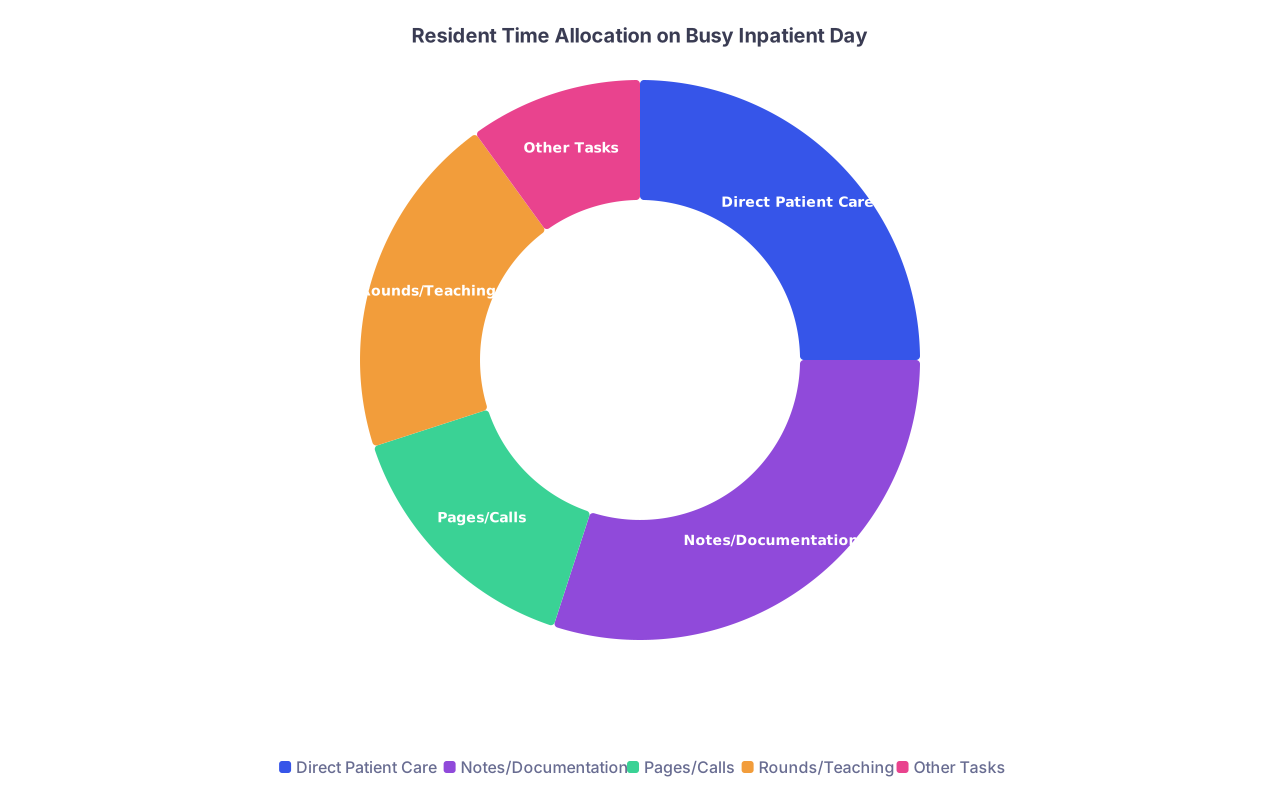
| Category | Value |
|---|---|
| Direct Patient Care | 25 |
| Notes/Documentation | 30 |
| Pages/Calls | 15 |
| Rounds/Teaching | 20 |
| Other Tasks | 10 |
When the Fear Becomes “What If They Think I’m Unsafe?”
This is the one that gnaws at you at 1 AM:
“If my notes are late, will they think I’m dangerous? Will this follow me forever?”
Here’s the unvarnished version.
Attendings and PDs worry about:
- Patterns of disorganization that spill into patient care
- Missed or incorrect documentation about critical stuff (code status, anticoagulation, allergies)
- Notes so late that no one ever knows what happened on a given day
But what they usually see first is this:
- Are labs ordered? Are vitals checked?
- Are patients seen and examined?
- Do nurses feel like you respond when needed?
- Do you show up prepared and roughly know your patients?
If all of that looks bad and your notes are late, they’ll see this as a global competence issue.
If your patient care looks decent but notes lag, they’ll see a specific, fixable weakness.
Your job is to make it very obvious which one it is.
That means:
- Don’t let documentation be the only visible weak area (e.g., don’t also be the one always late, unkempt, or clueless on rounds).
- Make it clear you’re actively working on it: “I’ve been slow with notes. I’ve started using a tighter template and doing them real-time. I’d love feedback if you have tricks.”
Yes, that admission feels terrifying. But I’ve watched attendings’ faces soften immediately when residents say this kind of thing. What they hate is defensiveness, not weakness.

| Step | Description |
|---|---|
| Step 1 | Pre round |
| Step 2 | Create skeleton notes |
| Step 3 | Write during rounds |
| Step 4 | Finish 2 to 3 notes by noon |
| Step 5 | Handle pages and orders |
| Step 6 | Complete remaining notes mid afternoon |
| Step 7 | Quick final review and sign |
What If You’ve Already Dug a Deep Hole?
Maybe you’re reading this with 45 unsigned notes sitting in your EMR and a pit in your stomach.
Okay. Breathe. You’re not the first one.
Here’s how you climb out without setting off every alarm in the program.
Be honest with yourself about the backlog.
Look at the number. How many notes, for how many days back? You can’t fix what you won’t even look at.Prioritize by risk, not by date.
You don’t start with the easy ones. You start with:
- The sickest patients
- Anyone who had an event (rapid, transfer, new diagnosis, escalation)
- Admissions and discharges (these really do matter downstream)
Time-box the cleanup.
Give yourself 1–2 hours per day (max) to grind away at the backlog. If you try to clear everything in one night, you’ll flame out and then avoid it longer.Tell a safe person.
A chief resident, trusted senior, or APD. “I realized I’ve let my notes back up and I’m working through them. I’d really appreciate some help figuring out a better workflow so this doesn’t happen again.”
Is that embarrassing? Yes.
Is it less embarrassing than your PD finding a chart audit months later? Also yes.

When You Should Actually Ask for Help (And What to Say)
You might be thinking, “If I ask for help, they’ll think I’m incompetent.”
Reality: people in trouble who don’t ask for help are the ones who get labeled problematic.
You don’t need a dramatic confession. You can say something like:
- “I’m noticing I’m consistently staying 1–2 hours later than everyone else finishing notes. I’m worried I’m doing something wrong with my workflow. Can I run my process by you and get suggestions?”
- “I’ve tried a few different templates and still feel behind with documentation. How do you usually structure your day so notes don’t pile up?”
Specific, humble, and solution-focused. That reads as mature, not weak.
Good signs you should do this soon:
- You feel a flash of panic when someone says “let’s look at your notes together.”
- You’re hiding how long you stay after sign-out.
- You’ve started cutting corners you’re not proud of (scribbling nonsense in physical notes, copying whole notes forward without reading, etc.).
I promise you: your seniors and chiefs have their own EMR horror stories. Some of them barely survived PGY-1. The “perfect” ones are mostly just better at looking calm.
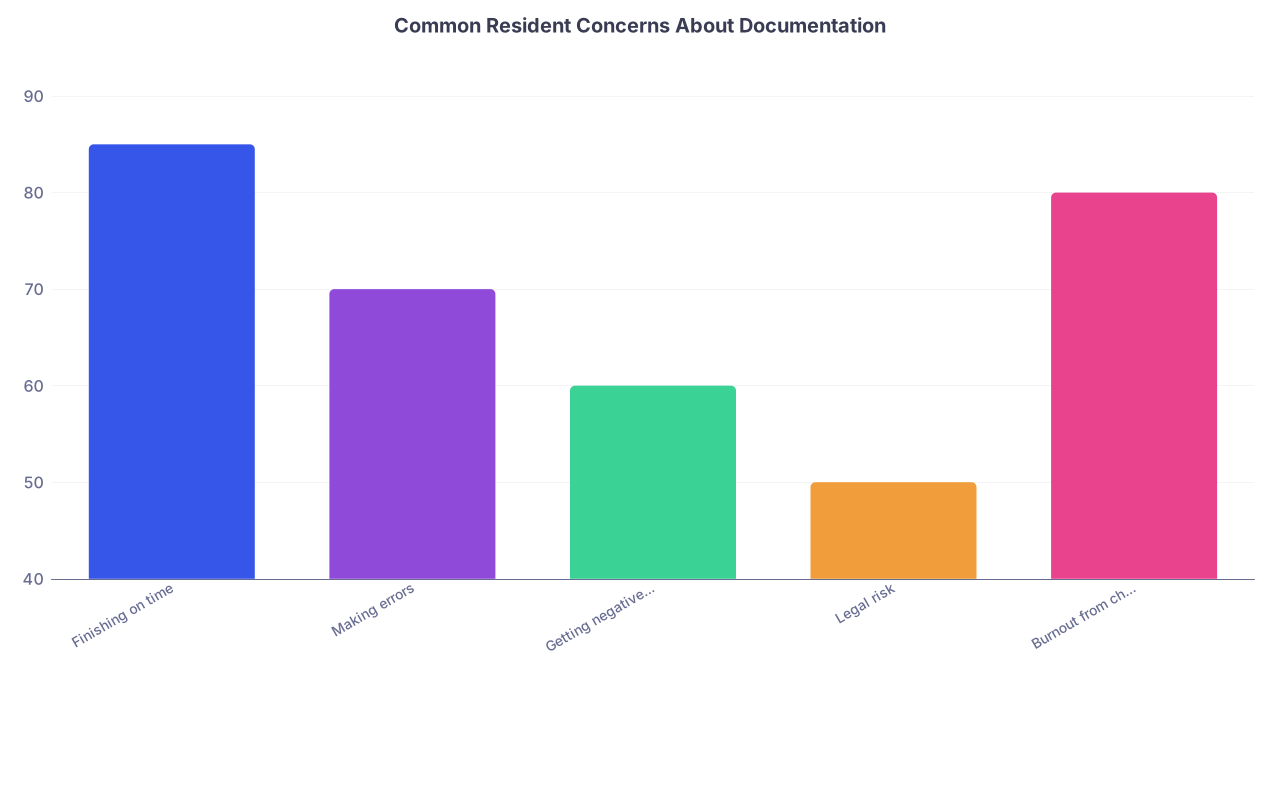
| Category | Value |
|---|---|
| Finishing on time | 85 |
| Making errors | 70 |
| Getting negative evals | 60 |
| Legal risk | 50 |
| Burnout from charting | 80 |
You’re Not Lazy; You’re Drowning
Everyone loves to use the word “efficiency” like it’s a personality trait.
Efficient people are good residents. Inefficient people just… need to “try harder.”
No.
You’re in a system that expects:
- Near-perfect documentation
- In a clunky EMR
- With too many patients
- While doing 8 other jobs simultaneously
You’re allowed to struggle with that.
But you still have to function in it.
So you start with the stuff that actually moves the needle:
- Notes begun early, not at the end of the day
- Ruthless, simple templates
- Changing the order of your tasks, not just trying to speed up in a broken sequence
- Admitting you need help before you implode
You don’t need to become the fastest note-writer in your program. You just need to get out of the danger zone where:
- Notes are days late
- People can’t tell what happened to the patient
- Your stress is so high you start dreading every shift
If you’re already in that zone, you’re not doomed. You just can’t stay there quietly.
Today—literally today—open your EMR, pull up one patient you’re following tomorrow, and build a brutally simple progress note template for them. Just one. Then ask yourself: “How can I have 50% of this filled in by lunchtime?” That’s the version of you that starts to feel less terrified by 5 PM.