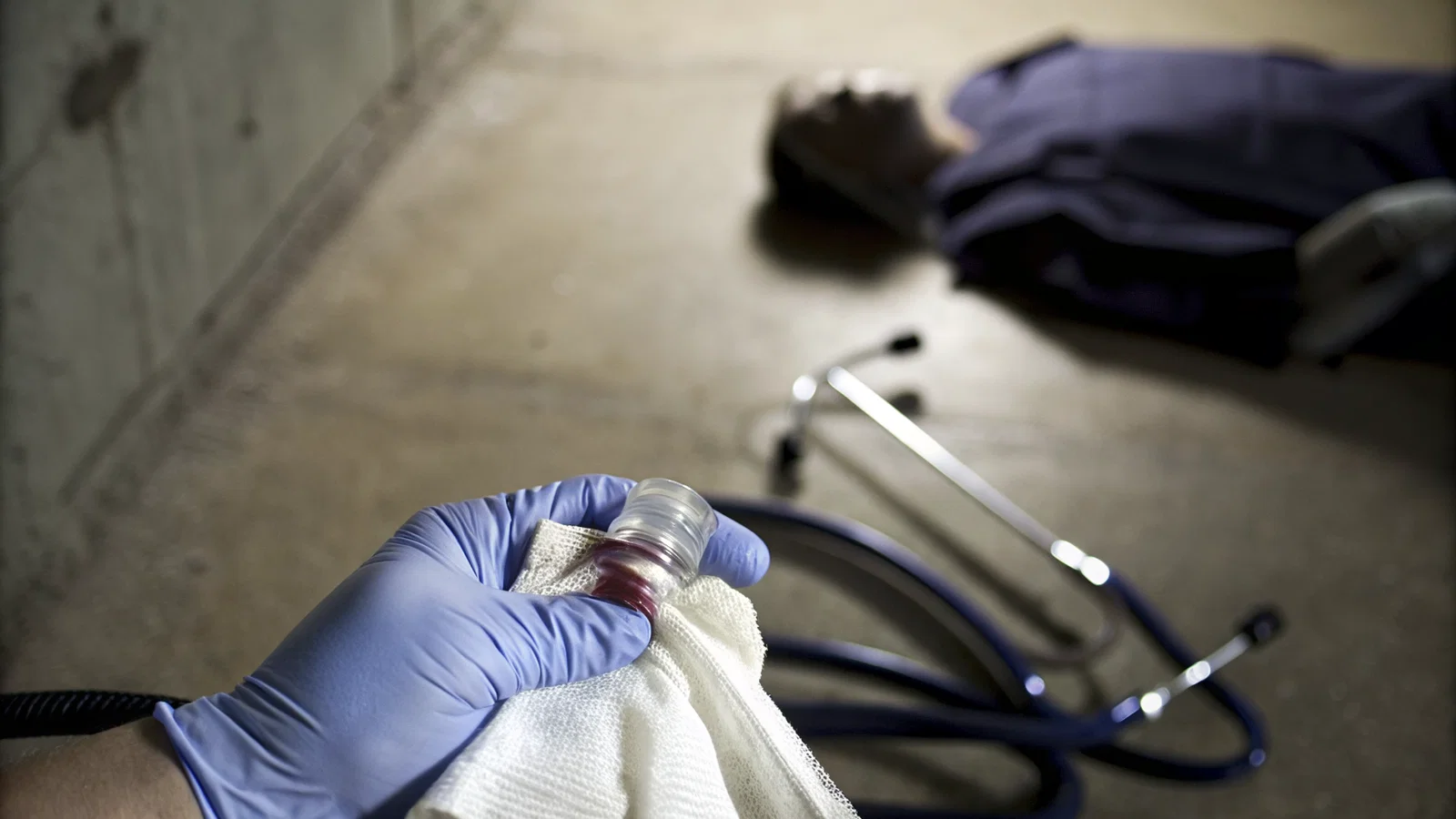
The monitor reads 74%. Then 68%. The ventilator screams. The nurse says, "He pulled it. His trach is out."
You look down. There is a hole in the neck. It is bleeding a little. It is bubbling. The patient is awake and terrified and trying to breathe through a stoma that collapsed two seconds ago.
This is not a simulation. The most dangerous airway in the entire hospital is not the morbidly obese intubation in the ED. It is the lost tracheostomy at 3 AM when ENT is 15 minutes away, anesthesia is in an OR, and you are the senior-most person in the room.
Every resident remembers this case. Let me break this down specifically so you own it before it owns you.
The 3AM Airway Standoff: You Are the Expert Now
A dislodged tracheostomy is a time bomb with a very short fuse. Complete obstruction gives you maybe 15 to 30 seconds before critical desaturation. Partial obstruction or a mucus plug buys a little more, but not much.
Your first job is not to intubate. Your first job is to triage what you are seeing. I teach this as three buckets:
1. Partial obstruction: Tube is in, but patient cannot move air. Stridor, high peak pressures, thick secretions. Capnography still has a waveform, albeit shark-finned. This is usually a mucus plug or a kinked inner cannula.
2. Complete decannulation: Tube is out on the bed sheet. Stoma is open, bloody, collapsed. Patient is mouth-breathing but cannot generate negative pressure because air is escaping out the stoma. Saturation falling fast.
3. False passage / Displaced tube: Tube looks like it is in, but it is sitting in the pretracheal space. You try to bag, you hear air in the neck tissues, no chest rise. The worst case. Subcutaneous emphysema starts in seconds.
The Golden Minute is exactly that. Sixty seconds from recognition to action. Do this:
For more guidance on stabilizing the crashed patient, see our detailed plan for the crashing postoperative patient at 2 AM (https://residencyadvisor.com/resources/residency-on-call-tips/stepbystep-plan-for-stabilizing-the-crashing-postop-patient-at-2-am).
- Call for help out loud. "Airway emergency, Room 412, call ENT and anesthesia stat and bring the difficult airway cart." Say the room number twice.
- Look at the patient. Put your hand over his mouth and nose. Does air move? Is he trying to breathe?
- Put a pulse oximeter you trust on. The finger probe is probably off. Use an ear probe or forehead sensor if you have it.
Also review the escalation pathway for managing status asthmaticus overnight (https://residencyadvisor.com/resources/residency-on-call-tips/managing-status-asthmaticus-overnight-escalation-pathway-for-residents) for parallel respiratory emergencies.
The attending ENT is on the way. That is good. That is not your rescue. You are the rescuer right now. Own the room. Own the algorithm.
Step 1: Stop the Bleeding & Call the Code
For every lost trach, my first move is paradoxical. I do not go to the neck. I go to the face.
Bag-valve-mask the mouth and nose immediately. Close that stoma with your other hand. A gloved thumb over the stoma, or a 4x4 gauze pressed hard, immediately converts a dual-airway leak into a single airway you can control.
If you can bag the mouth and nose and get chest rise? You just bought 120 seconds of oxygen. I have watched residents waste that gift by fiddling with the trach. Do not.
Now get your equipment. Suction first. Suction before anything else. You cannot rescue what you cannot see. A Yankauer and wall suction at 200 mmHg. A flexible suction catheter 14 French.
While respiratory brings the airway cart, identify what you are dealing with:
Is this stoma mature?
- Mature / Chronic trach: >7-10 days post-op, often >3 months, epithelialized. The tract is a lined tunnel. It will stay open if you put a finger in it. You can be more aggressive.
- Immature / Fresh trach: <7 days post-op, sometimes up to 3 weeks in malnourished or irradiated patients. This is raw tissue. It collapses like a punctured tent. Forcing a tube creates a false passage into the mediastinum. That is how you create a pneumothorax at 3 AM.
The drop-back technique that saves lives: If you have a complete decannulation but you can ventilate from above, put a gloved finger, or two gloved fingers, into the stoma and spread gently. Or keep your thumb occluding it. You are now the stoma stent. You keep it open while your brain catches up and your equipment arrives.
Do not leave the stoma open to room air while you search for a tube. You are bleeding oxygen through it.
If this involves a DNR-CC patient, review the nuances of managing non-arrest crises at 2 AM (https://residencyadvisor.com/resources/residency-on-call-tips/managing-non-arrest-crises-in-dnr-cc-patients-how-to-stay-within-scope-at-2-am).
Step 2 & 3: The Anatomical Rescue Map & the 'Ctrl+Alt+Del'
If BVM from the face works, you have time to orient. If not, you must go to the neck now. Either way, you need the map burned into your retina.
For more on navigating emergencies when senior help is delayed, read on call with zero backup strategies (https://residencyadvisor.com/resources/residency-on-call-tips/on-call-with-zero-backup-how-to-manage-when-senior-help-is-delayed).
I call it the Lifesaver Triangle. Three points you find with your eyes closed:
- Thyroid notch - the V at the top.
- Cricoid cartilage - the hard signet ring below the thyroid. In an obese neck, this is your only reliable midline landmark.
- Suprasternal notch - the bottom of the pit.
The stoma lives between cricoid and suprasternal notch. Ideally over tracheal rings 2-3. In reality? Anywhere in that triangle at 3 AM. If the patient has a cervical collar, edema, hematoma, or morbid obesity, remove the anterior part of the collar if spine-cleared, have someone hold cricoid pressure slightly up, and use a laryngoscope light to actually look into the hole. Blood is your enemy. Suction is your friend.
The Woolf/Bougie technique is the move that separates residents who rescue from residents who panic.
Take a bougie introducer. Coudé tip. Lubricate it generously. Angle 30 degrees caudad - toward the feet, not perpendicular to the skin. The trachea does not sit straight back. It angles down.
Slide gently along the anterior wall of the stoma. Feel. You should feel the distinct washboard, corrugated texture of tracheal rings. Not soft tissue. Rings. Clicks. If you feel it, you are in. That tactile feedback is worth more than any monitor.
Difficult anatomy specifics:
- Edema/hematoma: Do not dig. Visualize with a DL blade or Glidescope inserted into the stoma opening. Yes, into the neck. It works.
- Obese neck: You need a longer tube. A standard trach may not reach. A size 6.0 ETT is 8 cm longer and saves the day. Push hard on the tissue to compress fat.
- Cervical collar displacement: Tubes get pulled during logrolls. Have the spine team manual in-line stabilize and temporarily remove the front.
The Ctrl+Alt+Del in airway rescue is the supraglottic airway. If you cannot get the stoma, throw an LMA Supreme or iGel in from above. If that ventilates, you are back to a non-critical state. I have seen a size 4 LMA save a patient with a completely lost fresh trach and ENT 20 minutes away. Do not forget the mouth just because the hole is in the neck. The LMA also stops that stoma leak when you cover the stoma.

Other rescue conduits: A nasal trumpet connected to oxygen or Ambu. A small 6.0 ETT in the nose as a temporizing airway. Anything that gets oxygen to lungs.
Step 4: The Recannulation Suite, Bougie, ETT, and the Suction Catheter
You need Plans A, B, and C laid out on the bed before you touch the patient again. Never, ever attempt recannulation with just one option in your hand.
Plan A - Bougie Introducer: Your best friend. Lubricated, coudé tip up slightly. Gentle pressure 30 degrees caudad. Feel for rings. If you feel clicks and then a hold-up at the carina around 30-35 cm, you are definitely intratracheal. Railroad a size 6.0 ETT over it. Not a trach tube yet. An ETT. It is smaller, more rigid, tapered. Confirm ETCO2. Then exchange for proper trach when ENT arrives.
Plan B - Smaller ETT directly: If no bougie, take a 6.0 or 6.5 endotracheal tube. Remove the stylet? No. Keep it slightly shaped. Lubricate. Same 30-degree caudad angle. Pass directly into stoma. This is what most nurses have at the bedside crate. It works 70% of the time in mature stomas. Fresh stomas? High false passage rate. Be delicate.
Plan C - Suction catheter as introducer: The old ICU trick. A 14F Yankauer or flexible suction catheter is semi-rigid. You can pass it into the trachea and then railroad a small ETT over it, using the suction catheter as a Seldinger guidewire. Not elegant. Effective. I have used this twice in seven years when bougies were missing from the code cart. Both patients survived.
Plan D - The Final Common Pathway: Cricothyrotomy. If mouth/nose ventilation fails, and stoma recannulation fails, and LMA fails, you are in cannot-intubate-cannot-oxygenate. You must go surgical. For residents, I prefer Seldinger needle cricothyrotomy kit if available - less bleeding, less scarring. Scalpel-bougie-tube if not. Horizontal stab through cricothyroid membrane, bougie, tube. High risk, high reward. But dead patients do not bleed. Make the decision at 90% desaturation, not at 40%.
Understand these times. No rescue is 15 seconds to bradycardia. BVM face buys you two full minutes. Use it. Bougie is fastest definitive rescue.
And one absolute rule: Never force. Inexperienced operators shove. Experts feel. If you meet resistance, withdraw 1 cm, change angle 10 degrees, reattempt. Force creates false passage. False passage creates subcutaneous emphysema, pneumomediastinum, and death.
Step 5: Securing, Monitoring & the ENT Handoff
You got it back. ETCO2 is 38 with square waveform. Chest rise symmetric. Suction catheter passes and patient coughs hard. Good. You are not done. You are 50% done.
Securing now prevents a second disaster during transport to CT or when the patient wakes up combative.
Trach ties are okay for now, but sutures are better. 4-point silk: two lateral sutures through flange, tied to skin. If you do not have sutures, at least use umbilical tape with four square knots and ensure two finger-breadths under ties. Document depth: e.g., "Size 6.0 ETT inserted 5cm at stoma lip, cuff 4cc minimal leak, 18cm at teeth reference" or "Shiley 6 cuffed trach at skin level."
Ventilation strategy while awaiting ENT:
- Do not crank PEEP to 20. Leaky stoma plus high pressure equals massive surgical emphysema.
- If using BVM, two-person technique, low tidal volume, watch neck. If neck balloons, you are in pretracheal space even with ETCO2 from a small air pocket. Reassess.
- Jet ventilation via Manujet or 14G angiocath through stoma only if you are trained and you are sure you are intratracheal. Barotrauma is real.
- Get a portable chest X-ray immediately. Look for pneumothorax, pneumomediastinum, tube depth.
The handoff is a procedure itself. ENT will be stressed too. They drove in at 3 AM. They want SBAR but better.
Use this exact language: "This is a 68-year-old male, day 3 post-op total laryngectomy with Shiley 6 trach, complete decannulation during dressing change at 0315, initial saturation 62%, unable to ventilate initially, recannulated with 6.0 ETT over bougie at 0320 via stoma with 30-degree caudad angle, now capnography 36, on 1L O2, suction scant bloody, cuff minimally inflated, tube secured with silk, chest X-ray pending, no overt surgical emphysema. Needs urgent bronchoscopic confirmation and exchange to cuffed trach."
That handoff tells the specialist everything. Exact problem, exact maneuver, cuff status, confirmation, current oxygenation.
Document with bullet clarity: Time, problem identified, interventions attempted, outcome, current status. If you cannot document in real time, write a late entry but write it meticulously. Lawyers love trach emergencies.
Final action steps for your next call:
- Tonight, go find your difficult airway cart. Touch the bougie. Touch the 6.0 ETT.
- Memorize the Lifesaver Triangle landmarks on yourself.
- Rehearse thumb occlusion plus BVM face. That single move buys more time than any drug.
- Commit to Plan A/B/C before you touch any dislodged tube.
When ENT arrives 15 minutes late, sweaty and irritated, you want them to say, "Nice job securing it." Not, "What happened?"
That difference is a life.