
Cold Open: The overnight instinct is wrong more often than people admit
Here's the folklore: interns panic and call Rapid Response too fast; seniors stay cool, sort it out, and only escalate when it's truly necessary. Sounds neat. Also wrong.
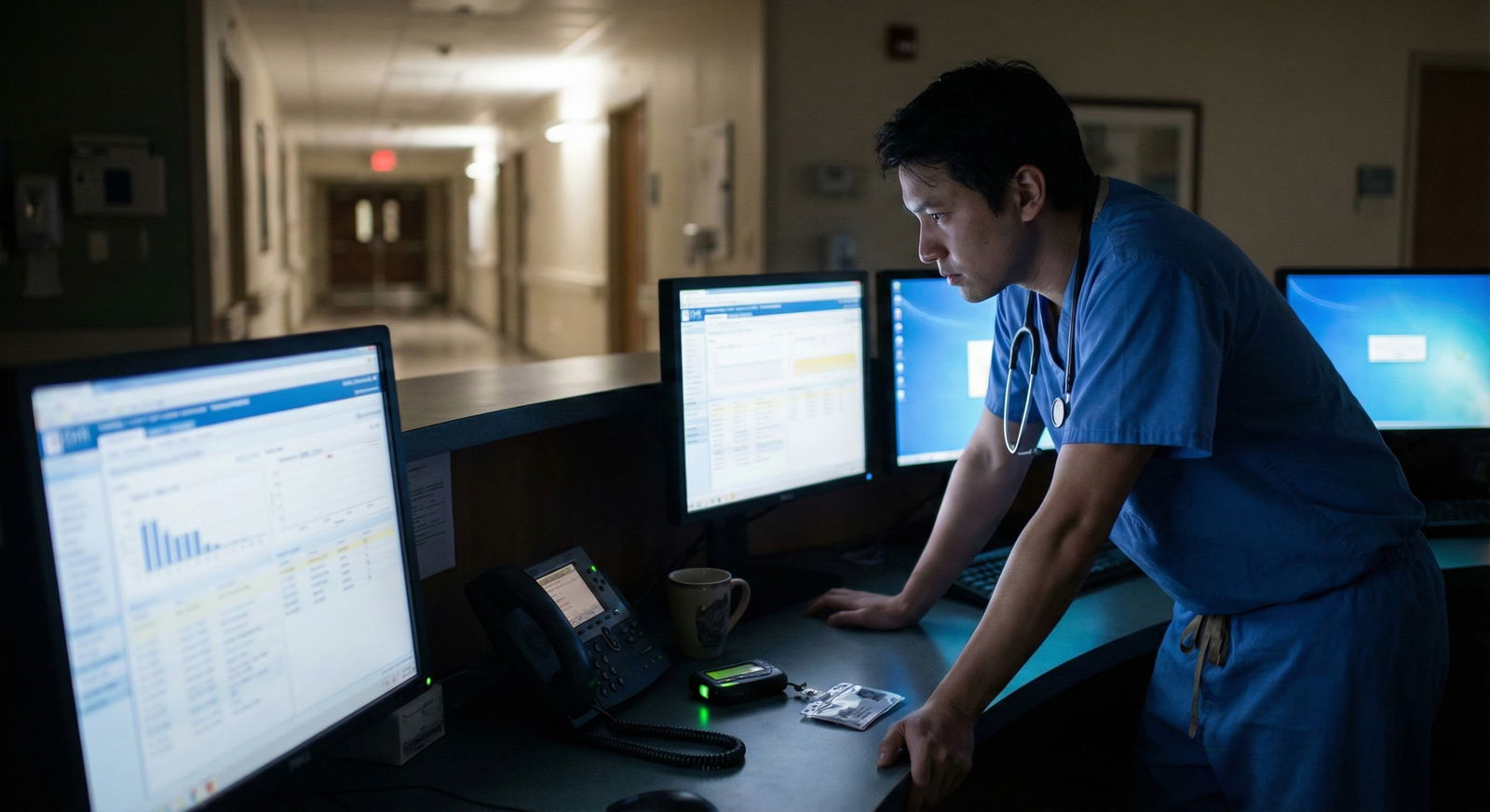
The real overnight problem isn't that junior residents call too often. It's that sick patients deteriorate in messy, ambiguous ways, and humans are terrible at respecting ambiguity when pride gets involved. I've watched this play out at 3:17 a.m. on medicine floors everywhere: heart rate drifting up, blood pressure soft but not disastrous, oxygen needs creeping, nurse uneasy, intern worried, senior saying, "Let's give it a little time." Sometimes that's fine. Sometimes that's how you buy yourself a code blue by dawn.
RRTs exist for one reason: catch deterioration early enough that the patient doesn't crash in a spectacular, preventable way. That's the whole game. And the failure mode the data punishes most consistently is delayed escalation, not wounded pride over an "unnecessary" call.
So let's bust the myth cleanly: job title alone does not tell you who should call an RRT overnight. What matters more is who notices the trend, who has a low enough threshold to act under uncertainty, and whether the system makes escalation easy instead of socially expensive.
What the data actually measures: call rates, timing, outcomes, and escalation errors
A lot of people talk about this question as if "who calls more?" and "who calls better?" are the same thing. They're not even close.
If an intern activates more RRTs than a senior, that could mean the intern is overcalling. It could also mean the intern is seeing deterioration sooner, is more bedside-connected, or is working on a service with sicker patients and less immediate support. Meanwhile, a senior with fewer calls might be showing excellent judgment. Or they might be filtering too aggressively and missing the window where deterioration was still reversible. Raw call volume is a lazy metric.
What actually matters are the buckets tied to patient safety: how often rapid response gets activated, how long teams wait after clear signs of deterioration, how often those patients end up transferred to the ICU, whether they progress to code events, and whether reviewers later judge the escalation delay avoidable. That last one matters more than residents like to admit. Retrospective case review keeps finding the same ugly theme: somebody recognized "something was off," but escalation got delayed because the threshold felt socially or cognitively inconvenient.
And yes, more calls do not automatically equal worse performance. That's one of the dumbest assumptions in hospital culture. If earlier calls reduce arrests, reduce delayed ICU transfer, or shorten time to definitive intervention, then "more calls" may reflect a healthier safety culture. Fewer calls only look virtuous if the patients are doing well. If they're circling the drain while everyone congratulates themselves for not overreacting, that's not restraint. That's failure wearing a calm face.
The literature is messy because the confounders are huge. Service complexity matters. Acuity matters. Case mix matters. Nurse-to-patient ratios matter. Whether a senior is physically in-house overnight matters a lot. A cross-cover intern on a heme-onc floor with brittle patients and excellent nursing may activate very differently from a senior on a lower-acuity service with in-person attending backup. Any article pretending there's a pure intern-versus-senior comparison untouched by context is selling simplicity, not truth.
Interns vs seniors: who calls more, who calls earlier, and who hesitates
Here's the broad pattern from studies, quality-improvement reports, and plain old lived hospital reality: interns often call earlier and with less resistance. Seniors often filter more. Sometimes that's helpful. Sometimes it creates delay.
That shouldn't be moralized. It's not "intern good, senior bad." It's mechanics.
Interns are usually closer to the bedside signal. They get the page first. They hear the nurse's tone. They walk into the room and see the patient who's speaking in shorter sentences than an hour ago, looks grayer than at sign-out, and suddenly needs two liters more oxygen for reasons nobody can package neatly yet. Interns are also more comfortable escalating uncertainty itself. They'll call because they're worried, not because the diagnosis is settled. Good. That's often exactly the right move.
Seniors, by contrast, are rewarded for composure and problem-solving. They often feel they should "handle it" first. You'll hear versions of it all night: let's trial fluids, let's repeat the gas, let's see if RT can suction, let's recheck in 20 minutes, let's avoid blowing up the whole team if we don't need to. Sometimes that's excellent medicine. Sometimes it's certainty-seeking theater.
And here's the part people hate hearing: seniority improves pattern recognition, but it can also amplify bad cognitive habits. Experience helps you recognize sepsis, flash pulmonary edema, occult GI bleed, impending hypercapnic failure. True. It also makes you more vulnerable to anchoring on last year's pattern, normalizing slow decline because you've seen "similar" patients muddle through, and mistaking confidence for accuracy. I've seen senior residents talk themselves out of escalation because the patient "always looks like this," right up until the ABG or the lactate or the sudden pressure drop forces reality into the room.
The best overnight caller isn't the most senior person. It's the clinician who detects physiologic instability before it becomes dramatic. That may be the intern, the bedside nurse, the respiratory therapist, the charge nurse, or the senior who's wise enough not to play hero. Titles matter less than thresholds.
That's why the cleanest myth-busting statement is this: interns often call more readily, seniors often hesitate more selectively, and neither behavior is automatically superior. The only question that matters is whether the patient benefited from the timing.
Why seniors sometimes under-call: the cognitive traps nobody wants to name
Let's say the quiet part out loud. Seniors under-call for reasons that have very little to do with superior judgment and a lot to do with cognitive bias plus hospital culture.
Anchoring is a big one. The patient came in with CHF, so every overnight change gets interpreted through the CHF lens even when the real problem has shifted to sepsis, PE, bleeding, or mixed shock. Then there's temporal false reassurance: "He looked okay when I saw him earlier." As if physiology cares about your previous exam. Another classic trap is waiting for a cleaner threshold. People want a dramatic number, a beautiful trigger, something they can defend on rounds later. But deterioration rarely arrives as a perfect board-style vignette. It's usually creep, drift, unease, and a nurse saying, "I don't like this."
There's also social pressure. Nobody puts it in the handbook, but everybody feels it. Interns fear looking incompetent if they don't call. Seniors fear looking incompetent if they do. That hidden incentive matters. If the culture treats RRT activation like an embarrassment rather than a tool, experienced residents will delay just long enough to make the eventual call uglier.
Experience without feedback is another problem. If a senior delays escalation three times and gets away with it, that behavior hardens into identity: "I know when to watch." But hospitals are full of survivors' logic. The misses that don't immediately explode still teach the wrong lesson. Confidence calcifies. Bad habit starts wearing the costume of wisdom.
That's why the best evidence doesn't worship individual judgment. It leans toward protocols, shared triggers, and explicit backup pathways.
What actually improves overnight RRT decisions: systems, thresholds, and backup culture
The fix is not "make everyone think like a senior." Frankly, that would worsen some units. The fix is also not "tell seniors to call more" as if this is a personality flaw. The solution is system design that makes the safe move the easy move.
Start with explicit criteria. Clear RRT triggers reduce the nonsense. Sustained oxygen escalation, worsening work of breathing, persistent hypotension after initial intervention, acute mental status change, rising early warning score, repeated nurse concern despite treatment. Put it in writing. Make everyone know it. Ambiguity never disappears, but standardization trims the dangerous part.
Early warning scores help when they're used as prompts, not as excuses. A score should push a conversation and a bedside reassessment, not replace clinical judgment. Nursing empowerment matters even more. Strong overnight systems don't force nurses to beg a reluctant resident for permission to worry. If the bedside nurse can activate or strongly prompt activation, patients win.
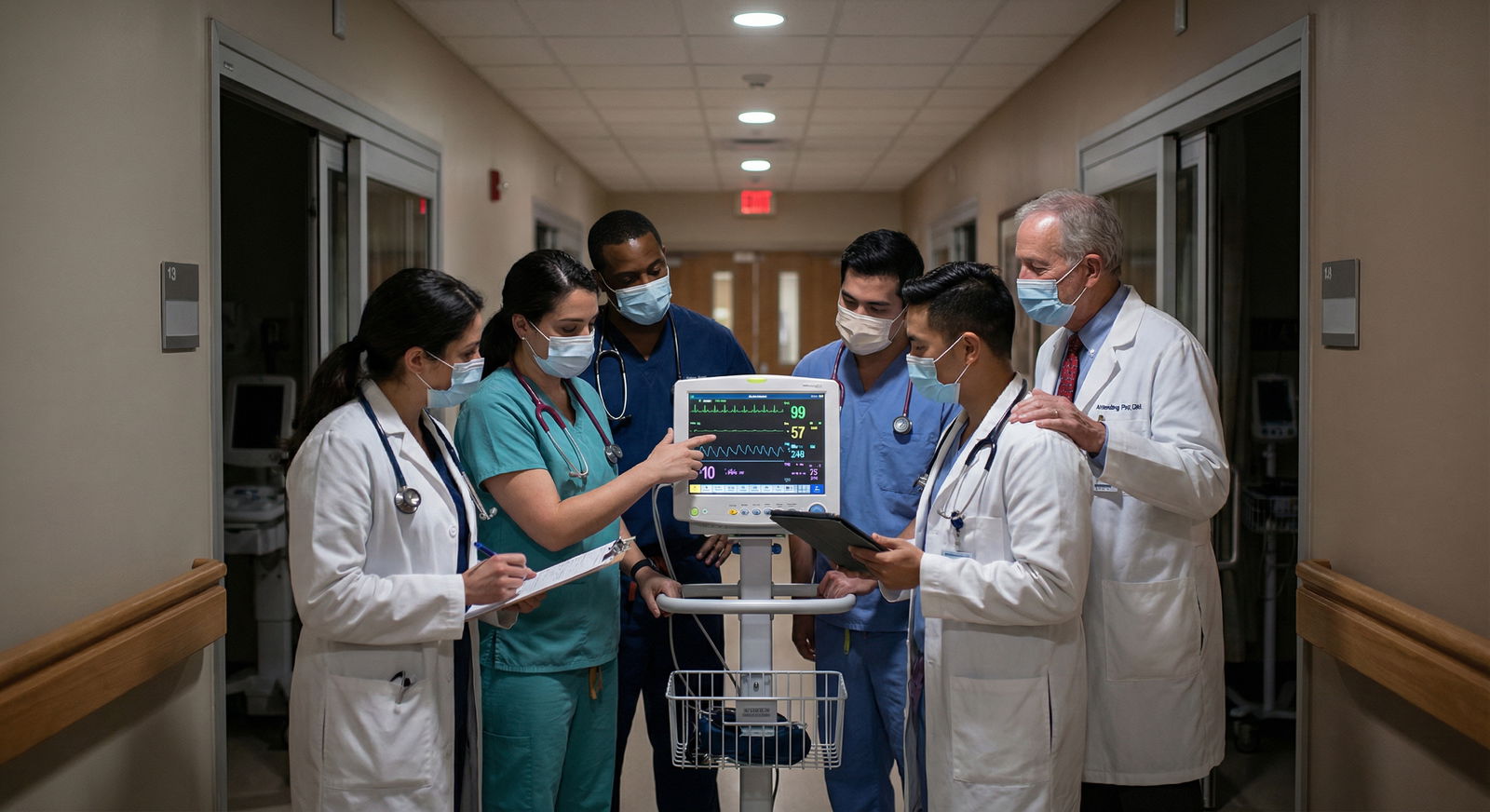
Direct senior backup is another big one. Not performative backup. Real backup. If the intern is worried, the senior should come, look, and either support the call or make a clearly documented alternate plan with tight reassessment. "Let's just watch" is not a plan. "Repeat vitals in 15 minutes, gas now, RT at bedside, I'll return in 10, and if oxygen need increases again we activate", that's a plan.
Debriefs matter too, especially after "good catches" that didn't end in catastrophe. Teams obsess over codes and often ignore near-misses. Bad mistake. You learn just as much from the patient who got escalated early and never crashed. Maybe more.
The safest overnight culture treats RRT like a clinical tool, not a scarlet letter. When teams normalize early escalation, the intern-versus-senior gap shrinks because the system no longer depends on one person's appetite for uncertainty. That's what the best data keeps pointing toward: good systems reduce reliance on heroics, ego, and hierarchy.
Bottom line: the best overnight caller is not the most senior one
Let's kill the myth properly. The data does not support treating seniority as the main determinant of good overnight RRT behavior. Experience helps. Of course it does. But experience can sharpen recognition or justify delay, and those are not the same thing.
The practical rule is simpler than residents want it to be: if the patient is unstable, trending worse, or you're hesitating because you wish you had more certainty before escalating, that hesitation is often the signal. Act. Call. Get help. The hospital is full of people who regret waiting for prettier evidence.
The real skill isn't "knowing when not to call." That line gets worshipped far too much. The real skill is knowing when delay becomes the risk. Interns sometimes understand that better than seniors because they haven't yet been socialized into mistaking restraint for mastery.
So no, the best overnight caller isn't the most senior one. It's the one who respects physiology more than hierarchy, trend more than ego, and patient safety more than appearances. That's what the data actually shows.