
The fastest way to burn out on call is to treat every page like a code. That is wrong.
You need a mental triage system for pages, or the night will eat you alive. Some things can safely wait 30–60 minutes. Some cannot wait 30 seconds. Knowing the difference is the core skill of night float and call.
Here’s the framework I teach interns and new juniors.
The 5‑level “Page Acuity” System
Think of pages like an internal 5‑level triage:
| Level | Response Time | Typical Examples |
|---|---|---|
| 1 | Immediate | Code, airway, anaphylaxis |
| 2 | 0–5 min | Chest pain, stroke, sepsis concern |
| 3 | 5–15 min | Hypoxia, moderate pain, new fever |
| 4 | 30–60 min | Nausea, mild pain, insomnia |
| 5 | Later/Batch | Routine orders, chronic issues |
You will not say this out loud to nurses, but you should run every page through it in your head.
Basic rule:
If ignoring it for 10 minutes could lead to death, permanent harm, or an ICU transfer → Level 1–2.
If the patient will be uncomfortable but not harmed by a short delay → Level 3–4.
If no one’s life or limb changes whether you do it now or in an hour → Level 5.
Now let’s get concrete.
Pages That Require You Right Now (Level 1–2)
If you hear any of these, you move. You do not finish your note. You do not argue. You go.
1. “The patient looks bad.”
The exact words vary:
- “Can you come see them now, they don’t look right.”
- “I’m worried about this patient.”
- “Something’s off, can you come?”
If an experienced nurse says this, you stand up and walk. I’ve seen more early sepsis, strokes, and bleeds caught by that sentence than by vitals alone.
You can ask one or two quick questions as you walk:
- “What are the latest vitals?”
- “Mental status change?”
- “Any chest pain or shortness of breath?”
But do not sit and brainstorm orders from your desk. Go see the patient.
2. Airway or breathing problems
These are non‑negotiable:
- “Patient is desatting / on 15L non‑rebreather / on BiPAP and still struggling.”
- “Stridor.”
- “New or worsening shortness of breath.”
- “Can’t lie flat because they can’t breathe.”
Response: immediate bedside evaluation while asking:
- “What are the vitals now?”
- “What’s their baseline O2 and device?”
- “Are they on telemetry?”
If major airway concern, call for help early (rapid response, ICU, anesthesia depending on your system). You will never get in trouble for over-calling when respiratory status is tanking.
3. Chest pain, stroke, and “big bad” symptoms
You treat these like an ED:
Immediate response for:
- New chest pain, pressure, or equivalent (jaw, arm, back) — especially with diaphoresis, nausea, dyspnea.
- “Stroke” words: facial droop, new weakness, slurred speech, word salad, new visual changes, acute confusion onset.
- “Worst headache of my life.”
- Sudden severe abdominal pain with peritonitis-like description (guarding, rigid, “9/10 and different from usual”).
If you’re still at your desk after hearing any of those, you’re wrong.
4. Mental status and safety emergencies
These often sound less dramatic than they are:
- “Your patient is acutely more confused.”
- “They were oriented earlier, now they’re not making sense.”
- “Patient just had a fall / unwitnessed fall.”
- “Actively suicidal / trying to leave / pulling lines.”
Rapid bedside evaluation is required. While walking, ask:
- “Was there a head strike?”
- “On anticoagulation?”
- “Any focal neuro changes?”
- “Any recent meds given? Opioids, benzos, sleep meds?”
These are early hemorrhages, delirium, over-sedation, or safety disasters waiting to happen if you sit on them.
5. Abnormal vitals that aren’t a one‑off blip
Pages like:
- “BP 70/40”
- “HR 150s sustained”
- “Temp 39.5 with rigors”
- “RR 30s”
- “O2 sat in the 80s despite increased support”
Core rule: sustained abnormal + concerning context = go now.
You can ask:
- “Is there a repeat reading?”
- “Any trend?”
- “What are they being treated for?”
But with hypotension, tachycardia with sepsis risk, or persistent hypoxia, you should pretty much always appear in person.
6. Bleeding and serious output changes
Urgent if:
- Hematemesis, coffee-ground emesis, bright red rectal bleeding.
- Large-volume melena if unstable.
- Hematuria with clots and not draining.
- “There is a lot of blood” (tourniquet, line sites, surgical drains with rapid fill).
Also urgent:
- “No urine output for 6 hours in a sick patient” — especially on pressors, sepsis, or known kidney issues.
Not something to “just put in some orders.” You need to examine them.
Pages That Need You Soon, But Not This Second (Level 3)
These are things that can usually withstand a 5–15 minute delay if you’re tied up with something more acute. You still take them seriously.
1. New fever or rigors
“Temp is 38.5 / 39 / they’re shaking.”
On a neutropenic cancer patient? Very high acuity.
On a postop day 1 with stable vitals? Still needs attention, but you can finish discharging a stable patient before sprinting.
Use the call to risk-stratify:
- “What are the other vitals?”
- “Any hypotension or tachycardia?”
- “Neutropenic or on chemo?”
- “Have they had any cultures drawn yet?”
Septic vitals or neutropenia → upgrade to Level 2 and see now.
Otherwise, come evaluate soon and start the sepsis workup if appropriate.
2. Escalating pain not controlled by current orders
Key here is change and severity:
- Chronic back pain asking for their 2 am PRN? That’s different.
- “This is new, much worse pain and they look uncomfortable” after surgery or with abdominal conditions? That’s a near-term priority.
You can often:
- Pull up their MAR quickly.
- Ask: “Have they gotten all PRNs they’re allowed?”
- If they’ve already had max meds, you probably need to lay eyes on them within ~15 minutes.
3. Moderate hypoxia or tachycardia without other red flags
Examples:
- “O2 sat 89–92% now, was 95–96% earlier; they’re on 2L now.”
- “HR 110–120s, rest of vitals okay, patient feels okay.”
These deserve attention, but you can usually safely:
- Ask for repeat vitals.
- Check last imaging / labs.
- Finish what you’re doing (as long as it’s not another unstable patient) and then go examine sooner rather than later.
Pages That Can Usually Wait 30–60 Minutes (Level 4)
This is where new residents massively overreact and ruin their night.
These are legitimate issues, but not emergencies.
1. Nausea, constipation, mild pain, and sleep
Common ones:
- “Patient is nauseated.”
- “Hasn’t had a bowel movement in 2 days.”
- “Mild pain, current order is q6h and last dose was 5 hours ago.”
- “Can we get something to help them sleep?”
Most of these can be handled with a quick chart review and an order. You do not need to run to bedside unless:
- There’s concerning associated symptoms (abdominal distension, severe pain, hematemesis).
- Recent surgery and possible complication.
- High aspiration risk.
You can often batch these: finish a note, address 2–3 of these at once, then move on.
2. Routine electrolyte repletions and “lab is back”
Classic: “K is 3.2, can you replete?” or “Phos is low.”
You should:
- Glance at creatinine, baseline values, QTc, and prior repletion orders.
- Place a reasonable order set.
Exception: Crashing K (like 2.5 on a patient with arrhythmias) or sodium shift in a neuro patient. Those start drifting higher up the acuity ladder.
3. “Patient wants to talk to the doctor about…”
Content matters. Most overnight “they want to talk” pages are:
- Discharge timing questions.
- “Why am I NPO?”
- “Can I go downstairs to smoke or walk around?”
You can usually finish your active task and then go have a 5-minute conversation. Only upgrade this if the nurse hints at agitation, escalating behavior, or refusal of meds that materially affects safety.
Pages That You Should Batch and Defer (Level 5)
These are the pages that destroy your night if you treat them like Level 2.
1. Clearly non-urgent orders
- “Can you reorder home vitamins?”
- “They want a different flavor of protein shake.”
- “Can we get PT/OT to see them tomorrow?”
- “Can you change the diet from regular to carb-consistent?” in a stable patient.
If you’re slammed, these can absolutely wait 1–2 hours or even pass to day team if truly trivial and not affecting patient safety.
Write them down on a notepad or electronic to‑do list. Batch them between critical tasks.
2. Documentation and “paperwork” pages
- “Can you complete this form?”
- “Need an updated activity order for PT.”
- “Can you change DVT prophylaxis from heparin to enoxaparin because pharmacy prefers it?”
If it won’t hurt the patient to wait, it goes to the back of the line.
Red‑Flag Phrases That Should Make You Move
You’ll hear thousands of pages. Certain phrases are disproportionately important.
When you hear:
- “I’m really worried about this patient.”
- “They don’t look like they did before.”
- “New chest pain / new shortness of breath.”
- “Mentation is worse / very confused all of a sudden.”
- “They almost fell / they just fell.”
- “O2 requirement is going up.”
- “He’s shivering uncontrollably and feels hot.”
You bias toward going. Even if the vitals in the chart look fine. The nurse at bedside beats the EHR snapshot.
How to Answer a Page Efficiently
You do not have time for 10-minute phone arguments at 3 am. You need a script.
When you get paged:
Get the one‑liner
“Can you tell me in one sentence what’s happening?”Ask targeted questions based on category
For vitals: “Full current vitals? On what O2?”
For bleeding: “How much? Where? On blood thinners?”
For mental status: “Baseline? Now? Any meds given recently?”Silently assign acuity level (1–5)
Then decide: rush, go soon, or handle from computer.State your plan clearly
“I’ll be there in a couple minutes.” (And then actually go.)
Or: “I’ll put in nausea meds now; if they vomit again or have severe pain, call me back and I’ll come see them.”
Clarity keeps everyone calmer and reduces repeat pages.
When You’re Buried: Explicitly Prioritize
On real call, you’ll have 3–4 issues at once:
- A febrile neutropenic patient.
- A fall with head strike.
- Two nausea pages.
- One “can we get melatonin?”
You can’t do all of them now. So say it:
To the nausea page:
“I’m currently heading to evaluate a patient with a fall and possible head injury. I’ll put in nausea medicine now and come see them to reassess within the hour. If anything changes before then, page me again.”
You’ve:
- Acknowledged the concern.
- Given a concrete plan.
- Set expectations.
That’s how you survive nights without alienating the nursing staff.
Common Mistakes New Residents Make
I’ve watched this play out every July.
Running to every page
You’re exhausted by midnight and then miss the subtle but truly sick patient at 3 am.Trying to manage obviously sick patients from the computer
You can’t fix sepsis with “Tylenol and a 500 cc bolus from the chart.” Go see them.Ignoring the nurse’s worry
You ask for 10 vitals and lab values but ignore “they just look really bad.” That line is clinical gold.Letting low‑acuity pages derail high‑acuity tasks
You stop ordering pressors to click in a melatonin order. Backwards.
On call, attention is your most valuable resource. Not your knowledge. Not even your procedures. Your attention.
Protect it.
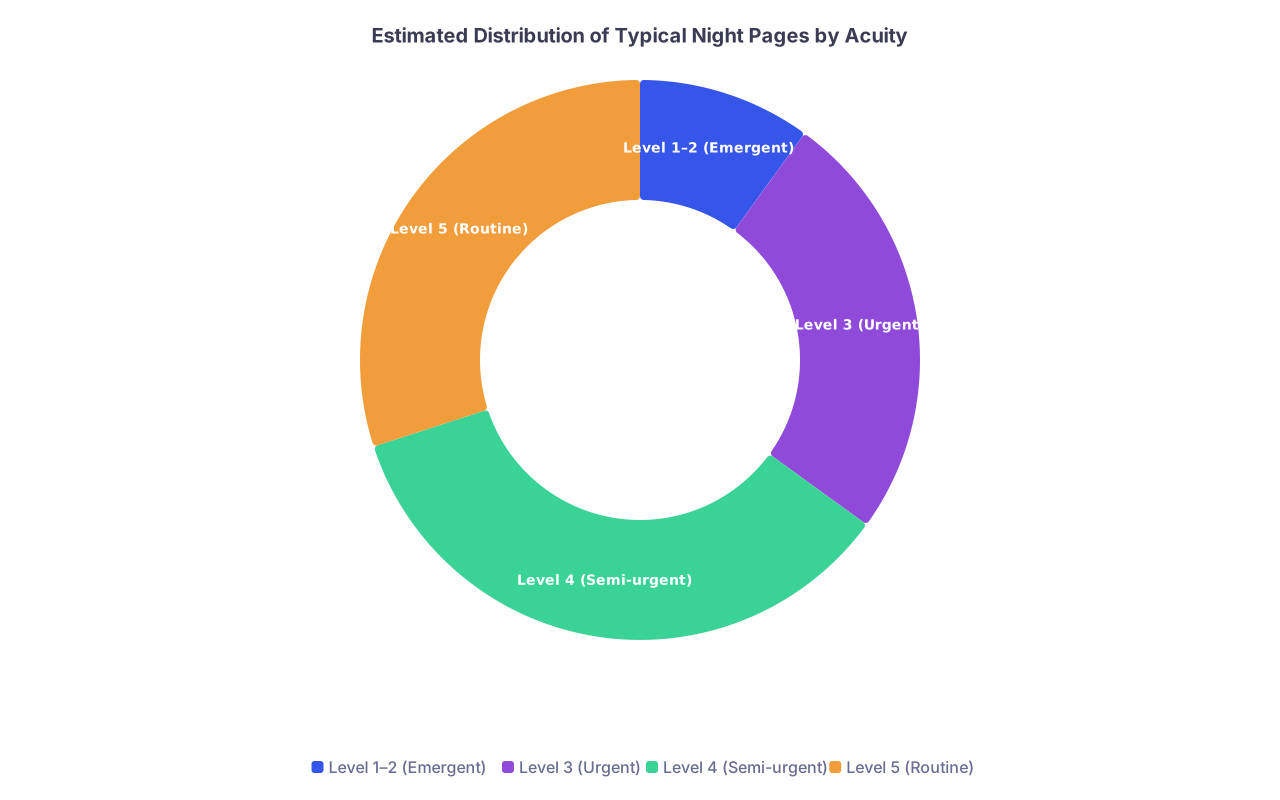
| Category | Value |
|---|---|
| Level 1–2 (Emergent) | 10 |
| Level 3 (Urgent) | 25 |
| Level 4 (Semi-urgent) | 35 |
| Level 5 (Routine) | 30 |
A Simple Mental Flowchart to Use Tonight
You do not need a complex algorithm. Use this.

| Step | Description |
|---|---|
| Step 1 | Page comes in |
| Step 2 | Go now |
| Step 3 | Reassess and act |
| Step 4 | Go after current task |
| Step 5 | Batch and handle later |
| Step 6 | Life or limb risk in 10 min? |
| Step 7 | Harm if delayed 1 hr? |
Translate that into plain English:
- “Could this kill or permanently hurt them soon?” → Drop everything and go.
- “Could this significantly worsen their condition within an hour?” → Finish your current high‑priority task, then go.
- “Is this mostly comfort/routine?” → Handle when you have a lull, or batch a few together.
You’ll refine your instincts over time. But this framework will prevent the biggest errors in both directions: panicking over trivia and missing the quietly crashing patient.
FAQ: Overnight Pages and Prioritization
1. What if I’m not sure if something is emergent or not?
If you’re honestly unsure and your gut feels uneasy, treat it as higher acuity. Go see the patient. You rarely regret over‑responding to potentially serious issues; you absolutely regret sitting on early sepsis, bleeds, and strokes. You can always de‑escalate once you’ve laid eyes on them.
2. How do I keep nurses from paging me about trivial things all night?
First, earn trust by responding appropriately to real issues. Second, close the loop: explain your reasoning. “I’m not coming in person because XYZ, but here’s the plan and when to call me back.” Over a few shifts, if you are consistent, nurses learn what you want to be called for urgently and what can wait or be bundled.
3. Should I ever tell a nurse ‘no, I’m not coming to see the patient’?
Rarely say “no”; say when. Example: “I’m in a room with a hypotensive patient right now. I’ll finish here and come see Ms. Smith in about 20 minutes. If anything changes before then (vitals, pain, mental status), please page me again and I’ll come sooner.” That’s honest prioritization, not dismissal.
4. What if I’m covering multiple services and they’re all paging me at once?
Triage globally. List issues, assign each a mental acuity level, and tackle in that order. Be transparent: “I’m currently managing a possible stroke; you are next on my list. For now I’ll put in X order; I expect to see your patient by around [time].” Use your senior or attending for backup if two truly Level‑1 problems hit at the same time.
5. How can I get better at this quickly as an intern?
Debrief. After a busy night, pick 2–3 cases where you struggled with prioritization. Ask a senior: “Would you have gone sooner or later for this?” Learn the red‑flag phrases they trust most. Pattern recognition builds fast when you actually review your decisions, not just survive the shift and forget it.
Open your sign‑out list for tonight and, for each patient, write one line: “If I get paged about this person, what will I worry about most?” You’ll be amazed how much faster you can triage pages when you’ve already previewed the likely disasters.