How many patients can you cover overnight before your brain starts cutting corners and patient care actually becomes unsafe—not just uncomfortable?
Let me be blunt: the number is almost always lower than what your hospital will try to hand you.
This isn’t a “one number fits all” situation, but it’s also not some mystical thing you can’t quantify. There are clear ranges that are usually safe, and clear situations that are ridiculous and dangerous. You need to know which is which so you can push back with data instead of just saying, “This feels like too much.”
Let’s break it down by specialty, context, and what actually happens at 3:47 a.m. when five things hit at once.
The Short Answer: Safe Ranges by Specialty
Here’s the reality most programs won’t spell out during interview dinners.
These are typical upper limits of what’s usually safe for an in-house resident covering established inpatients overnight (not admitting a ton of new ones), assuming a reasonably staffed floor and no major disasters that night:
| Specialty | Safer Upper Range | Clearly Concerning Range |
|---|---|---|
| General Medicine | 30–40 patients | >50 |
| General Surgery | 25–35 patients | >45 |
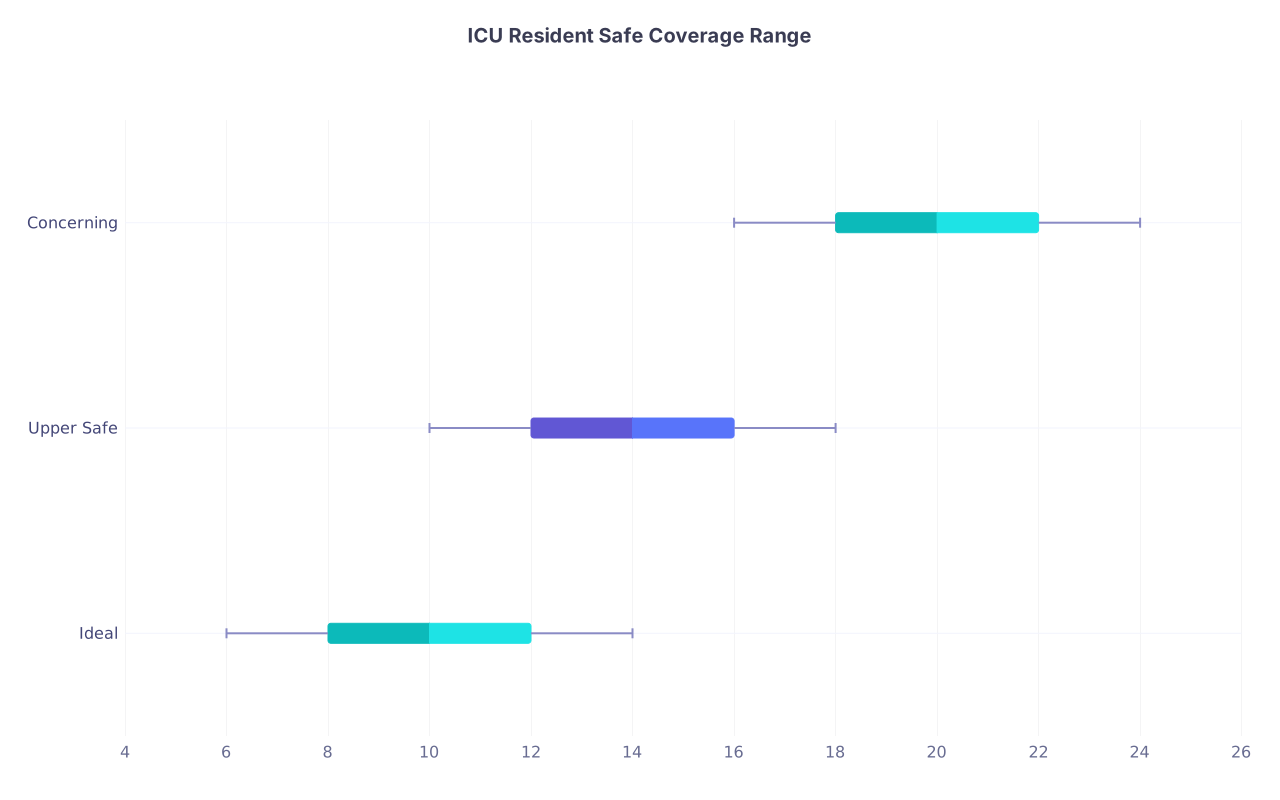
| ICU (1 resident) | 10–15 patients | >18–20 |
| OB/GYN L&D | 8–12 laboring + 10–20 ante/postpartum | >15 laboring |
| Pediatrics Floor | 20–30 patients | >40 |
| Psych Inpatient | 25–35 patients | >45 |
Those ranges assume:
- You’re not the only resident in the whole hospital.
- You have at least one nurse per usual ratio.
- You’re not also cross-covering multiple additional services you don’t know.
If you’re seeing numbers well beyond those ranges as a routine expectation, you’re in unsafe territory, and you should not normalize it.
Why the “Right Number” Changes: 6 Variables That Matter
The raw census number is only half the story. Fifty stable post-op day 5 hernias is very different from twenty GI bleeds in various stages of crashing.
Here’s what actually drives safe capacity.
1. Acuity: Sick vs “Sickish”
You can safely cover:
- More stable, daytime-rounded patients
- Fewer ICU-level, brittle, or just-admitted patients
As a rule of thumb:
- One ICU-level patient can eat the same time/attention as 5–10 floor patients.
- A fresh admit in the first 6–12 hours is easily 2–3x the workload of a stable follow-up.
That’s why a MICU resident with 14 ventilated patients is at the edge, but a medicine night float with 35 stable COPD/CHF patients might be okay.
2. Admission Load vs Cross-Cover
Night work splits into:
- Cross-cover: answering pages, dealing with decompensations, small orders.
- Admissions: new workups, notes, orders, family calls, consults.
You can cover more patients when:
- You’re mostly cross-covering a defined list. You can safely do far fewer when:
- You’re getting crushed with admissions.
Rule of thumb for medicine PGY-2/3:
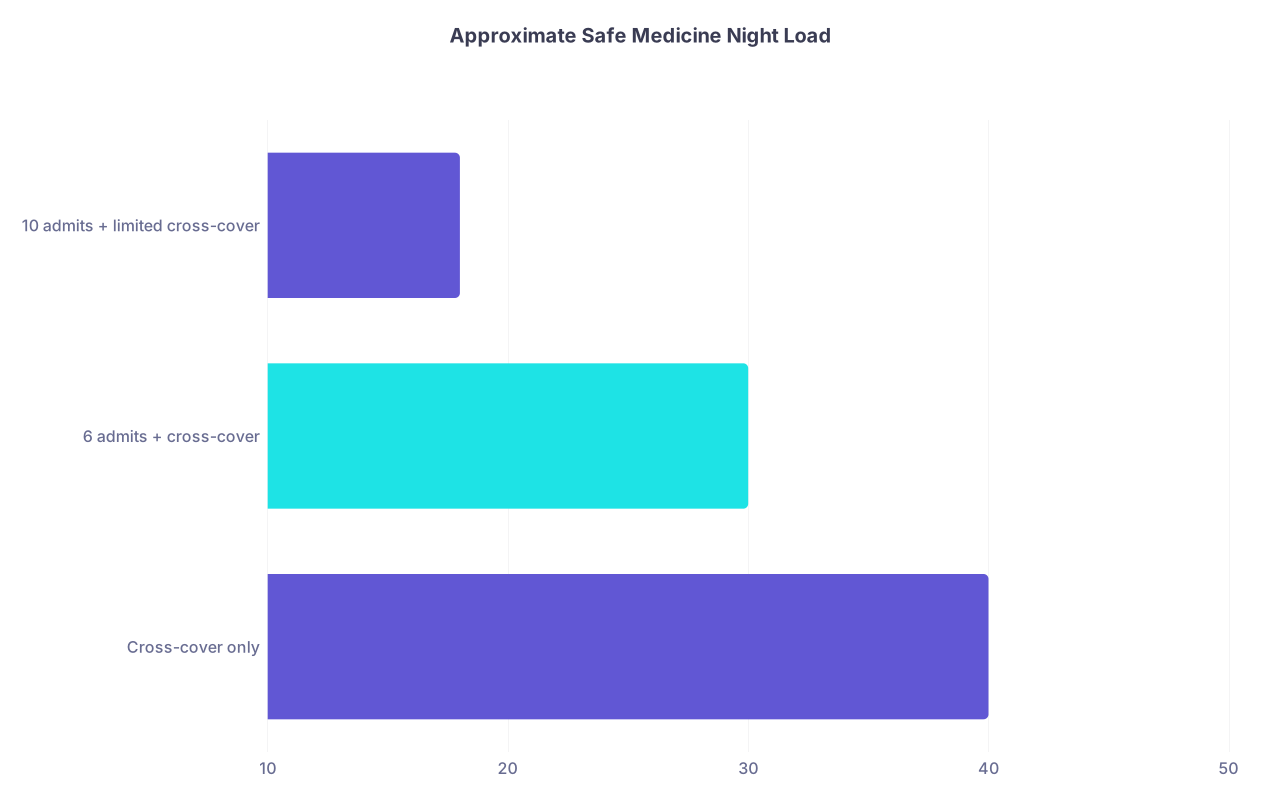
- Cross-cover only: 30–40 patients can be manageable.
- Admissions + cross-cover: 6–10 new admits plus 20–25 cross-cover is a full, busy night. Beyond that, quality drops fast.
| Category | Value |
|---|---|
| Cross-cover only | 40 |
| 6 admits + cross-cover | 30 |
| 10 admits + limited cross-cover | 18 |
3. Your Level of Training
PGY-1 vs PGY-3 is not the same human. A senior can safely handle more, think faster, and filter noise better.
Crude estimates:
- Intern: should not be the only in-house resident for a huge service. Safe upper cross-cover range usually 20–25 on medicine when backed by a reachable senior.
- Senior: can stretch those numbers, but not infinitely. A PGY-3 covering 50+ sick medicine patients alone is not “a good learning experience”; it’s system failure.
4. Support Staff and Systems
You can handle more patients when:
- Nursing is well-staffed, experienced, and not drowning.
- Phlebotomy, RT, IV team, and transport actually exist overnight.
- You have decent EMR tools: pre-built order sets, reasonable paging culture.
You can handle fewer patients when:
- Nurses are brand new or spread too thin.
- You’re constantly called to do basic tasks (routine blood draws, every IV).
- Pages are non-triaged and everything comes directly to you, all the time.
5. Physical Layout
One resident covering:
- 30 patients on one medicine floor is very different from
- 30 scattered across four buildings and three towers.
Running marathons between wards at night is not “exercise”; it’s time you’re not thinking. That kills your safety margin fast.
6. Call Structure
Two very different scenarios:
- q4 overnight call with 28-hour shifts
- Night float with 12–14 hour shifts, several nights in a row
You can stretch more on:
- Well-rested single nights with post-call days. You should stretch less on:
- Night float with accumulating sleep debt. By night 5, your brain is half-melted even if you think you’re “used to it.”
Specialty-Specific Reality Checks
Let’s get concrete.
Internal Medicine
Typical safe-ish upper limits:
- Cross-cover only, senior level: 30–40 reasonably stable patients.
- Intern cross-cover with senior backup: 20–25.
- Night admitting + smaller cross-cover: 6–10 admits + 20–25 cross-cover is about the upper safe range.
Red flags:
- Regularly covering >50 medicine patients alone overnight.
- Being both primary admitter and sole cross-cover for multiple teams cumulatively exceeding ~40–45 patients.
What this feels like when unsafe: You’re delaying seeing new hypoxic or hypotensive patients because you’re drowning in pages and orders. You find yourself saying, “I’ll check that in a bit,” and “a bit” is an hour later.
Surgery (General)
Surgery cross-cover is more “few very sick, many potentially volatile.”
Reasonable upper bounds:
- Senior covering 25–35 surgical inpatients on floor/stepdown.
- ICU surgical: 10–15 max for one resident; beyond that, you’re not really assessing everyone properly overnight.
Red flags:
- Being on call for >45 surgical inpatients including multiple fresh post-ops, plus consults from ED and floor.
- No clear triage (e.g., you’re fielding all pages from ED, PACU, floors, ICU with no backup).
Unsafe symptom: You’re clearing post-op checks in “drive-by” mode with 30-second exams just to get through the list.
ICU (Med/Surg)
ICUs pretend they are special—and they are. Lower numbers, much higher acuity.
Typical safer limit:
- 10–15 patients per in-house resident, with attending and possibly fellow backup. Feel sketchy:
- 18–20+ critically ill patients per resident, especially if:
- You’re writing all notes.
- You’re also taking new intubations and codes from the floor.
At that volume, you’re not deeply thinking about ventilator settings or hemodynamics. You’re firefighting.
| Category | Min | Q1 | Median | Q3 | Max |
|---|---|---|---|---|---|
| Ideal | 6 | 8 | 10 | 12 | 14 |
| Upper Safe | 10 | 12 | 14 | 16 | 18 |
| Concerning | 16 | 18 | 20 | 22 | 24 |
OB/GYN
OB is unique because labor doesn’t schedule itself and you can go from quiet to chaos in ten minutes.
Rough limits:
- One in-house resident can safely oversee:
- 8–12 active laboring patients (with good L&D nurses),
- plus 10–20 antepartum/postpartum patients that are mostly stable. Red flags:
- 15+ laboring patients with complications (preeclampsia, VBACs, inductions, non-reassuring tracings) and you’re the only resident overnight.
You know it’s unsafe when:
- You’re constantly “just glancing” at strips instead of really reviewing them.
- You’re delaying checks on preeclamptics or hemorrhage risks because another delivery is crowning.
Pediatrics
Kids compensate until they don’t. Undercover acuity is the main issue.
Typical safe ranges:
- 20–30 pediatric floor patients for a night resident cross-covering, assuming most are stable. Red flags:
- 40+ peds floor patients, especially if many are respiratory, oncology, or post-op.
You feel unsafe when:
- You’re too busy to personally assess every child with a new fever, increased work of breathing, or decreased intake.
Psychiatry
On paper, psych censuses look big. Safer numbers are higher because acuity is different (though safety, legal, and behavioral risk are high in other ways).
Reasonable:
- 25–35 inpatients for an on-call psych resident. Concerning:
- 45+ inpatients plus all ED psych consults and admissions.
You’ve crossed the line when:
- You’re rushing suicide risk assessments or not fully exploring psychosis, just to “clear” patients.
Concrete Signs Your Overnight Load Is Unsafe
Forget theoretical numbers. Here’s what unsafe looks like in real time, regardless of census.
If you notice these regularly:
- You’re triaging based on who yells loudest, not who’s sickest.
- You commonly delay seeing unstable vitals (hypotensive, hypoxic, tachy to 160) because you physically cannot get there sooner.
- You sign orders you haven’t fully thought through just to clear your inbox.
- You skip or shorten real exams on high-risk patients.
- You routinely finish your shift with several patients you never laid eyes on despite new issues overnight.
That’s not “learning.” That’s system-induced malpractice risk.
How to Push Back (And Not Just Complain)
You need a framework and language to talk about this with chiefs or program leadership. Here’s the basic strategy.
1. Track Concrete Data for a Week or Two
Document:
- How many patients you’re covering.
- How many admissions you’re doing.
- The number of serious events: rapid responses, new pressors, transfers to ICU, codes.
- How long it takes from page to bedside in true urgent cases.
You want to say: “Last Thursday I was cross-covering 58 medicine patients, did 9 admissions, and we had 3 rapid responses. One hypotensive patient waited 45 minutes before I could get there because I was intubating someone else.”
That lands. Vague “we’re too busy” does not.
2. Use Patient Safety Language, Not Just Resident Wellness
Program directors are legally and ethically obligated to care about patient safety. Wellness sometimes gets waved away as “everyone went through this.”
Say things like:
- “At this volume, I can’t safely evaluate all acute events in a timely way.”
- “We’re routinely forced to delay care for objectively unstable patients.”
3. Propose Specific, Realistic Fixes
You’ll get more traction if you’re not just dropping problems. Suggest:
- Adding a night float.
- Splitting services (e.g., hospitalist vs teaching team coverage).
- Rebalancing admissions among multiple teams.
- Creating a mid-level or nocturnist role.
Typical Load vs. Safe Load: Quick Comparison
To put it visually:
| Setting | What Many Programs Do | What I’d Call Safer |
|---|---|---|
| Med night float | 45–60 cross-cover | 30–40 |
| Med call + admits | 10–14 admits + 30+ CC | 6–10 admits + ≤25 CC |
| Single ICU resident | 18–24 patients | 10–15 |
| Surgery cross-cover | 40–60 inpatients | 25–35 |
| OB resident | 15+ laboring + 20 PP | 8–12 laboring |
FAQ: Overnight Coverage and Safety (7 Questions)
1. Is there an official maximum number of patients a resident can cover overnight?
No. Duty hour rules focus on hours, not census. The ACGME talks about “adequate supervision” and “workload must not compromise patient safety,” but it doesn’t publish hard patient caps. That’s why this problem persists—programs have wide discretion, and some abuse it.
2. Is it normal to feel overwhelmed on call, or is that a sign it’s unsafe?
Feeling stretched and tired is normal. Constantly feeling like you’re gambling with patient safety is not. If you’re repeatedly delaying care for obviously unstable patients, missing important issues because you physically can’t get there, or ending shifts having never seen several patients with new problems, that’s beyond “tough rotation.” That’s unsafe territory.
3. How many patients can an intern safely cover alone overnight?
On a medicine service, an intern should not be the sole responsible physician for a massive census. With backup available, a realistic safe range for cross-coverage is around 20–25 relatively stable patients. Much more than that, plus admissions, and you’re asking someone quite junior to be responsible for too many moving parts.
4. My program says ‘we all did it and survived’ when we complain. How do I respond?
You shift the conversation away from suffering and toward safety and outcomes. Say: “The standard should be what leads to safe patient care, not what prior generations tolerated. We’re seeing delayed responses to urgent issues and rushed decisions because of volume. That’s not just a resident wellness concern; it’s a patient safety problem.”
5. What’s more dangerous: a huge census or many admissions with a smaller census?
Both can be bad, but heavy admissions with high acuity is usually more dangerous because every admit needs real cognitive work: H&P, differential, orders, risk stratification. If you’re pushing 12–14 admits overnight on top of cross-cover, the depth of your thinking on each case drops. Big but very stable censuses are stressful but sometimes safer than constant new high-acuity admits.
6. When should I refuse more admissions or say ‘no’ overnight?
You don’t lightly refuse, but there is a line. If you’re already behind on evaluating unstable patients, running multiple rapid responses or codes, or you’ve hit a point where you can’t reasonably and safely assess a new high-risk admission in a timely way, you must speak up. Use clear language: “I’m at capacity to safely take new patients; adding more will delay critical care for current unstable patients.” Get your senior and attending involved.
7. How do I know if my experience is ‘just residency’ vs a toxic, unsafe program?
Look for patterns. If brutal nights happen occasionally during a seasonal surge, that’s residency. If covering 50–60+ patients alone, constant delayed care, and chronic understaffing are your baseline, not the exception, your program has a structural problem. Also watch leadership’s response: programs that listen, adjust, and redistribute are hard but healthy; programs that dismiss or punish concerns are waving a bright red flag.
Key points to remember:
- Safe overnight coverage is about more than a single number; it’s capacity = acuity + support + admissions + your training level.
- Once you’re regularly delaying care for obviously unstable patients due to volume, your workload is not just hard—it’s unsafe.