The worst mistakes with intern autonomy on call go in both directions: too much freedom with no guardrails, or a senior who micromanages every Tylenol order. Both are unsafe. Both burn people out.
Here’s the answer you’re actually looking for: on call, an intern should own the work but share the decisions. If you remember that sentence and apply it, you’ll be fine at 90% of programs.
Let’s break it down like someone who’s actually taken (and supervised) way too many calls.
The Core Rule: Intern Owns the Work, Senior Owns the Risk
On call, the intern should:
- Be the first person to assess the patient.
- Generate the initial plan.
- Put in routine orders.
- Call the senior for anything with real downside risk.
The senior should:
- Know what’s happening with every unstable or new-to-service patient.
- Edit and refine the plan, not create it from scratch every time.
- Step in directly when the situation is beyond intern level.
- Protect the intern from system failures and unsafe expectations.
If your day-to-day doesn’t roughly match that split, something’s off.
What Interns Should Do Independently On Call
Let me be blunt: by halfway through the year, if you still need your senior to co-sign every small decision, that’s a problem. Either you’re under-confident, or the system is over-controlling.
Here’s what’s reasonable autonomy for an intern on call on a typical IM, FM, Neuro, or similar floor-based rotation (ICU and surgery are a bit different; more on that later).
Safe for Interns to Do Solo (With Good Judgment)
These are things you should usually just do, and then update the senior as needed:
Initial assessment of new admissions
- See the patient.
- Do H&P.
- Look at vitals, labs, imaging.
- Form your own impression and draft plan.
Routine symptom management in stable patients
- Pain control within the agreed range (e.g., escalating oxycodone from 5 mg to 10 mg in a known chronic pain patient with stable vitals).
- Nausea, constipation, sleep meds, mild anxiety.
- Supplemental oxygen changes within a safe range on the floor (e.g., 2L → 4L NC if sats drop a bit, without distress).
Calling consults for non-emergent issues
- Orthopedics for a non-operative fracture.
- GI for stable GI bleed already resuscitated.
- Renal for chronic CKD management on a stable admission. You should call, present, and propose a question. Seniors don’t need to babysit that.
Ordering basic tests and labs
- CBC, BMP, Mg/Phos, troponin, BNP, UA, CXR, non-contrast CT head for typical reasons.
- ECGs, repeat labs for clarification.
Writing routine admission and cross-cover orders
- Diet, DVT ppx, home meds (with usual caution), monitoring parameters.
- Sliding scale insulin within policy.
- Fluid bolus for mild dehydration in a stable patient.
You can inform the senior afterward when it’s non-urgent: “I admitted a new CHF exacerbation to 632 – started IV Lasix 40, got CXR, troponin, BNP, and called cardiology for tomorrow.”
If you’re calling a senior to ask, “Should I get a CBC on this guy with new fever?” at 3 AM by month 8 of intern year, something’s gone sideways with your growth.
What Should Always Involve the Senior on Call
Now, the other side. Things interns sometimes think they should “handle” themselves overnight to look strong. That’s how you end up with M&M slides and awkward silence.
Here’s the line: if there’s a non-trivial chance of harming the patient by being wrong, your senior needs to be in the loop. Full stop.
Always Call Your Senior For:
- Any real change in stability
- New hypotension below the agreed threshold (e.g., SBP < 90 or a big drop from baseline).
- New sustained tachycardia, RR spikes, rising O2 needs.
- New chest pain, shortness of breath, neuro deficit, altered mental status.
You see the patient first. Then call the senior with:
- One-line summary.
- Brief focused exam.
- Initial thoughts.
- What you’ve already done (e.g., EKG, bolus, oxygen).
Escalations of care
- Moving someone to a higher level of care (step-down/ICU).
- Activating a rapid response or code (you may push the button first, but the senior must know fast).
- Calling ICU for transfer.
High-risk medications or big management shifts
- Starting/adjusting:
- Pressors (if your service does that at all).
- Heparin drip for new PE/DVT in a borderline patient.
- IV antiarrhythmics, IV beta-blockers in borderline hemodynamics.
- Insulin infusions, especially DKA/HHS protocols where it’s not fully standardized.
- Large fluid boluses in:
- ESRD patients.
- Decompensated CHF.
- Underlying severe valvular disease.
- Starting/adjusting:
If it’s something that could crash someone, your senior should be co-owning the plan.
Anything that makes you feel uneasy, even if vitals look “fine”
- Patient just looks wrong.
- Nurse is worried and you’re not sure why.
- Weird lab combos you’ve never seen. Call. This is where you earn trust. “I’m not sure but I’m worried” is a completely valid reason.
Bad outcomes, near-misses, or angry families
- Patient falls.
- Possible medication error.
- Serious family conflict or threatened complaint. These are not “handle it and hope it goes away” situations.
If you’re thinking, “If this goes badly, I don’t want to explain why I didn’t call,” then call.
How Autonomy Should Progress Over Intern Year
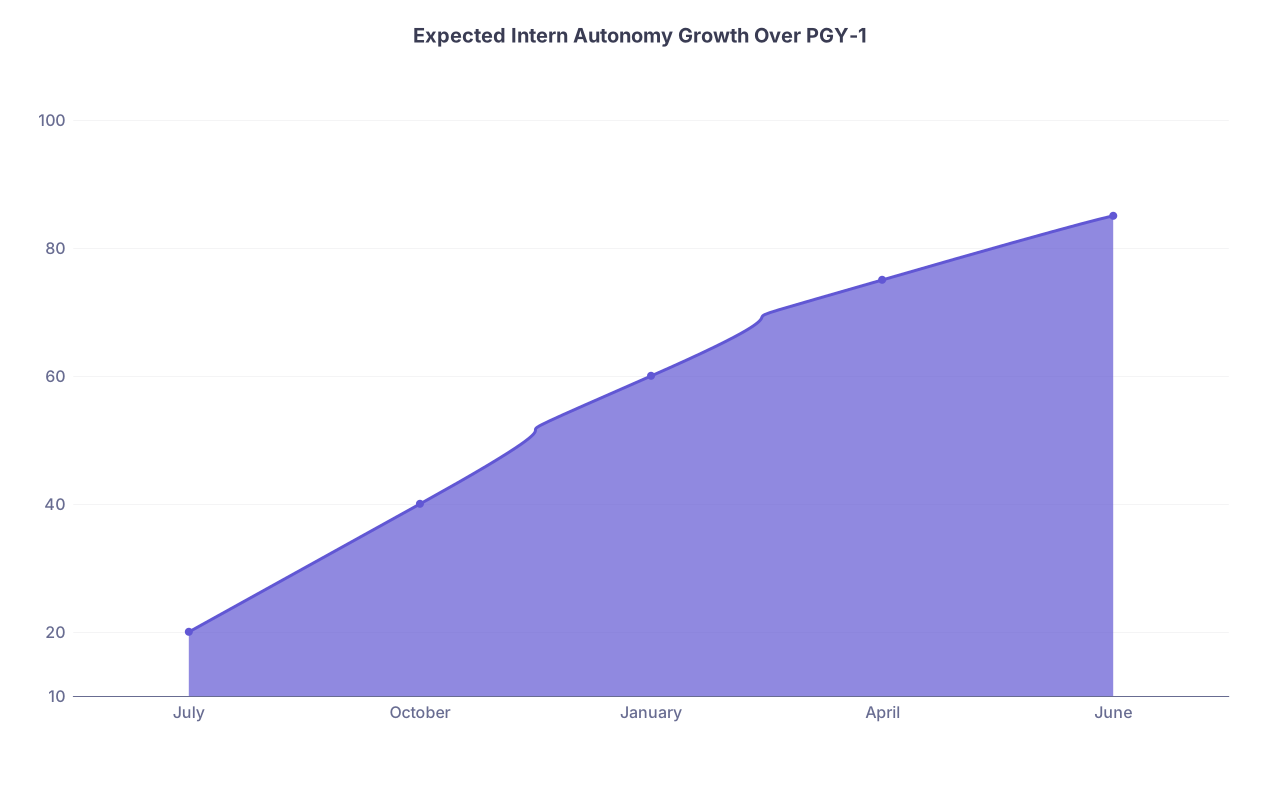
The right question isn’t “How much autonomy should an intern have?” It’s “How much autonomy should an intern have right now in the year, in this setting, with this senior and this hospital system?”
Here’s a realistic trajectory for a typical medicine intern on a call-heavy service.
| Category | Value |
|---|---|
| July | 20 |
| October | 40 |
| January | 60 |
| April | 75 |
| June | 85 |
(Values = rough percentage of routine decisions you’re handling mostly independently.)
Early Year (July–September)
You should:
- See basically everything first but check most non-trivial decisions with the senior.
- Call the senior more often than feels “cool.”
- Practice forming plans before you call: “New fever to 38.9, SBP 110, HR 102. I think it’s likely UTI; I got blood and urine cultures, ordered CXR, gave fluids, and I’m planning to start ceftriaxone if no allergy.”
Seniors should:
- Err on the side of coming to the bedside more.
- Verbally model thinking: “Here’s why I’m not freaking out about that heart rate of 105.”
- Give explicit green lights: “Next time this happens and vitals look like this, you can just do what you did and text me rather than calling.”
Mid-Year (October–March)
You should:
- Call for all the unstable / unsure / high-risk scenarios listed earlier.
- Just inform seniors about stable admissions and routine adjustments.
- Start predicting their feedback: “I knew you’d suggest fluids and CXR; I had already ordered both.”
Seniors should:
- Shift from “tell me everything” to “tell me what I need to know.”
- Occasionally say: “You didn’t need to call me for that, here’s why” – which is how you calibrate.
Late Year (April–June)
You should:
- Function almost like a competent PGY-2 on routine stuff.
- Rarely need to ask about straightforward calls: mild pain changes, minor oxygen titrations, repeat labs, routine consults.
- Call when there’s genuine uncertainty or risk, not just fear.
Seniors should:
- Treat late-year interns like near-peers on straightforward issues.
- Explicitly prep them: “You’re basically operating at PGY-2 level for cross-cover now; keep this up next year.”
If none of this progression is happening and you’re micromanaged in June like you were in July, that’s a program culture problem, not a you problem.
Differences by Setting: Floor vs ICU vs Surgery vs Nights
Not all calls are created equal. Where you are matters.
Floor-Based Services (IM, FM, Neuro, Peds Wards)
- Highest autonomy potential for interns.
- Most overnight decisions are pattern recognition and risk triage.
- You should be doing most of the grunt work and a lot of the decision-making with senior oversight.
ICU
- Lower autonomy early, and that’s appropriate.
- Vent settings, vasopressors, sedation titration, advanced lines – these require both repetition and supervision.
- You still see patients first, but the threshold to involve senior/attending is extremely low.
- By late year, in a good ICU rotation, you’ll have more independent leeway on things like basic vent adjustments, sedation changes, and simple pressor tweaks – but rarely with zero senior awareness.
Surgery
- Culture varies wildly.
- Interns often own:
- Floor issues.
- Basic pain and nausea.
- Standard post-op orders.
- Seniors/chiefs should:
- Be looped into any real change in vitals, bleeding, or post-op complications.
- Be more hands-on with decisions that might send someone back to the OR, imaging for acute abdomen, or anything involving anticoagulation post-op.
Night Float vs 24-Hour Call
- Night float tends to have more cross-cover work and fewer full admissions (depending on structure).
- Autonomy is actually highest here on routine calls because seniors can’t and shouldn’t micromanage every single cross-cover page overnight.
- You triage independently, call when it’s serious or weird.
What Good vs Bad Supervision Looks Like
Let’s be concrete. You’re on call. A nurse pages: “Your patient in 514 is more short of breath.”
Scenario A – Healthy Model
You:
- Go see the patient.
- Check vitals, exam, look at the monitor.
- Order CXR and ECG, give small fluid bolus or increase diuretics based on your impression, adjust O2, draw labs.
Then you call the senior:
- “Hey, 514, known CHF. More SOB, O2 from 2L to 4L, sat 92%. BP 115/70, HR 98, no fever. CXR with more congestion. I gave 40 IV Lasix, got labs. I think it’s mild volume overload. Anything you’d add or change?”
Senior:
- “Sounds reasonable. Let me know if the sats keep trending down or if BP drops. Good call.”
You did the work, they checked the risk. That’s the target.
Scenario B – Micromanagement
You:
- Go see the patient.
- Call senior before doing anything: “What do you want to do?”
Senior:
- Says, “I’ll come see them,” writes the orders, doesn’t explain the thinking.
You learn very little. You stay dependent and anxious. They’re exhausted and annoyed.
Scenario C – Dangerous Over-Autonomy
You:
- Decide it’s mild.
- Increase O2 from 2L to 6L, don’t call, don’t get labs.
- Hours later, the patient crashes and ends up intubated.
Senior:
- First hears about it during the rapid response.
That’s how people get hurt. “I didn’t want to bother my senior” is never a good defense.
A Simple Decision Framework You Can Use Tonight
When you’re on call as an intern, here’s the mental algorithm I’d use:
Did I personally see or evaluate the patient?
If no → go see them. Don’t call until you’ve seen them, unless it’s a code/rapid.Can this significantly harm the patient if I’m wrong?
If yes or unsure → call the senior.Is this a common, low-risk thing I’ve handled before?
If yes → handle, then text/update senior if they’d want to know.Do I feel uneasy, even if objectively it seems minor?
If yes → call the senior.
That’s it. Don’t overcomplicate it.
| Task Type | Intern Role | Senior Role |
|---|---|---|
| New admission (stable) | Full workup, initial plan, orders | Review plan, adjust as needed |
| New admission (unstable) | Rapid assessment, initial steps | Direct management, bedside presence |
| Routine cross-cover page | Evaluate, manage if low risk | Available for backup if needed |
| Major status change | First responder, call for help | Co-lead management, call attending |
| High-risk medication change | Propose plan | Approve/modify, share responsibility |
| ICU transfer consideration | Identify and stabilize | Decide on transfer, communicate |

| Step | Description |
|---|---|
| Step 1 | Page from nurse |
| Step 2 | See patient |
| Step 3 | Manage independently |
| Step 4 | Update senior if needed |
| Step 5 | Call senior |
| Step 6 | Discuss plan and next steps |
| Step 7 | Stable and low risk? |

How to Talk About Autonomy With Your Senior
If you’re not getting the right balance, you don’t have to just accept it. You also don’t need a dramatic confrontation.
Try something like this during sign-out or a quiet moment:
If you’re being micromanaged:
“I want to grow more in my decision-making on call. For things like mild pain adjustments or simple fever workups in stable patients, are you okay with me handling those and then updating you afterward so you’re still in the loop?”If you feel abandoned:
“Sometimes on call I’m not sure when you’d want to be looped in. Can we clarify what you definitely want to hear about overnight versus what you’re okay with me managing independently?”
You’re not attacking. You’re asking to calibrate expectations. Most good seniors will respect that.

FAQ: Autonomy for Interns On Call
How often should I be calling my senior as an intern on call?
Early in the year: a lot. If you go a whole night in July without calling once, that’s weird and probably unsafe. By mid-year, you should still call for all instability, high-risk meds, and anything that makes you uneasy, but you’ll stop calling for routine stuff like mild hypokalemia, pain adjustments, and simple fever workups in truly stable patients.How do I know if I’m bothering my senior too much?
Ask them explicitly: “For tonight, what do you definitely want me to call you for, and what are you okay with me managing independently?” If they ever tell you that you called “too much” for something legitimately concerning, that’s their red flag, not yours. Safety beats ego.What if my senior seems annoyed every time I call?
Don’t let that push you into unsafe independence. Keep calling for things you’d regret not calling about. You can acknowledge it: “I know it’s a lot of calls, but I’m trying to keep you in the loop for anything that could go bad.” If the pattern is persistent and toxic, that’s something to raise with a chief or trusted attending.Is it okay to do something first and then call my senior?
Yes, and it’s often preferred. Example: patient with new fever, stable vitals. You order labs, cultures, CXR, maybe start Tylenol. Then call and say: “Here’s what I saw, here’s what I did, here’s my plan. Agree?” For crashing patients, you do both in parallel: act (oxygen, code/rapid, basic ACLS) and call immediately.Should I ever call the attending directly as an intern on call?
For almost all services: no, you go through your senior first. Exceptions: your senior is unreachable for something urgent, or your program explicitly tells you to loop attendings directly in certain scenarios. If your gut says “someone attending-level needs to know now” and you can’t get your senior, then yes, call.What’s different about autonomy on call in the ICU?
The bar for calling is much lower. You call more, not less. You still see the patient first, but things like vent changes, pressors, sedation, and big fluid shifts in tenuous patients are usually not intern-alone decisions, especially early in the year. ICU is where “be conservative with independence” is absolutely the right move.How will I know I’m at the “right” level of autonomy as an intern?
A few signs: you’re tired but not panicked after call. You’re making most routine plans yourself. Your seniors say things like “That’s exactly what I would have done.” Nurses trust you and don’t bypass you to call the senior routinely. And when something bad happens, you can honestly say, “I saw the patient, I called my senior, and we made the decision together.”
Bottom line:
Interns on call should see the patient first, make a plan, and own the orders for routine, low-risk issues. Seniors should share the risk on anything unstable, high-consequence, or just plain unnerving. When in doubt, call. If you keep that division in mind—intern owns the work, senior owns the risk—you’ll land at the right level of autonomy more often than not.