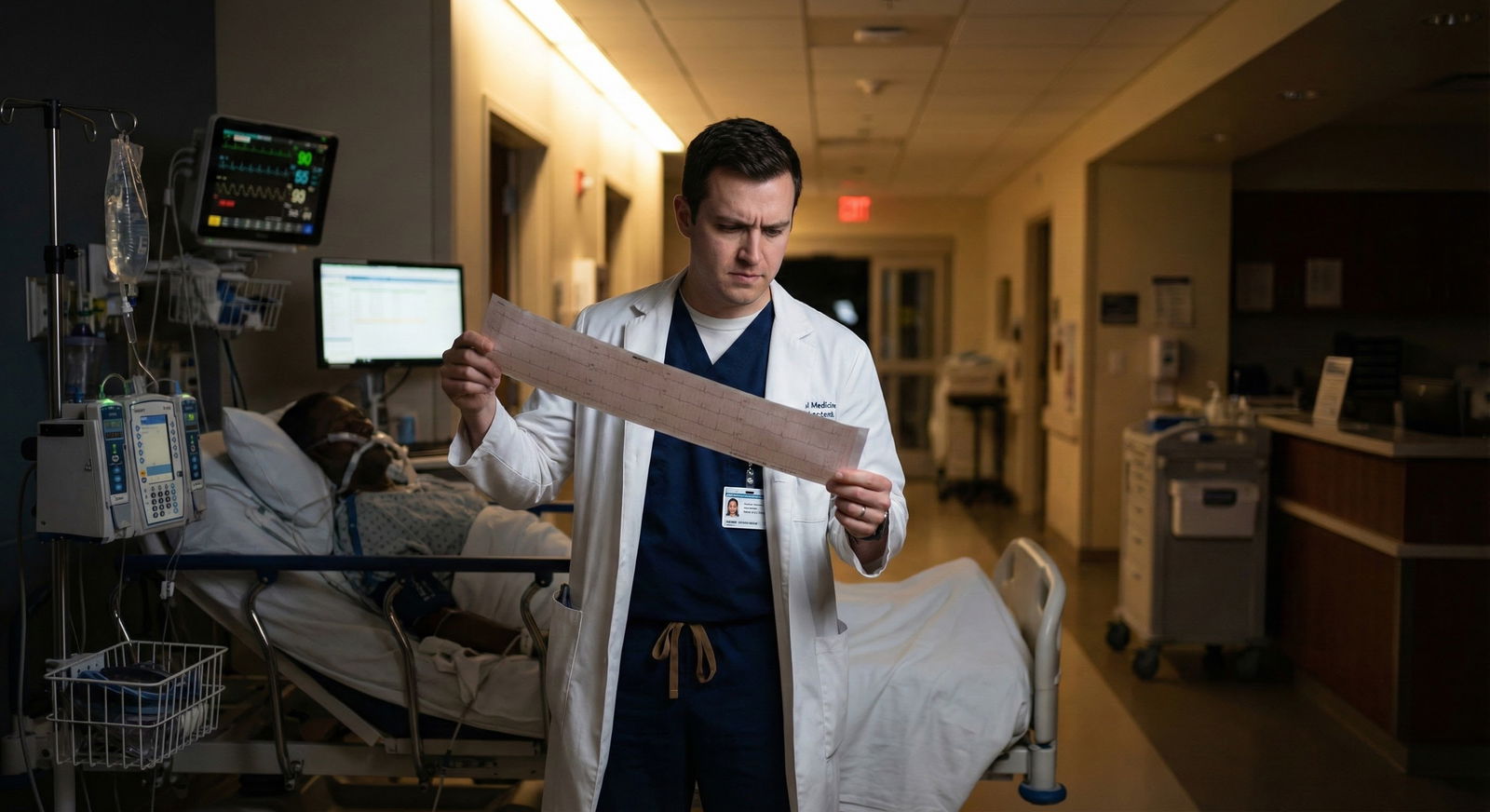
The way most interns handle 3 AM chest pain is wrong. They either panic and call a STEMI on every twinge, or they downplay obvious red flags because they’re exhausted and overconfident. You need something in between: systematic, fast, and appropriately paranoid.
Here’s the answer you’re looking for: you should always take chest pain at 3 AM seriously, but you don’t treat every complaint like a crashing MI. You run a structured risk assessment in the first 5–10 minutes, stabilize what you can, order a focused workup, and escalate early when something doesn’t fit.
Let’s break that into something you can actually use tonight.
Step 1: Decide in 10 Seconds – Sick or Not Sick?
You’re not starting with “What labs do I order?” You’re starting with “Is this patient about to die in the next few minutes?”
At the door (or on the phone with the nurse) you’re asking:
- Are they talking in full sentences?
- What are the vitals right now?
- Do they look gray, sweaty, or like they want to crawl out of their skin?
- Is this clearly chest pain, or “I feel weird”?
If you hear any of this, you treat it as sick until proven otherwise:
- New hypotension (SBP < 90 or clearly dropping from baseline)
- Tachycardia > 120 or bradycardia < 45
- O2 sat < 90% on baseline oxygen (or new O2 requirement)
- Respiratory distress (RR > 30, can’t speak in full sentences)
- Altered mental status
- Diaphoresis, pallor, or “impending doom” look
If sick: you go to the room now, grab the nurse, ask for the crash cart nearby, and start ABCs on autopilot while someone gets vitals and an ECG.
If not obviously sick: you still go quickly, but you can think in slightly longer sentences.
Step 2: First 5 Minutes – Stabilize and Get Data
Your priority is to get the minimum data set that tells you whether this is:
- Probable ACS / life–threatening
- Probably non-cardiac but needs evaluation
- “This is clearly not cardiac, but I’m going to document and prove it”
Minimum data set for virtually all chest pain on the floor:
- Full set of vitals (repeat if abnormal)
- Telemetry strip or monitor view (rate, rhythm, ST changes, ectopy)
- 12-lead ECG – non-negotiable for new chest pain
- Brief targeted history and focused exam
That’s it. Do not start with ordering CT PEs and panels of labs while still on the phone. You need eyes on the patient first.
Step 3: Ask the Right Five Questions
You don’t need a novel-length history. You need specific, high-yield answers.
Onset and character
- “When did this start? What were you doing? Sharp/pressure/burning/tight?”
- Sudden, tearing, maximal at onset → think aortic dissection.
- Pressure, crushing, radiating to arm/jaw, >20 minutes → think ACS.
Location and radiation
- Central/left chest with radiation to arm/jaw/back? Higher concern.
- Pinpoint, reproducible with one finger? Often MSK, but not always benign.
Associated symptoms
- Dyspnea, diaphoresis, nausea, syncope, palpitations?
- Hemoptysis, pleuritic pain, unilateral leg swelling? → think PE.
- Fever, cough, sputum, pleuritic pain? → pneumonia/pleuritis possibilities.
Context and risk factors
- Known CAD, prior MI, PCI/CABG?
- Recent surgery, immobility, cancer, OCPs? → PE risk.
- Aortic disease, Marfan, severe HTN? → dissection risk.
What’s different from their baseline?
- “Is this your usual GERD pain or different?”
- “Have you had this pain before? What did it turn out to be?”
You’re not fishing for every detail. You’re trying to drop them into a risk category fast.
Step 4: Know the Killers You Can’t Miss
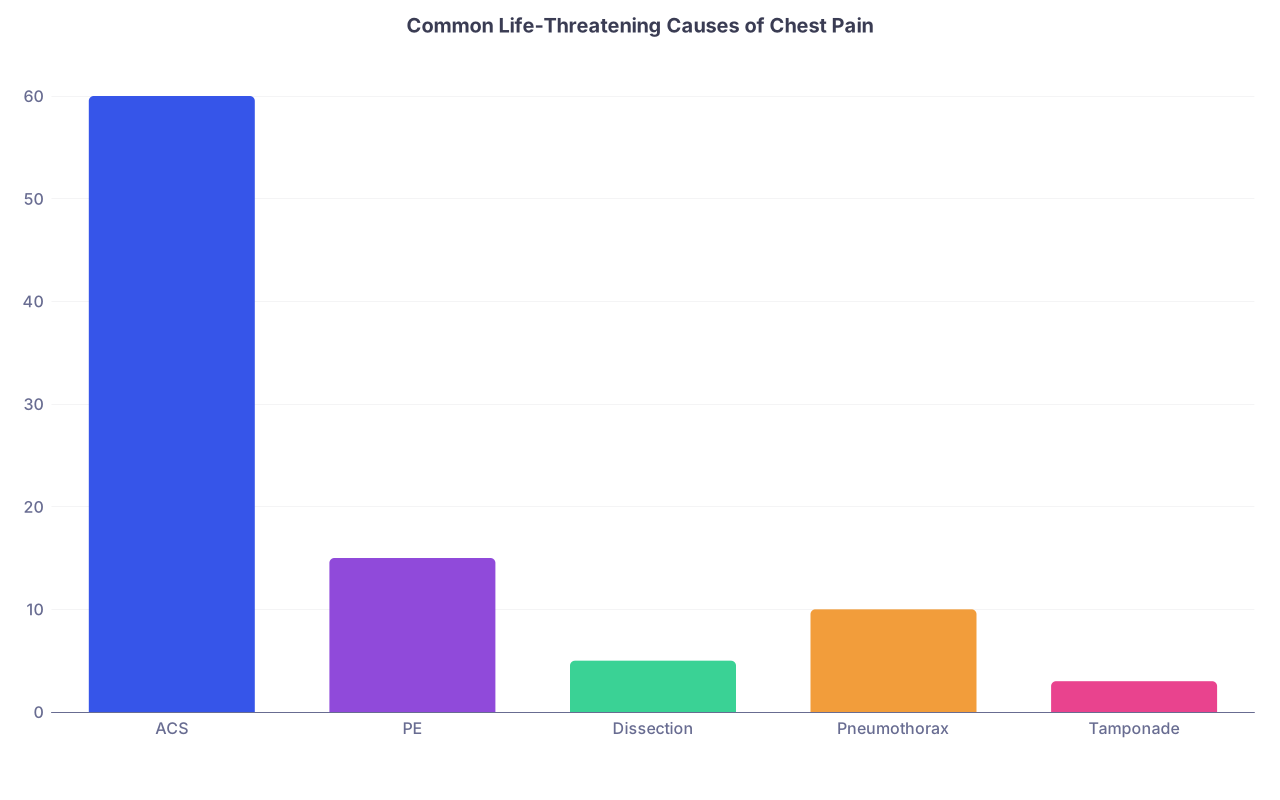
This is why chest pain at 3 AM scares people. You’re not just ruling out MI. You’re screening for the “don’t miss” list:
- Acute coronary syndrome (ACS)
- Pulmonary embolism (PE)
- Aortic dissection
- Tension pneumothorax
- Pericardial tamponade
- Esophageal rupture (Boerhaave)
- Massive pneumonia/sepsis causing hypoxia and chest discomfort
Any realistic concern for these, and your workup should be aggressive and your threshold to call for help should be low.
| Category | Value |
|---|---|
| ACS | 60 |
| PE | 15 |
| Dissection | 5 |
| Pneumothorax | 10 |
| Tamponade | 3 |
Step 5: Read the ECG Like a Triage Tool
You’re not a cardiologist at 3 AM. You’re a filter.
You care about:
- Obvious STEMI: ST elevation in a territorial pattern, new LBBB with concerning symptoms.
- Dynamic ST changes compared with prior ECG (if available).
- New arrhythmia (AF with RVR, VT, high-grade block).
- Widespread ST elevation + PR depression → pericarditis.
- Electrical alternans + low voltage + hypotension → tamponade suspicion.
If you see clear STEMI or equivalent:
- Tell the nurse: “Keep the patient NPO, put on oxygen if hypoxic, start two IVs.”
- Page cardiology/activate STEMI pathway per hospital protocol.
- Call your senior/attending quickly; this is not a “I’ll mention it at sign-out” thing.
If ECG is nondiagnostic but symptoms sound concerning, you do NOT relax. ECG can be normal early in an ACS, dissection, PE, etc.
Step 6: How Aggressive With Labs and Imaging?
Here’s where people swing too far in both directions. You should not be getting a CTA chest at 3 AM on every vague discomfort. But you also should not be sitting on a patient with crushing chest pain and risk factors waiting until rounds.
Start with what almost everyone should get:
- Troponin (baseline; repeat based on symptoms and protocol)
- BMP (electrolytes, kidney function)
- CBC if infection, anemia, or PE is on the radar
- Chest X-ray (portable) if any respiratory symptoms, trauma, or uncertain cause
Aggressive imaging is about pretest probability.
When to seriously think about CT PE:
- Pleuritic chest pain + dyspnea + tachycardia
- Unexplained hypoxia
- Risk factors (recent surgery, active cancer, immobility, pregnancy, prior VTE)
- Clear abnormal D-dimer if you’re using it (though in inpatients, it’s messy and often not helpful)
When to seriously think about CT angiography for dissection:
- Sudden onset, tearing chest/back pain
- Neurologic deficits, pulse deficits, differential blood pressures
- History of aortic aneurysm, severe HTN, connective tissue disease
Do not order these in isolation. Loop in your senior or attending for any high-risk imaging decision at 3 AM. That’s what they’re there for.
Step 7: Risk Stratification You Can Use Half-Asleep
You do not need a formal HEART score at the bedside, but the logic behind it is useful. In plain language:
You should be aggressive when:
- Pain sounds typical for ischemia (pressure, exertional, radiating, not positional or reproducible)
- Patient has significant CAD risk factors or known CAD
- Abnormal or dynamic ECG changes (not just old nonspecific ST-T)
- Elevated troponin or rising trend
- Hemodynamic instability or concerning associated symptoms
You can be more moderate when:
- Pain is brief, sharp, clearly positional, or reproduced with palpation
- No ischemic changes on ECG
- Low-risk history and risk factors
- Normal vitals, good appearance, oxygenating well
But here’s the rule: if you’re using the word “atypical chest pain” to make yourself feel better rather than because the story is truly benign, you’re usually underreacting.
Step 8: Nursing Calls – How to Respond Without Losing Your Mind
You’ll hear variations of the same call all year:
“Hey, your patient in 12A is having some chest pain.”
You should respond with a script in your head:
- “What are the vitals right now?”
- “Is the patient on the monitor? Any change in rhythm, ST, or rate?”
- “Is this new or has it been happening all night?”
- “Is the patient short of breath, sweaty, or does he/she look worse than earlier?”
If anything sounds off, you say: “I’m coming now. Please get a stat ECG and a full set of vitals. Put them on the monitor if they’re not already.”
If it truly sounds like mild, clearly chronic pain that just got worse but the patient looks okay: you still go. You just do not sprint. Floor chest pain is not a phone-management problem.
Step 9: When to Wake Your Senior or Attending
Residents get into trouble not for “over-calling,” but for missing the one bad chest pain that turned out to be an MI or PE.
You absolutely call your senior (and likely attending) when:
- You suspect STEMI or unstable ACS.
- The patient is hypotensive or requiring new oxygen for chest pain.
- There’s a new arrhythmia with chest pain (AF with RVR, VT, sustained SVT with ischemic signs).
- You’re even slightly considering PE, dissection, or tamponade that would need advanced imaging or ICU care.
- You’ve given initial therapy but pain is not improving or is worsening.
If you’re a junior: your threshold for “I’m not comfortable with this” should be low. No one reasonable will yell at you for waking them for a possible MI. They’ll absolutely be furious if you bury it until 6 AM.
Step 10: Pitfalls That Burn Interns
I’ve watched these play out more than once:
Anchoring on GERD or anxiety.
“She has reflux and anxiety documented, so it’s probably that.” Then the troponin comes back 5.0.Trusting an old normal ECG too much.
“He had a normal ECG yesterday, so it can’t be cardiac.” ACS can develop at any time.No repeat troponin.
One negative troponin early in the pain does not clear ACS. Follow your hospital’s timing protocol.Ignoring mild hypotension or tachycardia.
“Well his SBP is 92 but that’s probably his baseline.” Check the chart. If his baseline is 140, 92 is not “fine.”Delaying imaging because it’s night.
If you truly think PE or dissection is on the table, you don’t wait for day shift because CT is annoying to get at 3 AM.Poor documentation.
If you decide something is non-cardiac, your note should reflect that you considered cardiac causes, did an ECG, got at least an initial troponin or explained why you didn’t, and your reasoning. “Chest pain, probably anxiety” is garbage documentation.
Step 11: A Simple Workflow You Can Memorize
Here’s a mental flow you can run in under a minute:

| Step | Description |
|---|---|
| Step 1 | Chest pain call |
| Step 2 | Ask vitals and symptoms |
| Step 3 | Go now, ABCs, monitor, ECG |
| Step 4 | Go soon, focused history and exam |
| Step 5 | ECG, troponin, call senior |
| Step 6 | ECG, troponin, basic labs, CXR |
| Step 7 | Call senior, consider ICU/imaging |
| Step 8 | Symptomatic treatment, observe, repeat troponin if needed |
| Step 9 | Unstable? |
| Step 10 | High risk features? |
Not perfect. But if you follow that, you’ll miss far fewer bad cases and you won’t shotgun CT scans on everyone.
How Aggressive Should You Be? The Real Answer
You should be aggressive in assessment, selective in testing, and early in escalation.
Aggressive means:
- See the patient in person for any new chest pain.
- Get an ECG on everyone. No exceptions.
- Get at least one troponin on almost everyone unless the story is clearly non-cardiac and you can defend that.
But you don’t order every test on every patient:
- You reserve CT PE and CT angiography for patients with real risk and concerning stories.
- You avoid creating ICU-level workups on obviously stable, low-risk, reproducible MSK pain.
- You do not reflexively start nitro drips and heparin without a clear plan and senior buy-in.
Your job isn’t to prove you’re calm. Your job is to not miss the needle in the haystack and not burn the hospital down with unnecessary middle-of-the-night chaos.
One Thing You Can Do Today
Before your next call shift, open your hospital’s chest pain/ACS protocol and STEMI activation workflow. Print or save a screenshot. Then, pull up three old charts of patients admitted with “chest pain” and read the H&P and ECGs. Ask yourself: “Would I have been this aggressive at 3 AM? Should I have been more or less so?”
That 30-minute exercise will make your next 3 AM chest pain call a lot less terrifying—and a lot safer for your patients.