
The average on‑call handoff is dangerously vague. A good one is brutally clear, slightly paranoid, and ruthlessly prioritized.
You’re not trying to impress anyone with your sign‑out. You’re trying to keep patients alive and your night smooth. That’s it.
Here’s the simple truth: if your handoff nails five specific elements every time, your nights are safer, calmer, and much less likely to explode at 3 a.m. Miss them, and you’re gambling with both patient safety and your own sanity.
Let’s walk through a straightforward 5‑point checklist you can run on every single patient. On days. On nights. On ICU, floor, ED holdovers. Everywhere.
The 5‑Point “Good Handoff” Checklist
Use this as a mental checklist (or literally keep it printed in your pocket):
- Who is this patient and what is the one‑line story?
- What am I actually worried about tonight?
- What exactly do I want you to do if X happens?
- What’s the minimum data you need if things go sideways?
- What loose ends are still hanging that might land on you?
If your handoff answers those five, you’re already better than 80% of what I hear in real life.
Let’s break each one down with concrete examples.
1. Start With a Real One‑Liner, Not a Chart Dump
Bad handoffs start like this:
“She’s a 68‑year‑old with CHF, COPD, CKD, diabetes, admitted for shortness of breath.”
That tells me almost nothing useful for tonight.
A good one‑liner gives me context, trajectory, and why they’re here, in one breath. Aim for:
Who they are + why they’re here + current clinical direction.
Example of a good one‑liner:
“68‑year‑old woman with known HFrEF and COPD, admitted yesterday for acute hypoxic respiratory failure likely from CHF exacerbation, now improving on IV diuresis and 2L nasal cannula.”
That line already tells me:
- This is not a total mystery case
- We have a working diagnosis
- She’s not spiraling right now
- She’s still on oxygen and not all better yet
If you skip this and launch into labs or meds, the covering resident is flying blind.
Rule of thumb: If I overheard your one‑liner walking past the workroom, I should know why this person is still in the hospital and how worried I should be.
2. State Clearly What You’re Worried About (Or If You’re Not)
This is where most residents get lazy. They either say nothing or toss in something useless like “Just watch her.”
A good handoff says explicitly:
“What I’m worried about tonight is _____.”
Examples:
- “What I’m worried about tonight is her blood pressure – she’s been soft all afternoon despite fluids, and I’m concerned she could tank.”
- “Main concern overnight is alcohol withdrawal – he’s only 18 hours out from last drink, already on CIWA protocol, and tends to escalate quickly.”
- “Honestly, low concern tonight – he’s post‑op day 3, walking, vitals have been rock solid. Only thing is pain control.”
This does three things:
- Focuses the covering resident’s mental bandwidth
- Signals which patients are “stable‑stable” vs “stable‑ish”
- Makes it much easier for them to triage when three nurses call at once
If you’re truly not worried, say that too:
“I have no active safety worries on this one. Just routine stuff.”
That matters. The absence of concern is also information.
3. Give Explicit “If X, Then Y” Instructions
A “watch closely” note with no actions attached is useless.
A good on‑call sign‑out includes simple decision rules. Think of this as pre‑writing your own orders to your future self or your cross‑cover.
Use clear “if X, then Y” logic. Not vague guidance. Concrete.
Examples:
- “If SBP drops below 90 on two readings 15 minutes apart, give a 500 cc LR bolus and recheck. If still below 90, page me or the nocturnist.”
- “If her O2 sat is persistently < 90% on 4L, get a VBG and CXR, increase O2 as needed, and call me.”
- “If CIWA > 15 despite scheduled benzos, give an extra 2 mg lorazepam IV and page the cross‑cover to reassess.”
- “If he spikes a fever > 38.5, draw blood cultures that are already ordered as ‘PRN fever’ and start cefepime that’s pre‑ordered in the MAR.”
The key: Wherever possible, preload orders (PRNs, labs) so the night resident can act fast without fighting order entry in the middle of chaos.
If you don’t know what to recommend, that’s a separate problem. Ask your senior before sign‑out and create a simple plan together.
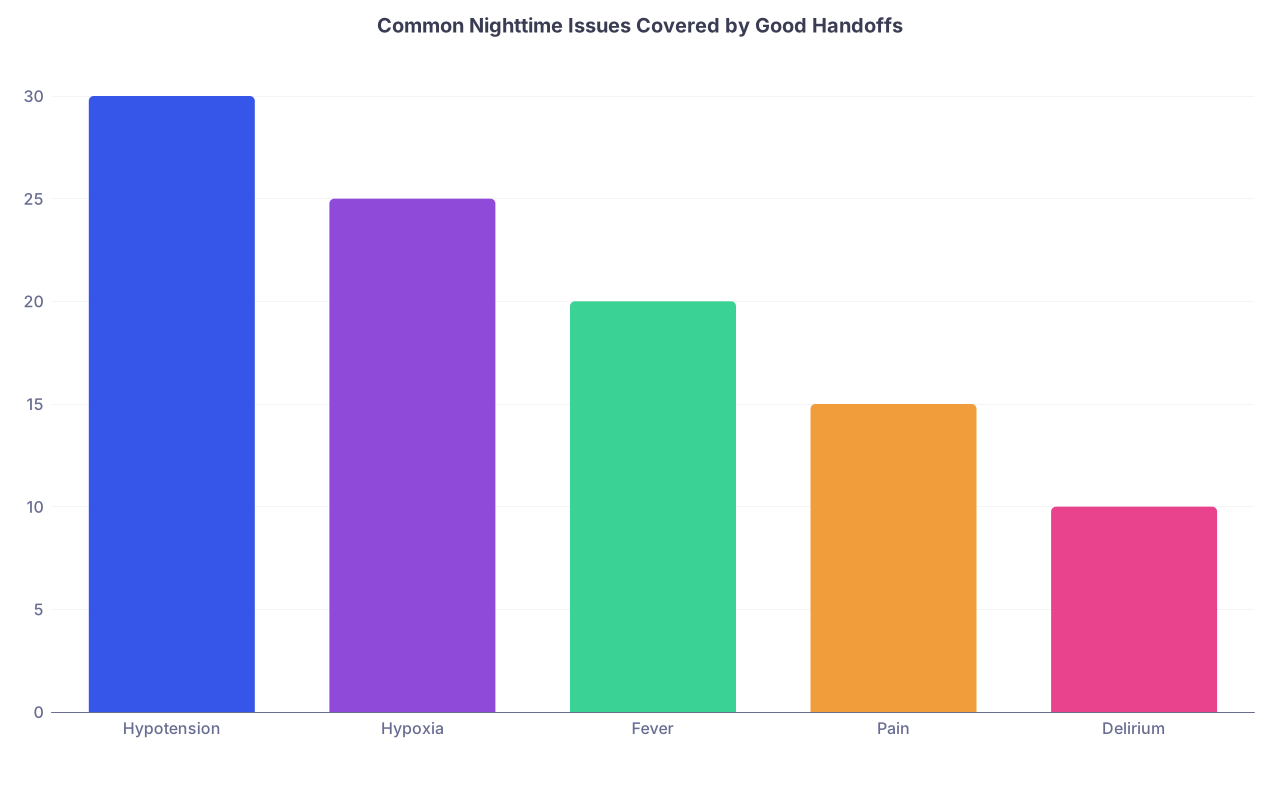
| Category | Value |
|---|---|
| Hypotension | 30 |
| Hypoxia | 25 |
| Fever | 20 |
| Pain | 15 |
| Delirium | 10 |
4. Make Sure They Have the Minimum Data to Act
On call, you rarely have time to read the novel in the chart. A good handoff anticipates what data actually matters for quick decisions.
Think like this: “If something goes wrong with this patient, what information will they desperately wish they knew but will not have time to dig for?”
Examples of “minimum dataset” to include verbally or in a tightly written sign‑out:
- Code status and goals:
- “Full code, but very frail – daughter is surrogate and wants all short‑term interventions, no long‑term vent.”
- Recent key vitals and trend:
- “Pressures have been 95‑105 systolic; HR 110‑120 today, previously in the 90s.”
- Relevant baseline info:
- “Baseline creatinine around 1.8 – so today’s 2.0 is mildly up but not catastrophic.”
- “Baseline mental status: oriented to self only; don’t be surprised if she’s confused.”
- Critical labs/imaging:
- “Last troponin was flat at 0.03 x2; TTE yesterday showed EF 25%.”
- “CT head tonight for fall was negative. No anticoagulation on board.”
Do not dump every lab value from the last week. You’re curating, not copy‑pasting.
On paper sign‑out or in your EMR handoff tool, keep it brutally brief:
- One‑liner
- Top problem / worry
- “If X, then Y”
- Code status
- One-line “min data” details
That’s usually plenty.
5. Flag Every “Possible Overnight Problem” and What You Already Did
Here’s where good residents separate from great ones.
You identify and label the likely overnight landmines so the cross‑cover is not ambushed.
Common “overnight traps” you should always think through:
- Borderline vitals
- New oxygen requirement
- Changing mental status
- Active bleeding risk
- Difficult family dynamics
- Pending critical results
Examples of how to sign these out well:
- “She’s had soft pressures all day but asymptomatic. I gave 1L total of fluids and held her evening lisinopril. If SBP < 90 and she looks worse, I’d start thinking sepsis vs cardiogenic shock and call the ICU fellow early.”
- “He’s on 4L and borderline; walked once and desatted to 86%. CT‑PE done, prelim negative, formal read pending. If he worsens, consider repeating gas and escalation to HFNC.”
- “Daughter is very anxious and calls a lot. I already updated her extensively at 4 p.m. If she calls overnight with non‑urgent questions, you can reassure that the day team will revisit things in the morning unless there’s an acute change.”
Key phrase: “What I’ve already done for this.” It tells the night resident they’re not starting from zero.
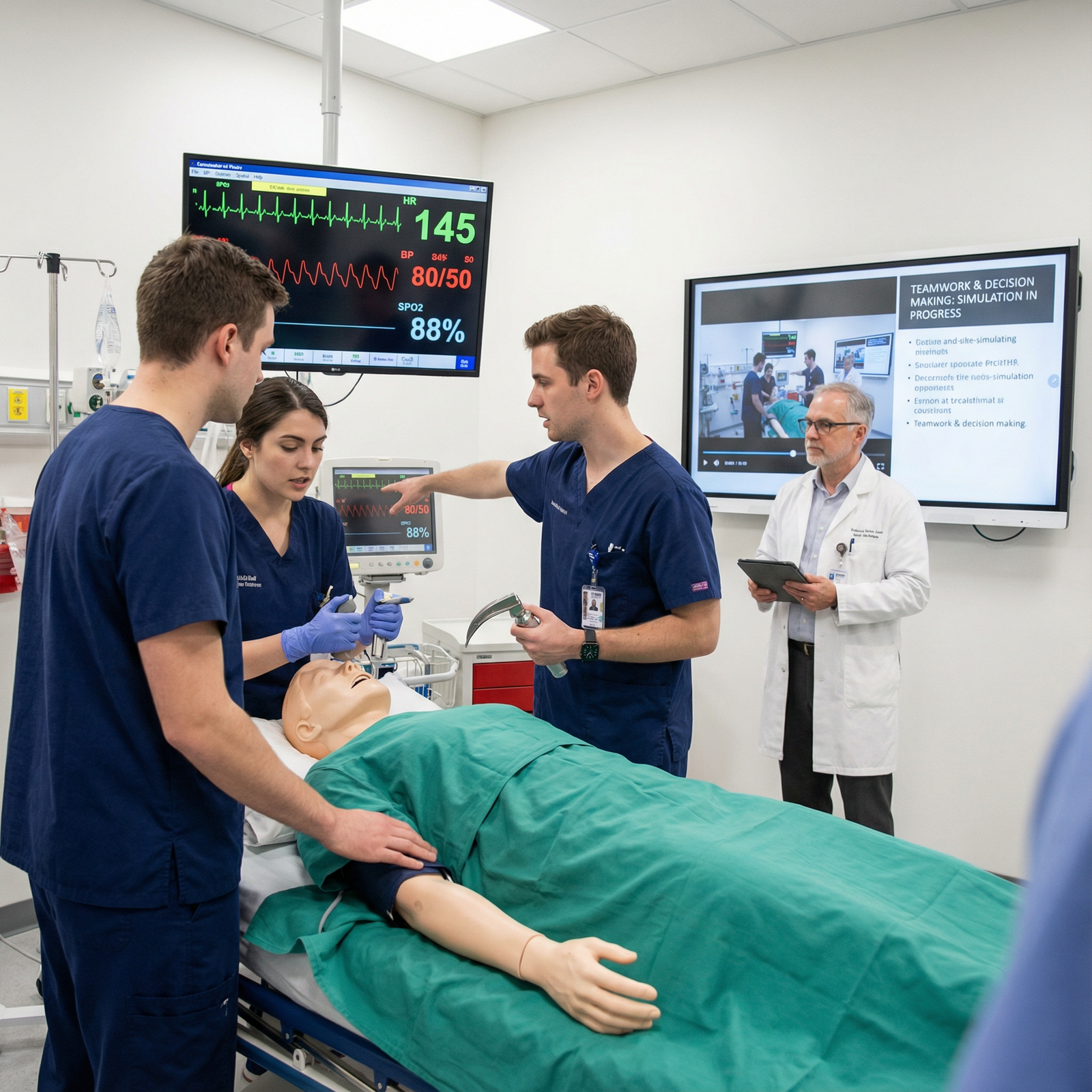
A Simple 5‑Point Template You Can Reuse
You don’t need a 2‑page sign‑out template. You need something you can repeat 40 times in 20 minutes without breaking.
Use this skeleton for each patient:
- One‑liner:
- “X‑year‑old [relevant PMH] admitted for [main problem], currently [trajectory].”
- Main overnight concern:
- “What I’m worried about tonight is…”
- If‑then:
- “If X happens, do Y and then Z (call me / ICU / etc.).”
- Key data:
- “Code: ___. Baseline: ___. Latest vitals/labs that matter: ___.”
- Possible problems + what’s done:
- “Things that could bite us: ___. I’ve already ___. If worse, consider ___.”
You can say all of that in 20–40 seconds per patient when you’re practiced.

| Step | Description |
|---|---|
| Step 1 | Start Handoff |
| Step 2 | Give one-liner |
| Step 3 | State main overnight worry |
| Step 4 | Give if X then Y plan |
| Step 5 | Share key data |
| Step 6 | Flag possible overnight problems |
| Step 7 | Ask for questions |
| Step 8 | Move to next patient |
Common Bad Handoff Habits (And Quick Fixes)
I’ve watched and given thousands of sign‑outs. The same sloppy patterns show up over and over.
The “Everything Is Fine” Lie
- “Yeah, she’s fine.” Then two hours later she’s in the unit.
Fix: If someone occupied your thoughts for more than 30 seconds today, they are not “fine.” Say what made you pause.
- “Yeah, she’s fine.” Then two hours later she’s in the unit.
The Novel
- Five‑minute monologue with every lab and consultant opinion.
Fix: If it doesn’t change overnight decisions, cut it. Keep details in your note, not your sign‑out.
- Five‑minute monologue with every lab and consultant opinion.
No Ownership of Uncertainty
- “Not sure what’s going on, but labs are pending.” Dead end.
Fix: Say what you think is going on and what the covering resident should watch for while the workup continues.
- “Not sure what’s going on, but labs are pending.” Dead end.
Hidden Code Status
- You bury DNR/DNI or “family considering hospice” in the chart.
Fix: Code status gets spoken out loud for every single patient. No exceptions.
- You bury DNR/DNI or “family considering hospice” in the chart.
| Situation | Weak Phrase | Strong Phrase |
|---|---|---|
| Hypotension | "BP has been low, just watch it." | "If SBP < 90 twice, give 500 cc LR and call me if no response." |
| Delirium | "He gets confused sometimes." | "Baseline is oriented to self only; new agitation or pulling lines is a change, please call." |
| Oxygen | "On 4L, watch sats." | "If sats < 90% on 4L, increase to 6L, get VBG, and page cross-cover." |
| Fever | "Might spike a fever." | "If T > 38.5, draw PRN cultures and start cefepime already in MAR." |
| Family | "Family is difficult." | "Daughter anxious, updated at 4 p.m.; non-urgent overnight questions can wait for day team." |
How to Practice Until It’s Automatic
You get good at handoff the same way you got good at writing assessments: repetition with feedback, not wishful thinking.
Try this:
- Pick 3–5 “highest risk” patients each day. For those, force yourself to fill all 5 checklist points.
- Ask your senior or nocturnist once a week: “Was my sign‑out useful? What was missing?”
- When you’re on nights, notice what information you wish you had. The next day, fix your own sign‑out style on days.
After a month of doing that, you’ll be noticeably better. Nurses will start telling you, “Your sign‑outs are actually helpful.” That’s not fluff. That’s patient safety.
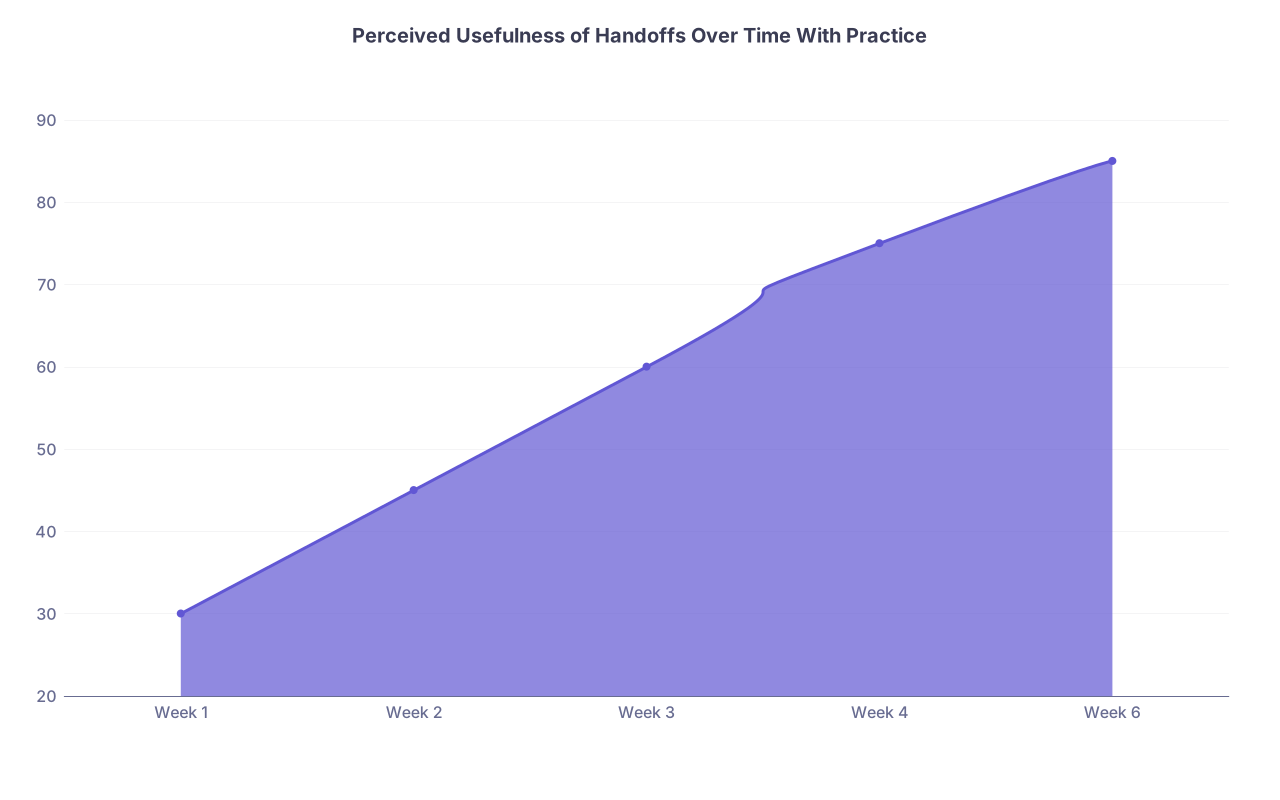
| Category | Value |
|---|---|
| Week 1 | 30 |
| Week 2 | 45 |
| Week 3 | 60 |
| Week 4 | 75 |
| Week 6 | 85 |
How This Keeps You Safer Too
This isn’t just altruism. A tight handoff protects you.
When something goes bad overnight, the first questions in the room are:
- “Did anyone see this coming?”
- “Was this communicated?”
- “Was there a plan?”
If your sign‑out clearly documented:
“I was worried about X, I said ‘If X, do Y,’ here is the code status, here is what we’d already done” — you’re standing on solid ground.
Weak, hand‑wavy sign‑outs are how residents end up in awkward M&M slides.

Quick Recap: The 5‑Point Checklist
For every patient you sign out, answer:
- Who is this, and what’s the one‑line story?
- What am I actually worried about tonight (or not)?
- If X happens, what exactly should the covering resident do?
- What key data do they need at their fingertips?
- What are the obvious overnight traps, and what have we already done?
Get those right, and you’re doing better handoffs than many seniors. No fancy templates. Just disciplined clarity.
FAQ: On‑Call Handoffs
1. How long should a good handoff take per patient?
For most stable patients, 15–30 seconds is enough if you stick to the 5 points. Higher‑risk or complex patients might take 45–60 seconds. If you’re regularly spending several minutes per patient, you’re including too much detail. The goal is targeted, not exhaustive.
2. Should I hand off every single lab and imaging result?
No. Only include results that change how the cross‑cover should respond overnight. “CT head negative for bleed” matters if you’re worried about anticoagulation or falls. “Magnesium was 2.0 this morning” usually doesn’t. Extra labs can live in your written note or EMR sign‑out field for reference, but don’t clutter the verbal handoff with noise.
3. How do I handle patients I barely know (like late admissions)?
Be honest and structured. For example: “New admission I picked up late. 72‑year‑old with likely pneumonia, on 2L O2, borderline pressures but responsive to fluids so far. What I’m worried about is sepsis progression. If MAP < 65 despite 2L total, get lactate and call ICU fellow.” Even if you don’t know everything, you can still define risks and simple rules.
4. How detailed should I be about code status in handoff?
Always state code status clearly and simply: “Full code” or “DNR/DNI.” For complex goals (like “okay with intubation short term but no trach/PEG”), give one ultra‑brief clarification: “DNR but okay with pressors and BiPAP,” for example. If the goals are messy or in flux, say: “Goals of care conversation ongoing; do not escalate without discussing with family/attending.”
5. What if my senior’s style is different from this checklist?
Fine. Still use the checklist in your head. You can adapt the wording to match your team’s culture, but the core content shouldn’t change. If your senior routinely skips clear plans or code status, you can still quietly add: “By the way, code status is…” and “If X, I’d do Y.” You’re responsible for your part of the handoff.
6. How do I handle difficult or high‑maintenance families in sign‑out?
Name it and frame it. Example: “Family is anxious but appropriate, likes frequent updates. I updated them at 5 p.m.; non‑urgent calls can wait for day team.” Or: “Family dynamics are tense; if they call overnight demanding major changes, document the interaction and defer big decisions to daytime unless there’s an emergency.” This heads off misunderstandings at 2 a.m.
7. Should I write versus just give a verbal handoff?
Do both. The written/EMR sign‑out is your structured backup: one‑liner, main concern, if‑then plan, code status, key data. The verbal handoff is where you emphasize nuance and risk. If you only write, stuff gets missed. If you only speak, things get forgotten. The best residents keep the written sign‑out brutally concise and then hit the same 5 points quickly out loud.