
What exactly are you supposed to say when you get called at 2:13 a.m. to “talk about goals of care” with a terrified family you’ve never met?
Here’s the answer you’re looking for: you do not need a perfect speech. You need a simple structure, a few reliable phrases, and the discipline not to say too much or too little.
This is the on‑call survival version. Scripted enough to be usable half-asleep. Realistic enough that attendings will nod, not cringe.
Step 1: Buy Time Without Abandoning Them
You will often get paged like this:
“Hi, this is the nurse on 7W. The family’s asking to speak to a doctor about code status. Can you come?”
Wrong move: sprint in and immediately try to fix everything in one conversation.
Better move: buy a little time to gather facts, then show up quickly.
Ask the nurse (on the phone, briefly):
- “Who’s in the room?” (patient capacity? family? health care proxy?)
- “What have they been told so far about the medical situation?”
- “What are they worried about right now? Did something just change?”
Then: “I’ll be there in about 5–10 minutes. Please let them know I’m coming.”
You’ve set an expectation. You are not disappearing.
On the walk there, glance at the chart. Problem list, recent notes, code status, latest events. You don’t need to master the whole chart; you just need a coherent one‑line summary so you don’t sound clueless.
Example quick read mental summary:
“84F with dementia, CHF, CKD, septic shock, on pressors, now in worsening respiratory failure.”
That’s enough for now.
Step 2: Open the Conversation the Same Way Every Time
Nighttime conversations are chaotic. The only way you stay steady is by making the opening automatic.
Walk in. Sit down if you can. Use their names if you know them.
You can say, almost verbatim:
“Hi, I’m Dr. Smith, one of the doctors taking care of Mr. Jones tonight. I’m so sorry it’s under these circumstances. I heard you wanted to talk more about what’s going on and what to expect. Can you tell me what you’ve been told so far?”
That last sentence is gold.
“Can you tell me what you’ve been told so far?”
It does three things:
- Shows respect for prior conversations
- Reveals misinformation or gaps
- Lets them start with their story, not your monologue
Then let them talk. Do not interrupt unless they go 7–8 minutes without a breath. Most will talk 1–3 minutes and reveal what they understand and what they fear.
When they finish, normalize and validate:
“Thank you for explaining that. This is a lot to take in, especially in the middle of the night.”
Now you’re on the same side of the table.
Step 3: Give a Clear, Plain‑Language Summary
You are not giving a grand rounds. You’re giving the 3–4 sentence version a smart 16‑year‑old would understand.
Structure:
- Where we are now
- What has changed / why we’re worried
- The key medical reality (reversibility vs approaching end of life)
Example (medicine floor):
“Right now, your mom’s lungs and heart are very weak. The infection in her body is making everything work harder. Despite antibiotics and oxygen, she’s still struggling to breathe and her blood pressure is low. I’m worried that her body may be too sick to get back to how she was before this.”
Example (ICU, very critical):
“Your dad is in a very serious condition. His lungs, heart, and kidneys are all failing despite all the treatments in the ICU. Based on how he’s doing, I’m worried he’s getting close to the end of his life, whether that’s in hours or days.”
Notice what’s missing: euphemisms, vague “turning the corner,” or over‑specific timing you cannot know.
Then explicitly bridge to them:
“Before I talk about options, I want to understand what matters most to him and to you.”
Step 4: Ask the One Question That Actually Matters
You can spin your wheels in details. Or you can ask this:
“When he was feeling more like himself, did he ever talk about what he would or wouldn’t want if he got very, very sick like this?”
If they say yes, follow with:
“What did he say?”
“How did he feel about things like machines keeping him alive if his chances of getting back to a meaningful life were very low?”
If they say no, or “we never talked about this”:
“That’s very common. Since we don’t have exact instructions from him, our job is to think about who he is—what gave his life meaning—and then try to make decisions that match that, as best we can.”
You’re framing this as honoring the patient, not deciding whether you “give up.”
If they’re stuck, offer a concrete contrast:
“For some people, staying alive as long as possible is the top priority, even if that means machines, CPR, and a long stay in the ICU. For others, avoiding suffering and focusing on comfort, even if that means a shorter time, is more important. Knowing him, which sounds more like him?”
Keep it binary at first. Families drown in ten‑option menus.
Step 5: Explain Code Status Without Jargon or Horror
Most residents over‑explain the mechanics of CPR (ribs cracking, tubes, etc.) or under‑explain (“it’s just chest compressions”). Both are bad.
Use this simple structure:
- What CPR is
- Chance of success in this patient
- Outcome if it “works”
- Then a recommendation
Example script:
“I want to explain what we mean by resuscitation or ‘code blue.’
If his heart were to stop, the default is that we push on his chest very hard, shock his heart, put a breathing tube down, and try to restart his heart with medicines. On TV this often works. In real life, especially for someone as sick and frail as your dad, it almost never gets people back to how they were.
In his condition—multiple organs failing, very weak overall—the chance that CPR would help him leave the hospital and go back to any sort of independent life is extremely low. Even if we did restart his heart, he would almost certainly remain on machines and very likely die in the ICU in the next days or weeks.
Given what you’ve told me about him, I would recommend that we focus on keeping him comfortable and allow a natural death if his heart stops, rather than doing CPR. That’s what we call ‘Do Not Resuscitate,’ or DNR. How does that sound to you?”
You gave them a recommendation. You didn’t just dump choices.
If they say they want “everything done,” do not argue. Clarify:
“When you say ‘everything,’ can you tell me what that means to you?”
Often they actually mean “we don’t want him abandoned” or “keep treating the infection,” which you can absolutely continue even with DNR.
Step 6: Make a Clear Recommendation (Don’t Be a Vending Machine)
Families want guidance. The worst move is to say, “It’s your decision, what do you want us to do?” with no framing. That’s abandonment dressed up as respect.
Your basic decision tree is simple:
- If the patient is dying and interventions are very unlikely to change that → recommend comfort‑focused care / DNR
- If there is some realistic chance of survival with intensive intervention → present both options, then recommend based on their values
- If prognosis is uncertain but not immediately terminal → sometimes your “goal of care” talk is just clarifying DNR vs full code, not deciding to comfort care tonight
Sample direct recommendation:
“Based on where we are in her illness and what you’ve told me matters most to her, I recommend we focus on comfort—managing her pain and breathing—and allow her to die naturally, without CPR or breathing machines. That would mean a DNR order and focusing on medications and support to keep her comfortable. I can write those orders now if that feels right to you.”
or, for continued aggressive care:
“Given that the doctors think there’s still a reasonable chance she could recover with intensive treatment, and that she always said ‘keep fighting as long as there’s a chance,’ I think it’s reasonable to continue the ICU care and remain full code for now. We’ll keep reassessing day by day.”
You are allowed to say “I recommend.” In fact, you should.
Step 7: Handle Common Nighttime Landmines
Here’s where people get stuck.
“We want a miracle”
You will hear some version of this. Do not mock it. Do not promise it.
Try:
“I really respect your faith and your hope. I’ve seen people surprise us before. At the same time, I have to be honest about what medicine can and cannot do. Medically, I think his time is very short.
What we can do is make his remaining time as peaceful and comfortable as possible, and be here with you through it.”
Then you gently steer back to: “Given that, how do you think he would want us to focus his care?”
“Do everything for 24 more hours”
Common compromise request.
If it’s medically acceptable:
“I think that’s reasonable. We can continue this level of treatment overnight and reassess tomorrow with the day team. Would it be okay if we also made him DNR in the event his heart suddenly stops, so we can focus on comfort and avoid CPR that’s very unlikely to help?”
If it’s not medically acceptable (e.g., they want ECMO‑level care for a dying 98‑year‑old with metastatic cancer):
“I hear that you’re not ready to let go, and that makes sense. I do need to be clear that there are some treatments, like [ECMO / more pressors / dialysis], that we do not think would help him and would only prolong his suffering, so we won’t be offering those. We will continue the treatments that can still help and focus on his comfort.”
You are not obligated to offer non‑beneficial care.
“We all have to be here to decide”
Middle of the night, half the family wants comfort care, one person on FaceTime is screaming for full code from three time zones away.
You say:
“These are big decisions. It’s okay if everyone is not on exactly the same page tonight. From a medical perspective, I do think he’s very close to the end of his life. What I can do now is make sure he’s comfortable, continue the current treatments that are already in place, and document that we will not do things that would clearly cause more suffering without real benefit.
The day team and palliative care can meet with all of you tomorrow to continue this conversation in more depth.”
You don’t need to fully resolve a 20‑year family conflict at 3 a.m.
Step 8: Close the Conversation in a Way That Holds Them
Do not just say “Okay, I’ll go put this in the chart” and bolt.
Use a closing routine. Something like:
- Summarize the plan in 1–2 sentences
- Check understanding
- Name your next concrete action
- Offer a point of contact
Example:
“So tonight, we’re going to focus on keeping him comfortable and peaceful. We’re not going to do CPR if his heart stops, and we won’t put him on a breathing machine. I’ll also increase his medication to help with his breathing and anxiety.
Does that match what you were hoping for tonight?”
“I’m going to step out to write these orders right now so nothing gets missed. I’ll let the day team know what we discussed so they can come back and check in with you in the morning. If you feel his symptoms are getting worse or you’re worried, please tell the nurse right away—they can reach us any time.”
Last piece: if appropriate, show simple human empathy.
“I’m really sorry you’re going through this. I’m glad you’re here with him.”
That’s usually enough.
Quick Comparison: Helpful vs Harmful Phrases
| Situation | Helpful Phrase | Harmful Phrase |
|---|---|---|
| Opening | "Can you tell me what you've been told so far?" | "Do you have any questions?" |
| Prognosis | "I am worried he is getting close to the end of his life." | "There’s always a chance." |
| Code status | "Given his condition, I recommend DNR and focusing on comfort." | "It’s your choice, we’ll do whatever you want." |
| Conflict | "It sounds like you’re not all in the same place yet. That’s okay." | "You all need to agree on something now." |
| Closing | "Tonight our focus will be..." | "We’ll see what happens." |
A Simple Mental Flowchart You Can Use Half‑Asleep

| Step | Description |
|---|---|
| Step 1 | Page for goals of care |
| Step 2 | Review chart briefly |
| Step 3 | Ask nurse what family knows |
| Step 4 | Enter room and introduce |
| Step 5 | Ask what they have been told |
| Step 6 | Summarize medical situation |
| Step 7 | Ask about patient values |
| Step 8 | Recommend comfort and DNR |
| Step 9 | Discuss options and align with values |
| Step 10 | Confirm understanding and write orders |
| Step 11 | Sign out plan to day team |
| Step 12 | Near end of life? |
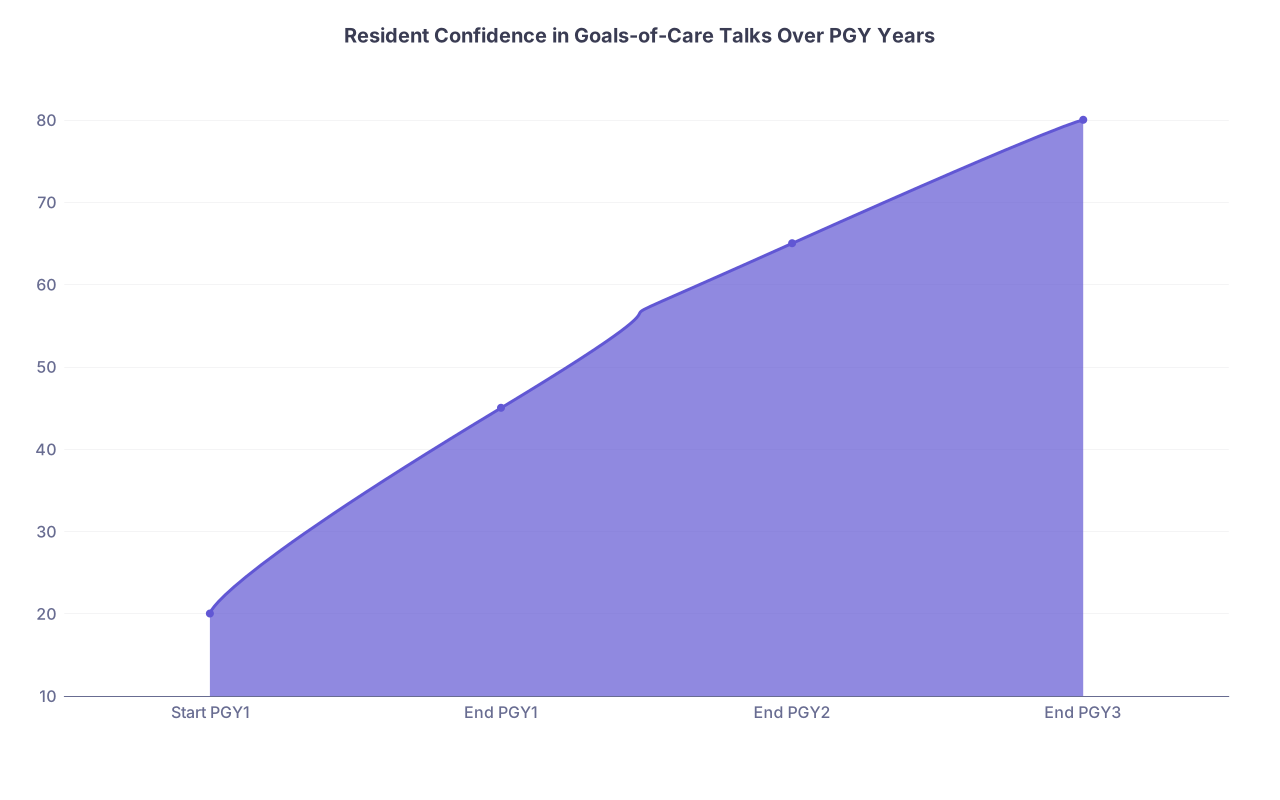
| Category | Value |
|---|---|
| Start PGY1 | 20 |
| End PGY1 | 45 |
| End PGY2 | 65 |
| End PGY3 | 80 |
You’ll move up that curve faster if you stop waiting to feel “ready” and start using a repeatable structure now.
FAQ (Exactly 5 Questions)
1. What if I strongly disagree with the family’s request but the attending isn’t available?
If they’re asking for clearly non‑beneficial interventions (e.g., CPR on a patient in active multi‑organ failure with no chance of meaningful recovery), you are not obligated to agree “for now.” Say: “I understand why you want everything that could possibly help. From a medical standpoint, some treatments do not help and only cause more suffering, so we do not offer them. What we can do is focus on keeping her comfortable and continue treatments that can still help.” If it’s a gray zone and not an emergency, you can say: “This is a big decision. I’d like to discuss this with the attending in the morning so we make the best choice for him.”
2. How much detail about CPR and dying should I give?
Enough for informed choice, not enough to traumatize. One to two sentences about what CPR is (chest compressions, shocks, tube), one sentence about the very low likelihood of returning to prior function in their specific situation, and one sentence about what “success” would realistically look like (ICU, machines, likely still dying). Skip graphic descriptions of broken ribs and gory details. If they ask directly, answer honestly and concisely.
3. What if the patient is awake and clearly doesn’t want to talk about it?
Respect that. Try: “I want to make sure we’re taking care of you in the way you’d want, especially if you got sicker. Some people like to talk about this now; others prefer not to. How do you feel?” If they decline, document that they declined and keep treating them. If they’re anxious but willing, keep it simple: “If your heart stopped and you died peacefully in your sleep, would you want us to try to restart it with CPR and machines, or let you go naturally?” No lecture needed.
4. How do I document a nighttime goals-of-care conversation so the day team doesn’t hate me?
Use a short, structured note:
– Who was present (patient capacity, family names/roles)
– Summary of medical situation as discussed
– What the family/patient understands
– Stated values (comfort vs longevity, independence vs any life, etc.)
– Your recommendation and what they agreed to (DNR/DNI, full code, comfort focus)
– Any unresolved conflicts or planned follow‑ups (e.g., “Family requests full family meeting with attending/palliative care tomorrow”)
Keep it lean but specific. No vague “discussed goals of care.”
5. What if I get too emotional or almost cry during the conversation?
You’re human. That’s usually not a problem unless you make the family take care of you. A brief pause, a quiet “I’m so sorry, this is really hard” is fine. If you feel yourself losing it, take a breath, look down at your hands or your note, and return to the structure: where we are, what matters to the patient, what I recommend. If you need a minute afterward, step into the stairwell, reset, then finish your documentation. Emotional numbness is not the goal; being steady enough to guide them is.
The core points to keep:
- Use a repeatable structure: what they know → simple summary → what mattered to the patient → clear recommendation.
- Avoid being a vending machine of options. Families want your honest guidance grounded in the patient’s values.
- You don’t need the perfect words. You need a few solid phrases, a calm presence, and the courage to say the reality out loud.