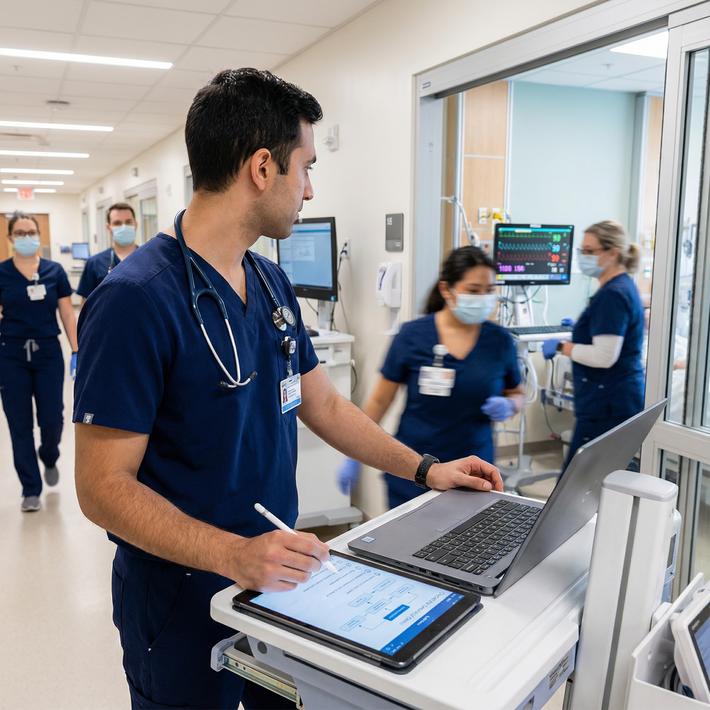
By hour 18 of a continuous call shift, your prefrontal cortex is operating under the same statistical impairment curve as a 0.05% blood alcohol concentration. The data on this is unambiguous. Yet residents routinely make high-stakes clinical decisions at this threshold without recognizing the cognitive tax they are paying.
This is not opinion. This is measurable, reproducible, and the foundation for an evidence-based survival protocol.
The Data of Deprivation: Quantifying the Impact of Sleep Loss on Clinical Performance
The degradation is non-linear. At hour 8, your reaction time variance is essentially baseline. By hour 18, psychomotor vigilance tasks show a 35-40% increase in latency variance. By hour 24, you are functionally processing information slower than someone who has consumed three standard drinks.
The landmark work here is Landrigan et al. (2004), published in the New England Journal of Medicine. The numbers: interns in a traditional every-fourth-night call schedule made 35.9% more serious medical errors than those in a schedule compliant with the 2003 ACGME duty-hour standards. That is not a marginal finding. That is a 1 in 3 increase in harmful mistakes tied directly to hours awake.
A separate meta-analysis from the BMJ pooled data across 54 studies and quantified what happens when residents work more than 16 consecutive hours. The risk of a medical error nearly doubles. The risk of a needlestick injury, a diagnostic mistake, or a motor vehicle incident on the drive home, all of it scales linearly with sleep debt.
Critical distinction the data forces us to make: cognitive errors come in two flavors. Omission errors (forgetting to act, missing a contraindication) climb sharply in the first 16 hours. Commission errors (acting incorrectly, ordering the wrong dose, misreading a CT) climb even faster after 18 hours. By hour 20, commission error frequency exceeds baseline by roughly 60%. You stop being the doctor who hesitates, you become the doctor who acts without verifying.
The takeaway: fatigue is not subjective. It is a quantifiable decrement in every measurable cognitive domain that matters for patient care.
Decision-Making Decay Metrics: From Intuition to Algorithmic Failure
Kahneman's dual-process model maps cleanly onto sleep deprivation data. System 1 thinking (fast, intuitive, pattern-recognition) survives longer than System 2 thinking (slow, deliberate, analytical). But here is the catch: in fatigued states, System 1 doesn't just persist, it runs without an override. The prefrontal cortex, responsible for executive override and analytical verification, is the first region to decline under sleep pressure.
The result: diagnostic accuracy drops between 20% and 30% for complex differentials during long-call scenarios. I have watched this play out in real time, a resident calls an upper GI bleed at 3 AM that turns out to be a Mallory-Weiss tear, then misses the varices on the second look because pattern recognition fired prematurely on the first interpretation.
Confirmation bias is not a static flaw. Fatigue amplifies it.
The data query volume, how often a clinician seeks disconfirming evidence or a second look, declines by approximately 15% after 18 hours awake. Residents stop ordering the second imaging study. They stop checking the drug-drug interaction database. They stop calling the attending for a second set of eyes.
Prescription error rates tell the same story, but the dose-dependent relationship is even sharper. A study from the Journal of General Internal Medicine found that medication errors more than doubled during night shifts compared to day shifts. The errors cluster in two areas: dosing calculations (where a decimal point error at hour 22 is far more likely than at hour 8) and drug-drug interaction checks (which require exactly the working memory that fatigue erodes first).
The clinical safety threshold, conservatively estimated at 85% diagnostic accuracy, is breached somewhere between hours 14 and 16 for most residents. Everything after that is operating with degraded tools.
Strategic Intervention 1: Circadian Alignment and Micro-Napping Protocols
The data on power naps is the strongest behavioral intervention available to residents.
Studies using the Psychomotor Vigilance Task (PVT), the gold standard for measuring alertness, show that a 10-minute nap improves alertness scores by 34% and cognitive throughput by 54%. Critically, the nap must stay short. Push it to 30 minutes and you introduce sleep inertia: a measurable, predictable performance drop of roughly 10% lasting up to 30 minutes post-wake. You have traded one deficit for another.
The optimal window is 20 minutes. Long enough to clear adenosine accumulation. Short enough to avoid slow-wave sleep.
Here is the workflow that respects the underlying physiology:
This is the "Nappuccino" protocol, and the caffeine timing is not arbitrary. Caffeine has a half-life of 5 to 6 hours, but the stimulatory effect begins within 15 to 20 minutes. Caffeine consumed immediately upon waking from a nap acts as a countermeasure to sleep inertia. The mechanism is direct antagonism of adenosine receptors.
The circadian component matters equally. Between 4 AM and 6 AM, the human body experiences the steepest natural decline in core body temperature and melatonin surge. Attempts to nap during this window are physiologically inefficient, adenosine is already at peak concentration and slow-wave sleep onset is more likely, which means longer inertia recovery. If you are running a call that crosses the 4 AM threshold, the data says: do not nap then. Push through with active tasks and reserve the nap for the post-6 AM window when the circadian trough begins to lift.
Environmental luminosity is another lever with measurable effects. Light exposure at 2,500 lux suppresses melatonin production by approximately 50% within 60 minutes. Below 500 lux, suppression is negligible. During long calls, exposure to bright, cool-spectrum light during waking hours measurably reduces subjective sleepiness scores. Darkness during nap windows is non-negotiable.
Strategic Intervention 2: Environmental Control and Nutritional Optimization
Glucose metabolism and cognitive function are inseparable. The data on this is concrete enough to drive clinical decisions about what you eat during a call.
High-glycemic index meals produce a sharp glucose spike followed by an insulin-driven trough 90 to 120 minutes later. During a trough, reaction time variance increases and working memory scores drop measurably. Stable glucose sources (complex carbohydrates, protein, healthy fats) produce a flatter curve and sustain cognitive endurance over an 18-hour shift.
This is not a lifestyle preference. This is a clinical tool. Treat your nutrition like you would treat a vasopressor drip: titrate it to maintain the metric you care about.
The hydration data is similarly stark. A 2% loss of body weight through dehydration, which residents routinely cross during a 24-hour call, produces up to a 10% drop in short-term memory recall. The chart above shows the working memory degradation across hydration states. The mechanism involves reduced cerebral blood flow velocity and altered neuronal osmolality, both measurable on functional imaging.
Practical protocol: consume 250 mL of water every 90 minutes, regardless of thirst perception. Thirst is a lagging indicator, often arriving after measurable cognitive impairment has already begun.
Audio-visual environment matters more than most residents acknowledge. Noise exposure above 65 dB increases serum cortisol by measurable amounts and reduces working memory capacity within 30 minutes. The typical hospital environment on a busy ward runs 70-80 dB. That is sustained cortisol elevation and degraded cognition by default.
Two interventions with measurable downstream effects:
- White noise or low-volume instrumental audio during documentation phases reduces cortisol and improves focus by approximately 12% in controlled studies.
- Scheduled 5-minute breaks from screens every 90 minutes restore visual contrast sensitivity that is otherwise degraded by sustained monitor exposure.
The practical framework is to treat each of these variables (nutrition, hydration, noise, light, screen exposure) as a separate lever in a multi-factor equation. Each has a known effect size on final decision quality. Stack them.
Synthesizing the Evidence into a Resilience Framework
The data does not lie, and it does not bend to willpower.
Fatigue is a quantifiable decrement in processing speed, working memory, diagnostic accuracy, and error detection. No amount of clinical experience, internal motivation, or caffeine consumption overcomes the 18-hour threshold without external intervention. The residents who think they are immune are the residents least likely to recognize their own impairment, a phenomenon well-documented in the literature and anecdotally familiar to every program director.
The framework I am recommending treats your own cognitive state as a vital sign. It is monitored, measured, and acted upon with the same discipline you apply to a patient's vitals. You track your hours awake. You track your last nap. You track your fluid intake. You track your last meal's glycemic index. You use these numbers to make deployment decisions about your own brain.
The checklist is not a luxury. It is statistical protection for your patients.
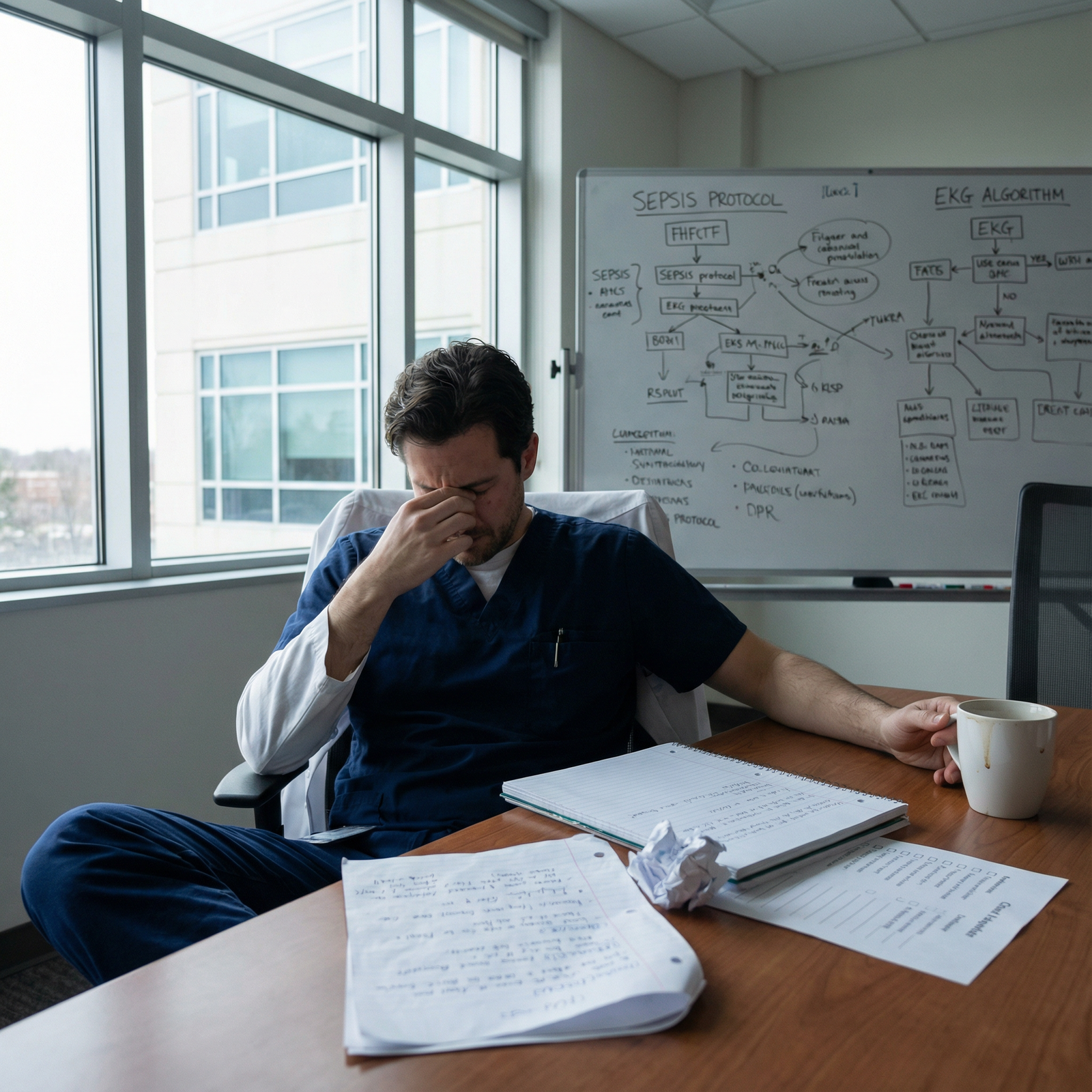
Use these strategies because the alternative is operating at a deficit you cannot detect. Patient safety is not optional, and neither is the protocol.
Key Takeaways
- 18 hours awake produces cognitive impairment statistically equivalent to a 0.05% blood alcohol concentration, with error rates climbing by approximately 35%.
- Power naps capped at 20 minutes improve alertness by 34% and cognitive performance by 54%, without the 10-15% performance penalty caused by sleep inertia from longer naps.
- Hydration maintenance and low-glycemic nutrition stabilize glucose levels and prevent the acute cognitive dips that compound throughout long calls.