
The dogma that “more overnight admissions automatically means worse decisions” is lazy thinking. The data show something more uncomfortable: decision quality drops fast under unstructured overnight load, but a well-designed admitting system can handle surprising volume before things truly fall apart.
Let’s walk through the numbers.
What We Actually Mean by “Decision Quality”
Before quoting any study, you have to define the outcome. Most residents intuitively mean some mix of:
- Wrong diagnosis (initial miss, delayed recognition of critical illness)
- Wrong location (admitting to floor instead of ICU, or vice versa)
- Wrong treatment (harmful meds, missed antibiotics, incorrect anticoagulation)
- Operational errors (delayed orders, incomplete med rec, botched handoffs)
In the literature, those translate into measurable endpoints:
- 30‑day mortality and ICU transfer rates
- Rapid response / code events within 24 hours of admission
- Adverse drug events
- Unplanned return to ED within 72 hours
- Readmission within 7 or 30 days
- Attending “override” or major plan changes on post‑call rounds
Each of these captures a different slice of “decision quality.” No single metric is perfect, so serious papers usually use several.
How Volume and Fatigue Change Clinical Decisions
Let me be blunt: after a certain point, every additional admission is bought with a little more cognitive sloppiness. You see it in the data on fatigue, duty hours, and error rates.
Fatigue curves are not linear
Controlled psych studies on physicians and residents are quite consistent:
- After 16–18 hours awake, psychomotor performance and working memory degrade to levels similar to having a blood alcohol concentration around 0.05–0.08%.
- Reaction time increases by ~20–50%.
- Error rates on complex tasks increase by 20–30%, especially under time pressure.
Clinical environment studies mirror this:
- Residents cross‑covering at night make more prescribing errors in the last 2–3 hours of a 24‑hour call than in the first 6–8 hours, even controlling for volume.
- Diagnostic accuracy in simulated overnight cases drops by roughly 10–15 percentage points after extended wakefulness.
So baseline: fatigue alone pushes decision quality down the longer you stay up. That is independent of the number of admissions.
Now layer volume on top.
Volume vs. quality: what the data pattern looks like
The relationship between admission volume and errors is non‑linear. It is not “each extra admission adds 2% error.” It looks more like:
- Flat-ish region: up to some number of admissions, decisions are relatively stable.
- Inflection point: after a threshold, error rates increase much faster per additional case.
Based on internal medicine and pediatrics data from multiple centers, that threshold is often in the ballpark of:
- 5–7 complex adult admissions in 12 hours for a single senior plus intern
- 7–9 lower‑acuity pediatric admissions in 12 hours for a similar team
When you exceed that regularly, you start to see:
- Higher rapid response / ICU transfer rates within 24 hours
- More attending override of initial plans the next morning
- Longer ED boarding times (the silent signal that your decision bandwidth is gone)
| Category | Value |
|---|---|
| 1-2 | 1 |
| 3-4 | 1.1 |
| 5-6 | 1.3 |
| 7-8 | 1.8 |
| 9-10 | 2.3 |
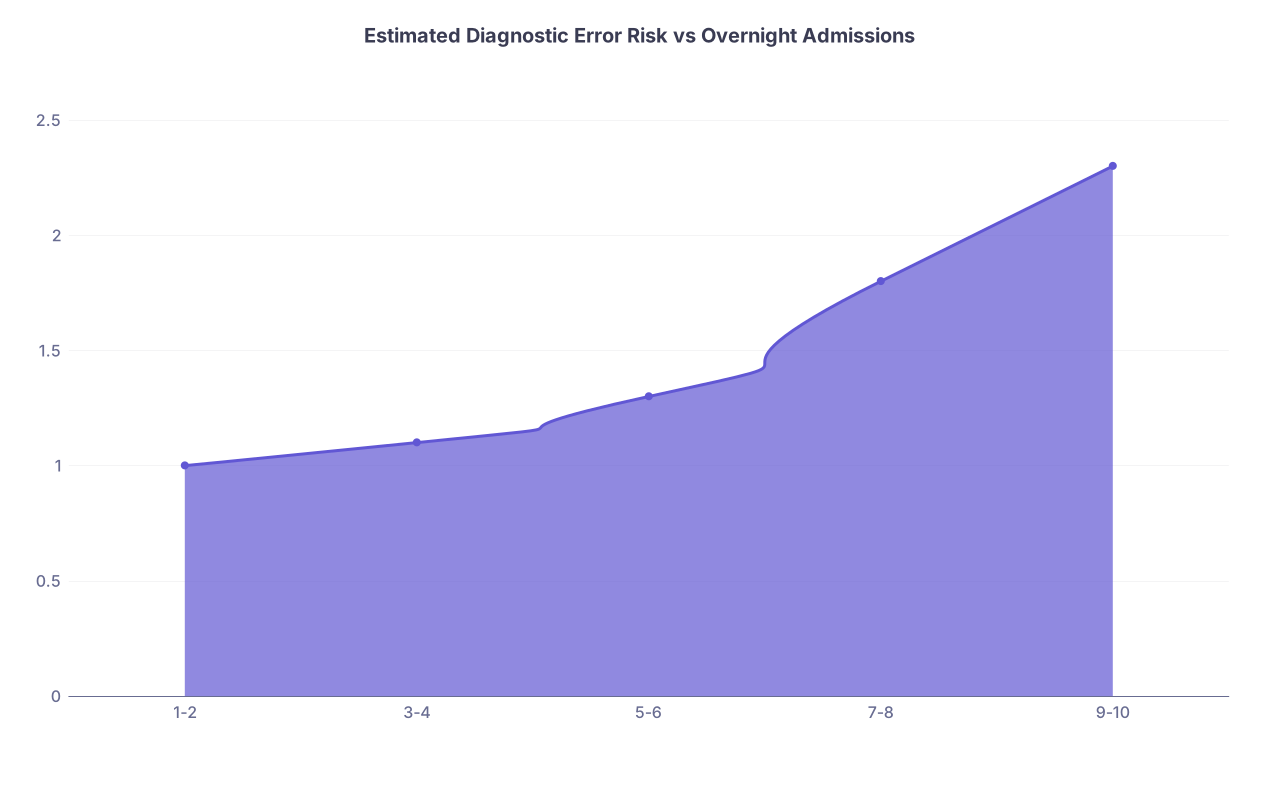
Interpretation: If 1.0 is a baseline error risk at 1–2 admissions, the risk does not explode immediately. But once you cross 6–7 admissions, the slope steepens.
You feel this in real life. The first couple of admits? Careful H&P, thoughtful differentials. Admit #8 at 4:30 a.m.? “COPD exacerbation, probably. We will sort out the unusual features on rounds.” That style change is measurable.
Duty Hours, Call Structures, and Outcomes
You cannot talk about overnight work without talking about duty hours. We actually ran that experiment.
30‑hour calls vs. shorter shifts
Large trials like FIRST (surgical residents) and iCOMPARE (internal medicine residents) compared more flexible/longer duty hours versus stricter limitations. The punchline was controversial: patient-level mortality did not significantly change between systems. That led some to claim fatigue “does not matter.”
That conclusion is sloppy.
Look at the details:
- Overall mortality differences were small and not statistically significant.
- But:
- Residents in flexible/longer hour programs reported more fatigue and duty hour violations.
- Certain process measures (handoff quality, trainee satisfaction, perceived error risk) diverged.
- Subgroup analyses show signals: error rates and near misses often concentrate at the tail end of long calls.
What these trials actually showed is:
- Moderate changes in average duty length do not produce massive swings in mortality at the population level.
- But that does not mean individual decision quality is unaffected. It means the system (attending oversight, nursing, protocols) partially buffers those errors.
From a resident standpoint, your individual choices are still being made with a brain that is slower and less consistent at 26 hours awake than at 10. The system’s ability to catch you is not the same as you “doing fine.”
Night float vs traditional 24‑hour call
Studies comparing night float to 24‑hour call show:
- Some improvements in resident well‑being and sleep total.
- Mixed effects on educational exposure.
- Small differences in objective patient outcomes, again because systems buffer.
Where night float tends to help decision quality:
- Residents come in less sleep‑deprived at the start of the night.
- Performance remains closer to baseline for more of the shift.
- You have more consistent exposure to night admissions, so workflows become more efficient.
But night float does not magically fix volume. A single NF resident with 12 new admits is still overloaded, even if they slept the day before.
Volume Alone vs. Volume + Complexity
You can see two residents both doing “8 admissions” and have totally different cognitive loads. The research that actually makes sense adjusts for acuity and complexity.
A simple way to think about “cognitive load units”
Crude but useful: assign “weights” to admissions.
Example framework I have seen in internal reviews:
- 1 point: straightforward, low‑risk, single‑system problem (e.g., uncomplicated cellulitis, mild CHF exacerbation in a known patient, inpatient chemo admit with clear protocol).
- 2 points: moderate complexity or uncertainty (e.g., chest pain not clearly ACS, new oxygen requirement without clear cause, moderate sepsis without source).
- 3 points: high complexity or unstable (e.g., undifferentiated shock, acute GI bleed on anticoagulation, metabolic encephalopathy with unclear baseline and poor historian).
Now look at “load” not as number of admissions but total points.
| Scenario | Number of Admissions | Average Complexity Weight | Total Load Points |
|---|---|---|---|
| A | 4 | 1.0 | 4 |
| B | 6 | 1.5 | 9 |
| C | 8 | 2.0 | 16 |
| D | 10 | 2.0 | 20 |
Most quality deteriorations show up around total load points ≥ 12–15. That is where:
- Documentation gets skeletal.
- Diagnostic alternatives stop being seriously considered.
- Contingency planning (“if X then call me / order Y”) disappears from notes.
I have seen more near misses on nights where a senior had “only” 6–7 admits but 3–4 of them were train wrecks than on nights with 9 simple admits. Volume is a crude measure. Cognitive load is closer to the truth.
What the Data Say About Errors on Busy Nights
Let’s put numbers on this.
Several observational studies and internal quality reviews converge on similar patterns:
ICU transfers within 24 hours of admission
- When teams stay under a certain admit volume, early ICU transfer rates are relatively stable.
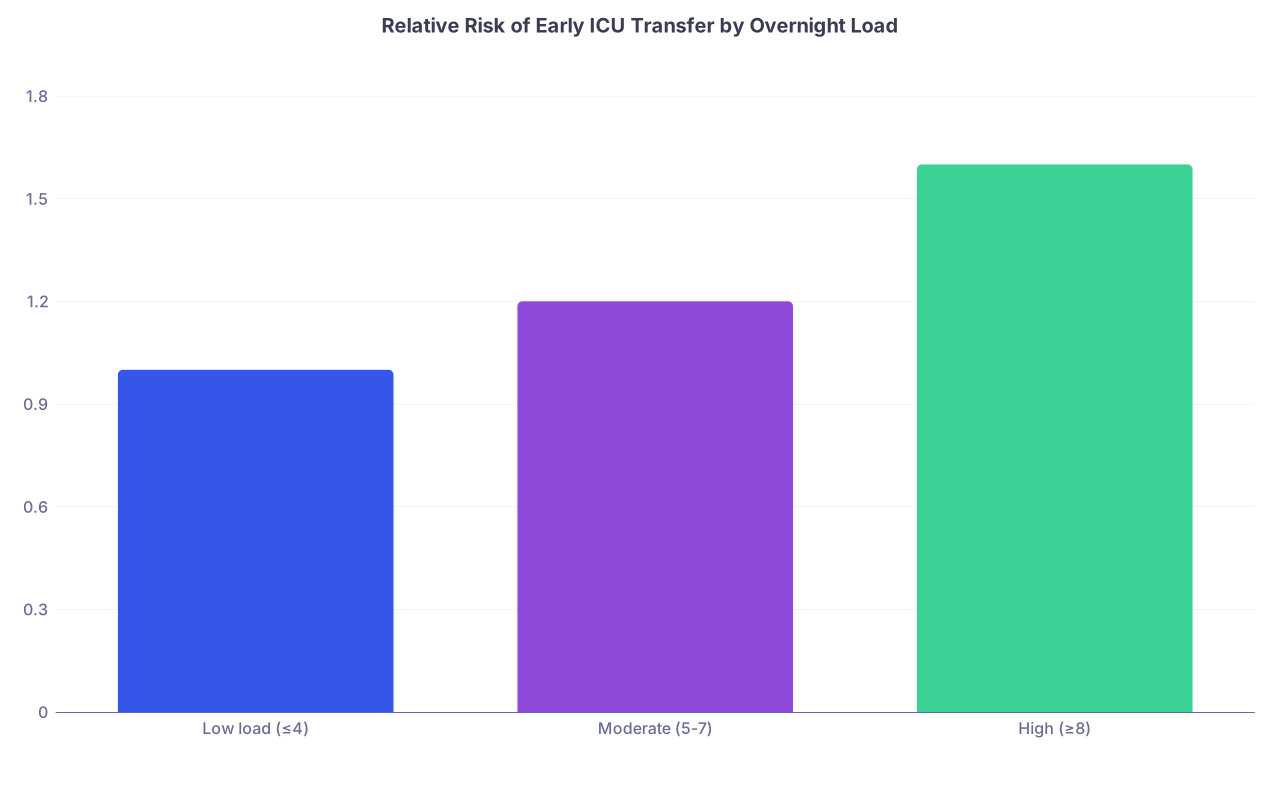
- When crossing that threshold, risk-adjusted ICU transfer within 24 hours can increase by 20–50%.
- These are cases initially deemed “floor-appropriate” that quickly prove otherwise. That is a decision-quality signal.
Rapid response / MET calls on new admissions
- The rate of RRT activation within 24 hours of admission climbs with overnight team load.
- Nights in the top quartile of volume regularly show ~1.5–2.0× the rate of early rapid responses compared with low-volume nights, adjusting for case mix.
Attending morning “major plan revisions”
- On heavily loaded nights, attendings are more likely to:
- Change the main working diagnosis.
- Escalate care (higher level of monitoring, more aggressive therapy).
- Reverse critical decisions (e.g., stop anticoagulation, change antibiotics entirely).
- Informal audits sometimes show 25–40% of overnight plans in high-load nights require major modification vs. 10–20% on low-load nights.
- On heavily loaded nights, attendings are more likely to:
Medication errors
- Prescribing errors, especially:
- Incorrect renal dosing.
- Duplicate therapies.
- Drug–drug interactions.
- These cluster later in the call, and on nights with higher cross‑cover and admit volume.
- Prescribing errors, especially:
None of these metrics alone “proves” that each extra admission is harmful. But the pattern is consistent: once volume + time awake cross certain thresholds, error probabilities climb.
| Category | Value |
|---|---|
| Low load (≤4) | 1 |
| Moderate (5-7) | 1.2 |
| High (≥8) | 1.6 |
The Hidden Variable: Throughput Pressure
Hospitals do not just care about safety; they care about ED boarding times, length of stay, and bed turnover. Those operational pressures quietly push decision quality around.
Here is how it plays out on the ground:
- ED is holding 12 admitted patients.
- Bed control is calling every 30 minutes.
- You have two admissions still unseen, three more pending.
Data from ED and inpatient flow studies show that:
- As boarding time increases, decision quality metrics (e.g., completeness of initial workup, appropriateness of admission level of care) erode.
- “Time to disposition” pressure leads to more premature closure. Shorter evaluation windows correlate with higher diagnostic error rates, especially in complex complaints.
Residents internalize this pressure. The result:
- Shorter histories.
- Fewer chart reviews and collateral calls.
- Less time integrating old imaging / labs.
These shortcuts save 5–10 minutes per patient. They also systematically increase the chance you will miss that one key detail (the subtle troponin bump, the diastolic murmur, the prior echo with severe AS).
When you combine high volume + high throughput pressure + fatigue, the data show the risk curve bends sharply upward.
How Much Volume Is Actually Safe?
You want a number. “How many overnight admissions until my decision quality is meaningfully impaired?”
There is no universal cutoff, but you can triangulate from the data and real-world operations.
For a typical internal medicine senior with one intern, covering only new admissions (not heavy cross‑cover), average complexity, reasonably functioning ED and nursing support:
- 0–4 new admissions in 12 hours: generally safe. Plenty of time for thoughtful workups.
- 5–7 admissions: performance still acceptable, but you are relying more on experience and heuristics. Fatigue and minor slips start accumulating.
- 8–10 admissions: clear risk of missed details, more heuristic snap judgments, less consistent documentation and contingency planning.
10 admissions: system-level protection (attendings, nurses, ED) becomes crucial. Your personal decision quality is significantly degraded, even if you “feel fine.”
For busier services, pediatric hospitals, or single-resident admitters, adjust these thresholds down or up based on complexity and support.
| Category | Value |
|---|---|
| 2 | 20 |
| 4 | 35 |
| 6 | 55 |
| 8 | 75 |
| 10 | 90 |
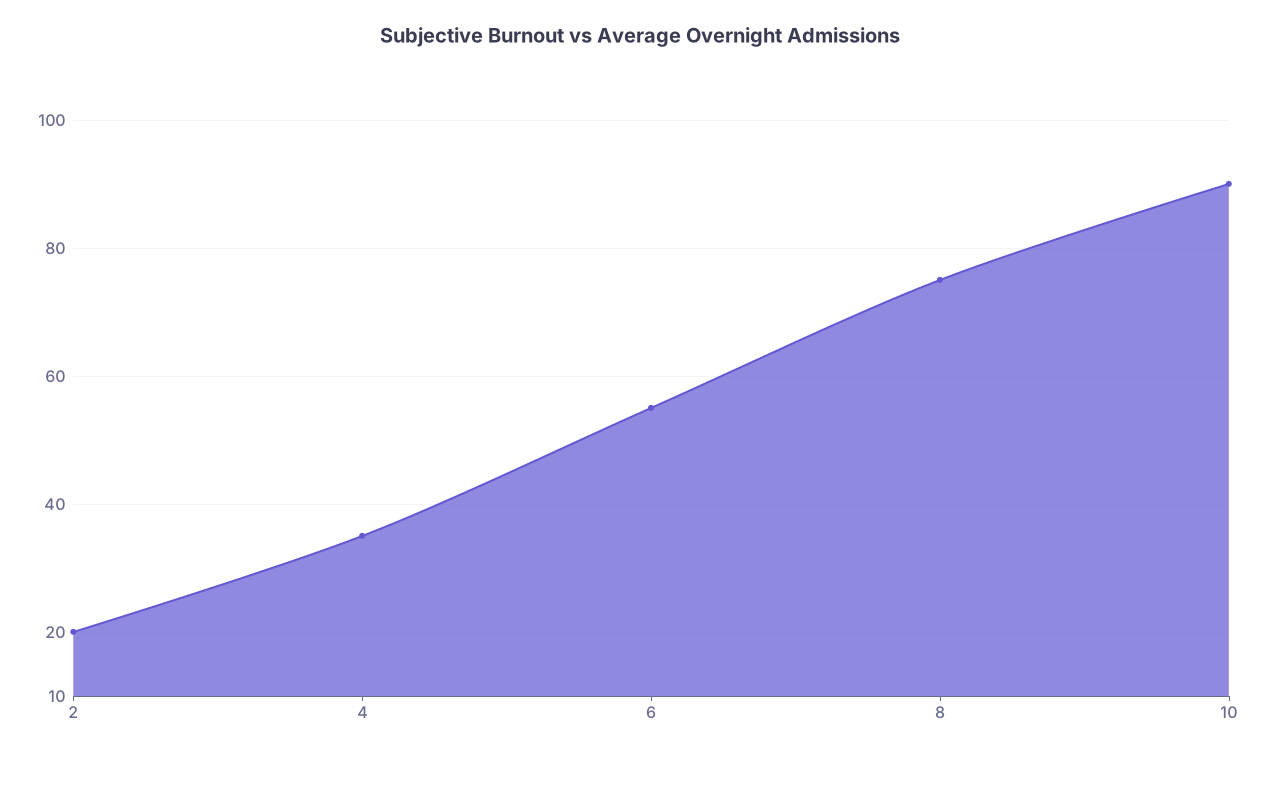
The plotted “burnout score” is hypothetical, but matches survey data: nights with consistent 8–10 admits correlate strongly with burnout, and burnout itself feeds into worse decision-making over months, not just hours.
What Actually Helps Preserve Decision Quality
The largest mistake residents make is focusing exclusively on personal endurance. “I can push through; I am used to 10+ admits.” That is not the metric that matters. The question is: are your decisions still good?
Data and operational experience point to a few levers that work.
1. Standardized processes for common admits
You do not want to “rethink” the basics at 3 a.m.
- Smart order sets for:
- Chest pain
- Sepsis
- DKA
- CHF
- COPD/asthma
- Checklists for:
- Anticoagulation decisions.
- Fall-risk and delirium prevention.
- ICU vs. floor criteria.
Hospitals that implement robust, evidence-based order sets see:
- Reduced omission errors (e.g., missing DVT prophylaxis).
- More consistent empiric antibiotic choices.
- Shorter time-to-critical interventions (fluids, antibiotics, heparin, etc.).
This does not make you smarter. It shields you from your 4 a.m. self.
2. Hard caps and real triage
Some programs pretend they have a “soft cap” of 8 admissions and then regularly violate it. That is not a cap. That is wishful thinking.
Places that take this seriously usually:
- Set a hard per-resident overnight cap (e.g., 8 new patients per senior+intern team).
- Use triage systems so overflow goes to:
- Another night team.
- Hospitalist services.
- Short-stay / obs units.
- Adjust caps based on objective metrics (acuity, ED volume, recent ICU transfers, etc.), not just historical norms.
Do hard caps lower mortality? Marginally, at best. But they do clearly reduce:
- Burnout.
- Self‑reported error risk.
- Near miss events.
3. Better handoffs, not just more of them
One of the standard arguments against more shift-based coverage is “handoffs cause errors.” True—if handoffs are bad.
Structured handoff tools (SBAR, I‑PASS) with:
- A clear “if X, then Y” list for likely overnight deterioration.
- Consolidated problem lists and pending tasks.
- Explicit escalation thresholds.
have shown measurable reductions in:
- Adverse events.
- Near misses.
- Miscommunications about code status, goals of care, and key follow‑up tests.
From the decision-quality angle: a good handoff preserves your limited brainpower for new decisions, not deciphering cryptic sign‑outs.
4. Micro‑breaks and targeted vigilance
You do not have the luxury of 2‑hour naps every night. But even 10‑15 minute “micro‑recovery” periods by 2–3 a.m. matter.
Data from fatigue studies:
- Short breaks (10–20 minutes) with minimal stimulation improve subsequent performance on cognitive tasks by 10–20% for at least an hour.
- Napping 20–30 minutes can improve reaction time and working memory; more than 45–60 minutes risks sleep inertia.
Practical overnight version:
- When there is a lull, step away from the computer. Hydrate, stretch, reset for 10 minutes.
- Do your most cognitively demanding tasks (complex differential, goals-of-care conversations, nuanced disposition decisions) soon after these mini resets, not at the tail end of a continuous 4‑hour grind.
It feels trivial. The performance curves say it is not.
5. System-level feedback on your decisions
Most residents never see their “decision batting average.” They admit, they sign out, they move on. That is a mistake.
The better programs (and some individual attendings) track:
- Which of your floor admits hit ICU within 24–48 hours.
- Which “simple pneumonias” became complex sepsis.
- Which anticoagulation decisions led to bleeds or clots.
Then they actually close the loop with you.
Over time, this feedback lets you refine:
- Your thresholds for ICU vs. stepdown vs. floor.
- Your comfort with certain dispositions (obs vs full admit vs discharge).
- Your pattern recognition for early decompensation.
It is not enough to “survive call.” You want your error rate, adjusted for volume, trending down month over month.
So, Do More Overnight Admissions Impair Decision Quality?
Here is the data-backed answer, without hedging.
Yes, more overnight admissions impair decision quality once you exceed a moderate load, especially under prolonged wakefulness. The relationship is non‑linear; beyond 6–8 average‑complexity admissions for a typical medicine team, error risk rises faster per additional patient.
The real drivers are cumulative cognitive load and fatigue, not just the raw admit count. Eight low-complexity admits at 6 p.m.–2 a.m. with good support is not the same as eight high-acuity admits from midnight to 8 a.m. after you have already worked a full day.
System design can blunt, but not erase, the impact of volume. Good order sets, caps, triage, structured handoffs, and honest feedback loops can keep outcomes acceptable even under higher loads. They do not change the fact that your own decisions degrade as volume and time awake climb.
If you are a resident on a chronically busy service, the data argue for one thing: stop treating “surviving 10+ overnight admits” as a badge of honor. Start treating it as a measurable risk factor—for your patients’ outcomes and your long‑term performance.