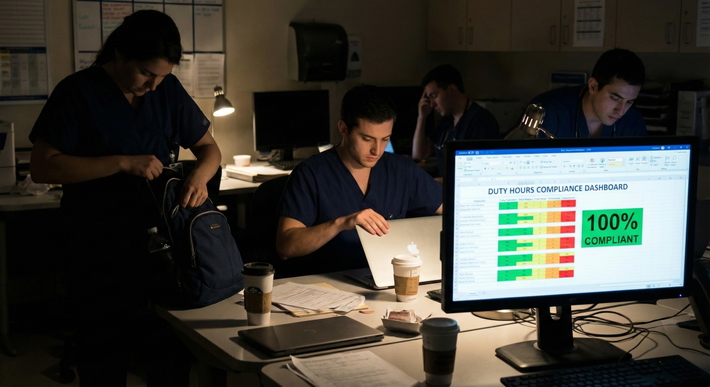
It is 4:45 PM on a Thursday. You have been on your feet since 5:00 AM. You managed three ICU admissions, wrote twelve progress notes, dealt with two family meetings, and haven't swallowed anything harder than cold hospital coffee since sunrise.
You are forty-five minutes away from sign-out. You could spend that time finishing your charts, catching up on orders, or, god forbid, leaving on time to sleep.
Understanding the distinction between true cultural issues and simple logistical strain is essential for your long-term success, as explored in how to identify if a residency program is malignant or just intense.
Instead, your chief resident walks into the team room to remind everyone that the mandatory 5:00 PM "Residency Mindfulness & Ice Cream Social" is starting in the auditorium. Attendance will be taken.
If this scenario makes your stomach drop, it should. Mandatory wellness is an oxymoron. It is institutional doublespeak designed to shift the burden of system failure onto individual doctors. When a residency program forces you to participate in performative relaxation under threat of non-compliance, it isn't caring for your mental health. It is telling you exactly how little it values your time.
Here is how to decode this major red flag during interview season, understand what it reveals about a program's culture, and handle mandatory events when you're trapped in one.
This article is for educational purposes only. It is not financial advice, not legal advice, and not tax advice. Figures vary by individual circumstances, so consult a qualified professional before acting.
The Illusion of Wellness: Why Mandatory Fun Backfires
Let's call mandatory wellness what it actually is: institutional gaslighting.
Before you assume these policies are standard, learn to recognize the signs that these efforts are failing, as discussed in Common Red Flags Applicants Ignore on Interview Day (And Regret Later).
When a hospital system exposes you to 80-hour workweeks, broken EMR software, missing ancillary staff, and relentless clinical pressure, you don't suffer from a deficiency of yoga or ice cream. You suffer from structural exploitation.
Structural System Failures (Understaffing, 80hr weeks, Poor EMR)
                  ↓
          Burnout & Exhaustion
                  ↓
   Program Response: "Mandatory Wellness"
                  ↓
   The "Wellness Penalty" (Lost free time, Increased guilt)
Always look for patterns of behavior in leadership, because Behind the Smiles: Faculty Behaviors That Signal a Problem Program is a critical indicator of long-term work satisfaction.
Always remember that your peers are your best source of truth; learn how to read between the lines when speaking with them in how residents secretly warn you about toxic programs on interview day.
When leadership responds to chronic exhaustion by stripping away your remaining free time for compulsory socialization, it creates intense cognitive dissonance. You are told the event is for your benefit, yet your real, acute needs, sleep, chart completion, personal chores, or quiet isolation, are actively undermined by your attendance.
The Signal vs. The Noise
Mandatory wellness sends a clear signal about how leadership views residents. It reveals a fundamental lack of institutional trust.
Healthy organizations trust intelligent adults to manage their own rest and recovery. Toxic organizations treat residents like children who must be rounded up, babysitting style, to prove they are engaging in "approved" self-care.
If a program director actually trusted you to self-manage, they would give you an unscheduled two hours off on a Friday afternoon and say, "Go home, sleep, play video games, see your kid, or drink a beer. Just don't be here."
When they force you into a room to watch a PowerPoint presentation on resilience instead, they aren't giving you wellness. They are collecting an attendance metric.
The "Band-Aid" Approach to Burnout
Performative wellness is cheaper than real operational change.
Adding an extra phlebotomist to night shift costs money. Fixing a broken call-room door costs money. Reducing patient caps to safe ratios costs money.
Buying three tubs of cheap ice cream and forcing fifteen exhausted trainees into a conference room costs fifty bucks.
Programs use these events to create the appearance of support without spending the capital required to build a functional work environment. It allows administration to wash their hands of institutional burnout. When you inevitably crash, the unwritten narrative becomes: "We gave them mindfulness seminars, but they just didn't use the tools."
The Psychological Cost: The Wellness Penalty
Every hour spent in a forced social event carries a heavy tax.
I've seen residents forced to stay an hour past sign-out to paint rocks for "stress relief," only to spend the next two hours at home writing late discharge summaries while their dinner gets cold. That is the Wellness Penalty. You are forced to pay for administrative optics with your own sleep, family time, and sanity.
Red Flag Indicators: Decoding Program Behavior
How do you distinguish between a program that offers real support and one that uses compulsory wellness as a public relations shield? Look at how autonomy is handled.
Autonomy vs. Coercion
Genuine wellness is always a resource, never a mandate.
- Healthy Programs: Provide opt-in resources. They hire dedicated resident counselors with open scheduling, offer coverage for personal doctor appointments without penalty, build buffer time into rotations, and make social events strictly optional. If five people show up to the pizza party, leadership doesn't send a stern email. They assume the rest were resting.
- Toxic Programs: Require badge scans, sign-in sheets, or camera-on Zoom participation for wellness events. They monitor who attends and track absent residents like late high schoolers.
Analyzing the Hidden Curriculum
Pay attention to the gaps between what leadership preaches and what they enforce. This is the hidden curriculum.
If a program spends two hours during orientation lecturing on the importance of mental health, but requires a formal doctor's note to take a single sick day, the wellness program is purely for compliance.
The primary driver here is often accreditation. The ACGME (Accreditation Council for Graduate Medical Education) mandates that residency programs provide wellness resources. A weak program checks this box by scheduling mandatory lectures because it creates an easy audit trail. They can hand the accreditation inspector a sign-in sheet proving 100% compliance with "well-being initiatives."
It protects their accreditation status. It does nothing for yours.
The Checklist Diagnostic
When researching residency programs or reflecting on your current one, ask these three diagnostic questions:
- Is time protected or added? Does the event replace clinical duties, or is it tacked onto the end of a full workday?
- What happens if you skip? Is there zero penalty, or does missing the event trigger a conversation about your "professionalism"?
- Is feedback acted upon? When residents report that mandatory events increase their stress, does leadership cancel them, or do they double down on why attendance is critical?
The Decision Path: Managing the Mandatory Trap
What happens when you find yourself in a program where wellness events are enforced with an iron fist? You cannot simply flip off your program director and walk out. You have a career to protect.
You need a clear tactical framework for when to comply, when to quietly duck out, and how to protect yourself from professional fallout.
Step-by-Step Scenario Analysis
Scenario A: The High-Risk Event
- The Situation: The Program Director is hosting a mandatory team-building dinner at their home, or a hospital-wide retreat where leadership personally checks off names.
- The Assessment: High political risk. Skipping this directly signals rebellion to the people writing your fellowship recommendations or employment evaluations.
- The Move: Attend. Show your face early, speak directly to the PD or Chief, eat a plate of food, stay for 45 minutes, and execute a quiet, polite exit. Do not sit in the corner scowling. That gets you labeled as having a "bad attitude." Smile, play the game briefly, and leave.
Scenario B: The Low-Risk Event
- The Situation: A generic lecture on "Resilience in Medicine" held in a large auditorium or over Zoom, organized by hospital administration, with no department leadership in direct attendance.
- The Assessment: Low political risk.
- The Move: If it's on Zoom, sign in, mute your microphone, turn off your camera, and complete your charts, study, or take a nap. If it's in-person, sit in the back row near an exit door. If attendance isn't actively audited at the door, spend that hour in the resident lounge catching up on life.
Scenario C: The Conflict Scenario
- The Situation: The mandatory event clashes directly with urgent clinical care or your absolute limit of physical exhaustion.
- The Assessment: Medium to High political risk requiring proactive management.
- The Move: Never simply fail to show up without notification. That leaves you open to "unexcused absence" flags. Frame your absence around patient safety or critical clinical duties before the event starts.
Strategic Self-Advocacy: Taking Back Your Time
If you must decline a mandatory non-clinical event, your framing is everything. Never pitch your absence as "I don't want to go" or "I need a break." That invites leadership to lecture you on time management.
Instead, frame your absence as an active decision to protect clinical duties and professional sustainability.

Scripts for Professional Boundaries
When you need to opt out of non-essential events without burning bridges, use these exact approaches:
Script 1: The Patient Care Buffer
"Dr. [Chief Resident], I have two patients undergoing active workups that require close monitoring this afternoon. To ensure safe handoffs and timely sign-out, I won't be able to step away for the wellness session today. I will focus on getting these tasks closed out."
Why it works: No chief resident or PD can reasonably tell you to abandon patient care for a mindfulness seminar without exposing their own terrible priorities.
Script 2: The Professional Conflict Frame
"I have a scheduled professional conflict during that hour tied to time-sensitive administrative responsibilities [or board preparation / mandatory clinical charting]. I'll be using that block to stay on track with my requirements."
Why it works: "Professional Conflict" is a standard corporate term. It is neutral, dry, and unarguable. It reframes your absence as an act of duty rather than slack.
Script 3: The Post-Call Exception
"Since I am coming off a 24-hour shift, I am prioritizing immediate post-call fatigue recovery to maintain safe practice for my next clinical shift. I will be heading home immediately following sign-out."
Why it works: Patient safety is the ultimate shield. By linking your departure directly to clinical safety on your next shift, you make forcing your attendance a legal and operational liability for them.
Cultivating Off-Grid Support Systems
Do not rely on your hospital system to meet your emotional needs.
The most resilient doctors build wellness infrastructure entirely outside their residency program:
- Build a Non-Medical Social Anchor: Keep friends who do not care about medicine. Talking about things other than patient care, hospital politics, and match statistics is essential for maintaining your identity.
- Protect Real Time Off: When you have a genuine day off, disengage completely from the hospital's messaging apps, email, and group chats. Put work chats on mute.
- Form Peer Solidarity Groups: Find two or three peers in your program who see through the administrative performative games. Use each other to trade shifts, cover chart blocks, and vent privately. Real resident wellness is found in organic peer support, not program-sanctioned ice cream.
Action Steps: Protecting Your Sanity in Residency
If you are evaluating programs or currently navigating mandatory events, put this strategy into immediate practice:
- Audit Your Program's Events: Identify which mandatory sessions carry actual career risk and which are administrative noise. Stop attending low-risk, unmonitored sessions out of vague guilt.
- Establish the "Professional Conflict" Defense: Stop giving emotional excuses for why you can't make an optional-mandatory event. Use dry, professional language focused on work completion and recovery.
- Log Your Time Accurately: If mandatory wellness events push your work hours over the 80-hour weekly limit, log those events accurately in your duty hour software. Watch how fast "mandatory" events become optional when they trigger duty-hour violations with the ACGME.
- Use Interview Season Wisely: When interviewing, ask residents directly: "What happens if someone misses a departmental social or wellness event because they are tired?" Their hesitation or nervous laughter will tell you everything you need to know.
Your time is your most valuable asset during residency. Defend it fiercely, spend it wisely, and don't let anyone force you to paint rocks when you need to sleep.