
What if the smiling PD, the polished slide deck, and the cheerful residents are all quietly covering up that the program is in serious ACGME trouble—and you don’t find out until you’ve already matched there?
That’s the nightmare, right?
Let me say the scary part out loud: yes, programs can absolutely be in trouble with the ACGME and still look “fine” on interview day. I’ve watched people match into programs that were put on probation within months. I’ve heard the “we had no idea” conversations. It’s not rare enough to ignore.
But it’s also not random. There are patterns. There are breadcrumbs.
Let’s walk through them, because pretending this can’t happen doesn’t protect you. Knowing how to spot the cracks does.
First: What ACGME “Problems” Actually Look Like
Before the paranoia fully takes over, you need to know what you’re even scared of. “ACGME trouble” isn’t one thing.
Broadly, you’re looking at:
- Citations (program not meeting standards in some area)
- Warning status
- Probation
- Loss of accreditation (partial or full, sometimes with a timeline)
| Status | What It Means Briefly |
|---|---|
| Citations | Problems identified, must fix |
| Warning | Significant concerns, at risk |
| Probation | Serious noncompliance, last chance |
| Withdrawal | Accreditation removed |
The ACGME isn’t super transparent for applicants. You can’t just search a public list of “problem programs” for most specialties. So you’re left reading between the lines.
Here’s the worst part: on interview day, everyone can lie by omission. They just… don’t mention it. Or they word it like, “ACGME had some questions we’re addressing” while the house is actually on fire.
So you need your own detection system.
Real Signs a Program Might Be Hiding ACGME Issues
I’m going to be blunt: one red flag alone isn’t enough to panic. A cluster of them? I’d be very cautious.
1. Awkward, Vague Answers to Direct Questions
If you do one thing, do this: ask direct, uncomfortable questions and watch how they answer.
Examples to ask the PD or APD:
- “Have you had any recent ACGME citations or site visits?”
- “Have there been any recent changes to your accreditation status?”
- “What were the main concerns from your last ACGME review and how did you address them?”
Red flag behavior:
- They change the subject.
- They say, “We’re fully accredited,” and refuse to expand.
- They say, “Every program has citations,” without ever naming what theirs are.
- They suddenly run out of time when these topics come up.
Normal, healthy answer sounds like:
“We did have a citation about duty hour violations two years ago. It was mostly related to one busy service. We added an extra night float, hired an NP, and our latest ACGME survey shows big improvement in that area.”
If they can’t say concrete things like that, I don’t trust it.
2. Strange Resident Behavior When Faculty Are Around
Residents usually know the truth. The question is whether they’re allowed to say it.
Things I’ve seen that made my stomach drop:
- Residents are super stiff and guarded during formal Q&A, but loosen up and give a totally different story when you catch them one-on-one in the hallway.
- A chief starts to answer a question about “program changes” and a faculty member or coordinator cuts them off with, “We can talk about that later.”
- You ask, “How’s morale after all the recent changes?” and the residents exchange looks before someone gives a canned line like, “We’re really excited about all the growth.”
If residents seem scared to contradict leadership, that’s a giant, blinking warning sign.
3. Sudden, Vague “Rebuilding” or “Transition” Narrative
Programs in ACGME trouble love the “we’re rebuilding” script. Sometimes it’s legit. Sometimes it’s code for “the ACGME smashed us and we’re trying not to collapse.”
Common lines:
- “We’re in a period of growth and reorganization.”
- “There have been a lot of leadership transitions, but we’re very excited.”
- “We’ve really changed how we do things this year.”
You have to press: why.
Follow‑up questions:
- “What triggered the reorganization? Was it feedback from the ACGME? Residents? Hospital?”
- “What were the main issues you were trying to fix?”
- “What measurable outcomes have improved since the changes?”
If they never name specifics—like “we lost several faculty,” “our board pass rates fell,” “we had duty hour problems”—I start thinking they’re hiding the root cause.
4. Weird Attrition or Resident Disappearances
Nothing screams “something is wrong here” like residents vanishing.
Watch for:
- Several PGY‑2 or PGY‑3 residents “transitioned out” or “pursuing other opportunities.”
- A class that’s noticeably smaller than the others with a hand‑wavy excuse.
- Nobody can clearly explain where departed residents went.
Healthy programs will say:
“We had one resident leave for family reasons—moved to be closer to home, transferred to X program. We helped them find a spot.”
Shaky programs say:
“Yeah, a few people left. It just wasn’t the right fit.”
When “not the right fit” happens multiple times in a small program, it’s not random mismatch. It’s structural.
5. Major Faculty Turnover… with Zero Clear Explanation
Yes, academics has turnover. But a swarm of exits all at once is suspicious.
Ask:
- “Have there been any major faculty changes in the past 2–3 years?”
- “Why did the previous PD step down?”
- “How long has your core faculty been here?”
Red flags:
- “The PD stepped down to focus on other opportunities” with no specifics.
- They keep using soft, PR language instead of giving real reasons.
- Residents privately tell you, “We’ve had 3 PDs in 5 years.”
Programs in ACGME trouble often churn leadership because someone got blamed, pushed out, or quit in frustration. If it looks like musical chairs, be careful.
6. Board Pass Rates and Case Logs Are… “Not Available”
Any time data disappears, I start to worry.
Look on the program website. Then ask during interviews:
- “What have your board pass rates been over the last 5 years?”
- “Have you ever had ACGME concerns about case volumes or clinical exposure?”
If they say:
- “We don’t track that.”
- “We don’t have that data available right now.”
- “We don’t like to focus on numbers.”
That’s not thoughtful philosophy. That’s hiding bad numbers.
A confident program will say, “We had a rough year in 2020 with a couple fails, but our rolling 5‑year rate is X%, and here’s what we changed.”
7. The ACGME Survey Vibes Don’t Match the Marketing
You can’t see their ACGME survey, but you can ask what they did with it.
Ask residents:
- “Do you feel comfortable giving honest feedback on the ACGME survey?”
- “Do you ever feel pressured to answer survey questions a certain way?”
- “Has leadership shared ACGME survey results with you and talked about changes?”
Big red flag: residents look anxious, say “we’re told the survey is really important,” but can’t recall any concrete improvements ever tied to survey results.
Here’s what a good program does: they say, “We scored low on X, so we added Y. This year it improved.” Bad programs just tell residents “answer positively or we’ll lose accreditation.”
Concrete Ways to Check If You’re Being Lied To
You’re not totally powerless here. You can’t pull secret ACGME files, but you can triangulate.
1. Use the ACGME Public Program Search
It’s limited, but not useless.
Go to ACGME’s public program search and confirm:
- The program is currently accredited.
- There’s no obvious “withdrawn” or “continued accreditation with warning” label, if visible for your specialty.
Sometimes updates lag. Sometimes warning status isn’t obvious. But if something looks off—like accreditation end dates that are abnormally soon—mentally flag it.
2. Look at Trends, Not Just Today’s Brochure
Use whatever you can find:
- Old program websites (Wayback Machine is your friend).
- Past resident lists—are there multiple people missing?
- Old vs. new case log claims, board pass rate claims, number of sites.
Sudden changes like:
- Dropping number of residents per year.
- Losing a main training hospital site.
- Major shift in rotations without clear explanation.
These aren’t always ACGME‑driven, but they often correlate with pain behind the scenes.
3. Ask Residents the Questions You’re Afraid to Ask
Pull a resident aside privately if you can.
Literal scripts you can use:
- “Off the record—have there been any ACGME issues recently?”
- “Did you feel like everything you were told on your interview day turned out to be accurate?”
- “If you were applying again, would you rank this place highly?”
And then watch their body language. The long pause before answering is often more telling than the actual words.
If they say, “I’d still rank it, but probably not as high as I did,” that’s honest. If they say, “I’d leave if I could,” believe them.
4. Pay Attention to How They Talk About Duty Hours and Workload
Look, if a program has serious ACGME trouble, duty hours and supervision are frequent culprits.
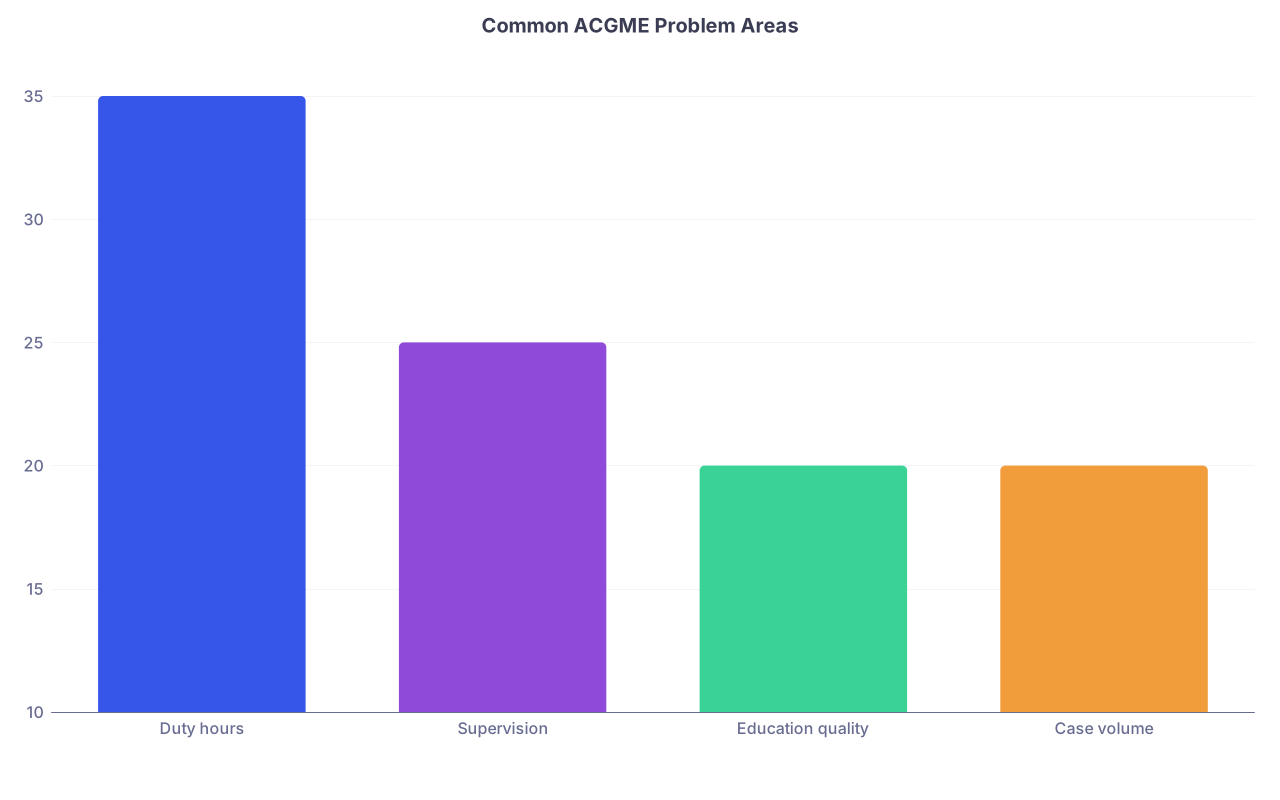
| Category | Value |
|---|---|
| Duty hours | 35 |
| Supervision | 25 |
| Education quality | 20 |
| Case volume | 20 |
Ask:
- “Have you ever had duty hour citations?”
- “How does the program monitor and respond to duty hour violations?”
- “Do you feel comfortable logging your true hours?”
If they make jokes about “we don’t log honestly” or “you just learn to round down,” that’s not cute. That’s literally ACGME violation territory. And it’s often connected to larger accreditation issues.
What If You Match and Then Find Out There Are ACGME Problems?
The worst‑case you’re spiraling about: you rank them high, you match, and then the email drops. Probation. Or status change. Or gossip explodes on social media.
Take a breath.
Programs on probation or warning don’t instantly disappear. ACGME usually gives a timeline to fix issues. Residents currently in the program are usually allowed to finish, or are supported in transferring if it truly collapses. It’s not like the floor opens and you fall into unemployment.

| Step | Description |
|---|---|
| Step 1 | Learn of ACGME problems |
| Step 2 | Talk to PD and program leadership |
| Step 3 | Ask for written ACGME action summary |
| Step 4 | Request remediation timeline and support |
| Step 5 | Talk to GME office and mentors |
| Step 6 | Explore transfer options |
| Step 7 | Plan to stay or leave |
If it happens to you:
Talk to the PD and GME office. Ask for:
- What the exact ACGME findings were.
- What the remediation plan is.
- How your graduation and board eligibility will be protected.
Talk to residents above you.
- “How is this actually affecting your day‑to‑day?”
- “Is anything improving or just getting more chaotic?”
Talk to outside mentors.
- They may know if this program has a history of problems or if this is a one‑off.
Leaving isn’t always the right move. I’ve seen residents ride out probation and graduate with solid training. I’ve also seen residents spend two years in a disaster and then scramble to transfer. The point is: you aren’t locked in a burning building with no doors.
How Much Should This Fear Change Your Rank List?
This is the real question: do you tank a program on your list because of a few weird vibes?
Here’s how I’d think about it.
If you notice:
- One or two mild red flags
- Residents seem mostly okay
- PD answers questions with specifics
…I’d keep it on my list, but not at the very top unless there’s something else incredible about it (location, niche training, etc.).
If you notice:
- Multiple red flags stacked: vague leadership, missing residents, secretive vibe
- Residents clearly guarded or unhappy
- No one will talk concretely about ACGME feedback or data
…I’d drop it significantly. Or off the list entirely if you have safer options.
Your future self isn’t going to say, “I wish I’d ignored my gut and ranked that sketchy program higher.” They’re going to say, “I wish I had taken my own discomfort seriously.”
Quick Comparison: Relatively Safe vs Seriously Concerning
| Area | Healthier Program | Concerning Program |
|---|---|---|
| PD answers | Specific, transparent | Vague, deflecting |
| Residents | Candid, mixed pros/cons | Guarded, scripted |
| Attrition | Rare, with clear reasons | Multiple unexplained losses |
| Data (boards etc.) | Available, even if imperfect | “We don’t track that” or “not available” |
| Changes | Tied to clear feedback, measurable goals | Hand‑wavy “rebuilding” stories |
No program is perfect. You’re not looking for perfection. You’re looking for honesty and direction.
The Part Nobody Says Out Loud
A lot of applicants assume: “If the ACGME is watching them, things will get better.” Sometimes yes. Sometimes the pressure makes leadership more controlling, more paranoid, more hostile to feedback.
What you want to see is a culture that says:
“We had problems. We owned them. Here’s what we’re doing. Here’s how you’ll be protected while we fix it.”
If instead you see:
“We’re great. No problems. Anyway, let’s move on.”
I’d start planning my exit… before even entering.

FAQ – Exactly What You’re Afraid to Ask
1. Can a program actually hide probation status from applicants?
They can avoid bringing it up. They can spin it. But outright lying about accreditation status is dangerous for them. The safer (but still shady) move is to be aggressively vague: “We’re fully accredited,” while leaving out “…on probation.” That’s why you need to ask specifically about “recent citations, warning, or probation” and watch how they respond.
2. If a program is on probation, will I still be board‑eligible?
Usually yes, if the program remains accredited during your training and meets the board requirements. Probation ≠ no accreditation. It’s like a last warning. The real panic scenario is if accreditation is withdrawn entirely while you’re there. Even then, there are often transition plans or transfer support. It’s messy, but you’re not instantly doomed.
3. Is it rude to ask directly about ACGME problems on interview day?
It’s assertive, not rude. Any program that punishes you mentally for asking how stable their accreditation is… is telling you something about their culture. Phrase it respectfully: “Could you share any recent feedback from the ACGME and how the program has responded?” If they get defensive, that’s data.
4. What if residents clearly look miserable, but say everything is fine?
Believe the misery, not the words. Residents are under pressure to “sell” the program. They may be scared, or they may feel trapped and not want to jeopardize anything. If faces, tone, and body language don’t match what they’re saying, assume the truth is closer to what you’re seeing than what you’re hearing.
5. Are small community programs automatically higher risk for ACGME issues?
Not automatically. Some community programs are fantastic and tightly run. But smaller programs do have less buffer: losing one faculty member or one hospital site can destabilize things faster. So I’d be a little more aggressive about asking structural questions—case volume, faculty stability, recent ACGME feedback—at smaller places.
6. How do I balance my fear of hidden problems with my limited interview options?
You don’t need to nuke every imperfect program. Focus on patterns. If you have a few interviews, rank all of them but put the clearly healthier, more transparent programs higher. If one place is setting off every internal alarm, it’s okay to rank it low or not at all, even if your fear brain yells, “But what if I don’t match?” Long‑term misery in a toxic, unstable program is worse than doing a prelim year and reapplying.
Key points to keep in your head: programs can hide ACGME problems, but they rarely hide them perfectly; clusters of vague answers and nervous residents are your biggest clues; and you’re allowed to prioritize honesty and stability over shiny marketing when you build your rank list.