
The fantasy of the “perfect” residency program is killing your sanity.
Because once you start really digging, it feels like every place you like has at least one big, ugly red flag. Malignant rumors. Terrible call schedule. Weak fellowship match. No diversity. Sketchy PD. And then your brain goes straight to: “If I pick wrong, I ruin my entire career.”
Let me say this bluntly: that all-or-nothing thinking is lying to you.
You’re not wrong that red flags matter. Some of them are absolutely real and dangerous. But the thing no one tells you is this: you will never find a program that doesn’t have something wrong with it. The trick is not “avoid all red flags.” The trick is “figure out which red flags are survivable for you and which are deal-breakers.”
Let’s walk through this like two people doom-scrolling FREIDA together at 1:30 a.m.
Step One: Admit the Horrible Truth – Every Program Has Problems
You’re not crazy: once you start collecting data, things get dark fast.
You hear stuff like:
- “Amazing fellowship match… but everyone is miserable.”
- “Super supportive PD… but scut work is out of control.”
- “Great culture… but no one publishes anything.”
- “Tons of autonomy… but attendings can be brutal.”
That’s not you being picky. That’s just… residency.
Here’s the uncomfortable reality I’ve seen over and over:
Most programs are some mix of:
- 1–2 hard red flags (scary but maybe fixable or context‑dependent)
- Several yellow flags (annoying but workable)
- A handful of green flags (the things that made you like them)
The disaster thinking kicks in when your brain goes: “Any red flag = don’t rank.” That’s how you end up with a rank list that’s three programs long and cortisol levels of a hummingbird.
Step Two: Sort Red Flags Into “Career-Ending” vs “Miserable-But-Manageable”
Not all red flags belong in the same mental bucket. Some really are “run” territory. Others might actually be okay depending on your priorities.
Here’s how I’d split them, if I’m being brutally honest.

1. Deal-Breaker Red Flags (These can absolutely wreck you)
These are the ones where I’d say: don’t rationalize, don’t “maybe it’ll be fine.” Just no.
Things like:
Documented duty hour abuse + pressure to falsify
Not just “we work hard.” I mean: residents being told to change hours, threatened if they report, or everyone laughing about “we don’t log honestly here.”Pattern of residents leaving, getting fired, or going unmatched for jobs/fellowships
One person leaving? Could be personal. Four people over three years? That’s a pattern.Consistent, specific stories of bullying/harassment from multiple sources
“The ICU attending is intense” is one thing. “Numerous attendings scream at residents in front of patients, use slurs, retaliate against complaints” is another.Financial/ACGME instability
Recent probation. Hospital bankruptcy concerns. Sudden major cuts to staff or services that affect resident education.
These are the “this could actually screw my license, my mental health, or my ability to practice” flags.
2. Risky But Context-Dependent (Scary but maybe survivable)
These are the ones you’re probably obsessing over:
High workload / very busy service
You’ll hear: “We’re a workhorse program.” That could mean “phenomenal training, you’ll be tired but competent” or “you’re the cheap labor holding up a collapsing system.”“Malignant” reputation online
Half the time this is a mix of old leadership issues, one loud angry grad, or pre‑reform culture. Sometimes it’s absolutely real. Needs more data.Weak research / few publications
Massive issue if you want cards at MGH. Much less of an issue if you just want to be a solid community doc in a good city and don’t care about NIH grants.Location you hate or social isolation risk
Rural when you’re a city person. City when you’re burnt out from crowds. Far from family. This can eat you alive mentally, but it depends on your support system and personality.
These deserve serious thought. But they’re not universal “no”s.
3. Annoying But Manageable (Will suck, might not break you)
Stuff like:
- Crappy EMR, old facilities
- No free food, parking is expensive
- Didactics are meh, but people are nice and service is strong
- Less glamorous hospital name
These feel huge when you’re reading Reddit at midnight. Three months in, you’re mostly mad about call schedules and cafeteria hours.
Step Three: Build a “Red Flag Matrix” So You Don’t Lose Your Mind
You’re probably trying to keep 20 different variables per program in your head. That never works. You just end up with a vague sense of doom about everything.
Make it concrete.
| Priority Level | Category | Deal-Breaker Example | Manageable Example |
|---|---|---|---|
| 1 (Non-Negotiable) | Safety & Culture | Bullying, cover-ups, retaliation | Blunt feedback style |
| 2 (High) | Training Quality | No supervision, poor outcomes | Limited subspecialty exposure |
| 3 (Medium) | Career Fit | No path to your goal specialty | Weaker research support |
| 4 (Lower) | Lifestyle/Perks | Unsafe call schedule | No free meals/parking |
Now pick:
- Two or three non-negotiables (if this is bad, I cannot be happy or safe here)
- Two or three strong preferences (I’d like this, but I might trade it for something else)
- A bunch of “it’d be nice but I can live without it”
You will not find a program that hits everything. But you can find ones that don’t violate your non‑negotiables.
Step Four: Put Each Program Through an Actual Decision Process (Not Vibes)
Your brain loves vibes. Vibes plus fear = chaos.
Use a simple, ruthless decision flow.

| Step | Description |
|---|---|
| Step 1 | Program You Like |
| Step 2 | Do not rank |
| Step 3 | Rank lower on list |
| Step 4 | Rank higher on list |
| Step 5 | Middle of rank list |
| Step 6 | Any deal breaker red flag? |
| Step 7 | Multiple risky flags in your top priorities? |
| Step 8 | Strong green flags in priorities? |
Ask yourself for each program:
Does it have any deal‑breaker red flags?
If yes → off the list. You’ll try to justify keeping it. Don’t.Does it have multiple risky flags in areas you care about most?
Like “malignant rumors” + “far from support system” + “brutal call.” That’s a heavy combo. Maybe rank lower.Does it have strong green flags where it matters to you?
Amazing mentorship for your dream fellowship. Incredible culture. Location where you actually want to live. That can outweigh one scary-but‑limited thing.
You’re not trying to choose The One Perfect Program. You’re trying to sort “probably good enough for me” vs “probably not safe for me.”
Step Five: Stop Treating Reddit and SDN Like the Bible
Here’s a deeply uncomfortable confession: I’ve watched people tank good options because of anonymous posts written by a single bitter person… while completely missing actual serious issues at other programs because no one complained publicly.
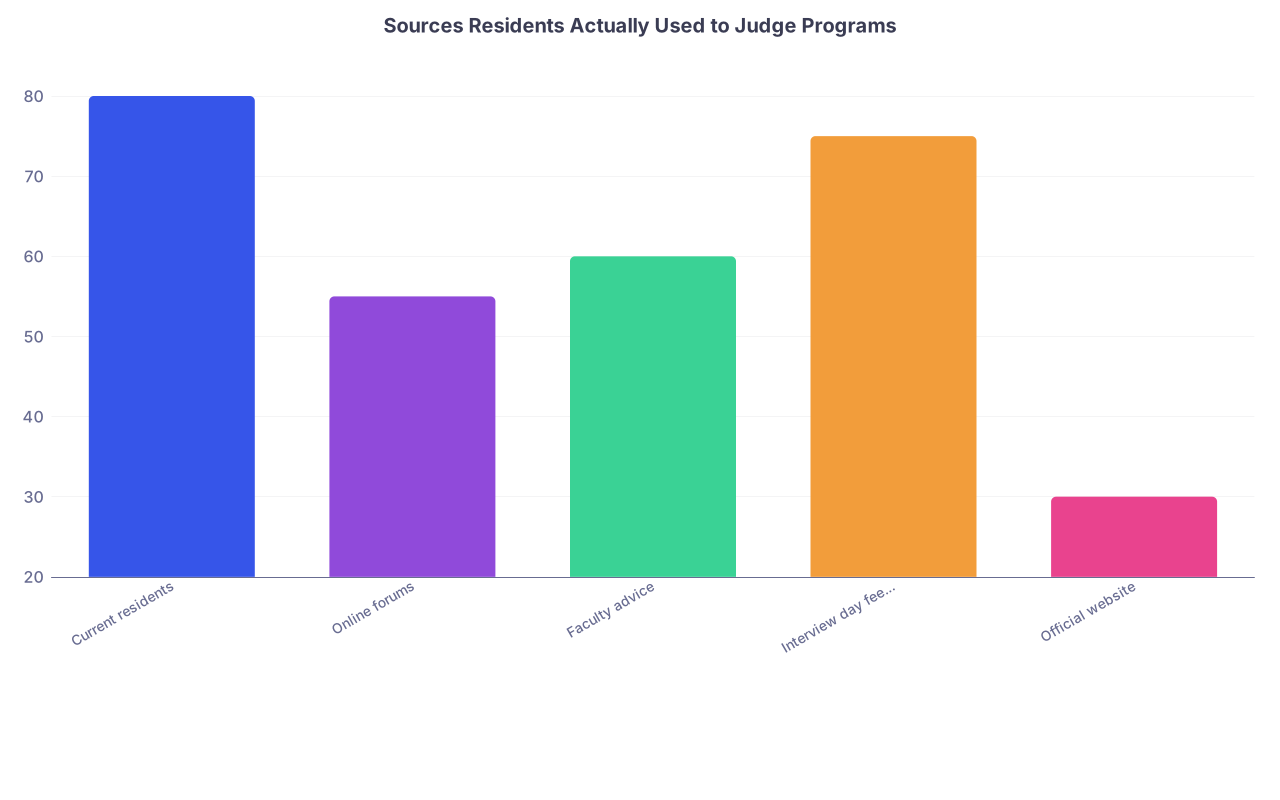
| Category | Value |
|---|---|
| Current residents | 80 |
| Online forums | 55 |
| Faculty advice | 60 |
| Interview day feeling | 75 |
| Official website | 30 |
What I’ve seen matter more in real life:
- Unprompted comments from multiple current residents
- The way people talk about leadership (“The PD listens” vs “Just survive until you graduate”)
- Whether juniors are willing to match there again
- Concrete examples of how feedback has changed the program
What’s less reliable:
- One SDN rant from 2016
- “My friend’s cousin said…” three degrees removed
- Vague “malignant vibes” with no specifics
- Starry‑eyed “BEST PROGRAM EVER” from a single PGY-2 who loves suffering
Use online info as smoke. Then you ask: is there an actual fire, or is this just burned toast?
Step Six: Remember How Much You Can Recover From a “Less Than Ideal” Program
Here’s the nightmare scenario in your head:
You pick a program with one red flag. That red flag grows into a monster. You’re miserable. You never match a fellowship. You hate your life.
Yes, worst cases exist. But they’re not the norm.
More common reality:
- You match somewhere that’s 70–80% good for you
- A few things really suck (call, one toxic attending, bad EMR)
- You adjust, find allies, get through it
- You still become a competent doctor
People:
- Transfer programs when necessary
- Pivot careers (academic → community, fellowship → hospitalist)
- Build research outside their home institution
- Forge their own mentorship through societies, online networks, conferences
You’re not choosing the only path to your future. You’re choosing a starting point. There are detours. There are second chances.
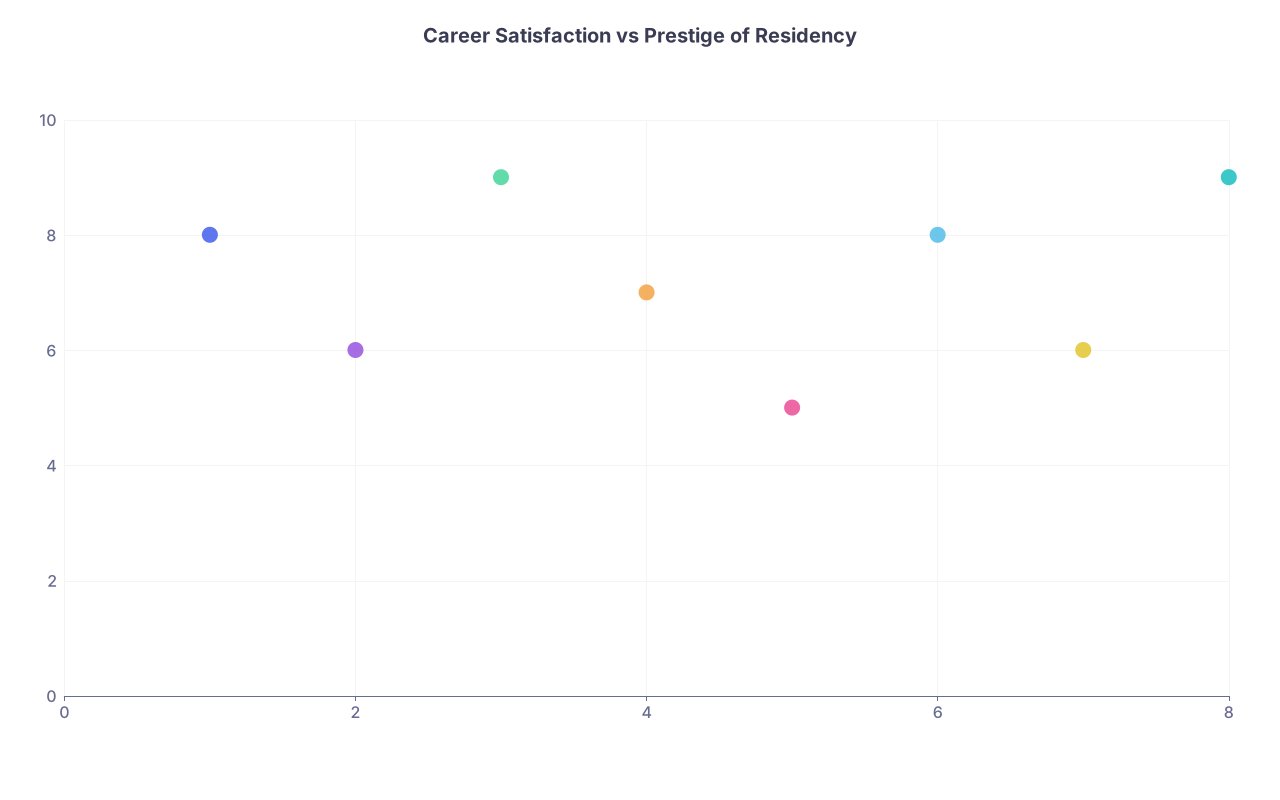
| Category | Value |
|---|---|
| Grad 1 | 1,8 |
| Grad 2 | 2,6 |
| Grad 3 | 3,9 |
| Grad 4 | 4,7 |
| Grad 5 | 5,5 |
| Grad 6 | 6,8 |
| Grad 7 | 7,6 |
| Grad 8 | 8,9 |
(Think of X as “program prestige rank” and Y as “career satisfaction out of 10.” It’s not a straight line. At all.)
Step Seven: How to Compare Imperfect Programs Side by Side
When all of them feel flawed, you need a way to compare them that’s not just “which one makes me slightly less nauseous today.”
Try this:
Make a simple spreadsheet with columns:
- Program name
- Deal breakers? (Y/N)
- Culture (1–5)
- Workload (1–5, where 5 = brutal)
- Career fit for your goals (1–5)
- Location fit (1–5)
- Gut feeling after sleep (1–5)
Fill it out only using:
- Your interview day
- Conversations with current residents
- Concrete match lists / schedules / case logs
Then look:
- Any 5/5 on “deal breaker”? → gone.
- Programs that score high on career + culture, even if workload is rough → probably higher rank.
- Programs that are chill but don’t fit your goals at all → middle or lower.

You’re forcing your brain to see “this one is strong for my goals and just has one painful flaw” vs “this one is mediocre everywhere and also has a red flag.”
Step Eight: What to Do If Literally Every Program You Like Has a Major Red Flag
Let’s go worst‑case, because that’s where your brain’s living anyway.
You might be thinking:
- “This one has malignant rumors.”
- “This one has terrible hours.”
- “This one barely matches into my dream fellowship.”
- “This one is in a city that will make me depressed.”
And somehow, those four are your favorite options.
So now what?
Clarify which pain you’re most able to tolerate.
You can’t avoid all pain. So ask: would you rather be:- Overworked but well-trained in your goal specialty?
- Slightly under-trained but in a city where you have support?
- At a mid-tier place where culture is excellent and you can grind your way into a fellowship with extra effort?
Distinguish “I’ll suffer but be okay” from “I will break.”
For one person, brutal hours = breakdown. For another, isolation in a rural town = breakdown. Be honest about your vulnerability.Ask a brutally honest mentor to rank them for you.
Someone who knows your goals and your stress patterns. Tell them the red flags. Ask where they’d put their own kid.Accept that “least bad” is sometimes the real choice.
That doesn’t mean you failed. It means you’re a human choosing in an imperfect system.

Quick Reality Check: You’re Allowed To Protect Yourself
You’re not selfish for saying:
- “I will not rank programs with harassment issues.”
- “I can’t do a super malignant environment even if the match list is sexy.”
- “I’d rather be a happy community doc than a miserable academic.”
Residency is three to seven years of your life. Not a line on a CV. You live there. You break down there. You grow there.
Programs are allowed to be imperfect.
You’re allowed to have boundaries about which imperfections you’ll live with.
FAQ (Exactly 4 Questions)
1. What if my top choice has a known malignant attending but everything else is great?
Then the question becomes: is leadership actually doing anything about it? If residents say, “Yeah, Dr. X is rough, but the PD backs us up and things have improved,” that’s one thing. If residents trade stories of being screamed at and “nothing ever changes,” that’s different. One toxic person in a supportive structure is survivable. A toxic person protected by a toxic structure is not. Ask directly: “How does leadership handle unprofessional behavior from faculty?”
2. Am I being too picky if I’m worried about lifestyle and location?
No. You’re a human, not a robot plugged into an EMR. If you know that being close to family, having outdoor spaces, or living in a safe neighborhood keeps you mentally functional, that’s not “picky.” That’s preventative medicine for yourself. Just be honest: sometimes you do trade some lifestyle perks for stronger training or better career fit—but that trade should be conscious, not shame‑driven.
3. How do I weigh prestige vs red flags?
Prestige is seductive. It feels like a shield against all future problems. It’s not. If a “big name” program has serious culture, safety, or abuse concerns, that prestige is not worth your mental health or license risk. A mid-tier but healthy program will launch a better career than a top‑tier but toxic one more often than people like to admit. Pick the place where you can actually function, learn, and not burn out to ash.
4. What if I match somewhere and later realize the red flags are worse than I thought?
First: you didn’t “fail.” Programs present their best side; problems get hidden. You gather allies: co-residents, chief residents, GME office, mentors. You document. If it’s unsafe or intolerable, people do successfully transfer. In the meantime, you protect your mental health as fiercely as you protect your patients: therapy, days off when you can, boundaries, saying “no” when it’s actually unsafe. There are paths out—even when it feels like you’re trapped.
Open your rank list (or your program spreadsheet) right now and force yourself to label each concern as Deal-Breaker, Risky, or Manageable. Don’t add or delete anything—just label. You’ll see, in black and white, which programs are actually dangerous and which ones are just imperfect.