
It’s March. Rank list is due in a few days. You’re staring at that one program you know has red flags. Malignant vibes on interview day. Residents hesitated before answering questions. Scut-heavy, sketchy work-hour comments.
And yet. It’s in a location you need. Or your partner’s job is there. Or your Step scores aren’t amazing and this is the only place that felt “safe-ish.”
So now the worst-case scenario is screaming in your head:
What if I rank this program high, actually match there… and then I’m stuck and can’t transfer out? Did I just blow my entire career because I was scared of going unmatched?
Let’s walk through that exact nightmare. Because honestly, you’re not crazy for worrying about this. I’ve watched people rank programs they didn’t like out of fear, and then panic for months thinking they’d ruined everything.
You haven’t. But you do need to be deliberate.
First: Are You Actually “Trapped” If You Match a Red‑Flag Program?
Let me be blunt: you’re usually less trapped than your anxiety is telling you, but more constrained than Instagram success stories make it look.
There are really three layers here:
- You match a red‑flag program.
- You realize it’s bad and want out.
- You discover switching is possible… but hard, slow, and political.
Most people imagine two extremes:
- Either “I can just transfer next year if it sucks.”
- Or “If I match there, my life is over, I’ll never be board-certified, and I’ll hate every day for three years.”
Reality is in the messy middle.
Transfers do happen. People do leave malignant programs. But it’s not like switching apartments. There’s no “simple online form” where you slide into PGY-2 somewhere else without consequences.
So before spiraling, you need a clearer picture of:
- What “red-flag” actually means in terms of risk
- What being unable to transfer really looks like
- How bad “worst case” actually is for your long-term career
Let’s pick that apart.
What Makes a Program So Red-Flagged You’d Want to Escape?
Some programs are annoying but tolerable. Others are soul-crushing, career-threatening dumpster fires.
On the “this sucks but I can survive” side:
- Poorly organized rotations
- Not enough structured didactics
- Older EMR, clunky workflow
- A few toxic attendings, but not the whole culture
On the “I might need to physically leave” side:
- Systemic duty hours violations, with retaliation if reported
- Chronic understaffing + unsafe patient loads
- Residents regularly failing boards or leaving the program
- PD and leadership ignoring bullying, harassment, or discrimination
- Consistent threats about contract renewal or “we can always replace you”
That second group is where the panic about being stuck really kicks in. Because you’re not just “unhappy.” You’re unsafe or your training is so bad it could actually hurt your future as an attending.
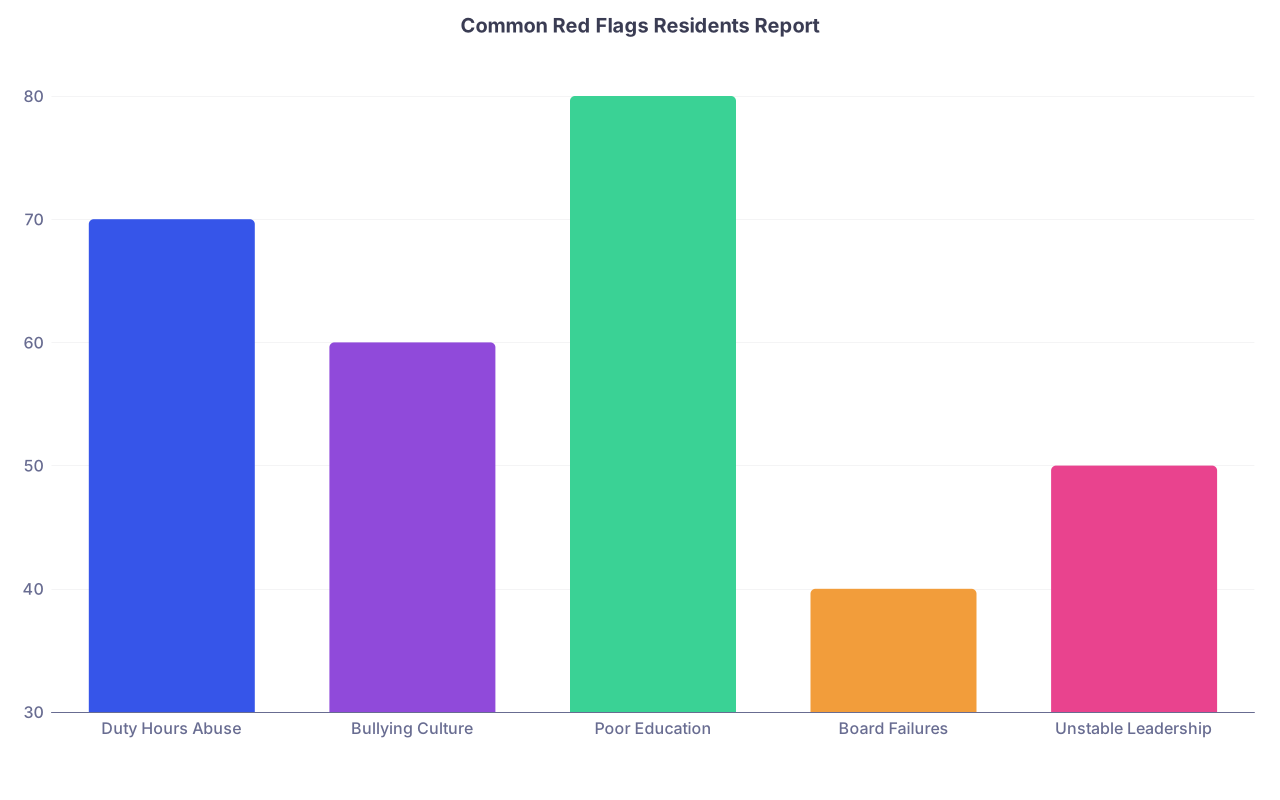
| Category | Value |
|---|---|
| Duty Hours Abuse | 70 |
| Bullying Culture | 60 |
| Poor Education | 80 |
| Board Failures | 40 |
| Unstable Leadership | 50 |
Numbers are approximate, but I’ve heard each of those complaints over and over. The “I need to get out” stories almost always center around some combo of unsafe workload + malignant leadership.
If you end up in that situation and can’t transfer out immediately, it feels like you’re locked in a burning building. I’m not going to sugarcoat that.
But I’m also not going to tell you your career is doomed if Year 1 or even Year 2 is rougher than it should be.
The Hard Truth About Transferring Out
Here’s the part no one on Reddit properly explains: transferring out is possible, but it’s messy, political, and slow. And it almost always takes longer than you’d like.
Here’s the practical reality:
- There are very few “open PGY-2/PGY-3 spots” in most specialties.
- Programs usually only have a spot if someone else left, failed, or they gained an extra funded position.
- Most programs want a PD-to-PD conversation. That means your current PD is involved, unless the new place is unusually flexible.
- The match system and NRMP rules make mid-cycle jumping complicated. You can’t just “re-match” next week.
So yes, worst-case scenario: you match a red‑flag program, realize fast that it’s malignant, try to transfer, and… nothing materializes for a while. Maybe a whole year. Maybe more.
That’s the fear that’s eating at you, right?
What if I try everything and I’m still stuck?
Let me sketch out what “stuck” usually means:
- You stay there at least one year, likely two, sometimes three.
- You spend that time planning your exit instead of blindly surviving.
- You work on CV, connections, and positioning yourself for:
- Transfer
- Fellowship in a better place
- Or a job that’s way better than your residency experience
“Stuck” rarely means “your entire future is permanently ruined.” It means “your next 1–3 years are tougher and less ideal than they should be, while you maneuver.”
It sucks. It’s not game over.
Can a Bad Program Actually Derail Your Career Long-Term?
You’re probably thinking something like:
“If I spend three years at a malignant program, I’ll never match a good fellowship, I’ll get terrible letters, my board pass rate will drop, and no one will hire me at a decent job.”
Deep breath.
Let’s look at the main long-term fears.
| Fear | More Realistic Reality |
|---|---|
| Won't match any fellowship | Harder, but possible with strategy |
| Attendings will blacklist me | Most care about competence, not program name |
| Board fail = career over | One fail is recoverable with support |
| No way to leave once I start | Transfers rare but do happen |
| Reputation of program will follow me | Your own performance matters more long-term |
Fellowship prospects
If you’re aiming for a competitive fellowship (GI, Cards, Heme/Onc, Derm research years, etc.), a weak home program doesn’t help. But it’s not an automatic “no.”
People in bad programs still:
- Do research with outside institutions
- Network at conferences
- Get strong letters from 1–2 good attendings
- Use away rotations or electives strategically
Will it be easy? No. Will it be binary “you’re out forever”? Also no.
Job prospects
Most community jobs and even plenty of academic ones care about:
- Board certification
- Competence
- Decent references
- Not being a nightmare to work with
They’re not doing deep NRMP forensics like, “Hmm, this residency had a 60% board pass rate in 2019, automatic rejection.” They’re asking, “Can this person safely see patients? Will they show up?”
A malignant environment can hurt your confidence and skill development, which indirectly affects your future. But that’s different from “you trained at X, therefore you’re done.”
Board exams
This is the one I take seriously. Programs with poor didactics and high burnout have higher board failure rates. That’s a real red flag.
But again, worst case isn’t “one bad year = guaranteed fail.” It’s:
- You have to self-study more.
- You may need a dedicated plan and maybe a prep course.
- You may have to be paranoid about protecting your study time.
I’ve seen residents from awful programs pass boards because they treated prep like a second job.
If You Truly Can’t Transfer: How Do You Survive Without Breaking?
Let’s say the true worst case plays out:
You match the red‑flag program.
You try to transfer.
Nothing opens.
You stay.
Now what?
This is where people either:
- Slowly unravel, lose all sense of self, and drag themselves to work, or
- Quietly build an escape hatch and protect their sanity as fiercely as they can.
If you’re “stuck” for a while, here’s the unglamorous, real strategy:
Protect your minimums:
- Minimum sleep you need not to fall apart.
- Minimum physical health (hydration, quick meals, walking up stairs instead of total inactivity).
- Minimum mental health (one human to vent to, ANY therapist if at all possible, or at least a peer outside your program).
Refuse to let the program take away every boundary:
- You might not be able to say no to all things, but you can pick small hills to die on: a post-call day you actually go home, a vacation week you don’t give up.
- Use GME, ombuds, and institutional resources if safety or true abuse is involved. Yes, it’s political. But doing nothing when you’re being legitimately abused is worse.
Preserve what you can of your CV and future:
- Get close to 1–2 attendings who are decent. You don’t need the whole department on your team, you need a small coalition who will vouch for you.
- Ask for specific projects: QI, small research, case reports – anything that proves you’re more than a cog.
- If your program’s teaching is trash, make your own micro-curriculum. Boards-focused. Realistically scheduled.
- Dates/times of major violations, hostile incidents, broken promises about duty hours, etc.
- Not to wage war right away, but to have a record if you ever need to escalate or explain why you sought transfer later.
You’re not overreacting to want out of a malignant place. But if you can’t get out immediately, your job becomes: stay intact enough that when a door does open, you’re still capable of walking through it.
How to Decide: Rank It High or Drop It Lower?
This is the actual decision you’re stuck on right now. Do you rank the red‑flag program high and risk being stuck there? Or do you push it down, maybe off your list, and accept a higher risk of going unmatched?
Here’s the brutal axis you’re really balancing:
- Risk of 1–3 years in a potentially toxic environment
versus - Risk of not matching and either scrambling (SOAP) or reapplying
Let me say something very clearly:
There are programs so toxic that I’d rather see someone go unmatched and try again than knowingly lock themselves into three years there.
Not “mildly disorganized.”
Not “a little malignant but people graduate.”
I’m talking truly unsafe, racist/sexist, retaliatory, chronic board failures, residents leaving mid-year, that whole thing.
If that’s what you’re seeing or hearing, I would not rank it high just to avoid the psychological hit of possibly unmatched in March.
On the other hand, if the program is:
- Rough around the edges
- Kinda malignant but people still graduate, pass boards, and get jobs
- In a critical location for you (kids, spouse, visa, etc.)
Then ranking it higher might be the rational choice, even if your anxiety hates that.
Ask yourself:
- If I matched there and never transferred, could I tolerate 3 years with a lot of coping strategies in place?
- Is this program worse than the idea of going unmatched and doing a research year, prelim year, or reapplying?
- Are my fears based on solid data (resident attrition, board pass rates, word-of-mouth from trusted people) or vague vibes and anonymous Reddit posts?

| Step | Description |
|---|---|
| Step 1 | Red flag program on list |
| Step 2 | Rank low or not at all |
| Step 3 | Rank according to overall priorities |
| Step 4 | Severe safety or abuse concerns |
| Step 5 | Graduates pass boards and get jobs |
| Step 6 | Can you tolerate 3 yrs if no transfer |
This isn’t about “being brave” or “not being picky.” It’s about a very cold calculation: which risk can you live with more.
A Few Things People Underestimate (That Might Calm You Slightly)
Three underappreciated realities:
You will grow coping skills you don’t currently have.
You’re imagining yourself at your current resilience level. You actually toughen up a lot in intern year. That doesn’t excuse toxicity, but it does mean future-you might handle it better than current-you imagines.You’re not the only one trying to get out.
People at red-flag programs quietly network together. Someone knows someone who knows a PD elsewhere. It’s not fun, but it’s not you vs the entire system alone in a vacuum.One bad program doesn’t define your whole identity as a doctor.
You feel like your residency program is your permanent label. Attendings do not walk around introducing themselves as “Hi, I’m Dr. Smith, trauma survivor of Midwest Malignant Internal Medicine 2018.”
After a few years in practice, no one cares where you trained as much as you think they do.
FAQ (Exactly 5 Questions)
1. If I match a red‑flag program, can I re-enter the Match again for another residency?
Yes, but it’s complicated and you have to be careful. If you’re under contract and decide to leave, there needs to be a clean paper trail — resignation, release from contract, etc. NRMP violations are a big deal. PDs will ask why you left your first program. If your explanation is reasonable and you have at least one PD/attending backing you, it’s not impossible. But don’t start a program assuming “I’ll just re-match next year” like it’s low-stakes.
2. Will other programs refuse to take me if my current PD doesn’t support a transfer?
It makes it harder, but not always impossible. Some PDs are willing to review you based on your own statement and evaluations from individual attendings if your PD is the problem. But: many programs do expect PD-to-PD communication. That’s why finding at least one allied attending who can vouch for you is so important. They can provide detailed context if your PD is obstructive.
3. What if I’m on a visa and stuck at a red‑flag program?
This is honestly one of the toughest situations. Your leverage is lower because leaving might jeopardize your immigration status. In that case, I’d weigh heavily toward avoiding truly malignant places even if it means ranking fewer programs. If you do end up at one, your main goals become: document everything, protect your physical and mental safety as much as possible, and aggressively plan for a better fellowship or job once training is done.
4. How much should anonymous online reviews influence my rank list?
They’re a data point, not a verdict. If multiple independent sources (residents you talked to off-record, alumni, faculty at your school) all echo the same negative themes you saw online, I’d take that seriously. If it’s just a couple of bitter posts with no specifics, don’t let that override your entire judgment. But if you see repeated mentions of “non-stop q3 28-hour calls,” “PD retaliates if you report,” or “three people left last year”… that’s smoke you shouldn’t ignore.
5. Is going unmatched really better than matching at a malignant program?
Sometimes yes, sometimes no. If a program is truly dangerous or is known for systematically destroying residents’ careers, I’d lean toward not ranking it at all. Unmatched plus a thoughtful plan (research year, prelim year, stronger application, honest advising) is painful but recoverable. Matching into an outright abusive environment where you’re trapped for years can leave deeper damage — to your mental health, your confidence, and even your board eligibility if the training is that bad. The hard part is being honest with yourself about which category that program falls into.
Here’s what you can do today:
Open your rank list, and next to that red‑flag program, write two mini-paragraphs:
- One titled: “If I match here and can’t transfer, my life for 3 years realistically looks like…”
- One titled: “If I don’t rank this and go unmatched, my next 1–2 years realistically look like…”
Not the fantasy version. The realistic version.
Then read both out loud to yourself.
Whichever one you can tolerate more — that’s the risk you choose. That’s where you rank that program.