

The “star resident” in a program is almost never the person you think it is. And the way a program talks about its “stars” tells you more about its culture than any mission statement, wellness slide, or fluffy website blurb ever will.
You want to know what a residency is really like? Watch how they treat — and talk about — their supposed top performers.
What Program Directors Really Mean By “Star Resident”
I’ve sat in resident selection meetings, Clinical Competency Committee meetings, and faculty lounges in multiple institutions. Let me translate a few phrases you’re going to hear.
When a PD says, “They’re one of our rock stars,” they almost never mean, “This resident is clinically excellent and balanced and respected by everyone.”
What they usually mean falls into one of a few buckets:
- “They say yes to everything, never complain, and stay late constantly.”
- “They cover for our scheduling failures without pushing back.”
- “They make my life easy by absorbing work other people should be doing.”
- “They don’t challenge faculty, even when we’re wrong.”
The true star — the one you want to be and work with — is the resident who is competent, ethical, reliable, teaches juniors, and still has enough backbone to say, “This is unsafe,” when it needs to be said.
The problem is, in many programs, that person is not the one being praised at faculty meetings.
That disconnect is the trap.
The Two Types of “Stars” — And Why It Matters
Let me separate the archetypes for you. Because every program has both, but which one they elevate tells you everything.

1. The Exploitable Star
This is the one toxic programs love.
You’ll recognize them:
They’re always “helping out” by picking up extra calls — because the program never fixed its broken backup system.
They’re praised for “always being available” — because boundary setting is quietly punished.
They’re called “the glue of the program” — because leadership offloads structural problems onto them.
In meetings, you hear:
- “We can always count on them, they never say no.”
- “They’ll cover if someone calls out.”
- “They’ll make chief; they do everything we ask.”
These “stars” burn bright and then burn out. They’re the ones applying for psych help in PGY-2, or quietly detaching and doing the bare minimum in PGY-3 because they’ve been wrung dry.
Toxic programs call that “losing motivation” rather than “we used this person up.”
2. The True Star
This resident:
- Runs a clean list. Patients know what’s happening.
- Juniors feel safe asking them questions.
- Nurses trust their orders.
- They escalate appropriately — to the right attending, at the right time.
- They push back on nonsense, but selectively and respectfully.
They might stay late occasionally, but not habitually. They are reliable, not self-sacrificial.
How do you know a program actually values this kind of star?
Listen for:
- “They’re excellent with feedback, and they give it up the chain as well.”
- “They protect their juniors from unnecessary scut.”
- “They’re efficient and don’t let themselves get buried.”
If you hear admiration for boundaries and judgment, you’re dealing with a healthier culture.
The red flag is when the only residents being praised are the ones who bleed for the system.
How Programs Manufacture “Stars” To Hide System Failures
Let me tell you something programs rarely admit out loud: the “star resident” narrative is often a coping mechanism for bad systems.
If your call structure, documentation burden, ancillary support, or staffing model is broken, you have two options:
- Fix the system
- Rely on a couple of high-output residents to plug the holes
Guess which one is cheaper.
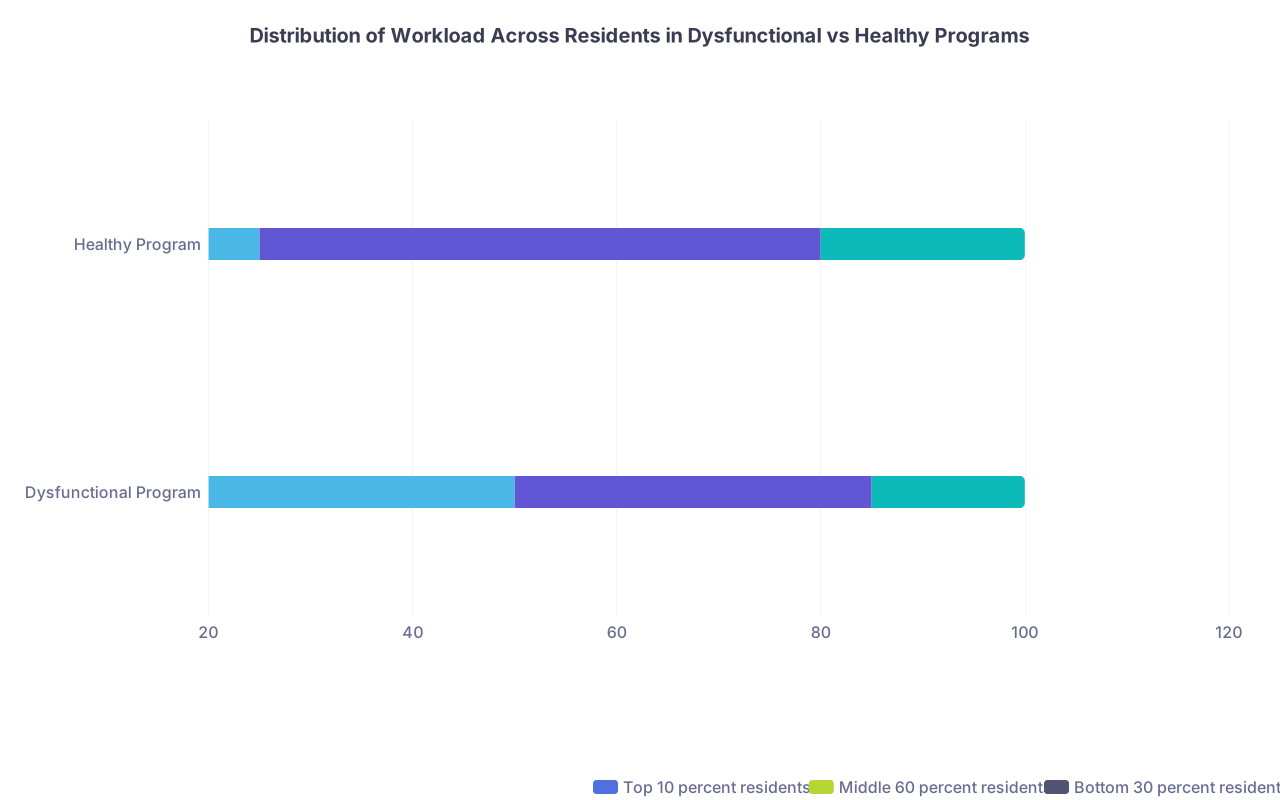
| Category | Top 10 percent residents | Middle 60 percent residents | Bottom 30 percent residents |
|---|---|---|---|
| Dysfunctional Program | 50 | 35 | 15 |
| Healthy Program | 25 | 55 | 20 |
In a dysfunctional program, the top 10% of residents are carrying a ridiculous share of the real work. Everyone knows it. Nobody says it plainly.
You’ll see it here:
- The same names on sick call coverage emails
- The same residents “volunteering” for every committee, QI project, patient satisfaction initiative
- The same person who “helped with that research,” “stayed until midnight,” “took that transfer”
Behind doors, faculty will say, “We need more residents like [Name].”
No. They need better systems. But it’s much more convenient to label one person a “star” and imply everyone else should just work like them.
Healthy programs armor their residents with process. They standardize sign-outs, streamline orders, leverage APPs, fight with the hospital for adequate staffing. They create an environment where most residents can look good, not just the ones willing to self-immolate.
If you see a program whose entire functioning depends on 2–3 super-residents, that’s not praise. That’s an indictment.
How To Spot The Star Resident Trap On Interview Day
This is where you get played the most.
You show up, and the program parades out their chief(s) or that one hyper-polished PGY-3. You’re meant to think, “I want to be like them.”
You should instead be thinking, “What did it cost them to be like that here?”

| Step | Description |
|---|---|
| Step 1 | Hear about star resident |
| Step 2 | Toxic culture risk |
| Step 3 | Healthier culture |
| Step 4 | Program offloads problems on stars |
| Step 5 | Program values boundaries and sustainability |
| Step 6 | What are they praised for |
Here’s what you look for and listen for.
Who’s Doing The Talking
If the same two residents are doing 80% of the talking on interview day, that’s a clue. In a healthy program, plenty of people feel safe speaking honestly. In a brittle culture, leadership leans heavily on the “safe” stars they trust to keep the narrative on script.
Watch the body language:
- Are other residents quiet, glancing at each other before answering?
- Does someone start to say something less polished, then correct themselves, “Oh, but overall it’s great!”?
- When a difficult topic comes up (work hours, ancillary support), does the star resident jump in to rescue the answer?
That dynamic is not accidental. It’s been rehearsed.
How They Describe Chiefs
Ask a simple question: “What makes a good chief here?” Then shut up. Let them talk.
Red-flag answers sound like:
- “Someone who’s always available to cover.”
- “Someone who puts the program first, no matter what.”
- “Someone who can get people to do what needs to be done.”
Better answers sound like:
- “Someone who advocates for us to leadership.”
- “Someone who protects our education when service demands creep.”
- “Someone who’s fair with scheduling and doesn’t play favorites.”
When chiefdom is treated as the reward for maximum self-sacrifice, the message is clear: your value is your willingness to be used.
What Happens When Stars Push Back
You won’t get this answered directly, but you can infer.
Ask: “Have there been any changes residents pushed for that actually happened in the last year or two?”
Healthy programs will have examples: change in rounding times, new night float structure, protected didactics enforced, fewer non-educational consults, etc.
Unhealthy ones will say some version of, “We’re working on it,” or, “There’s a committee,” or they point to cosmetic changes. The “star resident” in those places is the one who went along quietly after getting stonewalled.
If the only residents who become “stars” are the ones who never make leadership uncomfortable, you’ve learned exactly how that program handles dissent.
The Hidden Casualties: Everyone Around The Star
The trap doesn’t just hurt the “star” resident. It distorts the entire program.
Here’s what happens behind the curtain.
Middle-of-the-pack residents get compared upward constantly.
The PD says, “Look what [Star] manages, and they never complain,” as if that’s an argument, not a warning sign. Real concerns about workload get minimized because “others seem to handle it.”Underperformers get shielded instead of remediated.
Why confront the chronically late PGY-2 if [Star] will just pick up their slack? Programs with a couple of super-residents can coast for years without addressing genuinely problematic behavior.Juniors learn the wrong lesson.
PGY-1s watch who gets praised publicly. If the only people receiving public admiration are the ones who never push back and always stay late, that’s the template. They internalize: to be valued, you have to be available 24/7 and self-erasing.
I have heard variations of this line in more than one CCC meeting:
“Well, yes the workload is heavy, but [Star] is doing fine.” As though one outlier nullifies the reality of twenty others.
When a program uses its “stars” to invalidate legitimate concerns, that’s not just cultural rot. It’s dangerous.
Because here’s the punchline: those “stars” eventually leave. Fellowship, another institution, burnout, family. Then the entire thin system collapses onto the remaining residents, who were never supported or developed — just compared and pressured.
The Metrics Game: How Stars Get Weaponized For Recruitment
Programs care deeply about how they look. Less about how they are.
So they love to hold up the CV of their “star” resident like a trophy.
“Look at this PGY-3 — 12 publications, national presentations, chief year, fellowship at MGH.”
They want you to mentally insert yourself into that narrative. They rarely admit how much that person’s success depended on their personality, pre-existing connections, or raw obsession — not the program’s support.
| What Program Says | What Often Actually Happened |
|---|---|
| "We support research; look at their 10 papers." | Resident hustled with an outside mentor; program gave minimal real time. |
| "They presented at national conferences." | Resident used vacation/away time, fought for funding, paid out of pocket. |
| "They led multiple QI projects." | Those projects were unpaid administrative work that replaced real education. |
| "They matched into a top fellowship." | Fellowships cared more about LORs and individual grit than program branding. |
The red flag is when a program’s entire selling point to you is one or two superstar stories, instead of broad, average outcomes:
- Percentage getting their first-choice fellowship field
- Bread-and-butter competence across the class
- Number of residents in trouble or leaving the program
If everything is, “Look at this one,” it usually means the median experience is unimpressive, or worse.
You want a program where an ordinary, hardworking, sane person can build a solid career — not one that only works if you’re willing to grind yourself down like their “star.”
How To Protect Yourself From Becoming The “Star” They Use
If you’re a high-performing, conscientious person — especially if you’re conflict-avoidant — you’re exactly the type who gets trapped.
You arrive, you work hard, you want to be helpful. People realize quickly: “Oh, they’ll say yes.” Then slowly, almost invisibly, you become the unofficial backup for everything.
Here’s how this looks from the inside:
Year 1: “Thanks so much for staying late and helping with that admission. You really saved us.”
Year 2: “Can you just help with that new curriculum? You’re so organized.”
Year 3: “We know it’s last minute, but can you cover? We’re out of options and you’re so reliable.”
By the time you realize what’s happened, you’re the program’s crutch. And if you start saying no, you’re suddenly “less of a team player” than your reputation promised.
You have to set the guardrails early:
- Say yes selectively to high-yield, time-limited opportunities.
- When extra work appears, respond with: “I can do X, but that means I can’t do Y — which would you prefer?” Force leadership to choose, and you expose true priorities.
- Protect your off days ruthlessly. The resident who never turns off their phone is precisely the one programs exploit “just this once” every week.
Healthy programs will respect those boundaries. Toxic ones will label you “difficult” for enforcing them. You want to discover which kind of program you’re in sooner rather than later.
And if on interview day you instinctively feel like, “They’re going to make me into their workhorse,” do not ignore that.
The Future: Why The Star Resident Model Is Dying (Slowly)
Here’s the quiet shift happening across academic medicine: the old model where residency programs survive on a small number of over-functioning residents is becoming less tenable.
Burnout numbers are not hypothetical. I’ve seen program directors get called into meetings by GME after multiple residents go on mental health leave in a single year. Hospitals are starting to care because burned-out residents make more mistakes, quit more often, and damage accreditation reports.
Nationally, the conversation has moved — begrudgingly — from “resilience training” to “system redesign.” Some places still don’t get it. But the pressure is building.
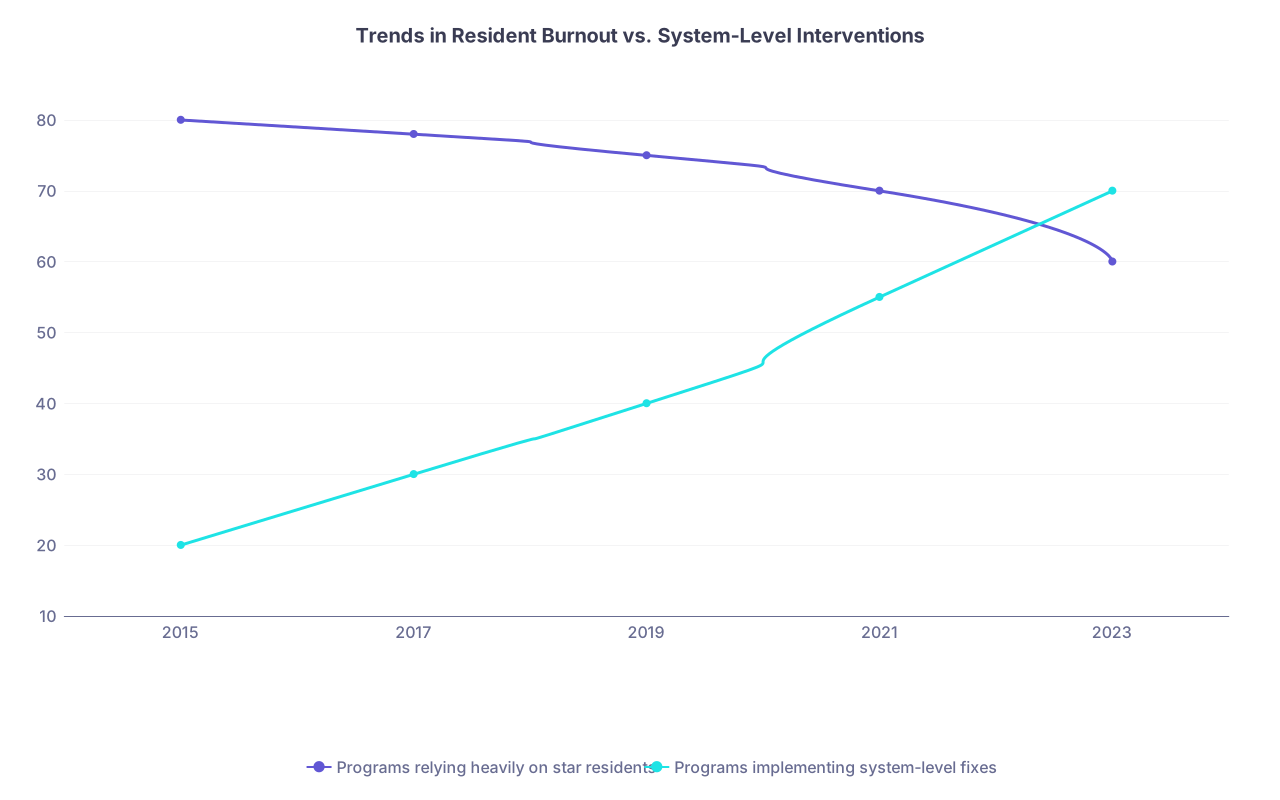
| Category | Programs relying heavily on star residents | Programs implementing system-level fixes |
|---|---|---|
| 2015 | 80 | 20 |
| 2017 | 78 | 30 |
| 2019 | 75 | 40 |
| 2021 | 70 | 55 |
| 2023 | 60 | 70 |
The programs that will survive and thrive are the ones that:
- Stop glorifying the resident who answers emails at midnight.
- Start admiring the resident who improves handoff processes, who insists on realistic caps, who refuses unsafe cross-coverage expectations.
- Redefine “star” as: the person who makes it less likely that anyone has to be a hero.
If you’re choosing where to train, you’re also choosing which world you’re voting for.
Do you want the old guard — where worth = self-sacrifice — or the emerging model where worth = competence, judgment, and sustainability?
You’re not just picking a program. You’re picking a culture you’ll internalize for decades.
Let me make this simple.
- A program that worships “star residents” for their endless availability is showing you its dependence on overwork and its refusal to fix systems. Believe that signal.
- Look past the one or two shiny CVs and ask what happens to the average resident there — their boundaries, their voice, their outcomes. That’s the experience you’re likely to have.
- Protect yourself from becoming the “star” they use to keep a broken machine running. Say yes strategically, set limits early, and choose environments that value sustainable excellence over martyrdom.


