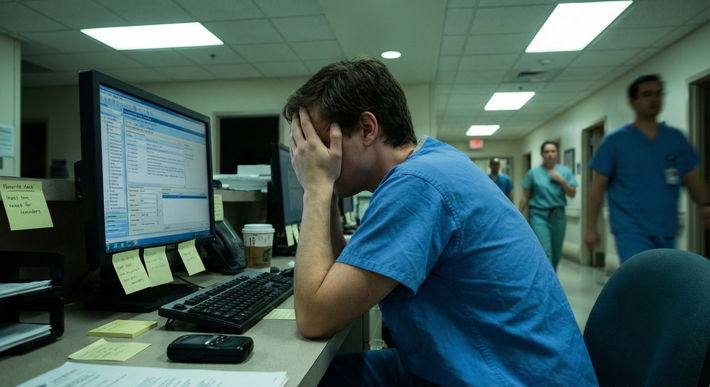
You're six patients deep. You've got your list organized, your notes half-written, your plan formulated for the next three admits. Then the overhead speaker crackles: "Code Blue, Room 412." That's your patient. Or worse, it's your attending's patient, and now you're running.
Forty minutes later, the patient's intubated, on three pressors, and headed to the ICU. Your rounds list is a smoking crater. The six patients you hadn't seen yet are still waiting. Two new admits have landed on your service. The nurse on 4West wants to know if Mr. Henderson can eat. Your senior resident is asking where you've been. And your attending is already three rooms ahead, wondering why you vanished.
This happens to every resident. Not occasionally, weekly. Sometimes daily. The question isn't whether it'll happen. It's what you do after.
The First Ten Minutes After the Code

Stop. Breathe. Do not go straight back to rounding.
I've watched residents sprint out of a code and immediately try to resume rounds like nothing happened. They're sweaty, adrenalized, and half-cognitively still in Room 412. They walk into the next patient's room and can't remember why they came. That's not efficiency, that's performing medicine while impaired by adrenaline.
Here's what actually works:
- Hand off the code patient properly. If they're going to the ICU, give a crisp SBAR to the receiving resident. Two minutes. Done. Do not linger. Do not help place the central line "just to be thorough." Your list is bleeding out.
- Check your watch and recalibrate. How much time do you actually have left in rounds? If it's 11 AM and rounds end at noon with eight patients remaining, you cannot do full presentations for all of them. Face that reality now.
- Triage your remaining patients into three buckets:
- Sick or potentially sick, see these first, full presentation
- Stable but waiting on a decision, discuss at bedside briefly
- Stable and nothing changing, sign-out note update, move on
Recalibrating Your Attending
Here's the thing most residents don't realize: your attending knows the code blew up your list. They're not stupid. What frustrs them isn't that you disappeared for 40 minutes during a cardiac arrest. It's when you disappear and then come back acting disorganized.
Walk up to your attending immediately after the code handoff. Say this:
"Sorry, Mrs. Chen coded, she's intubated and going to the ICU, I gave signout to Dr. Patel. I've got six patients left. I'm going to see the two sick ones now and then catch up. Want me to present them as I go or hold?"
That's it. You've acknowledged the disruption, demonstrated you handled the code competently, communicated a plan, and asked for preference. Your attending will either say "just catch up" or "let's go see them together." Either way, you're aligned.
The worst move? Avoiding your attending and hoping they don't notice you're behind. They noticed.
When You're Three Rooms Behind

Your attending has moved on without you. They're in Room 415 presenting the case themselves because you weren't there. This feels terrible. Get over it. Your job right now is damage control, not ego preservation.
Here's how you catch up without making it worse:
Don't try to retroactively present patients your attending already saw. If they presented 413 and 414 without you, let it go. Read the notes later. Ask the nurse if anything came up. Move forward.
See your sickest remaining patient first. Not the easiest one to make yourself feel productive, the one who might deteriorate. If you're going to get caught short on time, it should be on the stable patient whose note can be written at 2 PM, not the one who's about to transfer to the unit.
Use your interns. If you're a senior, this is the moment to delegate hard. "Hey, can you grab vitals and labs on 416 through 419 and text me anything abnormal? I'll be in 420." They'd rather help than watch you drown.
Write notes in batches, not one at a time. After you've seen three patients quickly, sit down and knock out all three notes in 20 minutes. Context-switching between patient care and documentation for each individual patient is a time killer.
The New Admits Problem
Codes don't pause admissions. While you were running CPR, two new patients got assigned to your team. The ED resident has called you twice. You haven't answered.
Here's my position: unless the new admit is actively deteriorating, they wait until rounds are done. Period. The ED resident can hold them. You cannot provide good care to your existing patients AND properly admit a new patient simultaneously. Trying to do both means doing both badly.
Call the ED resident back. Say: "I'm finishing rounds after a code. I'll see the new admit at [specific time]." Give a concrete time, not "soon." Soon means nothing.
If the admit is genuinely unstable, septic, hypotensive, actively declining, then yes, you go see them now. But recognize that means your rounds are effectively over for the remaining stable patients. Tell your attending. Adjust the plan. Don't pretend you can do both.
Rebuilding Your System After the Dust Settles
By early afternoon, the chaos should be settling. Your code patient is in the ICU. Your remaining patients are seen. Your notes are trickling in. Now you rebuild.
- Re-write your list from scratch. Not an update, a full rewrite. Your old list is contaminated with the panic of the morning. Start clean. New priorities. New order.
- Check on the nurses you left hanging. The nurse who wanted to know about Mr. Henderson's diet? She's been waiting three hours. Go find her. Answer the question. Apologize for the delay. Nurses remember residents who disappear during codes and residents who circle back after.
- Review the code itself, but not right now. File away what happened for later debriefing. At 3 PM, you're still in survival mode. Tomorrow morning, with coffee, ask yourself what went well and what didn't.
- Set up tomorrow's list to absorb disruption. Build in buffer time. Expect that something will go wrong. A list that assumes eight patients in three hours with no interruptions is a fantasy.
When It Keeps Happening
Some weeks, it's not one code, it's three. Tuesday you had a rapid response. Wednesday a GI bleed. Thursday your patient pulled their lines and self-extubated. By Friday, you're numb.
This is the reality of inpatient medicine, and no amount of organization fully prevents it. But residents who survive these stretches share a few habits:
- They never round without a prioritized list. Not an alphabetical list, a sickest-first list.
- They communicate disruption immediately. Not five patients later, the moment they realize they're derailed.
- They accept incomplete days. Sometimes you don't see everyone. Sometimes a note is late. Sometimes you sign out tasks. That's medicine. The residents who burn out fastest are the ones who treat every disrupted day as a personal failure.
A code blowing up your list doesn't mean you're disorganized. It means you're taking care of sick patients. The goal isn't to prevent disruption, it's to recover from it faster than yesterday.
Next time the overhead speaker goes off, grab your list, handle the code, and come back swinging. You've done this before. You'll do it again.