
Step 2 CK timing feels brutal because it is brutal. In the Step 1 pass/fail era, Step 2 CK became the score programs can actually sort with. That means your performance matters, but so does when that score exists. A great score that arrives too late can be almost as annoying as an average score that arrives on time. Not identical. But still damaging.
I’ve seen students make the same bad mistake every year: they plan from test day forward. They say, “I’ll take it in late August and hopefully the score comes back before applications matter.” Hopefully? That’s not a plan. That’s gambling with your file.
Programs don’t review your application in a vacuum. They review it relative to the pile sitting next to it. If your Step 2 CK score is missing when they first open files, you may lose the benefit of being seen as a complete, easy-to-process applicant. And programs love easy-to-process applicants. Especially early.
Score release windows aren’t identical forever, and administrative weirdness happens. Delays. Permit confusion. Needing to move the exam. Getting sick. Testing center nonsense. So the right mindset is simple:
At this point you should be working backward from ERAS opening and program review dates, not forward from your dream test day.
That one shift fixes a lot. It turns panic into logistics. And logistics are manageable.
Start With the Calendar: Build Your Personal ERAS-to-Score Timeline
First, pull up the actual ERAS season dates for your cycle. Don’t rely on what “usually happens.” Check the official timeline. You need three anchors:
- The date ERAS opens to applicants
- The date programs can begin reviewing applications
- Your target date to have a Step 2 CK score posted
Your target score date is not the same as your test date. That distinction is where students get sloppy.
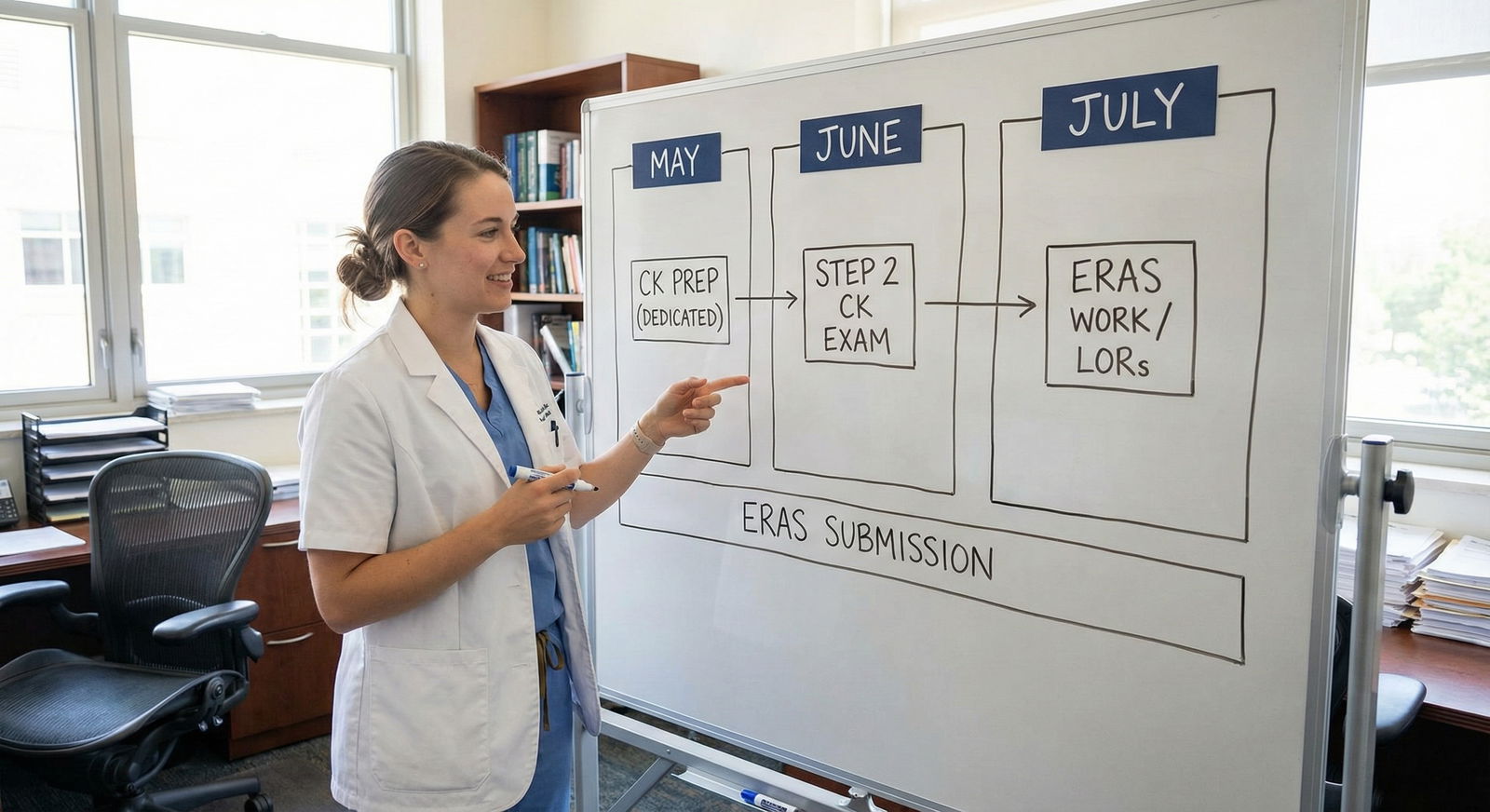
At this point you should build the timeline backward like this:
- Programs start reviewing applications
- You want your application complete before that
- Your Step 2 CK score needs to be available before that
- Score release needs its own window
- Therefore your exam date must land early enough to protect that window
A safe planning framework looks like this:
- Best case: score released comfortably before programs review
- Acceptable case: score released right around review opening
- Danger zone: score released after programs have already started screening
- Disaster zone: no score, no backup plan, no advisor input
Most students should not schedule the latest possible test date. That’s fake efficiency. What you want is a latest safe test date, which is different.
Build a buffer of at least 2 to 3 weeks beyond the expected release timeline if your schedule allows. Why? Because life is disrespectful.
Your buffer covers:
- testing-center reschedules
- travel delays
- illness
- burnout causing underperformance on practice tests
- permit or ID issues
- the ugly possibility that you need to delay because you’re simply not ready
Here’s the practical version. If programs can start reviewing on a certain Wednesday, don’t aim for a score that “might” drop that same week. Aim earlier. You are trying to submit a strong application, not win a dare.
Weeks Before the Test: What You Should Do 8 to 4 Weeks Out
This is where your plan either gets real or stays decorative.
At 8 to 4 weeks before the exam, you should have a study system that matches your weaknesses, not your fantasies. If your NBME forms show trouble with OB/GYN management, ethics, and inpatient peds, then that’s the work. Not another random pass through your favorite question bank topics because they feel good.
At this point you should do four things at once.
1. Lock the study plan
Use your data:
- UWorld block performance
- NBME trends
- shelf score patterns
- timing stamina
- error log themes
Your plan should answer:
- What are my 3 weakest systems?
- Am I missing knowledge or missing test strategy?
- Do I need content repair, or just more mixed timed blocks?
- Is my current score trajectory compatible with my scheduled date?
If the answer is no, move the test early enough to preserve ERAS strategy, not late enough to create a disaster.
2. Confirm logistics now
Do not wait until the week of the exam to discover a mismatch between your ID and permit. That’s amateur hour.
Checklist:
- testing appointment confirmed
- legal name matches exactly
- government ID valid and unexpired
- permit accessible
- travel and hotel set if needed
- route to test center checked
3. Push ERAS pieces in parallel
Step 2 CK should not become the only thing in your life. That’s how students end up with a score and no polished application.
By this point you should also be advancing:
- letters of recommendation
- personal statement drafting
- MSPE logistics
- transcript readiness
- program list building
- geographic preference decisions
- signaling strategy discussions
4. Meet with an advisor before panic starts
One clean meeting is worth ten frantic texts later.
Ask directly:
- If my score is delayed, should I submit without it?
- How important is Step 2 CK timing in my specialty?
- Does my current application have enough strength elsewhere?
- What score range changes my program list?
Test Week and Score Week: Day-by-Day Moves to Protect Your Application Timeline
The last 7 days are not for heroics. They are for protecting performance and preventing stupid mistakes.
Day -7 to Day -5
At this point you should:
- shift fully onto your intended sleep schedule
- reduce random resource hopping
- confirm exam time and site one more time
- do targeted review of persistent weak spots
- stop comparing yourself to classmates who claim they’re “chilling”
They’re not chilling. They’re lying or spiraling.
Day -4 to Day -3
You should:
- do one or two final mixed timed blocks, not ten
- review high-yield management algorithms
- pack what you need
- verify ID, permit, snacks, directions
- avoid big social events and late nights
If you’re still trying to learn everything at this point, that ship has sailed.
Day -2
You should:
- taper hard
- keep review light
- check the route to the testing center
- decide on wake-up time, breakfast, and departure time
- protect your evening
No “one last full-length” exam here. Dumb move.
Day -1
You should:
- stop heavy studying by early evening
- prep clothes, food, documents
- charge devices if needed for travel logistics
- eat normally
- get to bed on time
Anxious students love to self-sabotage the night before. Don’t join them.
Test day
Your job is simple:
- wake up early enough to avoid rushing
- eat something predictable
- arrive early
- stay off your phone drama
- test the way you trained
Immediately after:
- save your exam confirmation
- document the test date
- make a note of the expected score-release window
- do not spend the next 72 hours performing an autopsy on every question
Score week
At this point you should monitor the expected release schedule calmly. Not obsessively.
When the score posts:
- download and verify it
- make sure ERAS transmission is set correctly
- alert your advisor if the result changes your specialty or program strategy
- update your application plan the same day
If the score will miss your intended application window, contact your school advisor fast. Not with vague panic. With specifics:
- test date
- expected release date
- specialty
- whether the score is likely required for screening
- whether you should submit first and update later
If Your Score Will Miss ERAS: Decision Points, Backup Plans, and Submission Strategy
This is the part nobody likes talking about. But you need the plan before the bad news, not after.
If your Step 2 CK score won’t be ready by the time ERAS opens or by the time programs start reviewing, you have two broad options:
- Submit without the score
- Wait for the score, then submit
Which is better? It depends on specialty competitiveness and how much the score is carrying your application. But I’ll give you the blunt version:
- If you’re applying in a specialty where Step 2 CK is a major screen, a missing score is a real liability.
- If the rest of your application is strong and your specialty is less score-obsessed, submitting on time without the score may be smarter than waiting.
- If your whole strategy depends on a strong Step 2 CK redemption arc after a weak academic record or a shaky Step 1 narrative, waiting for the score may be worth it.
This is not the moment for ego. It’s strategy.
Submit without the score if:
- your specialty does not universally require Step 2 CK for initial review
- your application is otherwise complete and competitive
- your school advises early submission
- the score is only slightly delayed
- you can update programs quickly when it posts
Consider waiting if:
- your Step 2 CK score is likely to materially improve how programs see you
- your specialty heavily screens by score
- your current file looks incomplete or weak without it
- your advisor agrees the delay is worth the tradeoff
If the score is delayed unexpectedly
At this point you should:
- notify your advisor immediately
- confirm whether the delay is administrative or routine
- finalize a “submit now vs wait” decision within 24 to 48 hours
- revise your program list if your strategy depended on that score
- reassess signaling choices based on what programs will actually see
If the score is lower than expected
Don’t melt down. Adjust.
Your next moves:
- review your application realism with an advisor
- change your program mix
- be smarter with signals
- consider whether dual applying makes sense
- stop pretending your original list is still optimal if the data say otherwise
A bad strategy after a disappointing score is usually worse than the score itself.
If you need a retake plan or major pivot
That’s a separate level of decision-making. Move fast:
- get school-specific advising
- ask whether your specialty choice needs revision
- determine whether to delay, dual apply, or broaden aggressively
- protect the rest of the application materials from becoming collateral damage
Your week-ERAS-opens checklist
When ERAS opens, at this point you should be able to answer yes to these:
- My application is edited and proofread
- My personal statement is finalized
- My letters are assigned appropriately
- My transcript and MSPE logistics are in motion
- My program list is realistic
- My signal strategy is decided
- I know whether I am submitting with or without Step 2 CK
- I know exactly how I’ll respond once the score posts
That last item matters more than students realize. A delayed score is manageable. A delayed score plus confusion is poison.
Here’s the bottom line. Step 2 CK timing problems are rarely just testing problems. They’re application timing problems. Fix the calendar, and a lot of the anxiety gets smaller.
So do this today:
- Pull up the official ERAS dates.
- Mark your target score-release deadline.
- Count backward to your latest safe exam date.
- Add a real buffer.
- Make a backup plan before you need it.
That’s how you walk into ERAS season like an adult. Not relaxed, exactly. But ready.