
The obsession with Step 1 scores is dead; the metric that actually runs your life now is your shelf exams.
Let me be blunt: in the Step 1 pass/fail era, every serious program director I talk to has shifted their internal “who’s actually good?” filter toward clinical performance, narrative comments, and standardized exams that still produce a number. That means shelf exams and Step 2 CK. If you are not treating shelves like your running GPA for residency, you are behind.
Let me break this down specifically.
Step 1 Is Pass/Fail. The Game Did Not Become Easier.
Step 1 going pass/fail did not make things kinder. It just pushed the pressure downstream.
Before, your story looked like this:
Preclinical → Step 1 score → interview pile.
Now it looks like this:
Preclinical → Step 1 (do not fail, that’s it) → clerkships + shelf exams → Step 2 CK → interview pile.
Programs lost their main quick filter. They replaced it with a composite:
- Shelf exam performance (especially if your school reports percentiles or grade tiers tied to shelf scores)
- Clinical grades (which at many schools are heavily or dominantly shelf-driven)
- Step 2 CK score
- Class rank / quartiles
- Narrative comments (but these are noise if your numbers are weak)
The critical shift: your true “score” now emerges over a year of clerkships, not one eight-hour exam.
And shelf exams are the backbone of that new score.
How Shelf Exams Quietly Dictate Your Application
You are evaluated in clerkships on two broad domains:
- “Numbers”: shelf exam percentile, sometimes NBME subject exam, sometimes homegrown exam but still standardized.
- “Narratives”: attendings’ comments, professionalism, work ethic, how much they liked having you on service.
Everyone loves to pretend narratives matter most. They do not. They matter after you make the statistical cut.
At many schools, your clerkship grade is built like this (approximate but very common):
| Component | Weight (%) |
|---|---|
| Shelf / NBME Exam | 30–50 |
| Faculty evals | 30–40 |
| OSCE / practical | 10–20 |
| Assignments | 0–10 |
If the shelf is 40% of your grade, and your school caps “Honors” if your exam score is below some threshold, then the shelf exam becomes the gatekeeper to top marks. Not your “hard work on the floor.” Not “being a team player.” The exam.
Now stack that across all core clerkships:
- Internal Medicine
- Surgery
- Pediatrics
- OB/Gyn
- Psychiatry
- Family Medicine (often)
- Neurology (often)
You are sitting for 6–8 high‑stakes standardized exams that drive:
- How many Honors you get in core clerkships
- Whether you land in the top quartile of your class
- How convincing your MSPE “top 25% of class” language becomes
- How comfortable your school is writing, “Excellent performance on standardized clinical examinations” in your dean’s letter
- Your Step 2 CK readiness and ceiling
In the Step 1 P/F world, shelves basically function as:
- Your running Step 1 score surrogate, and
- Your Step 2 CK practice series under real pressure.
If you underperform on shelves, you are quietly building a negative transcript while everyone is still talking about how “Step 1 pass/fail reduced anxiety.” It did not. It spread it out and made it less obvious.
Why Shelf Performance Matters More Now Than You Think
Let me walk you through how programs think.
What PDs Are Actually Looking For
When I talk to program directors, they’re not shy:
- “I cannot interpret your preclinical pass/fail system.”
- “Your school’s ‘Honors’ means something different from the next school’s.”
- “I need something I can anchor to.”
So they look at:
- Step 2 CK – one clear number.
- How many Honors in core clerkships, especially in relevant ones.
- Any shelf-based or NBME-based comments (some MSPEs explicitly mention this).
Even if your school does not print raw shelf scores on the transcript, they often leak into:
- Grade cutoffs (H/HP/P explicitly tied to shelf thresholds)
- Language in your MSPE about “exceeded expectations on standardized exams”
- Internal ranking used when they write your summary paragraphs
Shelf Exams as a Proxy for Step 2 CK
Another key point: shelf content and style are essentially Step 2 CK in miniature.
Patterns are the same:
- Multi-step clinical reasoning
- “Next best step in management” questions
- Drug side effects, contraindications, guidelines
- Subtle trap answers that look right but are second-line or outdated
So sustained mediocre shelf performance predicts a tough time on Step 2 CK. Program directors know this. Clerkship directors know this. Your dean’s office definitely knows this.
You are not just taking a grade-determining test; you are stress-testing your Step 2 CK foundation multiple times over a year.
The New Metric: Treat Shelves as Your Ongoing “Score”
You need to reframe shelves in your head.
Old world:
- Step 1 = main standardized number.
- Shelves = annoying rotation tests.
New world:
- Step 1 = do not fail; nothing else matters much.
- Shelves = continuous standardized performance index.
- Step 2 CK = final summative standardized index.
The rational approach is to treat every shelf as a scored step toward your eventual Step 2 CK and your application signal.
Think in Trajectories, Not One-Offs
Programs do not love one weird data point. They care about trend:
- Strong shelves early → strong shelves later → strong Step 2 CK → consistent.
- Weak shelves early → modest improvement → still weak Step 2 CK → red flag.
- Improvement from truly poor early shelves to strong late shelves → OK but needs narrative explanation.
If your school gives you shelf percentiles, track them like an athlete tracks times.
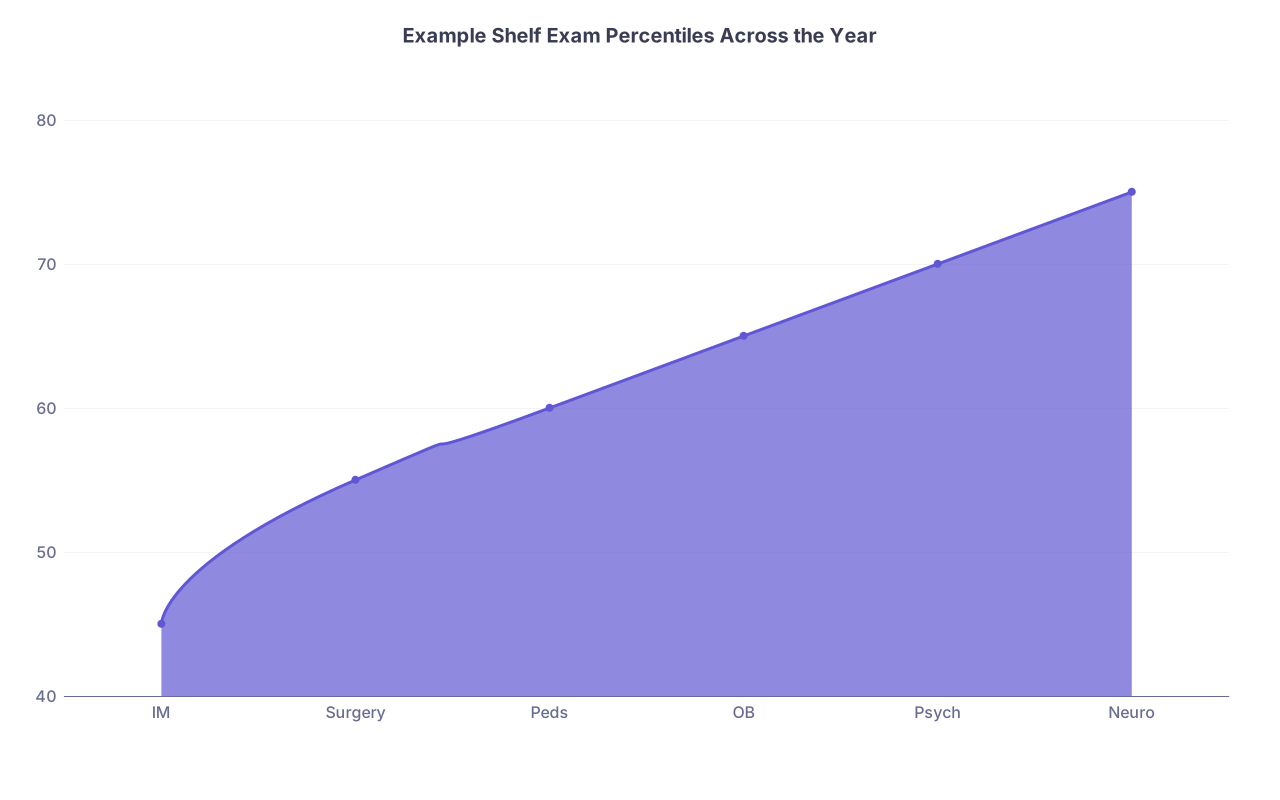
| Category | Value |
|---|---|
| IM | 45 |
| Surgery | 55 |
| Peds | 60 |
| OB | 65 |
| Psych | 70 |
| Neuro | 75 |
If your trend looks more like 20 → 30 → 35 → 40 → 42 → 38, you are not “figuring it out,” you are stalling. That has to be addressed early, not after you bomb Step 2 CK.
Why Students Systematically Underestimate Shelves
I see the same bad assumptions over and over.
“They are just rotation finals.”
No. They define your grade, your transcript, and your eventual Step 2 CK slope.“I will learn on the wards and that will carry me.”
No, it will not. Wards give stories and context. Shelves test breadth and pattern recognition across hundreds of topics you never saw on rounds.“I will ramp things up for Step 2 CK later.”
That is like saying you will learn to run by signing up for a marathon and skipping all the practice races.“My narratives are great; people love working with me.”
Good. They will love working with you as an R3 in a weak program if your numbers do not back that up. Harsh, but real.
You need to treat shelf studying as fundamental, not optional, from day one of clerkships.
Building a Shelf‑First Clinical Year Strategy
Now the practical piece. How do you actually use shelves as your true metric and not just an afterthought?
1. Set Target Percentiles, Not Just “Pass”
Step 1 being P/F tempts people to lower their own bar. Do not repeat that with shelves.
For competitive fields (Derm, Ortho, ENT, Plastics, IR, etc.), I want to see you aiming for:
- Consistent ≥ 70th percentile shelves, with several in the 80+ range if possible
- Especially high performance in medicine, surgery, and any specialty‑relevant clerkships
For mid-competitive fields (IM, EM, Anesthesia, OB) you still want to be safely above average:
- Aim for consistent ≥ 60th percentile, avoid any disasters < 30th
- Make IM and your specialty‑relevant clerkships your best shelves
For less competitive fields, shelves still matter, just with a slightly wider margin. A string of low-percentile scores will still hurt you.
2. Use Clerkships as a Long, Structured Step 2 CK Prep
Clerkship year is not a detour from Step 2 CK; it is Step 2 CK prep if you do it correctly.
Rotation strategy I like:
Month 1–2 of clerkships (e.g., IM, Surgery):
- Heavy question-based learning using UWorld Step 2 CK by system, aligned to your rotation
- Supplement with NBME subject exam practice when 2–3 weeks out from the shelf
- Build Anki / flashcards for high-yield tables and algorithms
Middle of year:
- Start cross-pollinating: your OB shelf studying will help surgery (post-op GYN, sepsis), your psych shelf prep helps IM (delirium vs psychosis), etc.
- Pay attention to recurring themes (DKA, sepsis, chest pain, syncope, neonatal resuscitation).
Late year:
- You should already be in Step 2 CK mode: finishing UWorld, layering NBME practice, using shelves almost like spaced Step 2 practice tests.
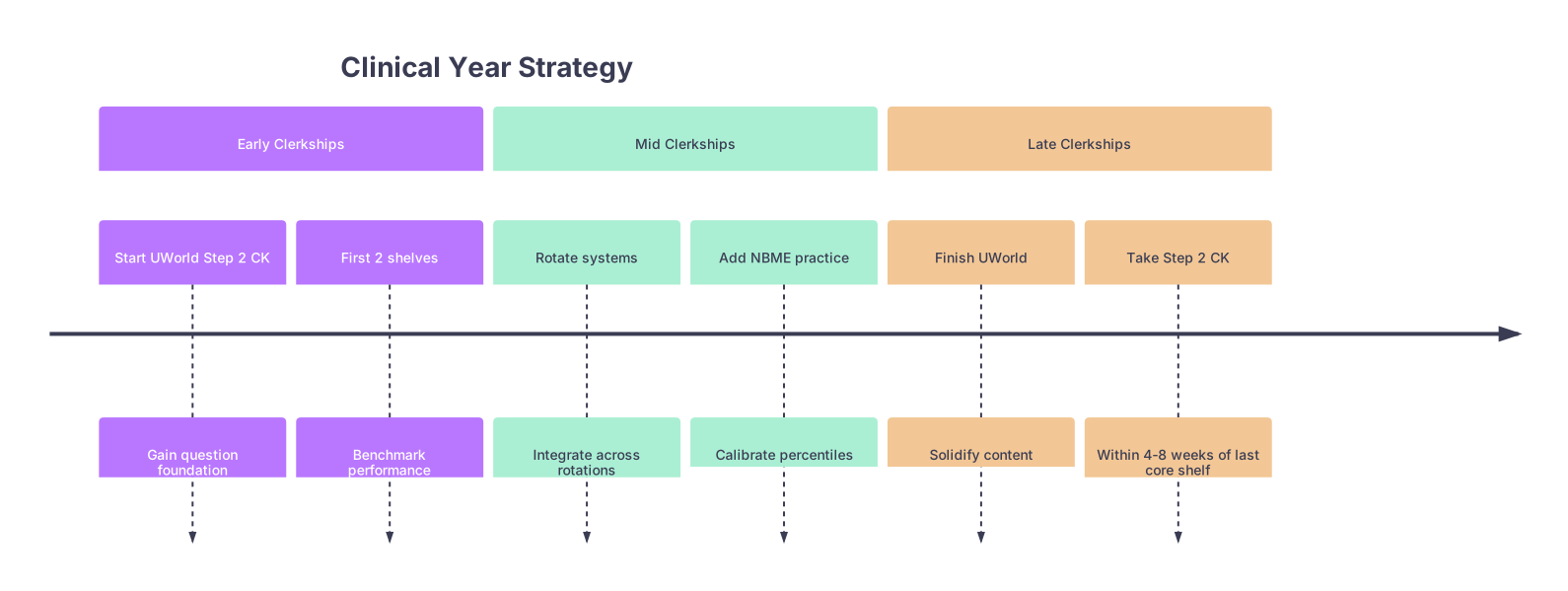
| Period | Event |
|---|---|
| Early Clerkships - Start UWorld Step 2 CK | Gain question foundation |
| Early Clerkships - First 2 shelves | Benchmark performance |
| Mid Clerkships - Rotate systems | Integrate across rotations |
| Mid Clerkships - Add NBME practice | Calibrate percentiles |
| Late Clerkships - Finish UWorld | Solidify content |
| Late Clerkships - Take Step 2 CK | Within 4-8 weeks of last core shelf |
The students who crush Step 2 CK in the P/F Step 1 era are not “cramming for Step 2 for 4 weeks.” They have effectively been studying for a year.
3. Build Rotation‑Specific Shelf Routines
You cannot “wing” shelves between 12‑hour days. You need structure.
Let me give you one concrete weekly template for a busy rotation (Surgery, IM):
Monday–Friday (on-service days)
- 20–30 high‑quality questions per day (UWorld, NBME if you are close to the exam)
- Immediate review in the evening, even if it is just 30–45 minutes
- Focus: what pattern or algorithm did I miss (e.g., chest pain workup, ascites management, anticoagulation bridging)?
Saturday
- 40–60 questions + 1–2 hours of content catch-up (videos, reading)
- Target weak zones from the week
Sunday
- Lighter QBank day (20–30 questions) + targeted review of notes / Anki
- Reset and plan next week based on your error log
For lighter rotations (Psych, Neuro at some schools, outpatient FM):
- You have no excuse not to do 40–60 questions per day on most days.
- Use the extra time to integrate non-rotation systems (e.g., do cardio Qs while on Psych; real boards do not separate them neatly).
The point: question work is not optional. Shelves are NBME‑style, vignette‑driven exams. Reading UpToDate alone will not cut it.
Reading Your Shelf Scores Like a Program Director
Do not just wait for “Pass/Honors.” You need to interpret your shelf data the way PDs will mentally interpret your overall performance.
Raw Percent vs Percentile
Many schools give you a raw percentage. That is almost useless for cross‑clerkship or cross‑student comparison because exam forms and cohorts vary.
Percentile is what matters. That is what tells me where you stand among other med students nationally.
Rough mental mapping of shelf percentile to signal:
| Percentile Range | Interpretation |
|---|---|
| ≥ 80 | Strong national performance |
| 60–79 | Above average, positive signal |
| 40–59 | Average, not a problem but not a plus |
| 20–39 | Below average, potential concern |
| < 20 | Red flag, needs remediation and context |
Now, pattern across rotations matters more than any single score:
- 80, 75, 82, 70, 78, 85 → this is a fundamentally strong test taker.
- 35, 40, 45, 50, 55, 60 → late improvement, but you will need Step 2 CK to show a clear upward trend.
- 70, 72, 75, 35, 38, 40 → that big drop will raise questions. Was it burnout? Life event? Poor fit with specialty content?
You should track this in a simple spreadsheet yourself.
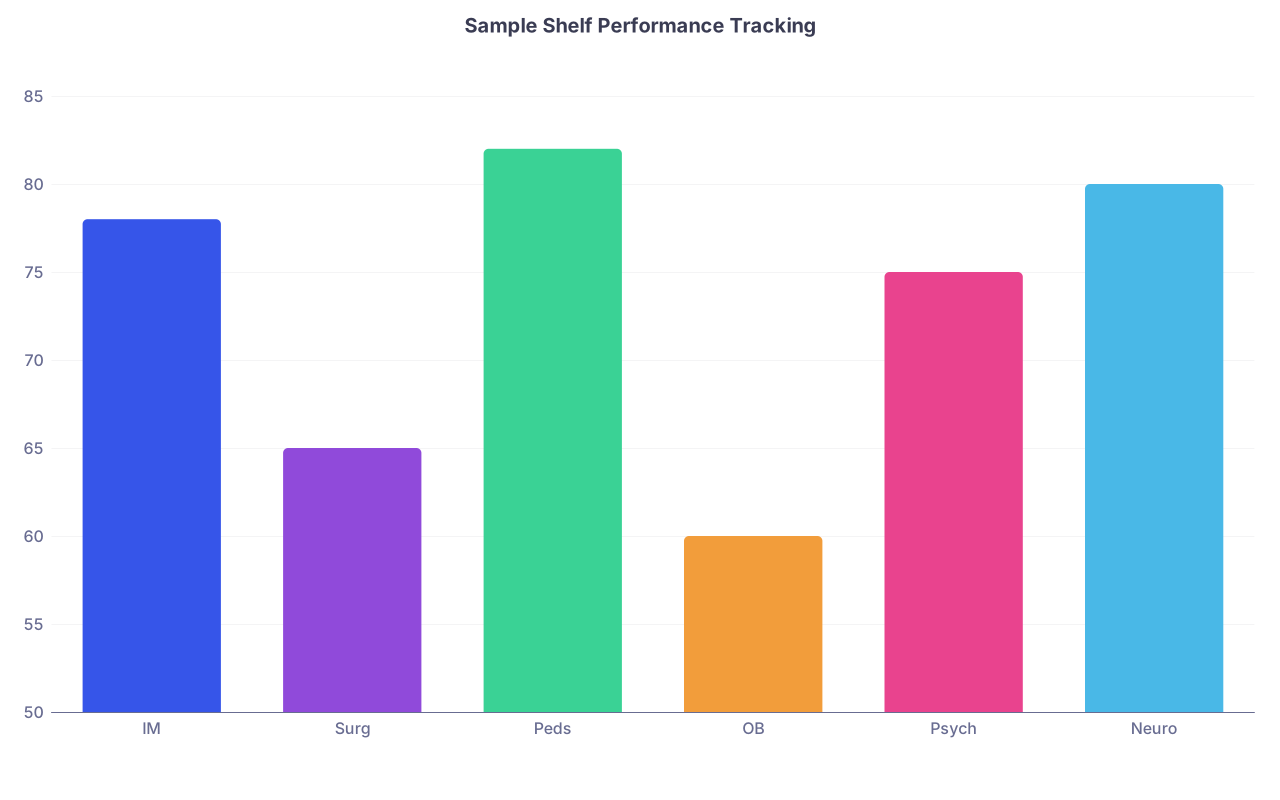
| Category | Value |
|---|---|
| IM | 78 |
| Surg | 65 |
| Peds | 82 |
| OB | 60 |
| Psych | 75 |
| Neuro | 80 |
You do not need institutional reporting to tell you where you stand.
Using Shelf Data to Fix Weakness Before Step 2 CK
Shelf exams are not only evaluative. They are diagnostic.
Patterns I commonly see:
- Chronically weak in OB and Peds → predictive of getting wrecked on newborn, pregnancy, and pediatric questions on Step 2 CK.
- Good in IM and Surgery, bad in Psych → almost always minimal dedicated psych studying, not inherent difficulty. Fixable with a focused block.
- All shelves around 40th percentile → global problem: question-reading, test anxiety, or incomplete content coverage.
Use your shelves to drive course correction:
After each shelf, write down:
- Percentile
- What you felt least prepared for (e.g., rheum, neonatology, endocrine)
- What resource you under‑used
Decide:
- Is this a content issue (e.g., you never truly learned OB hypertensive disorders)?
- Or a test‑taking issue (e.g., you change answers frequently, you misread key phrases, you run out of time)?
Build a 2–3 week micro‑plan to attack that specific weak spot before the next shelf.
Students who treat shelves like “I survived, moving on” repeat the same mistakes into Step 2 CK. Students who autopsy each shelf, even after a solid grade, climb.
How Schools and MSPEs Quietly Encode Shelf Performance
You may not see “third-year shelves: 63rd percentile overall” on your transcript, but it leaks in more ways than you realize.
Common encodings:
Clerkship comments like:
- “Excelled on standardized evaluations.”
- “Performed above the school mean on all NBME subject exams.”
- “Consistently achieved Honors performance on multiple NBME exams.”
Grade distributions:
- Some schools only award Honors if the shelf is above a certain percentile (e.g., > 70th percentile AND strong clinical evals).
- So an “Honors in Medicine” at your school often implicitly means “good shelf score.”
MSPE summary language:
- “Top 25% of class on standardized clinical assessments.”
- “Outstanding performance on NBME subject examinations.”
PDs know exactly what this means. They have seen thousands of MSPEs. They can reverse‑engineer your test performance without ever seeing a direct shelf score.
Shelf Strategy by Specialty Ambition
Let me be even more concrete.
If You Want a Highly Competitive Specialty
Example: Derm, Ortho, PRS, ENT, Urology, Neurosurgery, IR.
You need your shelves and Step 2 CK to scream, “This student is exceptional at standardized clinical reasoning.”
Practical implications:
Prioritize crushing:
- Medicine shelf
- Surgery shelf
- Any elective shelf in your specialty or related (e.g., Neuro if you want Neurosurgery)
Avoid:
- Multiple shelves below the 40th percentile. That is real damage.
- Taking Step 2 CK before you have turned your shelf trajectory upward.
Consider:
- Shelf remediation or NBME retake (if your school allows and it updates your record) to clean up any obvious disasters.
If You Want a Moderately Competitive Specialty
Example: EM, Anesthesia, OB/Gyn, Radiology.
You still need respectable, ideally above-average shelves:
You can survive an outlier low shelf if:
- Others are strong
- Your Step 2 CK is clearly good (top quartile or better for your cohort / specialty)
But if you are stringing together low‑average shelves, you are forcing Step 2 CK to carry your whole application. Risky.
If You Are Not Sure Yet
Treat shelves as your best currency to keep doors open.
You may think you want FM now and change to EM or Anesthesia later. If your shelves are weak, you have removed options before you even decide.
Using Shelf Exams as Feedback on Your Whole System
Here is the key mental shift: shelves are not “extra hurdles.” They are high-frequency feedback on:
- Your content coverage strategy
- Your question‑bank use
- Your note‑taking and retention systems (Anki, handwritten, outlines)
- Your sleep, exercise, and bandwidth
- Your resilience over a long testing year
If your shelf trajectory is flat or declining, ignore the sugar‑coated narrative comments and fix the underlying system.
I have seen this movie:
- Student passes Step 1 early in M2, relaxes too much, drifts into clerkships under‑prepared.
- Shelves land around 30–40th percentile all year.
- Clinical evals are great (“hard worker, well liked”).
- Step 2 CK ends up at or slightly below national mean.
- Suddenly, multiple specialties they liked are out of realistic reach at strong academic programs.
And the opposite:
- Student is anxious about Step 1 pass/fail, uses that energy productively.
- Treats every shelf like a mini Step 2, runs UWorld hard, fixes patterns after each exam.
- Shelf percentiles climb from 50 → 60 → 70 → 80 range.
- Step 2 CK lands very strong.
- Doors open in EM, Anesthesia, even some competitive IM-heavy fields.
The difference is not raw intelligence. It is respecting shelves as the real metric once Step 1 stopped being one.

Concrete Action Plan: What You Should Do Now
If you are early M2, late M2, or starting clerkships soon, here is how I would operationalize all this.
Decide on your shelf standard.
- Write it down: “I am aiming for ≥ 60th percentile on every shelf, ≥ 75th on at least half.”
Pick a question‑first study framework for clerkships.
- UWorld Step 2 CK as your core, supplemented by NBME practice tests closer to shelves.
- Stop thinking “read then do questions”; build around questions plus targeted reading.
Create a running shelf log. For each exam, note:
- Percentile
- Weak content areas
- Rotation + workload level
After 2–3 shelves, evaluate your trajectory.
- If flat and mediocre, change something major (question volume, resource choice, dedicated daily study block).
- Do not wait until after IM + Surgery + Peds are done. By then you have already locked in half your transcript.
Time Step 2 CK based on your shelf trajectory.
- Strong shelves → you can take Step 2 CK earlier (4–8 weeks after last core) with shorter dedicated.
- Weak shelves → you need a more structured, longer dedicated period with explicit remediation of shelf‑identified weaknesses.
Treat every shelf day as a simulation.
- Same routines: sleep, pre‑exam breakfast, anxiety management.
- Same exam behavior: time management, flagging strategy, post‑test debrief.
This is how you turn a supposedly “pass/fail Step 1 world” into an environment where you still have clarity and control over your metrics.

FAQ (Exactly 6 Questions)
1. If my school does not report shelf scores on my transcript, do they still matter for residency?
Yes. They still determine your clerkship grades, which absolutely matter. Honors vs Pass distinctions in core rotations are often heavily driven by shelf performance. Your MSPE will reflect your relative strength on standardized exams indirectly through phrases like “performed above expectations on NBME exams” or via grade distributions. Residency programs do not need to see raw numbers to infer your test performance.
2. How many low shelf scores can I “get away with” and still match into a competitive specialty?
You can sometimes absorb one genuinely low shelf (e.g., < 25th percentile) if the rest are strong and your Step 2 CK is high. Two or more clearly weak shelves, especially in core fields like Medicine or Surgery, start to build a pattern that is hard to explain away. For very competitive specialties, you want your shelves and Step 2 CK both sending the message that you are reliably excellent at standardized clinical reasoning.
3. If my early shelves are poor, can a strong Step 2 CK “erase” them?
Erase, no. Overpower, yes. A very strong Step 2 CK (e.g., clearly above the mean for your target specialty) can mitigate modest shelves and reframe them as “early adjustment issues.” But if your shelves are uniformly weak across the year, PDs will assume Step 2 CK is the outlier until proven otherwise. You want alignment: improving shelves + strong Step 2 CK → credible upward trajectory.
4. Should I ever delay a shelf exam if I feel underprepared?
Only if your school’s policies allow this without major penalty and you have a real plan to use the extra time productively. Constantly delaying shelves to “feel more ready” often backfires: rotations pile up, your schedule becomes chaotic, and stress rises. Usually it is better to aggressively rework your daily study structure than to push the exam repeatedly. Reserve delays for genuine crises or clearly unsalvageable preparation.
5. How many shelf‑style practice exams should I do before each shelf?
As a baseline, I like at least 1–2 NBME subject practice exams for each core clerkship, taken under realistic timing. That gives you calibration on difficulty and style. On top of that, you should be completing a substantial chunk of a high‑quality QBank (often 60–75% of the relevant system questions) during the rotation. The combination of daily QBank and 1–2 full NBMEs is much more predictive than either alone.
6. If I already passed Step 1 with a decent performance, can I relax a bit on shelves?
No. Step 1 is pass/fail for reporting, so whatever “decent” means, nobody sees it. Programs now lean more heavily on shelves and Step 2 CK to judge you. Your prior Step 1 performance may help your internal confidence and foundation, but it does not bail you out if your shelf and Step 2 data are mediocre. In the landscape you are training in, shelves are your real, visible, long‑term performance metric. Treat them that way.
Key takeaways:
First, Step 1 pass/fail did not remove pressure; it relocated it to shelf exams and Step 2 CK. Second, shelves are now your running standardized performance metric, shaping clerkship grades, MSPE language, and Step 2 readiness. Third, the students who win in this era are the ones who treat every shelf as both a high‑stakes exam and a data point to refine their entire test‑taking system.