/Questions, Lectures/Videos, Clinical Work, Admin/Notes](https://cdn.residencyadvisor.com/images/articles_svg/chart-time-allocation-shift-preclinical-vs-ms3-7901.svg "Time Allocation Shift: Preclinical vs MS3")
| Category | Value |
|---|---|
| [UWorld](https://residencyadvisor.com/resources/step1-pass-fail-era/early-usmle-style-clinical-reasoning-drills-for-the-pf-generation)/Questions | 50 |
| Lectures/Videos | 30 |
| Clinical Work | 15 |
| Admin/Notes | 5 |
The way most students try to “bring UWorld to the wards” is backwards. You do not need to make the hospital look like a multiple-choice question bank. You need to make your brain behave on rounds the way it behaves on question 1 of a fresh UWorld block.
Let me break this down specifically.
Step 1 going pass/fail broke a mental crutch. Before, you could hide behind a number. Now, third year is the first time people really see how sharp you are. And they are not looking at your NBME percentiles; they are listening to how you talk through a patient at 6:15 a.m. when you have not had coffee.
This is where Step 1–style vignette skills either become a weapon…or vanish completely.
1. What UWorld Actually Trains (When You Do It Right)
Most students misunderstand what they are practicing when they grind through UWorld. They think they are memorizing “facts.” No. The value is in the micro‑skills buried inside each question.
Every high‑quality Step 1 vignette forces you to:
- Extract essential data from noise.
- Generate 2–4 plausible diagnoses or mechanisms.
- Prioritize with a mental shortcut (pattern, prevalence, high‑yield buzz).
- Test the leading idea against the stem details.
- Choose and commit.
That is exactly what an intern is doing walking into a new admission. Same architecture. Different stakes.
On UWorld:
- You see: 22‑year‑old man, sudden onset chest pain after vomiting, subcutaneous emphysema, widened mediastinum.
- You think: Boerhaave syndrome vs Mallory–Weiss vs spontaneous pneumothorax.
- You pick: Esophageal perforation, next best step is CT with water‑soluble contrast / emergent surgery consult.
On wards:
- You admit: 22‑year‑old man “ripped something vomiting after shots.” CXR read “possible pneumomediastinum.”
- Your senior: “What are you worried about and what do you want?”
- You either sound like a UWorld explanation. Or you sound lost.
Same input, different format. The “translation” problem is not knowledge. It is format and speed.
So the core thesis: You should stop thinking “UWorld vs wards” and start thinking “multiple‑choice format vs open‑ended format.” Your goal MS3 year is to strip away the answer choices and still run the SAME internal algorithm.
2. The Hidden Structure of a Step 1 Vignette = The Hidden Structure of a Patient
Every Step 1 vignette has a skeleton. Faculty are not creative. They recycle the same blueprint with minor costume changes.
Strip a typical UWorld question down and you see:
- Demographics anchor (age, sex, risk factors).
- Chief complaint + time course.
- 3–5 key physical or lab findings that point to the mechanism.
- One or two “gotcha” distractors.
- Final line: what they actually want (diagnosis, mechanism, next step, treatment, risk factor).
Now compare that to the way a good intern presents a patient.

| Step | Description |
|---|---|
| Step 1 | Step 1 Vignette |
| Step 2 | Demographics |
| Step 3 | Chief complaint |
| Step 4 | Key findings |
| Step 5 | Mechanism |
| Step 6 | Diagnosis |
| Step 7 | Management plan |
When you present on wards, you are doing the same thing, just in narrative:
- ID: “This is a 22‑year‑old man with no past medical history…”
- Chief complaint + timeline: “…presenting with acute chest pain after forceful vomiting overnight.”
- Key findings: “He has crepitus in the neck, CXR shows pneumomediastinum, vitals borderline.”
- Interpretation: “This is most consistent with esophageal perforation.”
- Plan: “He needs NPO, broad‑spectrum IV antibiotics, and emergent CT esophagram and surgery consult.”
That’s a Step 1 question spoken out loud.
The translation error MS3s make is trying to “tell the story” like a novel instead of like a vignette. They flood the listener with unstructured data, the way a bad question stem throws in 30 irrelevant facts. Attendings hate that as much as you hated Kaplan’s 37‑line stems.
So first practical skill: consciously map your patient write‑ups to Step 1 skeletons.
When you see a new patient, ask yourself:
- If this were a UWorld question, what would the one‑line “lead‑in” be?
- What 3–5 details would UWorld include to force me toward the diagnosis?
- What would the question at the end be?
Then build your H&P and your oral presentation around that mental stem.
3. Converting “What’s the Diagnosis?” into “What’s Your Plan?”
Here is where Step 1’s pass/fail reality matters. You are not rewarded anymore for niche biochemistry for its own sake. You are rewarded for using basic science to justify your plan.
Programs increasingly care about:
- Can you think on your feet in an open‑ended environment?
- Do you understand pathophysiology enough to defend your orders?
- Can you do this under time pressure without crashing?
On questions, the “action” stops once you click an answer. On wards, that is just phase one. The attending’s next line is essentially the next question in the block.
Example:
UWorld stem:
“A 64‑year‑old woman with long‑standing rheumatoid arthritis on chronic prednisone presents with acute shortness of breath, pleuritic chest pain, and tachycardia. CT angiography shows a segmental pulmonary embolus. What is the most likely underlying mechanism?”
You answer: Hypercoagulability secondary to endothelial damage and immobility, Virchow triad, etc.
On wards, the attending does not care that you say “Virchow triad.” They care that you can snap to the management questions:
- “What is your anticoagulation plan?”
- “What else are you worried about in a chronic steroid user?”
- “How does this change her RA management?”
- “What if CT angio were contraindicated?”
You need to practice extending the vignette mentally into:
- Immediate stabilization (ABCs).
- Diagnostic workup steps.
- Treatment choices and contraindications.
- Disposition and follow‑up.
This is where most MS3s expose that they did questions for pattern recognition only. They can name the disease but go silent when asked for the first three orders.
Specific drill you should start doing:
Take 1–2 UWorld blocks per week during MS3. For any question that has a clear disease entity, after you see the explanation, do this on scratch paper:
- Write: “ED – first 3 orders?”
- Write: “Admission vs discharge – why?”
- Write: “Short‑term complication to monitor?”
- Write: “Long‑term outpatient management change?”
And answer in sentence form. No multiple choice. Train your brain that “recognize → act” is one pipeline, not two separate skills.
4. Rounding Like a Question Bank Author
Rounds are where students either look like future residents or like scribes with stethoscopes.
Here is the fundamental mindset shift: treat each patient as a live vignette you are curating for your team.
You already know how authors design questions:
- They foreground key pathognomonic findings.
- They hide red herrings in generic language.
- They clearly telegraph the clinical question they want you to answer.
You should do the same when you present:
Instead of:
“Mr. J is a 68‑year‑old retired mechanic who came in three days ago with cough, shortness of breath, and fever. He has a history of COPD, HTN, and BPH. Yesterday he had some low blood pressure overnight and needed some fluids, and his urine output was a little low, but now it is a bit better…”
Try the UWorld version:
“Mr. J is a 68‑year‑old man with severe COPD admitted 3 days ago for community‑acquired pneumonia, now day 2 of IV ceftriaxone and azithromycin, who developed new hypotension and oliguria overnight.”
Then:
- Three key positives (fever trend, respiratory status, lactate or creatinine, mental status).
- Two key negatives that prove you are thinking (no chest pain, not hypoxic now, no new infiltrates, etc.).
- One explicit question you answer: “I am most concerned about evolving sepsis with prerenal AKI versus early septic shock; I would like to…”
You have essentially written and solved the question for them. Attendings love this.
A practical structure that works very well:
- One‑sentence summary (vignette lead‑in).
- Overnight events that matter for the main problem only.
- Focused system review relevant to that problem.
- Interpretation: “This pattern is most consistent with X vs Y.”
- Plan framed in Step 2/3 “next best step” language.
You already know how “next best step” questions look. Use that phrasing out loud:
- “Next best step is to escalate fluids and broaden antibiotics because…”
- “Best initial test is repeat troponin and EKG because…”
- “Most appropriate long‑term therapy is starting a high‑intensity statin because…”
You are literally speaking NBME language into the wards.
5. Time Pressure and Cognitive Load: Why You Choke on Wards but Not in UWorld
On your laptop, you have:
- A quiet environment.
- Highlighting tool.
- One focused stem at a time.
- 90 seconds where nobody is watching.
On rounds, you have:
- An attending walking at 1.5x speed.
- The senior flipping through Epic faster than you can read.
- Nurses, alarms, hallway conversations.
- Zero highlighting. Social pressure.
Your cognitive load is blown before you even form a problem list.
The solution is not “try harder.” You need to automate pieces of your reasoning so they survive in chaos.
Think of your Step 1 work as building compressed mental templates. MS3 is accessing them under stress.
Three concrete habits:
Standardized one‑liner templates
For common complaints, pre‑build a UWorld‑style one‑liner in your head:- Chest pain: “Age, risk factors, character, triggers, vital sign instability, EKG/troponin status.”
- Shortness of breath: “Onset, exertional vs at rest, lung/heart history, oxygen requirement, CXR snapshot.”
- Abdominal pain: “Location, onset, associated GI/GU symptoms, fever, peritoneal signs, imaging status.”
In UWorld, that is the front half of the stem. On wards, that is your entire intro. Once you internalize those patterns, you can pull them up on autopilot even with noise around you.
Chunking labs and vitals like question stems
Stop reading every single value out loud. Question writers do not do that either. They highlight what changes the answer.Train yourself: when you see a list of labs, your eyes should automatically lock on:
- Sodium, potassium, creatinine, glucose.
- WBC, hemoglobin, platelets.
- LFT pattern (AST/ALT vs ALP/bili).
- Troponin, lactate, ABG if relevant.
Then the interpretation sentence, the way a UWorld explanation would:
“So we have an anion gap metabolic acidosis with acute kidney injury in the setting of sepsis.”Pre‑built differential frameworks
On questions, you carry mental lists. “Microcytic anemia: iron deficiency, thalassemia, anemia of chronic disease, sideroblastic.”
On wards, everyone suddenly forgets and says “could be anything.”Before rotations start, build and rehearse:
- Differential for chest pain in 5 buckets (cardiac, pulmonary, GI, MSK, other).
- Differential for fever in hospital day 5 (lines, lungs, urine, wounds, drugs, C. diff, clots).
- Differential for altered mental status (AEIOU TIPS or your flavor).
If you can rattle off clean differentials in 5–10 seconds, you look far more “clinical” even though it is the same content as a Step 1 question explanation.
6. How to Study During MS3 Without Abandoning Your Step 1 Brain
Step 1 is pass/fail now, but your Step 1 habits are either an asset or wasted. Most MS3s swing too far away. They stop doing questions and drown in UpToDate paragraphs.
That is a mistake.
The best MS3s I have seen do this:
- Use UWorld/AMBOSS during rotations, but repurpose them.
- Force themselves to verbalize answers as if in front of an attending.
- Convert question explanations into “how I would present and plan for this patient.”
Sample weekly structure on, say, Internal Medicine:
| Day | Clinical Day Focus | Question Bank Task | Translation Task |
|---|---|---|---|
| Mon | New admits | 10 UWorld IM Qs | Turn 2 stems into oral one-liners |
| Tue | Rounds-heavy | 5 Qs after work | For 3, write first 3 orders |
| Wed | Call day | 0–5 Qs (light) | Identify 1 real patient matching a question |
| Thu | Teaching day | 10–15 mixed IM | Turn 2 explanations into SOAP notes |
| Fri | Wrap-up | 10 NBME-style Qs | Practice “next best step” statements aloud |
Key subtlety: You are not chasing percentages. You are practicing translation.
For every question you do, ask yourself out loud:
“If this patient were mine on the floor, what would I say on rounds and what would I write in the orders?”
You will quickly see where your Step 1 knowledge is “trapped” in test format and not ready for real‑time use.
7. Attending Questions = Hidden Step 1/2 Questions
Once you see the pattern, you cannot unsee it. Almost every “pimp” question you get on wards is a mutilated NBME stem.
Examples:
On test: “A 34‑year‑old woman with a history of systemic lupus erythematosus develops new onset hematuria and proteinuria. Renal biopsy shows granular subendothelial immune complex deposition with low complement levels. Which type of hypersensitivity reaction is involved?”
On wards, nephrology attending: “So this lupus nephritis we just diagnosed. Tell me: what kind of immune injury is happening in the kidney? What is the complement doing here?”
Same content. No answer choices.
Or:
On test: “An elderly man with atrial fibrillation on warfarin presents with sudden onset left‑sided weakness. CT scan shows an intracerebral hemorrhage. What is the most appropriate next step in management?”
On wards, neurology resident: “Okay, 76‑year‑old with AF on Coumadin just bled into his brain. What are you going to give him right now? And why that and not FFP?”
So when you are on the spot, mentally translate the attending question back into NBME language:
- “What are they actually testing: mechanism, risk factor, diagnosis, treatment, complication?”
- “If this were a UWorld question, what would the answer choices look like?”
- “Which choice would I click?”
Then say that choice as a sentence instead of a letter.
This is also how you protect yourself against those “gotcha” style interrogations. You have already seen most of this in your question bank grind. You just need to un‑mcq it.
8. Clinical Reasoning as Step 1, Step 2, and Step 3 on Fast‑Forward
Let me be explicit about how your cognitive demand evolves:
- Step 1: “What is this?” (identify mechanism / diagnosis)
- Step 2: “What do you do next?” (initial workup / management)
- Step 3: “Then what?” (longitudinal care, complications, follow‑up)
Third year compresses all three into every patient interaction.
Take a single real scenario:
- 55‑year‑old obese man with new exertional chest pain. EKG shows ST depressions in V4–V6. Troponin borderline.
- Step 1 brain: This is subendocardial ischemia, NSTEMI, pathophysiology of plaque rupture and partial occlusion.
- Step 2 brain: He needs ASA, beta‑blocker, statin, heparin; risk stratification; cardiology consult.
- Step 3 brain: Cardiac rehab, long‑term med adherence, diabetes optimization, smoking cessation, screening family members maybe.
On wards, the attending is silently checking: Do you hit all of those levels? Even briefly.
Use this consciously. When you pre‑round on a complex patient, run a three‑pass mental loop:
- Path: “What is the core mechanism?”
- Acute: “What are the next 1–3 decisions in the next 24 hours?”
- Long: “What will matter after discharge?”
When you present, you do not need to say all three every time. But when you are asked a question, you will not be blindsided because you have already done the full Step 1–3 synthesis in your head.
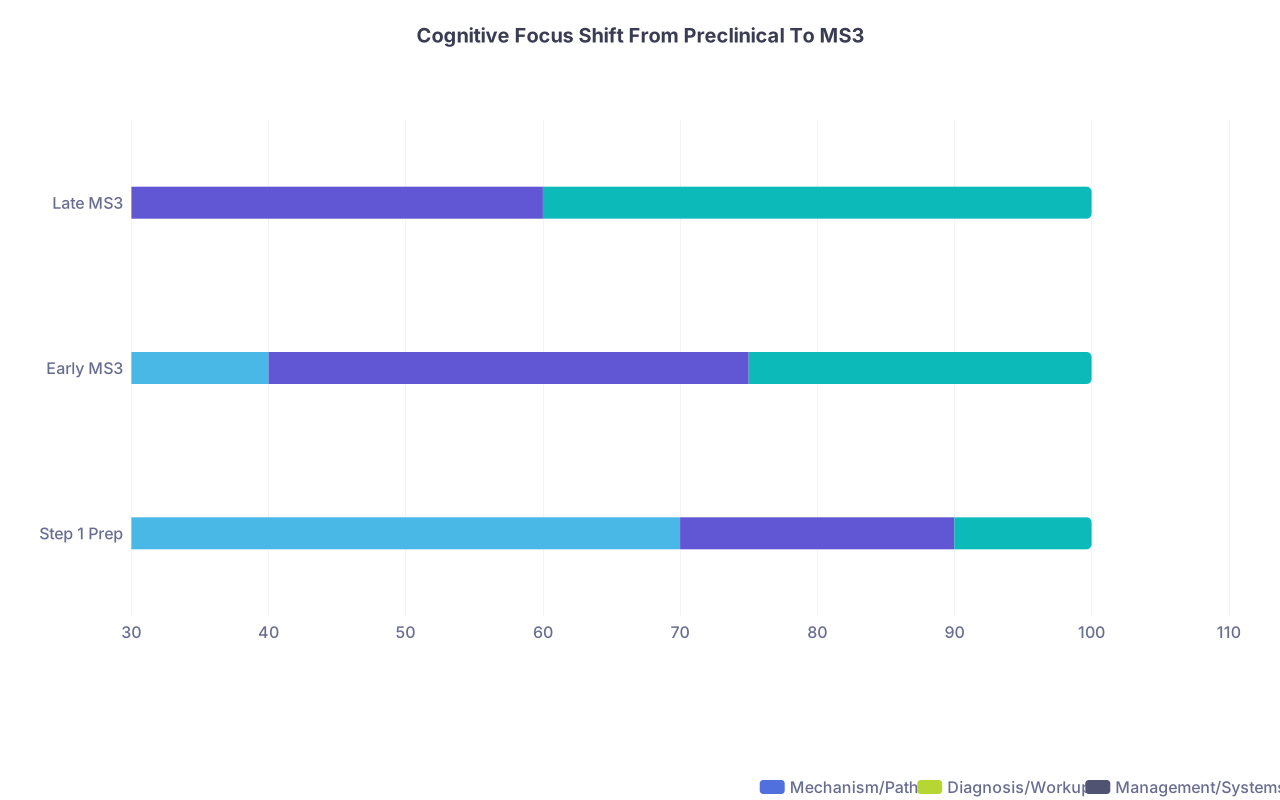
| Category | Mechanism/Path | Diagnosis/Workup | Management/Systems |
|---|---|---|---|
| Step 1 Prep | 70 | 20 | 10 |
| Early MS3 | 40 | 35 | 25 |
| Late MS3 | 30 | 30 | 40 |
You can see how the emphasis moves. You are not abandoning basic science. You are embedding it inside higher‑order tasks.
9. The Emotional Reality: Step 1 Is Pass/Fail, But Your Reputation Is Not
Here is the part people sugarcoat. Step 1 going pass/fail did not make life “easier.” It moved the pressure.
Before:
- You knew exactly what number you were chasing.
- You could disappear into First Aid and question banks and resurface with a score.
Now:
- You pass Step 1 and then walk into clinical evaluations that are subjective, noisy, and permanently embedded in your dean’s letter.
- You can no longer compensate for mediocre clinical performance with a stellar 260.
This creates a dangerous temptation: to abandon “question mode” and focus entirely on social dynamics, rapport, and looking busy. Those matter, but they are not enough.
Attendings absolutely notice who thinks like a test‑taker under the surface:
- Who anticipates overnight issues based on pathophysiology.
- Who speaks in clear, structured, NBME‑like reasoning instead of vague “I just feel like…” statements.
- Who can justify a plan with one or two clean sentences connecting Step 1 knowledge to Step 3 decisions.
I have seen plenty of students who “got by” on charm and effort their MS3 year. They struggle hard as interns. They can gather data; they cannot interpret and act.
You do not want to be that intern.
So yes, Step 1 is pass/fail. But your Step 1‑honed reasoning is one of the only objective edges you bring into an inherently subjective MS3 environment. Use it.
10. A Simple Practice Routine to Actually Make This Happen
Let me make this concrete. Here is a routine I have seen work for busy MS3s who are not masochists.
Daily on wards (takes 10–15 minutes total):
- Pick one patient you are following.
- On a scrap of paper, write a UWorld‑style vignette for them (4–6 sentences, one clear question at the end).
- Close your note, and answer your own question in one sentence as if it were an answer choice.
- Then, beneath that, write:
- “Initial orders today:” list 3–5.
- “Biggest risk next 24h:” one line.
- “Long‑term issue:” one line.
Weekly (30–60 minutes, not on call night):
- Do 10–15 mixed questions relevant to your rotation (UWorld, AMBOSS, NBME).
- For 3 of them, force yourself to:
- Present the patient out loud as if on rounds.
- State your assessment and plan out loud.
- Compare to the explanation and adjust.
Once a week, during downtime or post‑call:
- Look at two actual patients’ H&Ps you wrote.
- Ask: “If this showed up as a UWorld stem, what would they be testing?”
- If your write‑up does not make that obvious, tighten it.
You are essentially running a translation drill: UWorld → Wards and Wards → UWorld. Do this for a few months and the boundary vanishes. Your thinking style becomes uniform across both domains.

11. The “Future of Medicine” Angle Everyone Pretends To Understand
Let me zoom out for a moment. Step 1 went pass/fail partly because the system realized something ugly: we were training students to be world‑class test takers and mediocre clinicians for the first six months of residency.
The answer is not to throw away test‑taking. It is to align it with real clinical performance.
You are entering a world where:
- AI will be better than you at memorizing guidelines and rare syndromes.
- EMR systems will spit out differential lists for common complaints.
- Decision support will suggest antibiotic doses faster than you can calculate creatinine clearance.
What machines will lag at—for a long time—is weaving messy patient narratives, implicit goals, team dynamics, and pathophysiology into clean, actionable plans under time pressure.
That is exactly the skill you practice when you stop treating UWorld as a trivia game and start treating it as simulated clinical reasoning. And it is exactly what you demonstrate on wards when you present like a well‑authored vignette and manage like a Step 2/3 answer key.
So yes, this is about honoring the grind you already did for Step 1. But it is also about building career‑proof thinking habits. Pattern recognition + pathophysiologic reasoning + action planning. Compressed into 30 seconds of talking.
If you can do that, you will still matter when everyone else is delegating their thinking to algorithms.
Three points to carry out of this:
- A Step 1 vignette and a patient on rounds share the same skeleton; your job is to present and reason in that structured way without answer choices.
- During MS3, keep using question banks, but repurpose them: every question becomes a drill in oral presentation and management planning, not just fact recall.
- Your “test‑taking brain” is not obsolete in the pass/fail era; it is your main defense against chaotic wards and your biggest asset in becoming the intern people actually trust.