
Deep Dive: How Question Banks Quietly Shifted Post–Step 1 P/F
It is 11:47 p.m. You are on your third Anki session of the day, UWorld is staring at you from another tab, and somewhere between your 3rd micro question on Pseudomonas and your 5th question on restrictive lung disease, you realize something feels… off.
You are doing fine on blocks. But you also have this nagging sense that you are training for an exam that does not exist anymore. Step 1 is pass/fail. Yet your QBank is still screaming about “high-yield for test day,” giving you percentile curves, and showing you explanations that look like they were written in 2014.
You are not imagining it. Question banks did change after the Step 1 P/F shift—but not in the obvious ways students expected. The changes have been quieter, more structural, and honestly, more strategic from the companies’ perspective than from the students’ perspective.
Let me break this down specifically.
1. The Core Market Reality: Step 1 P/F Did Not Shrink QBank Demand. It Moved It.
The naive prediction when NBME announced Step 1 going pass/fail was: “QBanks are dead. People will chill. Step 2 will be king but Step 1 prep will soften.”
That is not what happened.
Most large players (UWorld, AMBOSS, Kaplan, etc.) saw something different: demand shifted, not disappeared. And they adapted in three concrete ways.
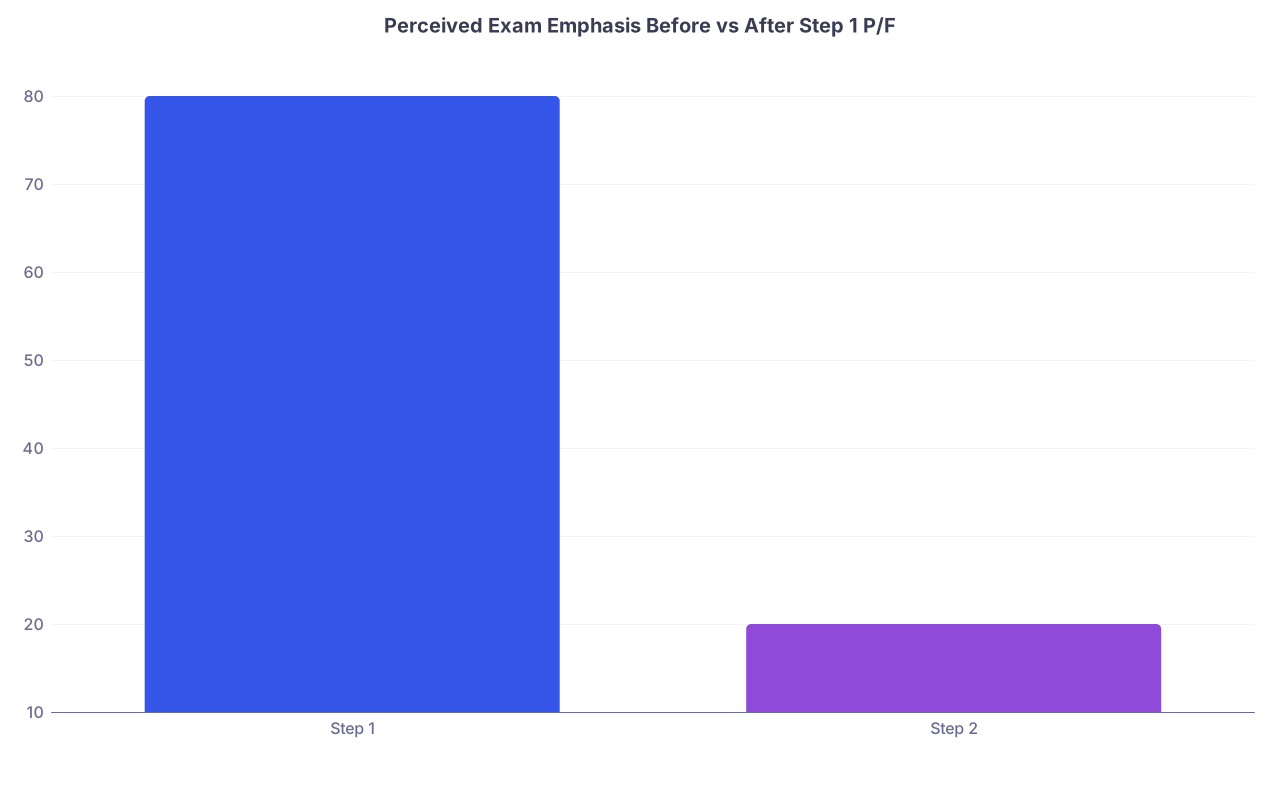
| Category | Value |
|---|---|
| Step 1 | 80 |
| Step 2 | 20 |
(Pre–pass/fail, most students emotionally weighted Step 1 massively over Step 2.)
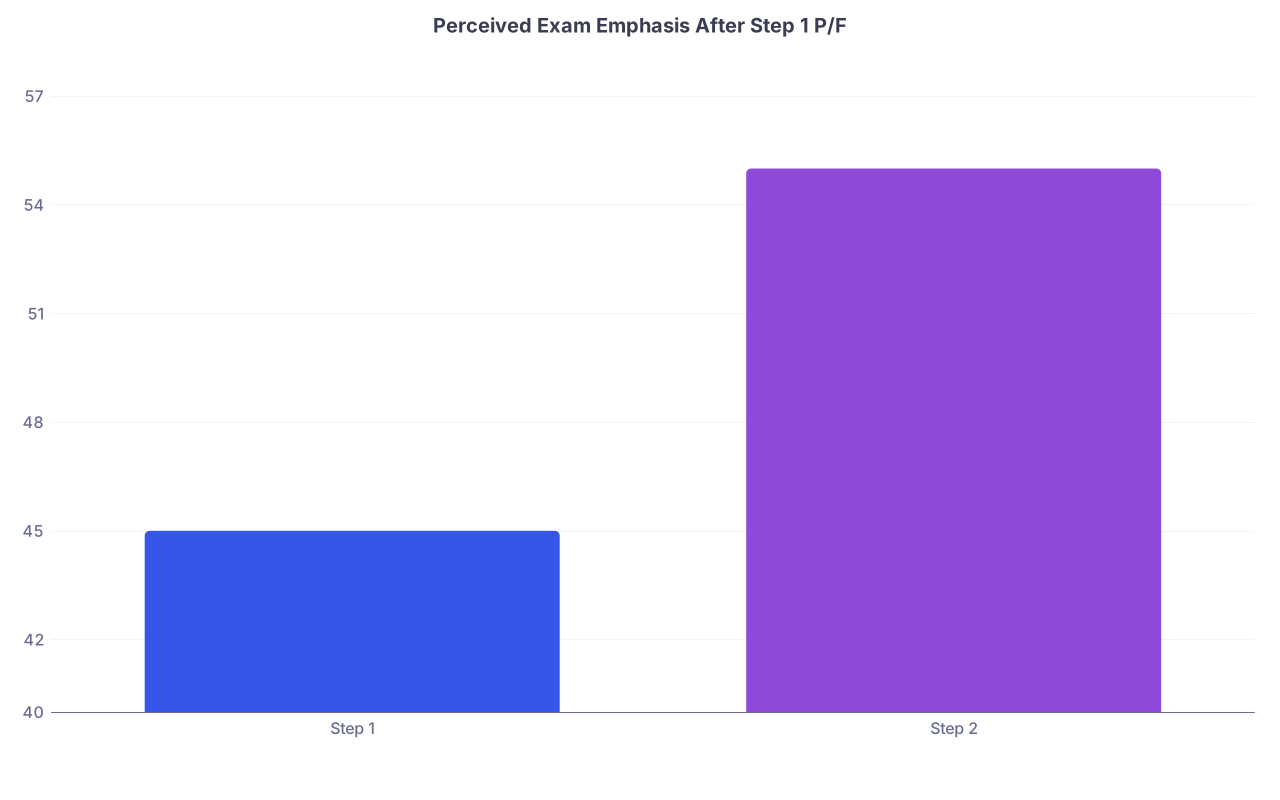
| Category | Value |
|---|---|
| Step 1 | 45 |
| Step 2 | 55 |
Notice what that did to incentives:
- Students still fear failing Step 1. Because remediation, delay, and the scarlet letter of a “fail” in ERAS are not trivial.
- Programs shifted their screening weight to Step 2 CK. So now Step 2 score pressure skyrocketed.
- Schools, terrified of drop in board pass rates, started baking QBank usage into their curricula.
So QBanks quietly pivoted their business posture without announcing it.
• They stopped selling “crush Step 1 for a 250+” and started selling:
– Start questions earlier
– Integrate with your preclinical courses
– We are the bridge to NBME and Step 2
• They expanded “institutional” products—full access for entire classes, analytics for deans, dashboards for course directors.
Translation:
They moved from being “test prep” toward being “core curriculum infrastructure.”
You feel this when: your school tells you, “You must complete X% of UWorld/AMBOSS questions for this course,” and suddenly your “personal” board prep tool is mandatory coursework.
2. What Actually Changed Inside the Step 1 Question Banks
Let’s talk content, not marketing. Because this is where the subtle shifts are.
2.1 Less “esoteric flexing,” more NBME-core alignment
Before P/F, QBank writers had an unspoken competition: whose explanations could feel smartest. Vascular anomalies, obscure lysosomal diseases, tertiary and quaternary biochemical pathways—if they could justify it as “high-yield for 260+,” it stayed in.
Post P/F, the incentive shifted: programs do not care if you crush a weird glycogen storage question. They care that you do not fail basic pathology, pharm, and pathophys.
Several things started to happen:
- More questions mapped explicitly to NBME content categories. You see this in tags: “NBME Systems: Cardiovascular; Task: Diagnosis; Physician Task: Patient Care.”
- A pruning (or down-ranking) of low-frequency zebras that did not match NBME style. They still exist, but far fewer “weird for the sake of weird” items.
- Vignettes that feel slightly more straightforward diagnostically, but with more emphasis on understanding why each distractor is wrong.
You experience this as:
More questions that feel like “classic presentation of a classic disease with a twist in management,” and fewer questions that feel like a Step 1 writer showing off their PhD in biochem.
2.2 Style drift toward clinical reasoning—even in so-called “basic science”
Programs started saying openly: “We will use Step 2 CK (and maybe Shelf performance) to judge clinical competence.” Schools responded by integrating more clinical reasoning earlier. QBanks followed.
So now the "basic science" questions increasingly look like this:
- Third-year-level clinical framing
- Step 1-level answer choices
Example pattern you may have noticed:
Old style:
“An experiment in a lab is performed on isolated rat cardiomyocytes…” → Answer: some obscure enzyme in oxidative phosphorylation.
Newer style:
“65-year-old man with dyspnea and orthopnea, echo shows reduced EF…” → You are asked about which receptor pathway in cardiomyocytes is modulated by a specific drug, with answer choices in second-messenger language.
Same mechanistic content. Entirely different frame. And that frame is deliberate: train you to hold the clinical picture in your head while manipulating mechanistic detail.
2.3 Analytics and difficulty curves subtly reweighted
Question banks have their own exam economy: difficulty ratings, percentile curves, average percent correct, etc.
Before Step 1 P/F, companies were incentivized to maintain a wide spread of difficulty. Ambitious students wanted very hard questions to differentiate themselves for 250+.
Post P/F, the key business fear is different:
Students failing Step 1 because they feel crushed, demoralized, and confused by overbrutal blocks.
What changed:
- Gradual toning down of “insane difficulty” questions in the core pool. Hard questions still exist, but borderline-sadistic items often get reclassified or moved into “advanced” or “optional” sets.
- Increased tagging of “basic pass-fail concepts” vs “advanced/extension” in explanations. You see lines like, “For Step 1, you must know X; Y is more Step 2 CK–level nuance.”
- Some companies quietly adjust difficulty coding when too many users get hammered. You will never see this announced, but you feel it when your average percent correct creeps up without you dramatically changing your study habits.
Is this good? Overall yes. But it makes one thing dangerous:
If you rely on QBank “difficulty” alone as your metric of readiness for Step 2, you are probably underestimating how sharp Step 2 still is.
3. The Real Pivot: Step 2 CK QBank Arms Race
The biggest consequence of Step 1 P/F is not inside Step 1 banks. It is what happened to Step 2 CK banks.
Companies realized very quickly: residency selection pressure did not disappear. It moved.
So they did three things fast:
- Expanded Step 2 QBank volume
- Increased integration with Step 1 content
- Marketed “one continuous pipeline” from M1 through Step 2 CK
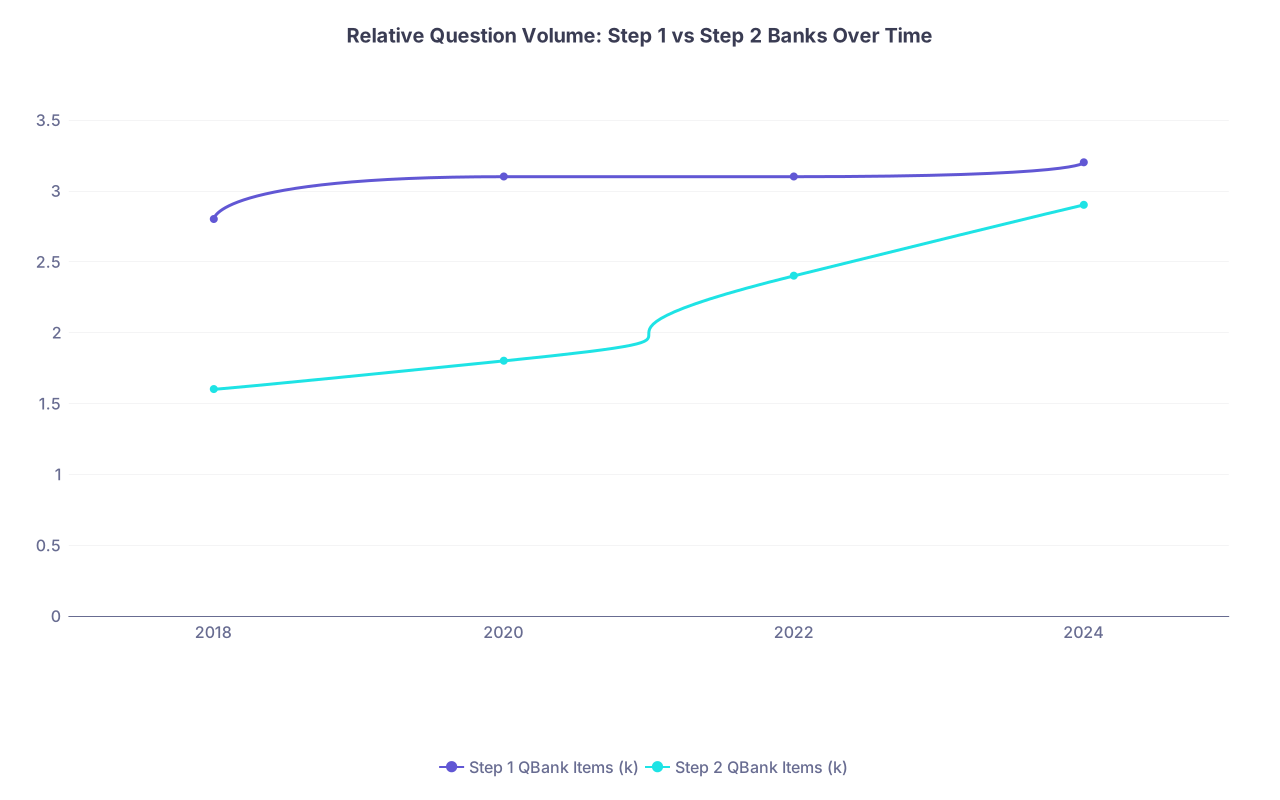
| Category | Step 1 QBank Items (k) | Step 2 QBank Items (k) |
|---|---|---|
| 2018 | 2.8 | 1.6 |
| 2020 | 3.1 | 1.8 |
| 2022 | 3.1 | 2.4 |
| 2024 | 3.2 | 2.9 |
You feel this everywhere:
- UWorld Step 2 blocks that look more polished, more integrated, more “flagship” than Step 1 blocks.
- AMBOSS heavily emphasizing Shelf + Step 2 CK alignment and question difficulty tuning to clerkship-level reasoning.
- Newer platforms selling “Foundations + Clinical” tracks as a package.
For you, as a student, this means:
- Your Step 1 QBank work is no longer a one-off mountain; it is the foundation layer for a two-step structure.
- The companies design Step 1 QBank explanations with an eye toward reusability in Step 2 learning: pathophys now constantly segues to management, workup, prognosis.
So yes, even your Step 1 banks are now quietly Step 2 prehab.
4. Pedagogy Shift: From “Assessment Tool” to “Primary Teaching Tool”
Here is the blunt reality: a huge number of schools quietly outsourced a meaningful portion of their teaching to question banks over the last five years.
Step 1 going P/F accelerated that trend, because schools care a lot less now about bragging “median 245” and a lot more about “no one fails Step 1, and everyone is basically safe for Step 2.”
Question banks picked up that signal and leaned hard into pedagogy.
4.1 Explanations became mini-tutorials, not just answer justifications
Historically, some explanations read like this:
- One paragraph on why the correct answer is right
- One sentence on why other options are wrong
- Maybe a line of “high-yield: remember X”
Post P/F, explanations in major banks increasingly look like short board review chapters embedded inside a question:
- Pathophys summary
- Key clinical features
- Basic diagnostic/management steps (even if Step 2-ish)
- Mnemonics, tables, and “compare/contrast” lists
You have probably noticed:
- Tables inside explanations: “Differentiate Crohn vs UC,” “SSRI vs SNRI side effects,” etc.
- A lot more “memory anchoring” language: “Classic triad is…,” “Hallmark lab finding is…”
- “Big picture” sections: “Why this matters clinically,” or “This concept recurs in Step 2 CK.”
Because of this, smart students now treat QBank explanations almost like their main textbook. That was not true 10 years ago at scale. It is absolutely true now.
4.2 Vertical integration: Preclinical → NBME-style → Clerkships
Let me show you the implementation pattern I keep seeing in schools:
- M1: Assigned basic science questions tied to lectures. Often lower difficulty, high repetition.
- M2: Full Step 1-style blocks as part of “board prep,” but scheduled by unit (cardio, renal, etc.).
- M3: Shelf exam prep using the same platform, now in Step 2 mode.
QBanks responded by tagging, reorganizing, and building “study modes” for each of those phases using the same item bank.
You will see options like:
- “Study by Medical School Curriculum”
- “Study by Org System / Discipline”
- “Clerkship mode / NBME Shelf focus”
So the same item is now:
- A “renal phys” item for M1
- A “Step 1 pass-fail foundational nephro path” item for M2
- Background knowledge for a “CK acute kidney injury management” item in M3
The creep is subtle but powerful: your mental model of physiology and pathology is now shaped more by how QBank writers scaffold learning than by your school’s lecture sequence.
That is not necessarily bad. But you should be aware of who is actually teaching you.
5. Behavior Change in Students: How You Use Banks Has Shifted (Even If You Did Not Intend It)
Students always adapt faster than faculty admit. Once Step 1 went P/F, you started using QBanks differently—even if nobody sat you down to talk about it.
5.1 Less obsession with percent-correct, more with “coverage”
Before P/F, I routinely heard:
“If my UWorld percentage is 75–80%, I am on track for a 250+.”
People tracked and graphed their cumulative percentages like a stock portfolio.
Post P/F, I hear different things:
- “Have you finished the bank?”
- “Did you reset and do a second pass?”
- “How many questions per subject have you seen?”
Students are optimizing for completeness and exposure, not just raw performance. Which tracks with the new goal: “I cannot afford a knowledge black hole that leads to a failure.”
So QBank interfaces shifted accordingly:
- More emphasis on “questions remaining,” “coverage progress,” and “subject completeness” bars.
- Less in-your-face “your percentile is X” on every dashboard screen.
This is not a coincidence. It is alignment with your new psychology: survive Step 1, position for Step 2.
5.2 Increased early adoption (M1s in QBank-land)
Pre–P/F, lots of faculty groaned when M1s started UWorld in their first semester. They were usually right; it was often premature.
Now? Schools themselves are sometimes forcing M1s into question banks early. Why?
Because:
- They want to push active recall and application from day one.
- They are terrified of an M2 “oh no, Step 1 is in 3 months and I have never done questions” crisis.
- QBank companies now pitch themselves directly to curriculum committees as “learning-science aligned” (spaced repetition, retrieval practice, etc.).
Result: your average M1 is doing way more QBank-style questions than a 2016 M1 did. And banks responded by:
- Creating easier, “learning-mode” questions with softer stems and more obvious answer choices.
- Adding “Educational Objective” blurbs that literally teach the concept explicitly even if you guessed correctly.
6. Subtle Content Drift: What’s Emphasized More (and Less) Now
You can feel some areas getting louder and some getting quieter. Let’s be specific.
6.1 Louder: Clinical relevance of basic science
Even purely mechanistic topics are now constantly hooked to a disease, a drug, or a management decision.
Examples:
- Pharmacology: less “mechanism only” questions, more “guy on this med comes in with side effect X, what receptor is involved?”
- Physiology: more “patient on ventilator with X settings, which pressure-volume loop matches this change?”
- Biostats: more questions wrapped around counseling, shared decision-making, and test characteristics described in words instead of raw tables.
This is deliberate Step 2 preparation in disguise.
6.2 Louder: Communication, ethics, and system-based practice
Despite Step 1 being “basic science,” you are seeing more:
- Breaking bad news style vignettes
- Questions about “next best step in communication,” consent, disclosure of errors
- Items framed around health-care systems, cost, or interprofessional teams
These are not high-weight on Step 1 numerically, but they are cheap to add, easy to justify under the “physician competencies” umbrella, and they pull Step 1 closer to Step 2’s feel.
6.3 Quieter: Deep, non-clinical experimental design
Not gone. Just less dominant.
Classic old-school Step 1 had a lot of:
- Wet-lab experiments with knockout mice
- Complex flow charts of enzyme activities with theoretical manipulations
- Pure molecular pathways with no patient in sight
Post P/F, those have been pruned or recontextualized. When they appear, they usually tie back to a human disease state or a therapeutic.
You still get experimental design and confounding, sure. But wrapped in clinical coats. Less “lab bench only,” more “translational flavor.”
7. Business-Side Changes You Never See But Definitely Feel
Behind the scenes, QBank companies acted like any rational business under changing regulation: they hedged, diversified, and integrated.
7.1 Cross-product bundling: You are not buying “a QBank” anymore
Look at the typical offer now:
- Step 1 QBank
- Step 2 CK QBank
- Self-assessments
- Flashcards or spaced-repetition tool
- “Learning library” or knowledge cards
- Institutional dashboards for schools
The Step 1 P/F shift pushed companies to make sure if Step 1 usage ever fell, they still had you for Step 2, shelves, and even preclinical coursework.
You notice:
- Bundles heavily discounted vs single-exam purchase.
- Long-duration subscriptions (18–24 months) targeted at M2s starting Step 1 prep but also covering Step 2.
- Aggressive institutional pilots: “We will integrate our platform with your LMS and align our questions with your curriculum.”
You are not just the customer. Your dean is also the customer.
7.2 Data feedback loop got tighter
Every time you answer a question, you are generating data: difficulty, discrimination, timing, performance by system, etc.
Post P/F, this data is more valuable for one reason: schools are now hungry for “early warning” signals of students at risk for Step 1 or Step 2 problems.
So:
- QBank analytics now often ship with “cohort performance” reports for schools.
- Your weak systems are potentially visible (in aggregate) to administration.
- Question writers use real-time data to tweak, retire, or rewrite questions faster.
That is why sometimes you revisit an old question and its explanation looks different, or its difficulty rating changed. You are living inside an ongoing A/B test.
8. How to Use Post–P/F QBanks Intelligently (Instead of Letting Them Use You)
You cannot change that the ecosystem shifted. You can absolutely decide how to exploit it.
8.1 For Step 1 (P/F) specifically
Your priorities are different than the 2018 crowd aiming for 260+. They should be.
Your primary Step 1 QBank objective: eliminate “fail-level” gaps.
That means:- Make sure you have seen a broad cross-section of bread-and-butter questions in every major system.
- Do not obsess over obscure questions that even explanations admit are rarely tested.
Use explanations as your main text for reinforcement, but not as your only source.
- Skim the “educational objective” and the key reasoning section thoroughly.
- If you feel repeated confusion in one topic (e.g., immunodeficiencies, renal phys), that is where you go back to a more structured source (B&B, Pathoma, etc.).
Track coverage, not just performance.
- Aim to complete the majority of a high-quality Step 1 QBank by 4–6 weeks before your exam.
- Then pivot some time to NBMEs and dedicated weak-point repair.
Do not be fooled by getting “good” percentages on artificially reweighted difficulty.
- You should still challenge yourself with mixed blocks, timed mode, and realistically paced review.
- Passing Step 1 is not trivial. Treat it seriously.
8.2 For Step 2 CK (where the game is now)
Here your posture must be different.
Treat Step 1 questions as the warm-up, not the main event.
- When you hit Step 2 QBank, you want basic mechanisms and pathophys to feel like second nature.
- If every Step 2 question turns into a pathophys refresher, you will drown.
Expect Step 2 QBank to be the “aggressive” bank now.
- Harder, more nuanced, longer stems.
- More ambiguous “best” answers, true to NBME’s style.
Use vertical integration to your advantage.
- When you miss a Step 2 question on, say, heart failure management, and the explanation calls back to preload/afterload curves, go track down a couple Step 1-style phys questions on the same concept.
- You are exploiting the fact that the same companies wrote both.
Accept that your Step 2 performance is now a central element in your residency application.
- Do not bring a “P/F chill” mentality into CK prep.
- The system did not get kinder. It just changed which exam matters.
9. Where This Is Likely Heading Next
Let me project forward a bit. Because the “quiet shifts” you are feeling now are just the first wave.
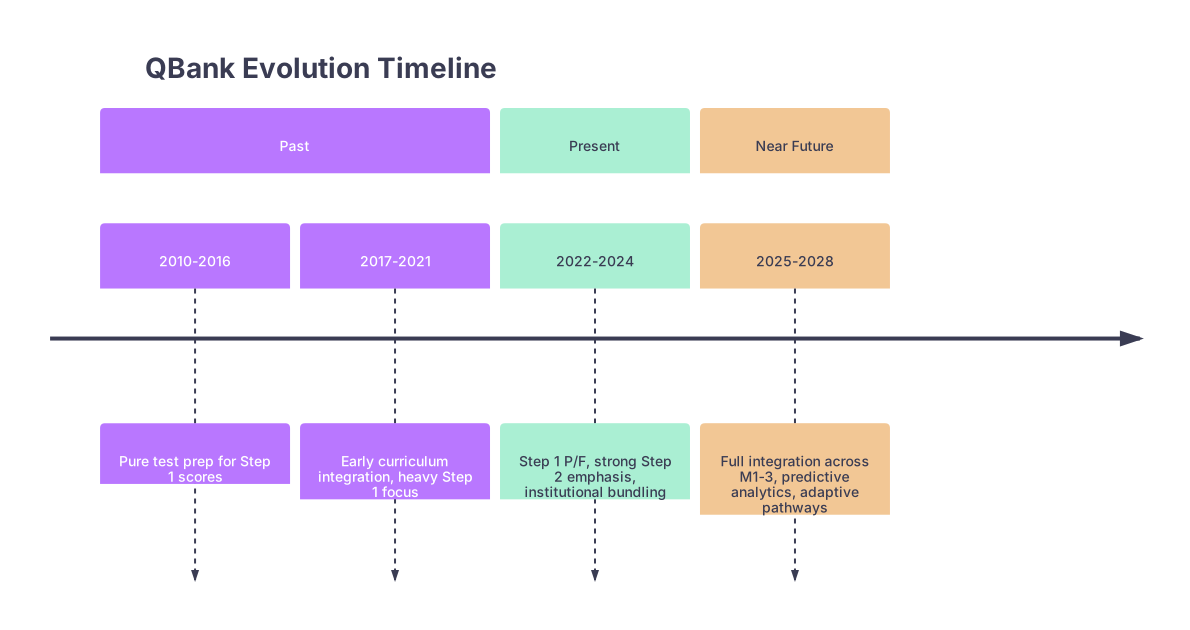
| Period | Event |
|---|---|
| Past - 2010-2016 | Pure test prep for Step 1 scores |
| Past - 2017-2021 | Early curriculum integration, heavy Step 1 focus |
| Present - 2022-2024 | Step 1 P/F, strong Step 2 emphasis, institutional bundling |
| Near Future - 2025-2028 | Full integration across M1-3, predictive analytics, adaptive pathways |
9.1 More adaptive, personalized QBank paths
Static “do questions 1–3000” is not efficient. With enough data, banks will:
- Adapt question difficulty based on your pattern of misses.
- Build “micro-remediation modules” automatically from your error clusters.
- Flag students at risk of failing weeks or months before school exams catch it.
Some of this already happens in crude form. Expect it to be more explicit pretty soon.
9.2 Deeper integration with school exams
Do not be surprised when:
- Your in-house midterm looks suspiciously similar to QBank style and difficulty.
- Some schools fully outsource formative assessments to QBank products.
- “Board-style” internal exams are basically QBank questions plus a thin local wrapper.
This blurs the boundary: you are not “doing QBank for boards” anymore; you are “doing QBank for med school, which incidentally is boards-aligned.”
9.3 Potential risk: training to the tool, not the test
When one set of commercial question writers dominates how multiple generations of students think about disease, side effects, and workflows, you get a subtle monoculture.
You start to:
- Recognize certain phrasings and patterned logic unique to that QBank.
- Anticipate the “trick” of a question because you know the bank’s style—not because you deeply understand the medicine.
NBME still writes the real exam. Their style shifts slowly. Your best defense is to:
- Always include NBME self-assessments actual forms in your prep.
- Notice where your main QBank over- or under-shoots NBME style.
- Adjust expectations accordingly.
| Domain | Pre–P/F Era Focus | Post–P/F Era Focus |
|---|---|---|
| Primary Goal | Maximize Step 1 score | Prevent Step 1 failure + build CK base |
| Question Style | Mechanistic, sometimes esoteric | Clinically framed, NBME-core |
| Main Metric for Students | Percent-correct, percentiles | Coverage, completion, weak-area repair |
| Product Strategy | Single-exam prep | Integrated Step 1+2, curricular use |
| Pedagogic Role | Assessment, practice | Primary teaching plus assessment |

10. Bottom Line: What You Should Take Away
You are living through an era where commercial question banks quietly became one of the dominant curricular forces in medical education, and the Step 1 P/F move actually strengthened that role instead of weakening it.
Use that to your advantage. But be conscious about it.
Key points to walk away with:
- Step 1 question banks have shifted from “score-maximizing weapons” to “safety nets plus on-ramps for Step 2.” Treat Step 1 as foundational, but put your competitive energy toward Step 2 CK.
- The pedagogy inside QBanks is richer, more integrated, and more clinically framed now. Explanations are your hidden curriculum; do not skim them mindlessly.
- Do not let QBank style become your only framework. Anchor yourself periodically with NBME materials and primary review resources so you are training for the real exam, not just for the platform you paid for.
Use the banks. Just do not let them quietly be the only voice in your medical education.