
Only 27% of Step 2 CK questions are truly “system-agnostic.” The rest are anchored in organ systems whether you notice it or not.
That matters more in the pass–fail Step 1 era than most students realize.
Let me be blunt: if you are still studying for Step 2 CK as a list of “high-yield topics” instead of as integrated organ systems, you are building on sand. The exam has already shifted. Your school’s curriculum is (slowly) shifting. If your study strategy does not follow, you will work harder and score lower than you should.
This is where vertical integration comes in. And no, it is not just curriculum jargon. It is a very practical way to future‑proof how you learn and how you score.
What “Vertical Integration” Actually Means for You
Forget the committee-friendly definition for a moment.
Vertical integration for a Step 2 CK test-taker = linking preclinical mechanisms to clinical decisions within a single organ system “stack.”
Instead of:
- “Cardiology: hypertension, heart failure, murmurs” on one list
- “Pharm: beta blockers, ACE inhibitors” on another
- “Micro: endocarditis bugs” somewhere else
You build a vertical stack:
Cardiovascular system → structure → physiology → pathophys → micro → pharm → imaging → guidelines → long‑term outcomes.
All inside one mental container. When you see a Step 2 question, you pull from that container instead of speed‑searching your brain for unconnected trivia.
In the Step 1 scored era, you could (sort of) get away with siloed learning:
- Memorize pathways + receptors for Step 1
- Learn guidelines + management trees for Step 2
That world is gone. Programs are increasingly using Step 2 CK as the hard filter, and NBME has been shifting questions toward mechanism-informed management. Not pure memorization. Not pure “calc score and treat.”
So if you try to prep Step 2 CK as “UWorld + some guidelines,” you are missing the layer that now separates a 245 from a 265: vertically integrated systems knowledge.
Why Organ Systems Are The Only Stable “Unit” Left
Guidelines change. Question styles drift. Score distributions compress. Organ systems… stay.
USMLE will rewrite hypertension targets every few years, but the kidney does not care. RAAS is RAAS. Coronaries are coronaries.
The smartest way to “future-proof” your Step 2 CK prep is to organize your learning around the one thing that will not be rewritten in the next NBME content update: organ systems as integrated units.
Let me make this concrete.
How Step 2 CK quietly uses systems even in “random” blocks
Students complain: “My block felt so random: psych, then renal, then OB, then ID.”
But if you look closely, you will notice patterning inside systems:
- A CKD patient with anemia of chronic disease → renal + heme + pharm (EPO, iron)
- A pregnant woman with pyelonephritis → renal + OB + micro + antibiotic safety
- A diabetic with foot ulcer and osteomyelitis → endocrine + MSK + ID + imaging + ortho consult
The exam is not testing “random OB” or “random renal.” It is testing how you:
- Recognize which organ system is central
- See how multiple domains (micro, pharm, ethics, imaging, biostats) attach to that system
- Make a decision that respects those integrated constraints
That is vertical integration. NBME will never use that phrase in a design doc, but you are seeing its effect on the test.
The Core Move: Build “Vertical Stacks” For Each Organ System
Let me break this down specifically, because this is where students either level up or plateau.
Pick an organ system. Say, renal. Your traditional Step 2 CK list might look like:
- AKI
- CKD
- Nephritic / nephrotic syndrome
- Hyponatremia
- Hyperkalemia
That is a topic list. It is not a vertical stack.
A vertical renal stack looks like this:
Core physiology
- Filtration, reabsorption, secretion basics
- RAAS, ADH, free water handling
- Where each diuretic works at the nephron level
Pathophysiology “motifs”
- Prerenal vs intrinsic vs postrenal logic
- Glomerular disease patterns (immune vs metabolic vs hemodynamic)
- Tubular vs interstitial pathologies
Clinical syndromes
- AKI staging, timelines, typical triggers for each category
- CKD complications: mineral bone disease, anemia, acidosis
- Proteinuria patterns: isolated, nephritic overlap, pure nephrotic
Diagnostics
- Urinalysis + microscopy patterns
- Indications for ultrasound vs CT vs biopsy
- Lab patterns: FeNa, urine osmolality, BUN/Cr ratios (and when they lie)
Therapeutic levers
- Which pathophys motif each therapy targets (ACEi, diuretics, bicarbonate, EPO, phosphate binders)
- Dialysis indications (AEIOU) with real patients you have seen, not a flashcard list
- When “do nothing yet” is actually the right answer
System-specific complications / cross-links
- Renal in pregnancy (preeclampsia, HELLP, physiologic changes)
- Renal in heart failure and cirrhosis (cardiorenal, hepatorenal)
- Renal in sepsis, contrast exposure, drug toxicity
Guidelines / longitudinal care
- BP targets in CKD, SGLT2 inhibitor roles, ACEi titration
- Screening, follow-up intervals, vaccinations, bone protection
When you do UWorld after building this stack, your brain is not doing “question → random guess from the giant cloud of renal facts.”
It is doing: “Question → which part of my vertical renal stack is this pulling on? Physio? Diagnostics? Complication management?” That is the shift.
And it is so much more resistant to exam drift.
Rock-Solid vs Fragile: A Quick Comparison
Here is the difference between old-school topic-based prep and vertically integrated systems prep for Step 2 CK.
| Approach | What You Actually Do | Long-Term Stability |
|---|---|---|
| Topic-based | Memorize lists: “management of AF,” “causes of AKI,” “treatment of depression” | Fragile – breaks when guidelines or question styles change |
| Resource-based | Grind UWorld, watch videos in order they are uploaded | Medium – works for pattern recognition but shallow understanding |
| Systems-based (horizontal only) | Group by organ: all cardio, all renal, all neuro | Better – still mostly disease lists, less mechanism tied to decision-making |
| Vertically integrated | Build organ “stacks” linking physio, pathophys, diagnostics, treatment, outcomes | Rock-solid – mechanism-informed decisions adapt to guideline shifts |
The last column is the only one you can trust over a 5–10 year shift in exam design. And we are already 3–4 years into that shift.
Step 1 Pass–Fail: Why Your CK Prep Has to Carry More Weight
In the pass–fail Step 1 era, here is the dynamic I see over and over:
- Preclinical years become more relaxed about deep mechanisms
- Students cram Step 1 just enough to survive
- Step 2 CK then expects them to use mechanisms they barely own to make nuanced management calls
You feel that gap especially in:
- Cardiology (valves, heart failure physiology, shock states)
- Pulmonology (ventilator management, blood gases)
- Endocrine (diabetes, thyroid, adrenal)
- Renal (electrolytes, acid-base)
CK questions are written with the assumption that you can both:
- Recognize the pattern from your clinical rotations
- And connect it back to the Step 1-level mechanism when the pattern is not textbook
If you never built vertical stacks during Step 1 (or you did, but they are rusty), CK is where you pay.
The solution is not to “do First Aid again.” That was a Step 1 world. You need to rebuild mechanisms directly inside organ-system clinical frameworks. Not as a separate block of “basic science review.”
That is what vertical integration looks like in practice.
Practical System-by-System Strategy: How to Rebuild Without Wasting Time
You are busy. Rotations are chaotic. Shelf exams are always 2–4 weeks away. You do not have time for philosophy; you need a playbook.
So here is a system-level workflow that I have seen work for CK scores in the 255–270 range, in the current era.
Step 1: Choose 1–2 anchor systems per 2–3 weeks
Do not try to “integrate everything” at once. That is how you create pretty Anki cards and no progress.
Pair systems that show up together clinically:
- Cardio + renal
- Pulm + infectious disease
- Endocrine + OB/GYN
- Neuro + psych
And align them with your rotation if possible. On IM? Cardio + renal. On OB? Endocrine + OB. On peds? Immunology + ID.
Step 2: Start with your own patients, not the textbook table
Take 3–5 real patients from that rotation who “live” in that system.
Example: You are on internal medicine. Your cardio-renal stack patients might be:
- 68-year-old with HFrEF, recurrent admissions, on furosemide and metoprolol
- 55-year-old with CKD stage 4 and uncontrolled hypertension
- 72-year-old with NSTEMI, PCI 3 days ago, on dual antiplatelet therapy
For each patient, do a quick (10–15 minute) vertical map:
- What is the primary organ system?
- What mechanisms are driving their main problem?
- Which labs, imaging, and monitoring parameters actually matter in their care?
- Which medications are targeting which mechanism?
- What is the next decision point in their course?
You are not writing an essay. Just make a notebook page (or OneNote page) for each.
Step 3: Link every UWorld question back to your stack
This is where most students are lazy, and where you gain ground.
After each UWorld block (timed, mixed or system-specific), do targeted integration, not just explanation reading.
For every question tied to your anchor system:
Identify which “layer” of your stack it used (physio, diagnostic strategy, treatment choice, complication prevention)
Add one or two lines to your system page:
- “ACEi ↓ efferent arteriolar tone → ↓ intraglomerular pressure → slows diabetic nephropathy”
- “In HF, hyponatremia = more severe disease; driven by ↑ ADH and free water retention”
Over 2–3 weeks, that system page becomes your personal, integrated, CK-relevant textbook for that organ. Concise. Mechanistic. Anchored to real patients and real questions.
Step 4: Use high-yield media surgically to fill stack gaps
You do not need to binge hours of videos per topic. You need surgical strikes:
Watch an explanation video when you notice a repeated gap in your stack (e.g., you keep missing hyponatremia questions → time for a physiology + management tight review)
Use one core reference per system:
- Cardio/renal: a solid IM text chapter (e.g., select sections from MKSAP, or a concise text like Step-Up to Medicine)
- Endocrine/OB: guidelines + a good OB text summary
- Neuro/psych: one neuroclinic-style resource + DSM-based overview
But everything you consume must be pulled back into the stack. If it does not get integrated, it will not stick.
Example: Vertically Integrating an Organ System for CK
Let us do one together. I will take cardiovascular, because CK loves it and it exposes the difference between shallow and deep prep.
1. Build the skeleton
Core categories for your cardio stack:
- Ischemic heart disease
- Heart failure (HFrEF/HFpEF)
- Arrhythmias (AF, SVT, VT, AV blocks)
- Valvular disease
- Pericardial disease
- Hypertension + hypertensive emergencies
- Shock states tangent (cardiogenic vs others)
2. Layer in mechanisms
For each category, write 2–4 mechanism sentences that connect directly to management.
Examples:
- HFrEF: “Systolic dysfunction → ↓ CO → neurohormonal activation (RAAS, SNS) → vasoconstriction + fluid retention → ACEi/ARB/ARNI target RAAS; beta blockers target SNS; SGLT2i improve outcomes via diuresis + metabolic effects.”
- AF: “Disorganized atrial activity → stasis in left atrial appendage → thrombus risk; stroke risk driven by CHA₂DS₂-VASc score → decision to anticoagulate based on risk, not symptom severity.”
If you cannot connect treatment to at least one mechanism sentence, you do not own that topic yet.
3. Attach diagnostic logic
For each category:
- What is the “first test”?
- What pushes you to echo vs stress vs cath?
- What is the “dismissing test” (the one that rules out something dangerous)?
Example – chest pain vertical slice:
- Mechanism: mismatch between oxygen supply and demand, plaque rupture vs vasospasm vs demand ischemia
- First tests: EKG, troponin
- Branching:
- ST elevation → immediate cath
- NSTEMI/unstable angina → risk-stratify, heparin, antiplatelet
- Normal EKG and troponins in low-risk patient → non-cardiac workup, reassurance
When CK gives you a subtle chest pain question with near-normal labs, you are not guessing. You are running that vertical diagnostic tree.
4. Add pharm with intentional redundancy
Instead of a separate “cardio pharm” section, weave medications into each category’s mechanism.
Example – HFrEF drug layering:
- ACEi/ARB/ARNI → RAAS blockade → mortality benefit
- Evidence-based beta blockers → SNS blockade → mortality benefit
- Mineralocorticoid receptor antagonists (spironolactone, eplerenone) → aldosterone block → mortality in selected patients
- SGLT2 inhibitors → mortality and hospitalization reduction
- Loop diuretics → symptom relief only, no mortality benefit
CK loves that last contrast. And it is pure vertical integration: mechanism → outcome.
5. Integrate cross-links
Now layer in:
- Cardiorenal: how diuresis and ACEi affect creatinine, when rising creatinine is acceptable vs concerning
- Cardio-OB: pregnancy in patients with valvular disease, cardiomyopathies, anticoagulation decisions
- Cardio-ID: endocarditis, device infections, post-MI pericarditis vs Dressler
When you see those messy vignettes with 4 comorbidities, this is what keeps your brain organized.
How Exam Trends Are Quietly Rewarding Vertical Integration
Look at the recent tendencies in CK-style questions (NBMEs, UWorld 2, new releases):
- More vignettes where disease labels are not explicitly given. They describe physiology and you are expected to infer the diagnosis.
- Management questions that require you to integrate multiple constraints: pregnancy, renal function, allergies, prior adverse events.
- Increasing presence of “What is the mechanism of benefit of this therapy?” or “Which pathway does this drug block?” even in CK.
This is NBME stepping closer to vertically integrated assessment.
Here is a simplified illustration of where exam time is actually going now:
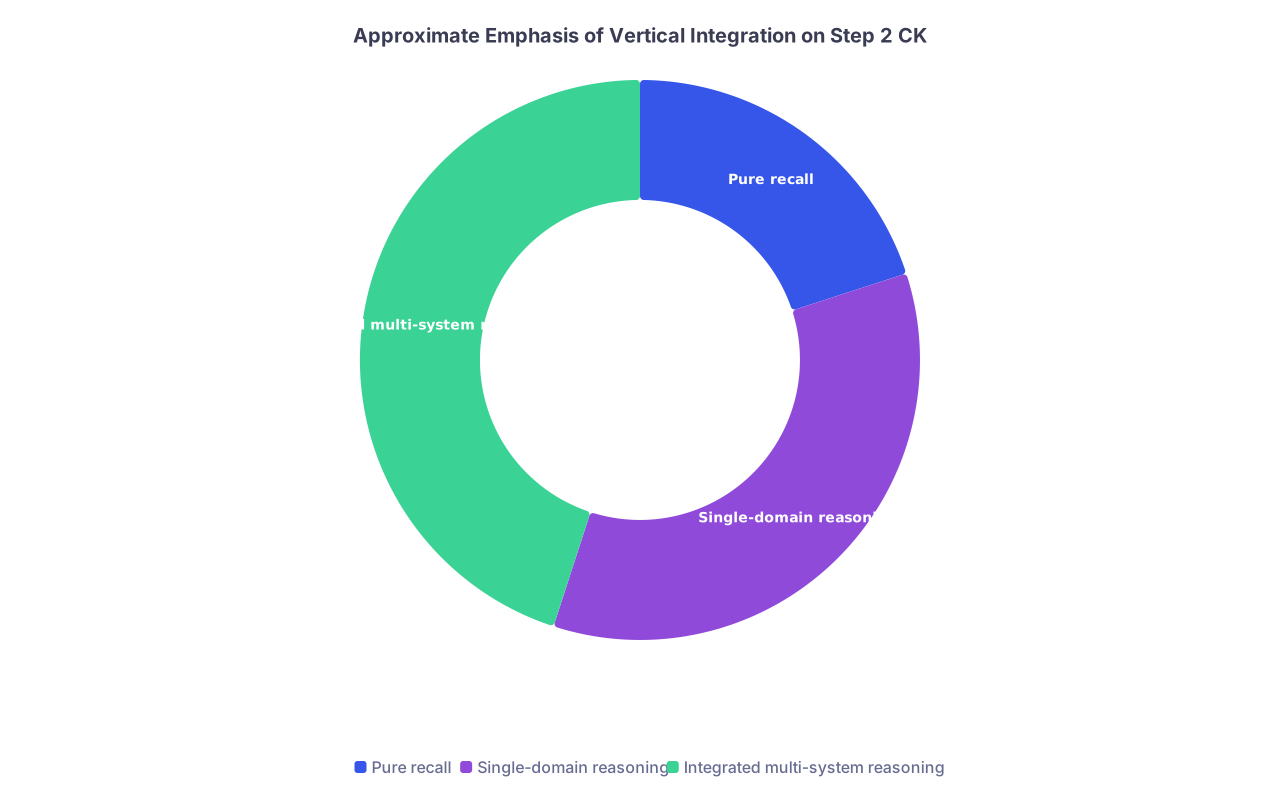
| Category | Value |
|---|---|
| Pure recall | 20 |
| Single-domain reasoning | 35 |
| Integrated multi-system reasoning | 45 |
So if your study strategy is still built on:
- Decks of pure recall
- One-dimensional algorithms (“if X, then give Y”)
You are over-invested in the smallest portion of the real exam.
Clinical Rotations: The Hidden Vertical Integration Lab
Here is a hard truth: most students waste their best vertical integration environment—clinical rotations—by operating in survival mode.
They:
- Pre-round, write notes, present, nod at teaching, then cram random UWorld blocks at night.
- Never convert ward chaos into structured system stacks.
You can flip that without increasing total hours, just by changing how you label experiences.
Quick, realistic rotation habits that feed CK
One vertical case per day.
Choose a patient who clearly lives in an organ system you care about. After sign-out, spend 10 minutes mapping their vertical stack: mechanism, diagnostics, therapies, complications.Ask one mechanism-based question per attending.
Not “What is the dosing for X?” but “Why are we using a non-DHP CCB here instead of a beta blocker, physiologically?” People light up when asked these questions. You get vertical pearls that never appear in review books.Tie shelf prep to systems, not chapters.
Studying for IM shelf? Do not say, “I am doing 20 cardio questions today.” Say, “I am strengthening my HFrEF vertical stack today.” Same questions, different framing, better retention.

| Step | Description |
|---|---|
| Step 1 | See Patients |
| Step 2 | Pick 1 System-Focused Patient |
| Step 3 | Map Mechanism and Diagnostics |
| Step 4 | Link Therapies to Mechanism |
| Step 5 | Do System-Focused UWorld Questions |
| Step 6 | Update Organ System Stack Notes |
Looks simple on paper. Almost no one does it consistently. Those who do are the ones calmly scoring 260+ while everyone else is sweaty-refreshing Reddit.
How to Retrofit Vertical Integration if You Are Late in the Game
If you are 4–6 weeks from your exam and just now realizing your prep is flat, you do not have to start from zero. You just need to be surgical.
Identify your two weakest major systems that are also heavily represented: usually renal and endocrine, or cardio and neuro.
For each, during weeks 1–2 of your dedicated:
Do UWorld system-specific sets in tutor mode for that system only
Build a minimal but explicit vertical stack note for that system
Every time you miss or feel shaky on a question, ask:
- “Which layer of the stack is weak here? Mechanism, diagnostic choice, or treatment step?”
- Add 1–2 clarifying lines to that layer.
In weeks 3–4, switch to mixed blocks, but every missed question must be assigned to a system and a stack layer. No “oops, whatever.”
You are not trying to vertically integrate the whole universe at once. You are:
- Making two or three systems truly robust
- Getting comfortable with the mental motion of “What system? Which layer?” for every question
That skill itself transfers to other systems, even if their content is weaker.
The Long View: Why This Matters Beyond CK
Vertical integration is not just exam strategy. This is literally how good physicians think.
- When you see a septic shock patient, you are doing cardio + renal + pulm + ID + pharm in real time whether you name it or not.
- When you manage a pregnant diabetic with preeclampsia, you are doing endocrine + renal + OB + cardio, constantly trading off competing risks.
USMLE is slowly pushing the test in that direction because practice has already moved there. Fragmented “topic-based” practice is outdated in real clinics; it is dying on exams too.
If you build organ-system vertical stacks now, you are not just “future-proofing” Step 2 CK. You are future-proofing:
- Your in‑training exams
- Your boards (IM, surgery, peds, EM—does not matter)
- Your day-to-day sanity when the pager does not care if you are on “cardio week” or “renal week”
Key Takeaways
- Step 2 CK is already a vertically integrated, organ‑system exam in practice; topic lists and pure recall decks are misaligned with where points are shifting.
- Building vertical organ system stacks—linking mechanisms, diagnostics, therapy, and complications inside each system—is the single most stable way to prepare in the Step 1 pass–fail era.
- Use clinical rotations and UWorld intentionally: every patient and every question should be labeled by system and by stack layer so your knowledge becomes integrated, not just accumulated.