
The way most students use Anki dies somewhere between their first NBME and their first ward month. That is a systems failure, not a willpower failure.
You do not need another inspirational post about ‘consistency’ or ‘just keep doing reviews’. You need an integrated Anki system that is architected to survive:
- pre‑clinical chaos
- the Step 1 Pass/Fail era
- the Step 2 / clerkship grinder
…and still be useful in residency.
Let me break this down specifically.
1. The Core Problem: Why Most Anki Systems Collapse
Traditional med school Anki advice was built for a very specific world: long pre‑clinicals, Step 1 numerical score, and relatively chill M3. That world is gone.
Now your system has to survive:
- High‑density, board‑style pre‑clinical curricula
- Shorter dedicated time
- Step 1 pass/fail (so Step 2 becomes the real filter)
- Clerkship hours + shelf exams + Step 2 pressure at the same time
If your Anki setup does not explicitly account for those realities, it will fail. I have watched this play out hundreds of times.
The usual pattern looks like this:
- M1: Download all of AnKing or similar. Add 800–1200 new cards per week. Feel like a hero.
- Late M1: Reviews hit 700–1000/day. You “suspend a bit just for this week”.
- M2: Qbanks start. You have 500 due, 40 questions to review, 4 hours of lecture. You start skipping weekends. Interval hell begins.
- Dedicated: You panic‑unsuspend entire Step 1 decks. Reviews explode. You start flipping cards mindlessly.
- M3: You walk into wards with a rotting Step 1 deck, zero structure for shelves, and a vague intention to “get back into Anki”.
That is not a study plan. That is a slow‑motion failure.
An integrated Anki system has three non‑negotiable properties:
- It is modular (pre‑clinical, Step 1, clerkships, Step 2 are coordinated, not competing).
- It is prunable (you can drop load without abandoning the system).
- It is Qbank‑driven in the clinical phase, not deck‑driven.
If your setup is not deliberately designed for those, it will eventually crumble.
2. Architecture First: How to Physically Structure Your Anki
Stop thinking in terms of “which big deck should I use” and start thinking in terms of architecture.
You need a folder structure that mirrors your real life and stays stable from day one through Step 2.
Here is the structure I recommend repeatedly, because it works:
| Deck Level | Example Name | Primary Use |
|---|---|---|
| Top | 00_CORE | Long-term anchors (pharm, path, micro) |
| Top | 01_PRECLIN | Systems & courses M1–M2 |
| Top | 02_STEP1_BRIDGE | High-yield Step 1 integration |
| Top | 03_CLERKSHIPS | Shelf-specific Qbank decks |
| Top | 04_STEP2 | UWorld/AMBOSS Step 2 cards |
Then build subdecks like this:
00_CORE::Pharm00_CORE::Micro01_PRECLIN::Cardio01_PRECLIN::Renal02_STEP1_BRIDGE::Pathoma03_CLERKSHIPS::IM::UW03_CLERKSHIPS::Surgery::UW04_STEP2::UW04_STEP2::AMBOSS
Why this structure works:
- You can suspend entire layers without blowing up everything.
- You can keep
00_COREalive all the way into residency. - You can deactivate
01_PRECLINafter Step 1 without messing with your clinical decks. - You can clearly see where new cards from each phase should land.
Most people never do this planning, then wonder why their decks are a graveyard of half‑forgotten tags.
3. The Four Pillars: What Must Survive From M1 to Step 2
Some content is disposable. Some absolutely must persist.
The four pillars that should survive both Step 1 and Step 2 are:
- Pharmacology
- Microbiology / ID
- Pathology fundamentals
- “Thinking patterns” cards (decision rules, interpretation schemas)
If you memorise every renal transporter but cannot remember what to do with a high‑risk chest pain patient, you have missed the point.
Here is how to build each pillar so it actually lasts.
3.1 Pharmacology: From brute force to clinical tool
Pharm is the number one long‑term return on Anki investment. But not as giant “Mechanism / Side effects / Indications” walls of text.
You want three practical card types per important drug:
- Mechanism‑level card (one fact per card)
- “First‑line / second‑line for X” style card
- Toxicity or key interaction card tied to a realistic scenario
Example – wrong way (what I see all the time):
- Front: “Metoprolol”
- Back: “Selective beta‑1 blocker used in hypertension, angina, heart failure, MI, side effects include bradycardia, AV block, exacerbation of asthma…”
You will stop reading this card in week three.
Better system:
- “Metoprolol – receptor target” → “β1‑selective adrenergic blocker”
- “Metoprolol – mortality benefit in which chronic condition?” → “HFrEF (heart failure with reduced EF)”
- “Metoprolol – main acute toxicity concern” → “Bradycardia / AV block, hypotension”
That is three small, survivable cards you can still handle on a busy ward month.
And then link them with a “thinking pattern” card:
- “Which 3 beta blockers reduce mortality in HFrEF?” → “Metoprolol succinate, carvedilol, bisoprolol”
This makes your pharm deck clinically relevant, not just Step‑trivia.
3.2 Micro/ID: Build around syndromes, not organisms
Boards still love bugs. But clinicians think in syndromes, not in genus/species.
Your core micro cards should be organized as:
- Bug → trait (Gram+/−, shape, key virulence factor)
- Syndrome → most likely bugs
- Empiric therapy → for each syndrome / setting
Bad card example:
- “Listeria monocytogenes” → Gram status, shape, motility, toxins, etc.
Good integrated set:
- “Listeria – Gram / shape” → “Gram+ rod”
- “Listeria – high‑risk patient groups” → “Neonates, pregnant, elderly, immunocompromised”
- “Empiric meningitis tx in elderly – why add ampicillin?” → “Cover Listeria”
That last card is the one you will still care about in PGY‑1.
3.3 Pathology: Keep the pattern, drop the trivia
Path is where people bloat their decks beyond usability.
You do not need 12 cards about every eponymous disease. You need durable “if X, think Y” patterns:
- “Nephritic vs nephrotic – key difference in pathophysiology”
- “High‑anion gap metabolic acidosis – mnemonic and categories”
- “Restrictive vs obstructive PFT pattern – FEV1/FVC vs TLC”
These are the pattern recognitions Step 1, shelves, and Step 2 all hit.
When you create cards from Pathoma, Boards & Beyond, etc., ask: “Will this still matter on an IM shelf?” If the answer is “probably not”, that card goes in 01_PRECLIN, not in 00_CORE.
3.4 “Thinking pattern” cards: The secret layer
Most people do not create these. They should.
Thinking pattern cards capture:
- Algorithms (“first test”, “next best step”)
- Interpretation schemas (ABG, basic EKG rules, chest pain workup)
- Risk stratification rules (Wells, PERC, CURB‑65 – at least their directionality)
Example cards:
- “PERC rule – used to do what?” → “Rule out PE in low risk patients without D‑dimer”
- “High AG metabolic acidosis + normal osm gap – 3 large categories” → “Lactic acidosis, ketoacidosis, renal failure”
- “Initial imaging for suspected nephrolithiasis without contrast” → “Non‑contrast CT abdomen/pelvis (except pregnancy / peds → ultrasound)”
Store these in 00_CORE::Patterns. This subdeck should be tiny but sacred.
4. Time Phases: How Anki’s Role Shifts From M1 to Step 2
You cannot use Anki the same way in M1 and on surgery call. The role of Anki must evolve deliberately.
Let me map it phase by phase.
Phase 1 – Early Pre‑clinical (M1)
Primary function: Build basic vocabulary and facts using pre‑made decks + light custom cards.
Target load (assuming 5 days/week Anki):
- New: 50–80/day
- Mature reviews: 150–250/day
If you find yourself with 400+ reviews daily in M1, your future self is in trouble.
Your focus:
- Use a mature base deck (e.g., AnKing) but be ruthless with tags. Suspend aggressively.
- Do not unsuspend everything in a topic just because you had a lecture about it.
- Add custom cards only when:
- You repeatedly miss a concept in questions
- Your lecture material clearly fills a gap in your base deck
From day one, keep 00_CORE small and carefully curated. Most new cards go to 01_PRECLIN, not 00_CORE.
Phase 2 – Late Pre‑clinical / Early Qbank (M2 pre‑dedicated)
Now Qbanks enter. Your relationship to Anki must change.
Primary function: Retain Qbank learning + maintain Step‑relevant core.
Target load:
- New: 40–60/day
- Reviews: 250–350/day
Main shift: Every UWorld/AMBOSS block must produce cards.
But not 1 card per fact in the explanation. Think “1–3 cards per question you actually got something from”.
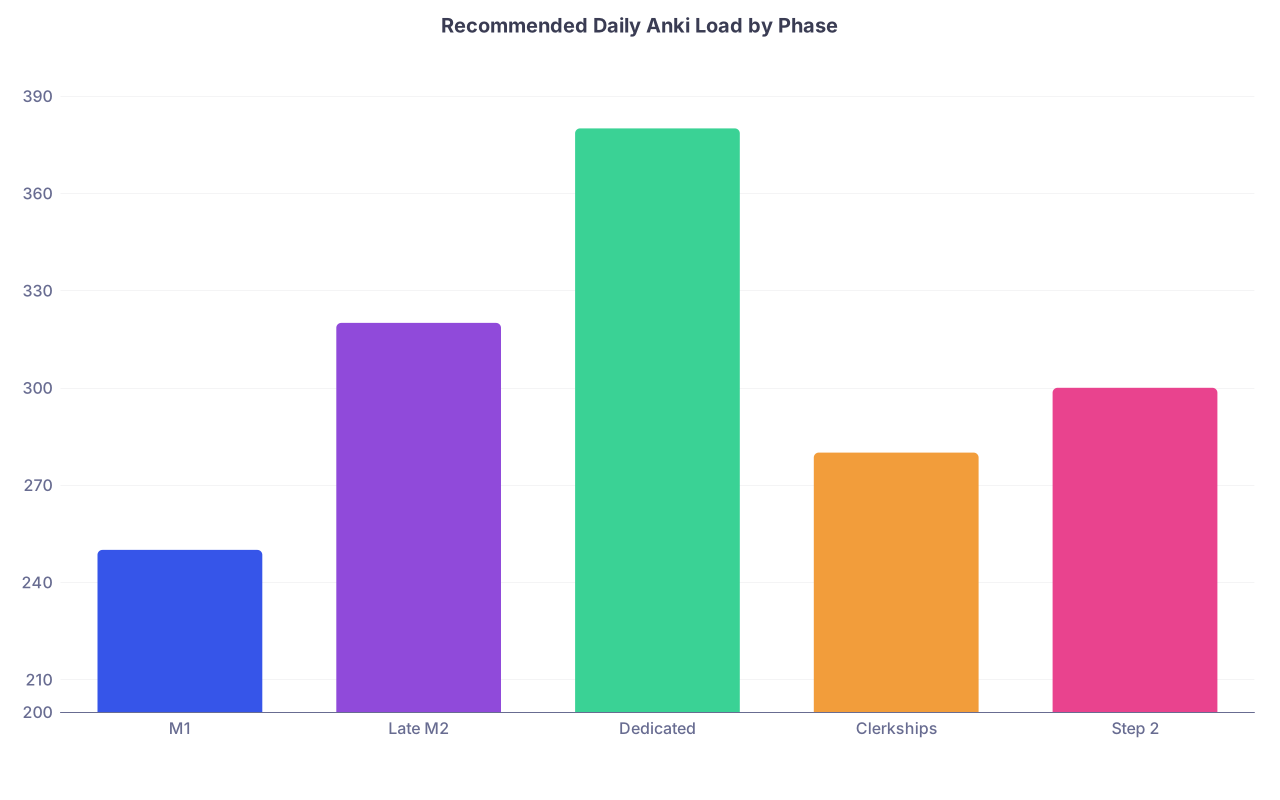
| Category | Value |
|---|---|
| M1 | 250 |
| Late M2 | 320 |
| Dedicated | 380 |
| Clerkships | 280 |
| Step 2 | 300 |
If you are entering dedicated with 500–700 reviews/day, you are already at the upper red zone. That is salvageable but not ideal.
Phase 3 – Step 1 Dedicated (Pass/Fail era reality)
Step 1 is pass/fail, but it is not optional. Failing Step 1 still poisons your MS3 year and your application.
Your Anki job in dedicated:
- Solidify weak systems
- Lock in pharm/micro
- Add targeted cards from NBMEs and weak spots
You do not need to add every new fact from every resource. You need to identify the patterns you keep missing.
Recommended:
- Temporarily suspend older, low‑yield pre‑clinical subdecks that are not paying rent.
- Keep
00_COREand02_STEP1_BRIDGEactive. - Use filtered decks (with a strict cap) to hit “wrong in last 7 days” and “low ease” cards.
If you are still trying to “finish” an entire massive pre‑made deck in dedicated, you are misusing Anki. At that point it should be precision, not volume.
Phase 4 – Clerkships + Shelves (M3)
This is where most Anki systems die. Long days, unpredictable calls, exhaustion.
You must assume:
- Some days you will do zero cards.
- Some days you will only do 20–50 reviews.
- Your deck must tolerate that without exploding.
Primary function shifts to:
- Encoding Qbank learning for each shelf
- Maintaining a trimmed core (pharm + patterns)
- Creating rapid‑fire “on rounds” style recall (short, clinically phrased cards)
Architecture rules:
- One Qbank → one subdeck inside
03_CLERKSHIPS. - UW IM shelf →
03_CLERKSHIPS::IM::UW - Use tags for topics (e.g.,
im_cardio,im_gi) but do not let tags drive daily review.
Pruning rules:
- If pre‑clinical
01_PRECLINis still producing 150+ reviews/day in M3, you cut it. Suspend large chunks and keep only00_COREactive.
This is not failure. This is intelligent triage.
Phase 5 – Step 2 CK Study
At this point your Anki should be:
- Leaner
- Majority Qbank‑derived
- Focused on management and reasoning, not memorizing every side effect of every rare drug
Your primary deck: 04_STEP2::UW (and maybe ::AMBOSS).
Every incorrect or lucky guess that teaches you something non‑obvious gets:
- 1–3 cards max
- Short, clinically framed
- Prefer “what is the next best step” and “what feature differentiates X from Y” over “definition” cards
If you did your earlier pruning correctly, you can sustain 250–300 reviews/day through Step 2 with work.
5. Card Design Rules That Survive Both Exams
Your card design is either your best ally or your slow death.
Here are hard rules for survival.
5.1 One fact per card. No exceptions.
If you catch yourself writing “and” on the back of a card more than once, you are probably cramming too much.
Bad back: “ACE inhibitors decrease Ang II and increase bradykinin, leading to vasodilation and cough/angioedema.”
Better split:
- “ACE inhibitors – main vasoactive peptide ↓” → “Angiotensin II”
- “ACE inhibitors – peptide ↑ that can cause cough/angioedema” → “Bradykinin”
- “ACE inhibitors – main hemodynamic effect” → “Vasodilation → ↓ afterload (and some ↓ preload)”
Yes, that is three cards. But they are bite‑sized and durable.
5.2 Cloze deletion for dense information
For processes, pathways, or algorithms, cloze is your friend.
From a UWorld explanation:
“Patients with high pretest probability of PE should undergo CT pulmonary angiography rather than D‑dimer testing.”
Turn into:
- “High pretest probability PE – preferred initial test” → “CT pulmonary angiography (not D‑dimer)”
- Or cloze: “High pretest probability of suspected PE → {{c1::CT pulmonary angiography}} (not {{c2::D‑dimer}})”
Cloze works particularly well for treatment hierarchies and algorithms. But cap each card at 2–3 clozes. Beyond that you will start failing the easy parts.
5.3 Clinical phrasing by default
If a fact can be phrased in a way that looks like a test stem or a real patient, prefer that.
Not: “What is the mechanism of thiazide diuretics?”
Better: “Thiazide diuretics – main nephron segment target” → “Distal convoluted tubule Na‑Cl symporter”
Not: “What is the treatment for DKA?” (way too broad)
Better:
- “DKA – first fluid to give (after ABCs)” → “Normal saline (isotonic)”
- “DKA – key therapy that closes anion gap” → “Insulin infusion (with potassium management)”
6. Scheduling and Review Logic: Settings That Do Not Cripple You Later
The default Anki settings are not designed for med school volume.
You must tune them.
For a student starting M1 planning to go through Step 2 with the same profile, I like:
- New cards/day:
- M1: 50–80
- Late M2: 40–60
- M3/Step 2: 20–40 (mostly Qbank‑derived)
- Maximum reviews/day: 250–300 (hard cap, not a “suggestion”)
- Steps (minutes):
15 1440(so new cards come back same day, then next day) - Graduating interval: 3–4 days
- Easy bonus: 1.3–1.4 (not 2.5)
- Interval modifier: 0.9–1.0
Goal: keep intervals modest, avoid “easy → 13 days → forget everything”, and prevent new cards from overflowing into old age too fast.
Use filtered decks aggressively but intelligently:
- “Due today and rated ‘hard’ in last week” → cap at 30–50/day
- “Tagged: NBME_missed_last2weeks” → cap at 20/day
This lets you do targeted second passes without flooding your main review queue.
7. Integration With Qbanks and Resources (Where Most People Get Sloppy)
An integrated Anki system is pointless if you do not integrate it with your other tools.
Here is the hierarchy that actually works:
- QBanks (UW, AMBOSS)
- Core videos / texts (Pathoma, Boards & Beyond, Sketchy, etc.)
- Anki as the memory scaffold that sits underneath both
The correct flow in practice:
- Do a 40‑question block of UWorld timed.
- Review each question actively:
- For ones you truly understood: no cards, unless there is a single, crisp pearl.
- For wrong / lucky guess questions:
- Ask: “What is the single fact or pattern here that will change my behavior next time?”
- Make 1–3 cards capturing exactly that. Link to the topic video if helpful via tags (e.g.,
b_and_b_respiratory_03).
Do not:
- Make 10 cards from every explanation.
- Copy entire paragraphs into backs of cards.
- Put screenshot dumps into cards with no editing. That is how you bury yourself.
Use tags sparingly and purposefully:
source_uworld,source_nbme,source_ambossclerkship_im,clerkship_surgery, etc.weak_topic_renal– but only if you actually intend to pull a filtered deck from it later.
Do not turn tagging into a hobby. Tagging is only justified if it changes what you do later.
8. Common Failure Modes – And Exactly How to Avoid Them
You are going to recognize some of these from your classmates. Possibly from your own Anki browser.
Failure mode 1: The “everything deck”
Symptoms: One giant deck, 40k+ cards, no structure, constantly changing settings.
Result: You can not meaningfully prune or prioritize when clerkships hit. Everything comes due, all at once.
Fix: Split by function and phase (the architecture earlier). Do it now, not “after this block”.
Failure mode 2: The abandoned graveyard
Symptoms: Around first clerkship your review queue hits 800+. You stop for “a few days”, then just do new Qbank cards. Old deck quietly dies.
Result: You lose all the leverage of 1–2 years of grind when it matters most.
Fix: Scheduled pruning + caps.
- Cap daily reviews at a sane number.
- Mass‑suspend least‑important decks.
- Consciously choose what to keep alive (
00_CORE, current clerkship Qbank deck, maybe one more).
You are allowed to let systems die. You are not allowed to let all of them die by accident.
Failure mode 3: Pre‑clinical trivia hoarder
Symptoms: Thousands of cards about embryologic derivatives, obscure tumors, enzyme names you will never see again.
Result: You are spending memory capital on things that do not improve your NBME or Step 2 scores.
Fix: Move low‑yield content to 01_PRECLIN and suspend it after Step 1. Keep only what actually appears in Qbanks / NBME / Pathoma highlight.
Failure mode 4: No clinical cards until it is too late
Symptoms: Deck is 90% pure recall facts. Very few “next best step”, algorithm, or interpretive cards.
Result: You struggle to convert knowledge into scored questions on shelves and Step 2.
Fix: Starting from your first Qbank, bias your new cards toward:
- “What feature points toward diagnosis A vs B?”
- “What is the appropriate next test?”
- “What is first‑line therapy in this specific patient context?”
Facts support clinical reasoning. Not the other way around.
9. A Concrete Example: One Week in IM Clerkship With Sustainable Anki
Let’s make this painfully specific.
You are on internal medicine. You want to keep Anki alive without imploding.
Proposed weekly structure:
Daily:
- 20–30 UWorld IM questions
- 20–40 new cards from UW explanations (max) into
03_CLERKSHIPS::IM::UW - 150–200 reviews total across:
00_CORE(pharm + patterns) – 60–8003_CLERKSHIPS::IM::UW– rest
Weekly:
- 1 NBME or UWorld self‑assessment style exam every 2–3 weeks
- After each assessment, 20–40 new cards tagged
source_nbmefocusing only on missed concepts that:- You have seen before but keep missing
- Or are clearly shelf‑relevant patterns
Your Anki day on a 12‑hour shift might look like:
- Pre‑round: 60 reviews (10–15 minutes)
- Post‑round (if quiet): 40–60 reviews
- Evening: 10–20 new cards from your Qbank block, 30–40 more reviews
If you have a brutal call day and do zero? Fine. Next day, accept that some cards lapse. Do not chase a perfect record; chase a surviving system.
10. Metrics That Actually Matter (And Ones That Do Not)
People obsess over streaks, total cards, heatmaps. Useless.
The metrics that actually correlate with survivable systems:
| Metric | Healthy Range |
|---|---|
| Daily mature reviews | 150–250 |
| New cards added per week (M3) | 80–200 |
| Ease factor median | 230%–260% |
| Lapses per day | < 30–40 |
| Total active cards (M3) | 8k–15k |
If your mature reviews are consistently 400+ and your lapses are >60/day, your system is eroding. You either:
- Added too much junk, or
- Refuse to suspend dead weight.
Fix that before Step 2 preparation. It only gets harder later.
Ignore these vanity metrics:
- Total cards ever created
- Day streak length
- % correct on reviews (you can game this by pressing “easy” on everything)
Much more useful is an honest weekly gut check: “Are my cards making questions feel easier or just making me resent opening Anki?”
If it is the latter, you are building the wrong cards.
11. Future‑Proofing Beyond Step 2
You are building a system not just for exams, but for early residency sanity.
Which subdecks can and should live into PGY‑1?
00_CORE::Pharm– still golden when you are paged about a weird drug dose at 3 a.m.00_CORE::Micro– knowing empiric regimens cold makes you look surprisingly competent.00_CORE::Patterns– ABG interpretation, shock classification, chest pain workup.03_CLERKSHIPS::IM::UWtrimmed down to cards that still matter in your chosen specialty.
Everything else is negotiable.
The transition looks like this:

| Step | Description |
|---|---|
| Step 1 | M1 - Build PRECLIN and CORE |
| Step 2 | M2 - Add STEP1_BRIDGE |
| Step 3 | Step 1 - Prune PRECLIN |
| Step 4 | Clerkships - Build CLERKSHIPS decks |
| Step 5 | Step 2 - Consolidate into STEP2 deck |
| Step 6 | PGY1 - Keep trimmed CORE and relevant CLERKSHIPS |
The mistake is treating Anki like a 2‑year project. It can be a 6‑year asset if you design it that way.
12. A Minimalist Blueprint You Can Implement This Week
If you want a concrete action plan, here is one you can execute without obsessing for hours over settings.
Create the deck structure:
00_CORE::{Pharm, Micro, Patterns}01_PRECLIN::{your systems}02_STEP1_BRIDGE03_CLERKSHIPS::{IM, Surgery, Peds, etc.}04_STEP2::{UW, AMBOSS}
Audit your current cards:
- Anything purely lecture detail → move to
01_PRECLIN. - Any pharm/micro/algorithms → move to
00_CORE. - Any Qbank‑derived cards → move into correct Qbank subdeck.
- Anything purely lecture detail → move to
Set daily caps:
- Cap reviews at 250–300.
- Adjust which decks are active so you stay under that cap. Yes, that will mean suspending things.
Start Qbank‑driven card creation immediately:
- For each 40‑question block, cap yourself at ~30 new cards.
- Phrase them clinically. One fact per card.
Once per month:
- Look at your deck load. If a subdeck is contributing lots of reviews but almost never helping you answer questions, suspend big chunks.
- Trim. Again and again.
This is not glamorous. It is not a perfect, color‑coded system. But it is the kind that will still be functioning when you are rounding on a full list and coming home exhausted.
You are not building an Anki masterpiece. You are building a tool that has to survive hostile conditions.
Get the architecture right, protect the four pillars, bias toward Qbank‑driven clinical cards, and prune mercilessly. If you do that, your Anki system will not just limp through Step 1 and Step 2—it will still be pulling its weight when the pager starts going off.
With that foundation in place, the next frontier is how you pair this with a question‑first schedule for each specific shelf and Step 2. That is where the real score jumps happen—but that is a strategy session for another day.