
Everyone is lying to you about Step 1 going pass/fail: micro and pharm did not suddenly become optional.
Step 2 is now the real scorecard. And Step 2 still punishes anyone who treats microbiology and pharmacology as “Step 1-only” content. I have watched too many smart students coast through P/F Step 1, then get punched in the face by CK-style vignettes that assume rock-solid bug–drug–mechanism mastery.
Let me break this down specifically.
The New Reality: Step 1 P/F Did Not Make Micro and Pharm “Less Important”
The core mistake I see: students mentally sort content into “Step 1 stuff” and “Step 2 stuff,” then quietly demote micro and pharm into the first bucket.
That mental model is wrong.
Step 2 CK is not just “medicine and management.” It is:
- Step 1 foundations (especially micro/pharm/path)
plus - Clinical reasoning, guidelines, and management
plus - Test-taking stamina and precision
Micro and pharm are the language Step 2 uses to test “management.” If you cannot do these fast:
- Identify the bug from a sparse vignette
- Recall first-line vs second-line agents
- Understand contraindications, adverse effects, and drug–disease interactions
…you will burn time, miss questions, and cap your ceiling.
Here is the dirty secret: before Step 1 went P/F, serious students overbuilt micro and pharm. They needed cushion for a 250+ attempt. Now, many of you are stopping at “good enough to pass.” That is exactly how you end up with:
- Barely passing Step 1
- Mid-220s CK when you wanted 245+
- Weakness in shelf exams (especially IM, peds, ID-heavy rotations)
So the strategic question is not “Do I still need micro and pharm?” It is:
How do I retain micro and pharm efficiently in a P/F Step 1 era so that Step 2 CK scores do not suffer?
How Step 2 Actually Uses Micro and Pharm Knowledge
Step 2 rarely asks, “What is the gram stain of X?” or “What is the mechanism of Y?” in isolation. Instead it buries micro and pharm inside clinical decisions.
You see stems like:
“A 67-year-old man with a prosthetic valve, persistent fevers, and positive blood cultures grows gram-positive cocci in pairs and chains despite 5 days of IV vancomycin…”
→ You need bug identification (enterococcus), vanc failure mechanisms, and alternative agents. Fast.“A 24-year-old pregnant woman with pyelonephritis, history of G6PD deficiency…”
→ You must know safe drugs in pregnancy, drugs contraindicated in G6PD, and resistance patterns.“A patient on amiodarone develops shortness of breath and a nonproductive cough…”
→ Mechanism, toxicity profile, what to stop, and what to do next (PFTs, HRCT, alt antiarrhythmic).
This is where weak micro/pharm show up:
- You recognize the diagnosis.
- You vaguely know there is a “preferred drug.”
- You confuse two adjacent agents, or forget a toxicity, or miss a contraindication.
- You pick a plausible but wrong answer.
Repeated over a 9-hour exam, that is how you lose 15–25 questions. That is the difference between 235 and 255.
The Cognitive Science Angle: Why Micro and Pharm Leak So Fast
Microbiology and pharmacology are high-entropy domains. Tons of:
- Similar names (cefazolin vs ceftriaxone vs cephalexin)
- Similar bugs (different Staph / Strep / enteric rods)
- Mechanisms / side effects that blur together
Your brain will absolutely discard these unless:
- You re-encounter them at spaced intervals.
- You attach them to meaningful, vivid anchors (stories, images, patient cases).
- You use them in active recall, not passive rereading.
Relying on:
- “I did Sketchy once.”
- “I watched Pathoma during first pass.”
- “I wrote Anki cards for 3 months then stopped at dedicated.”
…is a great way to have 30–40% of micro and pharm unusable by the time CK hits.
Retention is not about one intense block of studying. It is about:
- Small, structured, relentless refreshers over 18–24 months.
Strategic Overview: Your Micro/Pharm Retention Architecture
Let me lay out a robust architecture, then we will slice it by phase: preclinical, dedicated for Step 1, clerkships, CK prep.
Your long-term retention plan should cover:
Core resources that standardize your mental model
- Micro: Sketchy Micro or equivalent visual mnemonics
- Pharm: Sketchy Pharm, AnKing pharm tags, or B&B pharm
- Integration: First Aid / Boards & Beyond / Amboss
Spaced repetition backbone
- A curated Anki deck (AnKing-style) with:
- Tagged micro (organism → presentation, virulence, treatment)
- Pharm (MOA, indication, AEs, contraindications)
- A daily review habit that does not go away during clerkships
- A curated Anki deck (AnKing-style) with:
Clinical integration using question banks
- Step 1 era: UWorld Step 1 micro/pharm questions
- Clerkship era: UWorld IM, surgery, peds, ob/gyn, neuro — filtered for ID and pharm-heavy questions
- Pre-CK era: UWorld CK full blocks with systematic post-hoc tagging of micro/pharm misses
Compression tools
- Personal “bug–drug–scenario” spreadsheets
- High-yield micro/pharm one-pagers
- Rotation-specific “ID and pharm traps” lists
This is not theoretical. I have seen this architecture carry students from mediocre preclinical grades to solid 250+ CK because their micro/pharm foundations were indestructible.
Phase 1: Preclinical Years with Step 1 P/F – What Actually Matters
If your school is P/F preclinical and Step 1 is also P/F, the temptation is to aim for “barely competent” foundations.
That is a mistake.
You do not need to memorize every obscure bug or third-line drug. You do need:
Infectious diseases:
- All common organisms by: morphology, disease patterns, first-line treatments
- Key resistance / special-case organisms (MRSA, VRE, Pseudomonas, ESBL, atypicals)
Pharmacology:
- All major classes used in: cardiology, ID, psych, anesthesia, endocrine, pulmonary, GI
- Tox profiles that drive test questions (torsades, agranulocytosis, hepatotoxicity, nephrotoxicity, teratogenicity, serotonin syndrome, NMS, etc.)
Practical setup during M1/M2
Pick a single primary micro resource. Commit.
- Sketchy Micro is still king for strong visual learners.
- If you hate cartoons, then Amboss micro articles + Anki + cases can work, but you must accept more grind.
Pair every new micro/pharm concept with Anki from day 1.
- Do not rely on school-provided decks that are bloated or misaligned.
- Use a curated deck (e.g., AnKing) and unsuspend tags as you hit systems.
- Modify cards that feel too wordy or too trivial.
Daily rhythm (preclinical)
- 30–60 minutes Anki per day (no zero days).
- 10–20 new micro cards + 10–20 new pharm cards on “heavy” days.
- Mixed questions (amboss / UWorld sampler) 2–3 times per week that hit micro/pharm.
Regular self-testing beyond cards
- Once every 2–3 weeks, do a 20–40 question block of purely micro and/or pharm.
- Purpose: stress-test retention, not just passive spaced rep.
- Keep a simple “leak list” of bugs/drugs that repeatedly fail recall.
You are not trying to max Step 1. You are building the substrate that CK will later assume.
Phase 2: Step 1 Dedicated in a P/F World – How Hard Do You Push?
For P/F Step 1, you do not need a 6–8 week death-march. But you also cannot treat it like an NBME subject exam.
Smart target: aim for the knowledge base of a 235–240 Step 1 student, even though score does not show. That level of understanding makes CK much easier.
Specific micro/pharm goals for Step 1 dedicated
Zero major holes in core bacterial, viral, fungal, and parasitic pathogens
- You should be able to:
- Go from bug → disease → route → virulence → first-line drug in under 10 seconds.
- Recognize classic weirdness (e.g., Listeria in neonates and elderly, pseudomonas in neutropenic hosts and CF).
- You should be able to:
Confident grasp of big pharm classes used clinically
Focus on drugs that will absolutely show up again on wards and CK:- Antibiotics (beta-lactams, vanc, linezolid, aminoglycosides, FQs, macrolides, tetracyclines, TMP-SMX, clindamycin, daptomycin, azoles, ampho B).
- Cardio (beta-blockers, ACE/ARB, diuretics, antiarrhythmics, anticoagulants, antiplatelets, statins).
- Psych (SSRIs/SNRIs, TCAs, MAOIs, antipsychotics, mood stabilizers, benzos).
- Endocrine (insulins, oral diabetes meds, thyroid meds, steroids).
- Pulm (beta-agonists, anticholinergics, ICS, leukotriene modifiers, biologics basics).
- GI (PPIs, H2 blockers, antiemetics, laxatives, IBD meds).
Targeted Anki “hard reset”
- During dedicated, compress your Anki to focus on:
- All due micro and pharm cards.
- Any pathophysiology cards that repeatedly show up in UWorld misses.
- During dedicated, compress your Anki to focus on:
Micro/pharm daily minimums during dedicated
- 30–45 minutes of micro/pharm-specific Anki.
- At least 5–10 UWorld questions per day that feature ID or heavy pharmacology.
You do not need 100% mastery, but you should walk out of Step 1 feeling like: “If Step 2 gave me micro/pharm-laden vignettes tomorrow, I would not panic.”
Phase 3: Clinical Years – Where Most Students Lose Micro and Pharm
This is the critical phase. You are tired, overworked, and tempted to live block-to-block.
This is also where micro and pharm either crystallize around real patients or get flushed.
Typical bad pattern I see
- Student finishes Step 1 → “I never want to see Sketchy/Anki again.”
- Starts rotations → only studies shelf-specific books/questions 1–2 weeks before exam.
- Micro/pharm Anki → abandoned.
- CK prep → “I’ll clean this up later with a dedicated period.”
Result: by the time CK dedicated arrives, 40–60% of bugs and drugs feel “familiar but fuzzy.” That is catastrophic when qbanks assume you can process them fluently.
The sustainable pattern that actually works
You need a low-dose, high-consistency pattern across M3:
Anki minimal daily dose
- 20–40 reviews per day. Non-negotiable.
- Prioritize: micro and pharm tagged cards, plus your “leak list” items.
- This is a 15–20 minute habit between cases, on the bus, etc.
Clerkship-specific micro/pharm integration
Internal Medicine, Pediatrics, and Surgery (including trauma/ICU) are ID-rich rotations. Use them.
For each rotation:
- Build a running note with these headings:
- “Inpatient ID patterns I saw”
- “Antibiotic regimens I actually prescribed”
- “Adverse drug events that occurred on the team”
- Every time you admit a pneumonia, UTI, meningitis, cellulitis, etc., write:
- Likely bug(s)
- Empiric regimen
- Narrowed regimen
- Duration and route
Converting cases to flashcards is overkill for some, but at least review them weekly.
- Build a running note with these headings:
Shelf prep that explicitly targets micro/pharm
During each clerkship, do not just trust “osmosis” from UWorld. Use filters.
For example, in UWorld IM:
- Create separate blocks where you filter:
- “Infectious disease” + “pharmacology” tags.
- Do 10–15 of these questions 2–3 times per week.
- Pay attention not only to the correct agent, but to why every wrong choice is wrong:
- Wrong bug coverage?
- Contraindication (pregnancy, renal failure, QRS prolongation, etc.)?
- Wrong route or duration?
That is exactly how CK questions are written.
- Create separate blocks where you filter:
Phase 4: Dedicated Step 2 CK Prep – Turning Foundations into Points
By the time you hit CK dedicated, the goal is not to “learn micro and pharm from scratch.” It is to:
- Tighten, integrate, and sharpen.
- Identify persistent blind spots.
- Speed up retrieval under time pressure.
How to structure micro/pharm during CK dedicated
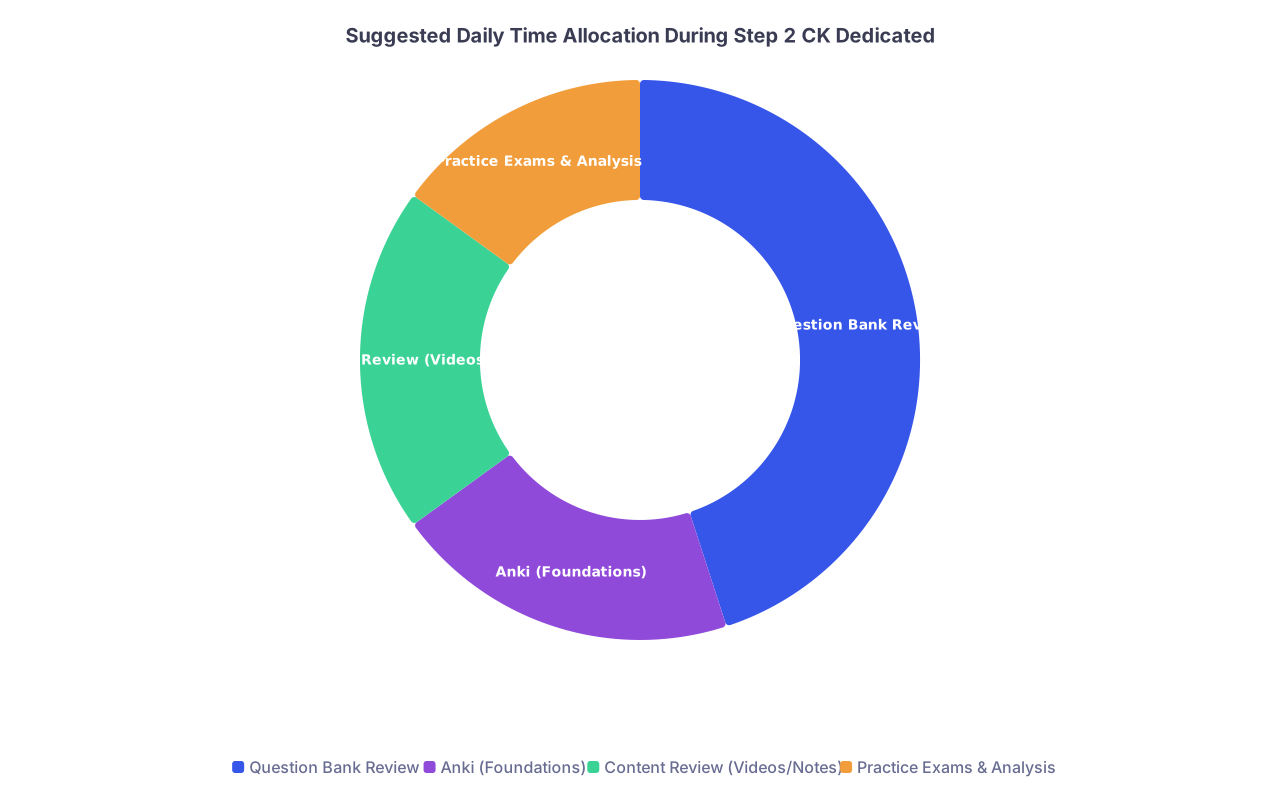
| Category | Value |
|---|---|
| Question Bank Review | 45 |
| Anki (Foundations) | 20 |
| Content Review (Videos/Notes) | 20 |
| Practice Exams & Analysis | 15 |
So if you study 10 hours per day, a reasonable split would be:
- 4.5 hours question bank
- 2 hours Anki (foundations including micro/pharm)
- 2 hours focused content review
- 1.5 hours practice exam review / strategy work
Within that:
Question bank strategy
Early CK dedicated:
- Do mixed blocks, but tag every question that:
- Involves antibiotics, antivirals, antifungals, chemo agents, anesthetics, psych meds, or ID.
- After 4–5 days of blocks, review tagged questions as a micro/pharm-specific “weakness bank.”
- Do mixed blocks, but tag every question that:
Mid/late dedicated:
- Build intentional micro/pharm-heavy blocks 2–3 times per week.
- Review these with obsessive focus on:
- Why first-line is preferred (e.g., spectrum, toxicity, guidelines).
- Which alternatives exist if allergy, renal failure, pregnancy, resistance.
Micro/pharm “compression pass”
Take 3–5 days (not consecutive; spread them out) where your evening study is only:
- Revisiting high-yield antibiotic charts.
- Re-watching 1–2 Sketchy pharm/micro videos that you consistently forget.
- Writing or updating 1–2 pages of “ID and pharm rules I must know cold.”
The point is not to blanket-review everything; it is to heavily overtrain the things that appear again and again:
pneumonia regimens, meningitis regimens by age, febrile neutropenia, endocarditis, osteomyelitis, sepsis bundles, psych side effects, cardio drug contraindications.Practice NBMEs/UWSAs with micro/pharm lens
When you review a practice exam:
- Flag every question that you would have gotten wrong if you had to justify the exact drug and dose used.
- If you “guessed right” but the mechanism/specification was fuzzy, it is still a weakness.
- Convert repeated patterns to concise rules:
- “Never use FQs in pregnancy unless…,”
- “Benzos in elderly delirium usually wrong,” etc.
Concrete Tools: Checklists, Tables, and Systems
Let me give you a few concrete anchors.
1. Micro/Pharm Retention Checklist by Phase
| Phase | Daily Anki | Primary Focus | Questions per Week (Micro/Pharm-Focused) |
|---|---|---|---|
| Preclinical | 30–60 min | Build foundations | 60–100 |
| Step 1 Ded | 30–45 min | Patch gaps, synchronize res. | 80–120 |
| Clerkships | 15–30 min | Maintain, integrate clinically | 40–80 |
| CK Dedicated | 60–120 min | Sharpen, speed, integrate | 120–160 |
These are ranges, not commandments. But if your numbers are far lower, do not be surprised by retention issues.
2. “Bug–Drug–Scenario” Table Concept
You should build your own, but an example of the structure:
| Scenario | Likely Bugs | First-Line Therapy | Key Alternatives / Notes |
|---|---|---|---|
| CAP, outpatient | Strep pneumo, atypicals | Azithro or doxy | Levofloxacin in comorbid patients |
| CAP, inpatient | Strep pneumo, Legionella | Ceftriaxone + azithro | Levofloxacin if beta-lactam allergy |
| HAP, ventilated | Pseudomonas, MRSA | Pip-tazo + vanc | Cefepime + linezolid alternative |
| Febrile neutropenia | Pseudomonas, gram negatives | Cefepime or pip-tazo | Add vanc if line infection concern |
You do not need fancy formatting in real life. A scrappy Google Doc or Notion page works.
How Much Is “Enough” Micro and Pharm for CK?
You want a benchmark? Fine.
You are on track if all of these are true 2–3 months before CK:
- You can do a 40-question UWorld block filtered to ID plus pharm and score ≥70–75%.
- You can complete that block without timing out or feeling mentally flooded.
- You can, from memory, write down:
- Empiric regimens for: CAP (out/inpatient), HAP, meningitis (by age), UTI/pyelo (pregnant vs not), cellulitis, osteomyelitis, febrile neutropenia, infective endocarditis.
- First-line treatments for: major psych conditions, common arrhythmias, HF, ACS, PE/DVT, asthma/COPD, diabetes, thyroid disorders, seizures.
- You can explain in plain language the one or two toxicities that define each major drug class.
If you cannot do that, your ceiling is probably capped in the 230s–240s, regardless of how good your “medicine” feels.
Common Traps and How To Avoid Them
Let me call out the traps I see repeatedly.
Trap 1: “I’ll relearn micro/pharm right before CK”
You will not. You will not have the time or cognitive bandwidth.
Fix: keep low-dose Anki + case-based integration running all through M3. Treat micro/pharm like language fluency—you never fully stop speaking it.
Trap 2: Overreliance on passive resources (videos, reading) in CK dedicated
Watching endless videos on antibiotics or antipsychotics without question practice is comforting and low-yield.
Fix: for every 1 hour of content review, do at least 1–2 hours of question-based application. Always end with recall: summarize regimens or mechanisms without looking.
Trap 3: Ignoring pharm on the wards
Students often defer to residents/attendings and mentally tune out medication decisions: “they know better.”
Fix: every day on wards, pick 1–2 patients and ask yourself:
- “Why this drug and not another?”
- “What would the alternative be if allergy / pregnancy / renal failure?”
Then verify with UpToDate or your attending. Those micro-decisions stick ten times better than any lecture.
A Realistic Weekly Template (Clerkship Year)
To make this concrete, here is what a sane week might look like during a busy IM rotation.

| Step | Description |
|---|---|
| Step 1 | Daily Anki 20-30 min |
| Step 2 | 3 Weekday Evenings |
| Step 3 | UWorld 10-20 Qs Mixed |
| Step 4 | UWorld 10-15 Qs ID/Pharm Focused |
| Step 5 | Weekend |
| Step 6 | 40-60 Qs Mixed |
| Step 7 | Review Bug Drug Notes 30-45 min |
In words:
Every day:
- 20–30 minutes Anki (micro/pharm priority).
Three weeknights:
- 10–20 mixed UWorld questions.
- 10–15 ID/pharm-filtered questions (alternate nights).
Weekend:
- One or two 40-question blocks, mixed.
- 30–45 minutes focused bug–drug review based on your cases that week.
If you follow that pattern for 6–9 months, micro and pharm become background noise: always present, rarely overwhelming.
Final Thoughts: Micro/Pharm as a Career Investment, Not an Exam Hurdle
Step 1 going P/F confused a lot of people into treating foundational sciences as negotiable. They are not.
Micro and pharm are the scaffolding for:
- CK performance
- Shelf exam success
- Residency readiness (especially IM, peds, EM, surgery, OB, neuro, psych)
- Day-to-day decisions that keep real patients alive
You can either:
- Coast through Step 1 with minimal retention and then fight uphill during CK and residency.
- Or deliberately overbuild and maintain micro/pharm now, so that Step 2 feels like an extension of what you already own.
Your call.
With a steady backbone of spaced repetition, targeted question practice, and deliberate clinical integration, you will not just “remember enough” micro and pharm to survive Step 2—you will weaponize them. And that changes your entire trajectory.
You have the blueprint. The next step is execution across months, not days. The real test is whether you keep this system alive once the ward pager starts going off. But that is a story for another day.