
The mythology that “basic science no longer matters because Step 1 is pass/fail” is flat-out wrong.
What has changed is how basic science is tested, how deep they go, and how much clinical wrapping they put around it. If you are still studying like it is the 2015 Step 1 era—memorizing endless lists of minutiae and enzyme cofactors in isolation—you are preparing for an exam that does not exist anymore.
Let me break this down specifically.
1. The Core Shift: From “Can You Regurgitate?” To “Can You Use It Clinically?”
Before Step 1 went pass/fail, the exam rewarded:
- Pure recall of obscure facts
- Micro-detailed First Aid memorization
- Isolated biochemistry or pharmacology trivia
You saw things like:
A researcher identifies an enzyme that catalyzes the conversion of X to Y in the cytosol of hepatocytes… Which of the following cofactors is required?
No patient. No management decision. Just pure mechanistic recall.
After the transition to pass/fail, NBME and USMLE did not abandon basic science. They reframed it. The questions now lean hard into:
- Clinical vignettes that require mechanistic reasoning
- Pathophysiology as the bridge between findings and answer
- Recognizing how a basic science change alters diagnosis, prognosis, or therapy
So instead of:
Which enzyme is deficient in disease X?
You get:
63-year-old man with chronic kidney disease on multiple medications presents with new confusion and asterixis… Labs show X, Y, Z… Which mechanism best explains his neurologic symptoms?
Same underlying basic science: ammonia handling, astrocyte swelling, glutamine, etc. But now the question is anchored in an actual patient scenario, with you using the mechanism to explain a real-world problem.
That is the fundamental change: from static recall to applied mechanism.
2. How Each Basic Science Discipline Quietly Morphed
Let’s get concrete. Because this did not shift evenly across all disciplines.
| Discipline | Pre P/F Emphasis | Post P/F Emphasis |
|---|---|---|
| Biochemistry | Enzyme details, pathways | Molecular mechanisms in disease |
| Physiology | Normal values, equations | Pathophysiologic responses |
| Pharmacology | Drug lists, side effects | Mechanisms, interactions, toxicities |
| Microbiology | Organism ID trivia | Syndromes, resistance patterns |
| Immunology | Cytokines, CD markers | Immune therapies, hypersensitivity mechanisms |
Biochemistry: Less “what pathway,” more “what mutation explains this finding”
Old style:
Straight-up pathway recall.
Which enzyme converts fructose-6-phosphate to fructose-1,6-bisphosphate?
New style:
Biochemistry is now woven into genetics, oncology, metabolic disease, and pharmacology.
Patterns I keep seeing in newer-style questions and NBMEs:
- Mechanistic questions about enzyme deficiencies linked to specific clinical histories (diet, age of onset, organ involvement).
- Questions that jump to consequences: accumulation of substrate, depletion of downstream products, secondary organ dysfunction.
- More emphasis on molecular pathogenesis of cancer: oncogenes, tumor suppressors, signal transduction, targeted therapies.
You still need the urea cycle, glycolysis, TCA, etc. But they ask:
A novel drug acts by inhibiting enzyme X, leading to decreased ATP in ischemic myocardium but not in skeletal muscle. Which metabolic pathway explains the tissue-specific effect?
You must know the pathway and the tissue-specific usage pattern. Not just the enzyme name.
Physiology: From baseline normals to “what should happen next?”
Physiology took on an even more central role post P/F. Because physiology is where “basic” and “clinical” meet.
Old style:
A patient is given drug X, which blocks sodium reabsorption in the proximal tubule. What happens to filtered load?
Now:
Patient blood loss, specific vital signs, key lab changes—then they ask which physiologic response is appropriate or which abnormal response explains the problem.
Common updated patterns:
- Hemodynamics: shock states, changes in SV, CO, SVR given a scenario.
- Respiratory physiology: A–a gradients, V/Q mismatch, shunt vs dead space, response to supplemental O2.
- Renal: RAS system, diuretics plus volume status, urinary electrolyte changes paired with disease and drugs.
- Endocrine: hormone feedback loops tied to imaging, lab abnormalities, and medication use.
Physiology is no longer isolated “if you clamp the renal artery, what happens to GFR?” Instead you see:
A patient with long-standing heart failure has diuretic dose increased. Two weeks later, labs show… Which hormonal change best explains the persistent edema?
You are integrating volume status, renal perfusion, RAS, natriuretic peptides, sympathetic tone. That is very Step 2-like, but anchored in Step 1-level physiology.
Pharmacology: Mechanism and toxicity took center stage
Step 1 pharmacology once loved:
- Straight mechanism-of-action recall
- Memorization of endless side effect lists
- Drug–drug interaction facts in isolation
Post pass/fail, pharmacology questions still love mechanism—maybe more than before—but the use case shifted:
- Mechanism questions are tied to toxicities in specific organ systems.
- Adverse effects are tested via clinical presentation, not “which of the following is a side effect.”
- Interactions are often presented in the context of polypharmacy: anticoagulants, antiepileptics, psych meds, transplant drugs.
So now:
Elderly patient with atrial fibrillation is started on amiodarone and warfarin. Three weeks later, he presents with bruising and elevated INR… Which pharmacokinetic mechanism explains this effect?
That is entirely basic science: cytochrome P450, inhibition vs induction, half-life, volume of distribution. But wrapped in a real patient story.
Pharmacology might be the discipline where the illusion “basic science is less tested” feels strongest—because the format is so much more clinical. But the underlying knowledge is still first-principles pharmacology.
Microbiology: From “bugs and drugs” charts to syndrome-based reasoning
The pure bug-ID trivia got cut down. Things like:
Which organism is oxidase positive, catalase positive, and urease negative?
Less common now, more likely seen in question banks than on modern NBMEs.
Instead, microbiology appears as:
- Syndrome-based identification (neonate with meningitis, AIDS with brain lesions, post-splenectomy sepsis).
- Virulence factor or immune evasion mechanism explaining a specific clinical course.
- Resistance mechanisms connected to prior antibiotic exposure.
Common updated frames:
A patient on broad-spectrum antibiotics develops watery diarrhea, leukocytosis… Which toxin mechanism explains the symptoms?
or
A young man with cystic fibrosis, recurrent pulmonary infections with a particular pattern, chronic colonization—then ask about biofilm formation, quorum sensing, or resistance mechanism.
You are still expected to know the organisms, but the prompt is clinical first, microbiology second.
Immunology: Checkpoints, biologics, and targeted therapy
Classic immunology questions about IL-1 vs IL-6 vs TNF-α still show up occasionally, but they are decreasingly the point. Now the focus is:
- Monoclonal antibodies and their targets.
- Checkpoint inhibitors: CTLA-4, PD-1, PD-L1.
- Autoimmune diseases and immune deficiencies as functional defects.
For example:
Patient with melanoma treated with a drug that blocks PD-1 develops severe autoimmune colitis and pneumonitis. Which mechanism explains the therapeutic action?
You need to know T cell activation, inhibitory receptors, and how immune checkpoints prevent autoimmunity and allow tumors to escape.
Basic immunology is alive and well; it just wears oncology clothing now.
3. Question Format: How Stems and Answer Choices Actually Look Different
If you have done older NBMEs and then compared them to the newest forms, you have probably noticed the difference in how stems are built.
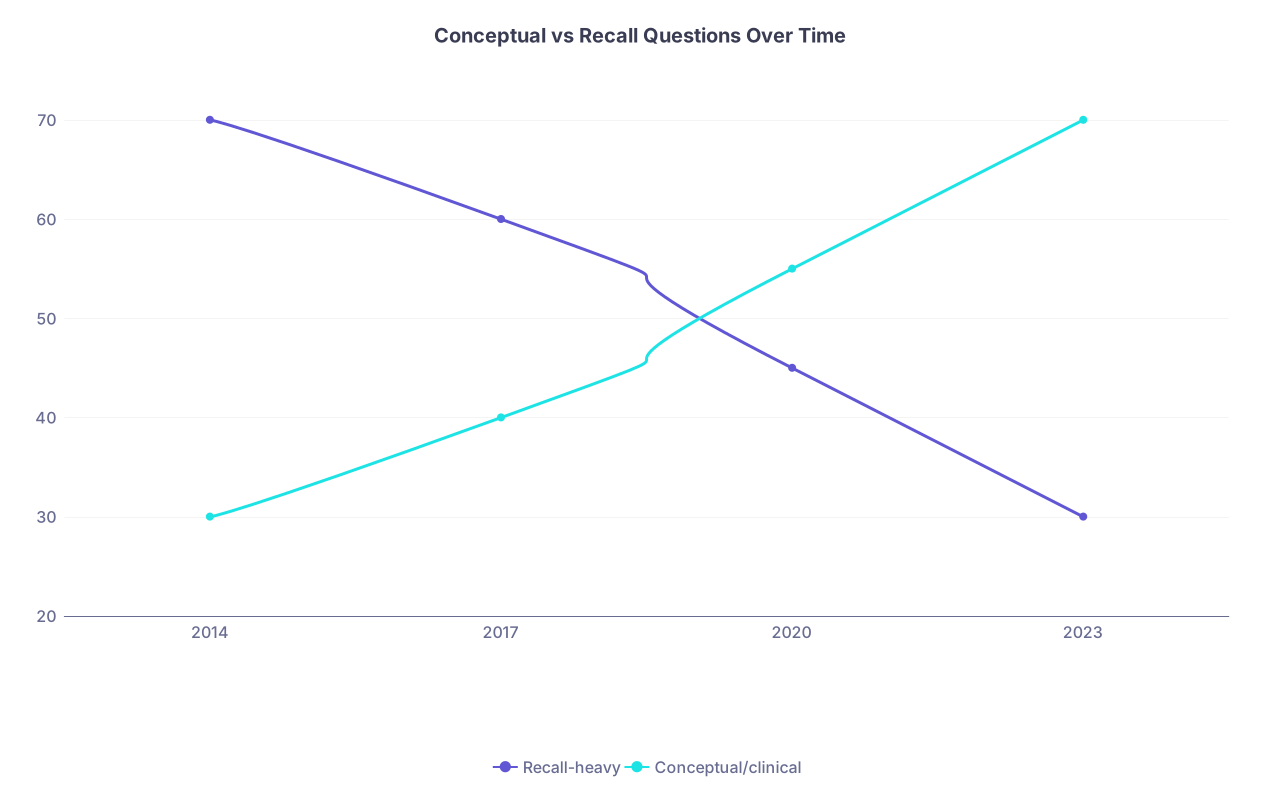
| Category | Recall-heavy | Conceptual/clinical |
|---|---|---|
| 2014 | 70 | 30 |
| 2017 | 60 | 40 |
| 2020 | 45 | 55 |
| 2023 | 30 | 70 |
Rough trend: not literal NBME stats, but an accurate reflection of what students report and what I see in released materials.
The main changes:
Longer stems, more data
You get vitals, labs, imaging findings, medication lists, and then a mechanism-level question. The basic science is now hidden behind two or three layers of clinical data.Fewer “definition” questions
They almost never simply ask, “What is the definition of X?”
Instead, they show you a scenario that is X, then ask what mechanism, mutation, or physiologic defect matches.Answer choices more conceptual, less vocabulary-based
Options are often mechanisms or processes, not just “the name” of a disease or enzyme.
For example, compare these two:
Old style:
Which of the following best describes the mechanism of action of drug X?
A. Competitive inhibition at active site
B. Noncompetitive inhibition
C. Irreversible inhibition
D. Allosteric activation
E. Substrate mimic
New style:
Patient on drug X has steady-state levels of substrate Y increased twofold, Vmax unchanged, Km increased. Which mechanism best explains this drug action?
Choices: all mechanistic descriptions, not drug names.
Same topic (enzyme kinetics). Very different cognitive load.
4. Timing of Basic Science: Tested Later in the Vignette, Not Up Front
A subtle but key shift: on the current exam, basic science is often the second or third layer of reasoning, not the first.
This is exactly what trips up students who are “good at Anki, bad at exams.”
A typical modern Step 1 question structure:
- Recognize the clinical syndrome (Step 2-style recognition).
- Identify the key pathophysiologic process underlying it (Step 1-level physiology, biochem, immunology).
- Apply that to a genetic, molecular, or pharmacologic fact.
If you are still expecting:
“Which enzyme is deficient?”
You will be thrown off by:
- Vignette describing a child with recurrent hypoglycemia, hepatomegaly, and seizures.
- Then they ask: “Which change in metabolic flux would you expect after a 24-hour fast?” or “Which substrate accumulates in cytosolic hepatocytes?”
Same disease, but they want the step deeper. Mechanism, not label.
This is one reason why many students felt Step 1 got “harder” after going pass/fail. It did not get harder in the sense of more obscure content. It got harder because you must actually understand, not just recite.
5. The Illusion of “Less Basic Science”: Why Students Misjudge the Shift
There is a common narrative on Reddit and in study groups:
“Step 1 is pass/fail now, so they’re making it easier and more clinical.”
The pass/fail part is true. The rest is not.
The exam did become more clinically flavored, but that is not the same as easier. Here is the trap:
- If you memorize First Aid and question bank explanations superficially, clinical questions feel doable.
- When they embed two layers of mechanism under that vignette, your lack of deep understanding gets exposed.
What changed is:
- The exam penalizes shallow memorization more effectively.
- The absolute volume of super-obscure low-yield minutiae seems lower.
- But the conceptual ceiling—the depth at which they can test mechanisms—did not go down.
USMLE used pass/fail as an opportunity to make Step 1 more educationally aligned with what they claim it should be: a test of whether you can use the basic sciences to understand medicine. Not just list facts.
So if your takeaway from pass/fail is “I can relax on the details,” you are misunderstanding the direction of travel.
6. How This Directly Changes How You Should Study Basic Science
Let me be blunt: your old senior who crushed a 260 with 8 passes through First Aid is not living in your exam world anymore.
You cannot just copy their plan.

| Step | Description |
|---|---|
| Step 1 | Read vignette |
| Step 2 | Identify syndrome |
| Step 3 | Determine key pathophysiology |
| Step 4 | Link to basic mechanism |
| Step 5 | Select answer |
Study needs to map to that flow.
Stop: Isolated, label-only memorization
- “What is the enzyme deficiency in McArdle disease?”
- “What is the triad of Charcot?”
- “What is the mechanism of ACE inhibitors?”
you are only training Step 0 of the reasoning chain. Recognition. Labels. Definitions.
The exam now demands:
- Can you predict exercise test findings in McArdle?
- Can you differentiate Charcot triad from Reynolds pentad and then link that to path of obstruction, infection, and sepsis?
- Can you infer how ACE inhibitors change efferent arteriole tone, GFR, and creatinine in bilateral RAS?
So your studying must include:
- Active explanation of mechanisms in your own words.
- Linking each disease to its pattern of labs, hemodynamics, and responses to interventions.
- Practicing questions where answer choices are mechanisms, not names.
Start: Mechanism-first mental models
For each disease or drug, you should be able to answer three mechanistic questions:
- What is broken or changed at the molecular, cellular, or physiologic level?
- What are the direct consequences of that change inside an organ system?
- How do those consequences manifest as signs, symptoms, labs, imaging?
Example: Beta-blockers in heart failure.
- Mechanism: β1 blockade → ↓ cAMP in cardiac myocytes → ↓ Ca²⁺ influx → ↓ contractility acutely.
- Long-term: ↓ sympathetic drive, ↓ remodeling, ↑ survival.
- Consequences: transient worsening symptoms if started at too high a dose; bradycardia, AV block; must titrate.
If a question shows a patient whose symptoms worsen after a huge dose escalation, and asks for the mechanism… you are ready.
Practice bank strategy must be different
Most students now overuse Step 2-like “pattern recognition” to get questions right in UWorld. That works right up until the exam asks a:
“which of the following mechanisms best explains”
or
“which change in X/Y/Z is most likely”
You should:
- Consciously force yourself, when reviewing questions, to go back to the first-principles basic science behind the explanation.
- Rewrite missed questions as pure mechanism prompts: “What happens to preload, afterload, SV if we do X?”
- Use explanation time as learning physiology and biochem, not just bank trivia.
7. What This Means for Step 2 and Residency Downstream
There is another layer here most students ignore: Step 1’s change is not isolated. It reshapes how Step 2 and even residency directors interpret your file.
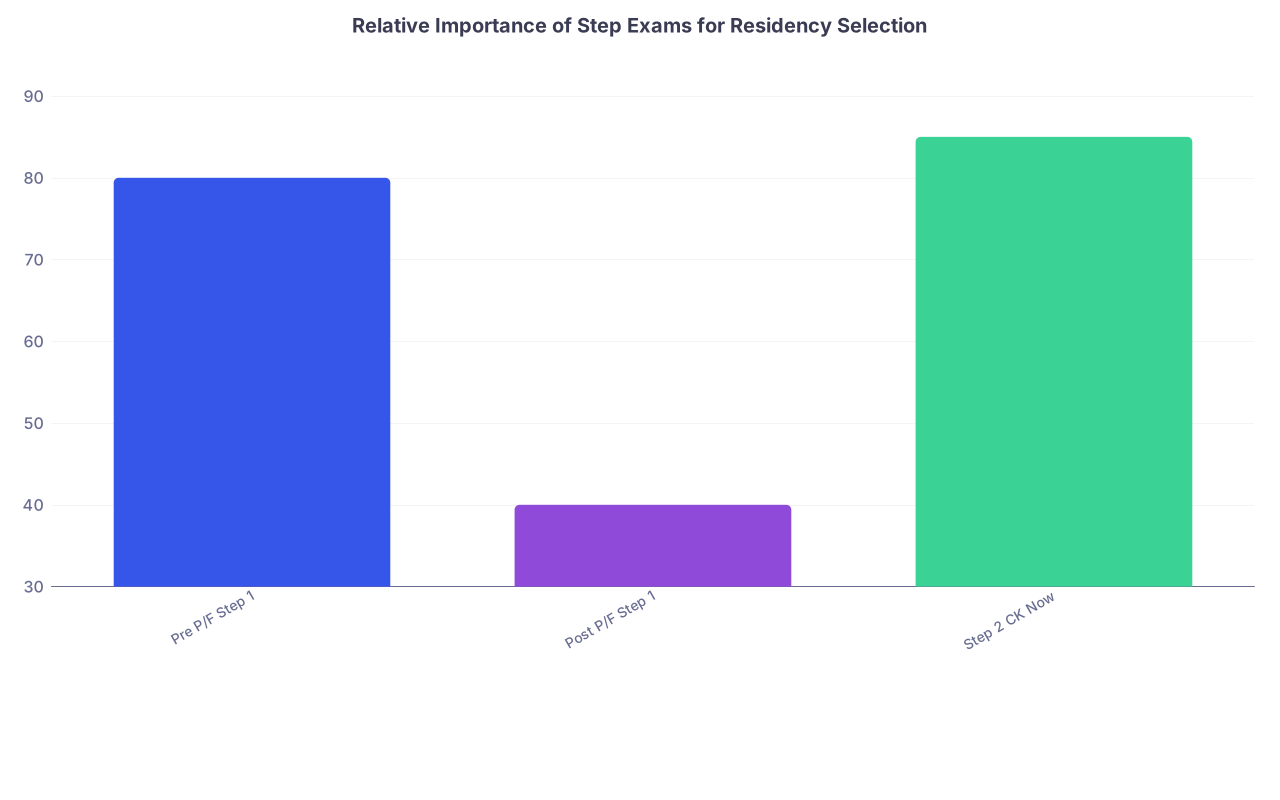
| Category | Value |
|---|---|
| Pre P/F Step 1 | 80 |
| Post P/F Step 1 | 40 |
| Step 2 CK Now | 85 |
Again, not literal NBME data, but pretty close to what PD surveys show: Step 2 CK is now king.
Here is the catch:
- Step 2 CK is heavily mechanism-aware now.
- Cases often assume you understand why certain findings occur, not just what to do next.
- If you learned basic science as “just enough to pass Step 1,” you are building a weak foundation for Step 2.
I have watched this play out:
- M2: “Step 1 is pass/fail, I will just hit the high-yield.”
- M3: Struggles with medicine clerkship shelf exams—cannot interpret complex acid–base, hemodynamics, endocrine questions.
- Step 2 CK score plateaus in the 220s–230s despite heavy question practice because the mechanisms were never solid.
Residency PDs care less about your Step 1 now, sure. But they care more about whether you understand patients. That still starts with physiology, pharmacology, and pathophysiology.
Step 1’s new style is not just gatekeeping. It is the first stress test of whether you actually get how disease works.
8. Where The Exam Did Back Off on Basic Science
Let me be fair. Some traditional Step 1 content truly got dialed down, both in NBME practice and reported exam experience.
- Ultra-obscure metabolic diseases with borderline-zero clinical relevance.
- Rare eponyms or named fibers, nuclei, or tracts that do not affect actual medical decision-making.
- Detailed enzyme cofactors and vitamin chemistry that never show up in clinical reasoning.
- Pure “bug ID by lab test” questions without a syndrome context.
You are less likely to see:
Which cytokine is uniquely produced by cell type X?
More likely:
They show a biologic targeting a cytokine and ask what effect it will have on a specific immune process or disease course.
So yes, the noise got turned down. The board finally admitted they do not need you to memorize every enzyme in heme synthesis by name.
But the signal—the central physiologic and molecular logic of disease—became non-negotiable.
9. A Concrete Example: Old vs New Style Question on the Same Topic
Let me walk you through a side-by-side comparison. Same topic, Step 1 before and after pass/fail.
Topic: Insulin and glucose transport
Old style question:
A researcher studies the effects of insulin on skeletal muscle cells. Administration of insulin leads to an increased number of which of the following transporters in the cell membrane?
A. GLUT1
B. GLUT2
C. GLUT3
D. GLUT4
E. SGLT1
This is pure recall. You either memorized “GLUT4 is insulin-dependent, in adipose and skeletal muscle” or you did not.
New style question on same concept:
A 55-year-old man with long-standing type 2 diabetes is started on a medication that increases insulin receptor signaling in skeletal muscle cells. Several weeks later, a biopsy from skeletal muscle shows increased transporter-mediated glucose uptake at the cell membrane. Which of the following transporters is most likely increased at the cell membrane of this patient’s skeletal muscle cells?
Same answer: GLUT4. But now:
- Clinical context (type 2 diabetes)
- Drug mechanism (increase insulin receptor signaling)
- Tissue (skeletal muscle)
- Application (transporter-mediated uptake)
You must understand function, not just label.
Now push it one level deeper, which is what you might actually see on a current-style exam:
They could ask which downstream intracellular signal is activated (PI3K/Akt), or what metabolic pathway is increased in those muscle cells (glycogenesis, glycolysis).
This is the real shape of modern basic science questions: patient → process → molecular mechanism.
10. Looking Forward: How Basic Science Will Likely Evolve Next
I do not expect a return to the old trivia-heavy Step 1. The direction is clear:
- Closer alignment with real clinical reasoning.
- Stronger integration of molecular medicine, oncology, and targeted therapies.
- More emphasis on multi-system physiology: cardio-renal, hepatorenal, neuroendocrine.
Expect more of:
- Questions that make you interpret curves and graphs: PV loops, oxyhemoglobin dissociation curves, dose–response curves, renal clearance plots.
- Questions linking genetics to therapy choice and prognosis.
- Immunology tied to biologics and immunotherapy.
And fewer of:
- Standalone enzyme names with no clinical attachment.
- “Which of the following is true about X?” with five factoid options.
If you are an early M1 or premed looking ahead, the smart move is to stop romanticizing the old era. You will never see it.
Instead, build your study around:
- Understanding processes: renal handling, acid–base, endocrine feedback, hemodynamics.
- Connecting drugs to these processes.
- Explaining, out loud or in writing, why each sign, symptom, or lab abnormality occurs.
That is the currency Step 1 now trades in.
Key Takeaways
- Basic science on Step 1 did not disappear with pass/fail. It shifted from isolated recall to clinical, mechanism-based reasoning embedded in patient vignettes.
- Disciplines like physiology, pharmacology, and immunology are now tested primarily as pathophysiology and drug mechanisms linked directly to real clinical scenarios.
- If you study by memorizing labels and trivia, you will get punished. If you understand and can explain mechanisms across organ systems, you are aligned with the new Step 1—and you will be better prepared for Step 2 and actual patient care.