
The idea that Step 1 going pass/fail makes early pathophysiology “less important” is dangerously wrong.
If anything, you are now more exposed. Step 1 used to force everyone to build a certain baseline. Ugly, stressful, but effective. Now? You can coast to a pass with shallow understanding, then get exposed in clerkships, on Step 2, in sub-Is, and in residency when no one cares what your score was—only whether you can think.
Let me break this down specifically.
1. What Changed With Step 1 Pass/Fail – And What Did Not
The exam changed format. Disease mechanisms did not. Clinical complexity did not. Faculty expectations did not.
Step 1 pass/fail did three main things:
- Removed high-stakes numerical stratification at the M2 level.
- Shifted competitive pressure downstream to:
- Step 2 CK
- Clinical grades
- Letters and narrative comments
- Exposed gaps in students who never truly mastered pathophysiology, because they are now judged in a more “live fire” environment.
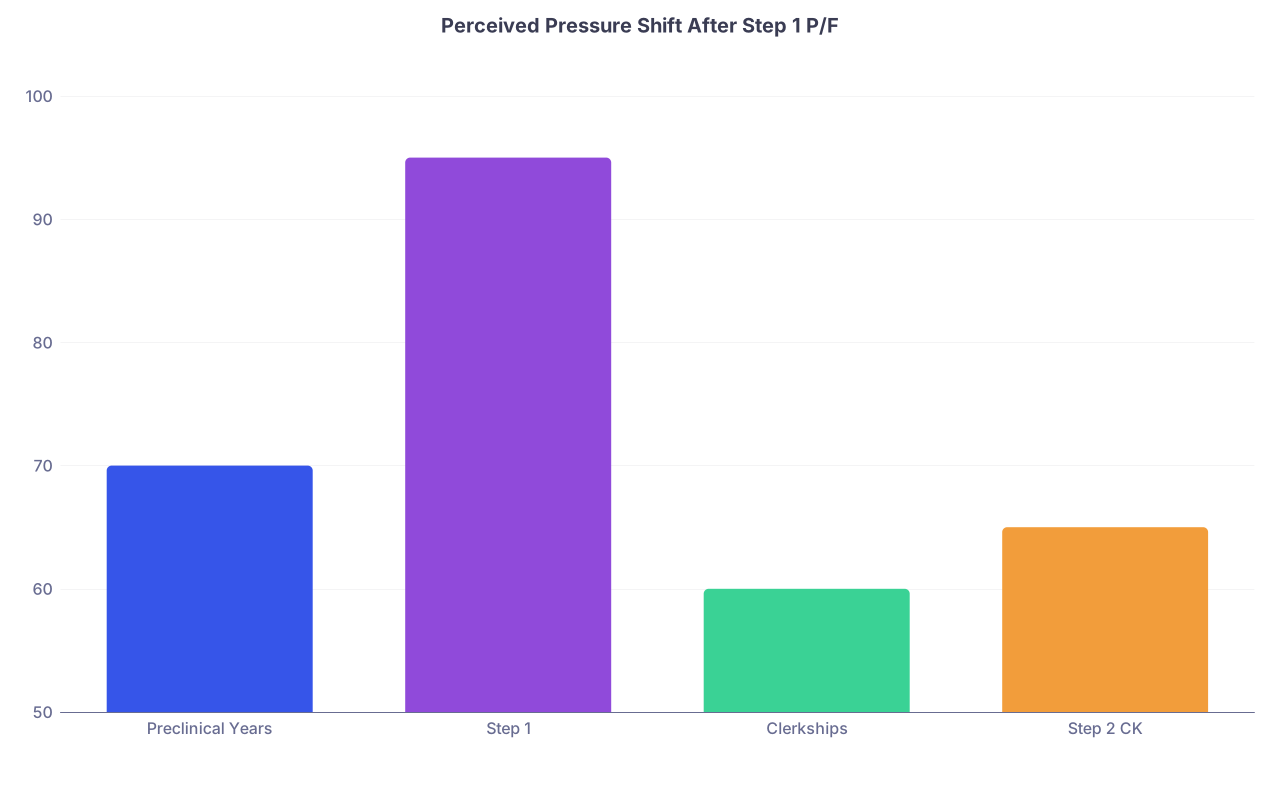
| Category | Value |
|---|---|
| Preclinical Years | 70 |
| Step 1 | 95 |
| Clerkships | 60 |
| Step 2 CK | 65 |
I see three common but flawed reactions in current M1/M2s:
The Minimalists
“It’s pass/fail, I just need to clear the bar.”
These are the students who look fine until they start third year and get wrecked by simple “why” questions on rounds.The Old-Schoolers
Try to study exactly like the 260-chasing crowd did—same volume, same anxiety—despite a different landscape. They burn out, waste time on low-yield trivia, and still lack conceptual depth because they chased question volume, not understanding.The Strategists
Use the lower Step 1 pressure to build deeper foundations, slower, with more clinic-oriented reasoning. They still use UWorld, First Aid-style resources, and Anki—but they are deliberately targeting vertical integration, not flashcard completion rates.
You want to be in group three.
Pass/fail did not change:
- The complexity of internal medicine, ICU, or surgery patients
- The expectation that a future cardiologist actually understands heart failure pathophysiology
- The fact that Step 2 CK heavily leans on Step 1 content, just wrapped in clinical clothing
If you treat Step 1 like a “just pass and move on” exercise, you are building a house on sand. It might stand long enough for a pass. It will collapse when you are on call at 3:00 a.m. with a crashing patient and no algorithm to follow.
2. Why Pathophysiology Still Determines How Dangerous You Are As A Doctor
Sounds dramatic. It is.
When residents talk about whether a junior is “safe,” they are not talking about:
- How many Anki cards you did
- How many UWorld blocks you crushed preclinically
They are talking about whether your brain actually runs in mechanisms, not memorized associations.
Mechanisms vs memorization
Take a classic example: hyponatremia in a hospitalized patient.
A “memorizer” brain does this:
- Hyponatremia → think SIADH, CHF, cirrhosis, diuretics
- Maybe remember a flowchart from Step 1 prep
- Order some random labs, wait for someone to tell them the plan
A pathophysiology brain does this:
- Asks: “What is the effective serum osmolality?”
- “Is the patient hypovolemic, euvolemic, or hypervolemic by exam and vitals?”
- Reasons:
- Hypovolemic hyponatremia → fluid losses (GI, renal, third spacing) → treat with volume
- Euvolemic hyponatremia → SIADH, endocrine issues → fluid restriction, address cause
- Hypervolemic hyponatremia → CHF, cirrhosis, nephrotic syndrome → manage overload
That is Step 1 physiology and pathophysiology in action. On the wards. With real patients.
The same pattern shows up everywhere:
- Shock states (distributive vs cardiogenic vs obstructive vs hypovolemic)
- Acid–base (respiratory vs metabolic, appropriate compensation, mixed disorders)
- Renal failure (pre-renal vs intrinsic vs post-renal)
- Respiratory failure (hypoxemic vs hypercapnic, V/Q mismatch vs shunt vs diffusion)
What you “kind of remember” from second year becomes the difference between:
- Recognizing septic shock early
- Missing a mixed acid–base disorder
- Confusing pre-renal azotemia with ATN and ordering the wrong tests or interventions
So no, Step 1 P/F did not reduce the importance of pathophysiology. It just removed a numerical scoreboard that forced you to respect it.
3. How to Build Foundational Pathophysiology Intentionally (Not Accidentally)
You need a plan. “Just watch lectures and do questions” is not a plan. It is how you drift.
Step 1: Reframe your goal
Your target is not “pass Step 1.”
Your target is: “Have a mental model of most major disease processes that I can explain to a reasonably skeptical attending in 3–4 steps.”
That means:
- Understanding normal physiology first
- Then knowing what is broken (pathology)
- Then knowing the mechanism that connects the two (pathophysiology)
- Then knowing how drugs or interventions interact with that mechanism
Notice: this is not about listing all side effects of ACE inhibitors. It is understanding why ACE inhibitors improve mortality in heart failure—at the RAAS level, at the afterload/preload level, at the remodeling level.
Step 2: Use your resources for depth, not just exposure
Everyone uses similar tools. The difference is how.
Typical toolkit:
- Boards-style video lectures (e.g., Boards & Beyond, Pathoma, Sketchy micro/pharm)
- Question banks (UWorld, AMBOSS)
- Condensed review texts / outlines
- Anki decks
The trap in the P/F era is to:
- Watch everything at 1.75x
- Do questions purely to memorize answer choices
- Let Anki devolve into brute-force recognition
Instead, structure each system with a mechanism-first framework.
Take heart failure as an example.
Your “pathophys build” sequence should look like this:
Start with normal:
- Cardiac cycle
- Frank–Starling
- Preload, afterload, contractility, compliance
Then the core disturbances:
- Systolic vs diastolic failure (what specifically is failing?)
- LV vs RV failure (where is the blood backing up?)
Then the body’s responses:
- Neurohormonal: RAAS, sympathetic, ADH
- Hemodynamic: increased preload, vasoconstriction
- Structural: remodeling, hypertrophy, dilation
Then connect to:
- Symptoms: dyspnea, orthopnea, PND, edema
- Physical findings: S3, JVD, rales, hepatomegaly
Finally, treatment and mechanism:
- ACEi/ARB/ARNI: RAAS blockade, decreased afterload
- Beta blockers: sympathetic modulation, remodeling effects
- Diuretics: symptom relief via volume control
- SGLT2 inhibitors: natriuresis + other effects
If your studying does not naturally produce this kind of 4–5 step chain, you are skimming.
4. Concrete Weekly Structure for Building Pathophysiology
Let me give you an actual skeleton week. Adapt to your school’s schedule, but keep the proportions.
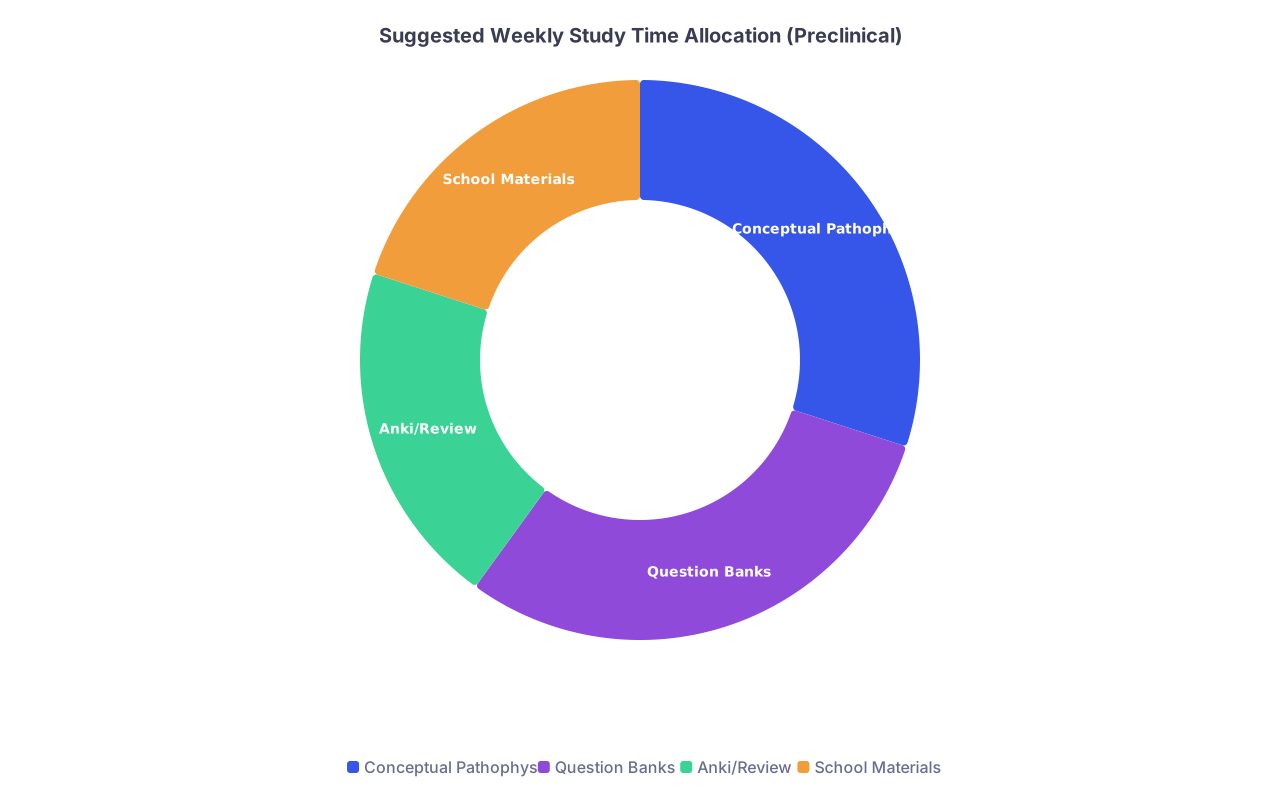
| Category | Value |
|---|---|
| Conceptual Pathophys | 30 |
| Question Banks | 30 |
| Anki/Review | 20 |
| School Materials | 20 |
Core idea
You split your week into:
- Concept build time (slow, deep, fewer pages, more thinking)
- Application time (questions)
- Spaced recall (Anki or equivalent)
- Integration with school (lectures, labs, small groups)
A rough example (M2, during a systems block):
Daily anchors (Mon–Fri)
- 60–90 minutes: dedicated “pure pathophysiology” time
- One process at a time (e.g., nephrotic syndrome, COPD, MI)
- Draw it out: normal state → insult → molecular/physiologic change → organ-level change → clinical manifestations
- 40–60 minutes: UWorld/AMBOSS questions focused on that system
- 30–45 minutes: Anki / spaced recall
One longer session (Sat or Sun)
- 2–3 hours: “vertical integration” session
- Choose 3–4 diseases in one organ system
- For each: mechanism → presentation → tests → treatment → why treatment works
- Force yourself to speak it out loud or write it in outline form
You are building a concept atlas in your own brain. Not just checking off that you watched 25 videos.
5. Techniques That Actually Deepen Pathophysiology (Beyond Passive Studying)
If you want foundational understanding, you need to force yourself to produce reasoning, not just consume content.
Here are several techniques that consistently separate strong from weak trainees.
Technique 1: “Explain to a skeptical attending” drill
Pick a topic. For example: anion gap metabolic acidosis.
Then:
Write (or speak and record) a 2–3 minute explanation as if an attending said:
“Okay, explain to me why lactic acidosis gives you an elevated anion gap and how the body tries to compensate.”
Your explanation should hit:
- The basic formula for anion gap and what “unmeasured anions” means
- How lactic acid dissociation increases unmeasured anions
- How Henderson–Hasselbalch ties pH, bicarbonate, and CO₂
- Expected respiratory compensation (Winter’s formula)
Then compare your explanation against:
- A trusted text/video
- UWorld/AMBOSS explanations across multiple questions
If you cannot produce that explanation cleanly, you do not own the concept.
Technique 2: Mechanism → symptom chain
For any named symptom or finding, force a 3–4 step chain.
Example: orthopnea in left-sided heart failure
- LV dysfunction → increased LV end-diastolic pressure
- Backward transmission to pulmonary veins → increased pulmonary capillary hydrostatic pressure
- Lying flat: redistributes blood from lower extremities to central circulation
- Further increases pulmonary capillary pressures → interstitial edema → worsened dyspnea when supine
Write these chains in your own shorthand. You will start to see patterns repeating across diseases (congestion, obstruction, ischemia, inflammation).
Technique 3: Build and reuse “mini-templates”
For categories like:
- Anemias
- Jaundice
- Shock
- Chest pain
- Dyspnea
Create a mini-template that you mentally reuse:
Example: Shock template
- Variable: Cardiac output, SVR, preload
- Types: Hypovolemic, cardiogenic, distributive, obstructive
- For each:
- Primary disturbance (what is failing?)
- Compensatory response
- Typical hemodynamics
- Treatment logic
You fill the same four slots for every new disease in that category. After a while, pathophysiology stops being random facts and starts being pattern recognition with mechanistic reasoning.
6. Integrating Pathophysiology With Clinical Years and Step 2 CK
The big mistake in the P/F era: treating preclinical and clinical as separate universes.
They are not. The students who look “shockingly good” as early third-years are almost always the ones who treated preclinical pathophys like Step 2 prep with training wheels.
Clerkships: how your foundations show up
You will see this immediately on internal medicine and surgery:
Scenario: Patient with GI bleed, hypotension, and tachycardia.
Student A (weak pathophys):
- Regurgitates: “We give fluids and maybe blood? Check Hgb?”
- Does not think through preload, oxygen delivery, compensation, ongoing loss.
Student B (solid pathophys):
- Recognizes this is hypovolemic shock with decreased preload leading to decreased stroke volume and cardiac output
- Expects tachycardia as compensation
- Understands why blood pressure might be “okay” at first but fall later
- Knows that Hb can be initially normal until redistribution/fluids
- Communicates: “This is likely acute blood loss causing hypovolemia—we need large-bore IV access, resuscitation, type and cross, and localize the bleed.”
That difference is 80% pathophysiology, 20% memorized protocol.

| Step | Description |
|---|---|
| Step 1 | Preclinical Pathophys |
| Step 2 | Pattern Recognition |
| Step 3 | Clerkship Reasoning |
| Step 4 | Step 2 CK Performance |
| Step 5 | Residency Readiness |
| Step 6 | Mechanism Based Treatment |
Step 2 CK: the “Step 1 you cannot evade”
Step 2 CK questions are saturated with physiology/pathophysiology expectations. They just hide them in vignettes.
Examples:
- Choosing between diuretics, vasodilators, inotropes in heart failure depends on mechanism
- Differentiating causes of hypoxemia (shunt vs V/Q mismatch vs diffusion) is pure physiology
- Recognizing endocrine feedback loops in hypercalcemia or thyroid disease—again, pathophysiology
You will not magically “add” deep physiologic understanding in the 6–9 month Step 2 window if you never built it preclinically. You will, at best, memorize algorithms and pattern-match on UWorld. That works up to a point. You will plateau earlier than your potential.
7. Avoiding the New Era Traps: What Not To Do
Let me be blunt about a few patterns I see repeating that you should avoid.
Trap 1: Studying only at the “testable” surface
You see this when students say things like:
- “Do I really need to understand the molecular steps of insulin signaling? Step 1 is P/F.”
- “I just memorize which drug is first-line. The mechanism is less important.”
Bad framing. The depth of your understanding determines:
- How quickly you can learn new variations (new drugs, new guidelines)
- How well you can reason through weird presentations
- How much attending teaching “sticks” rather than passing through
You do not need to memorize every cytokine or obscure pathway. But for major diseases, you should be able to reason at mechanism level.
Trap 2: Over-indexing on Anki and under-indexing on explanation
Anki is powerful. But it is not a complete education.
Red flags:
- You are “good” at cards but choke when asked “walk me through why” on rounds
- You recognize answer choices but cannot explain why four choices are wrong mechanistically
- You never speak pathophysiology in full sentences—only see it as flashcard chunks
Fix: For “big ticket” concepts (shock, heart failure, acid–base, AKI, respiratory failure, diabetes complications, coagulation), you must periodically explain them in your own words, not just click “Good” or “Again.”
Trap 3: Treating school material and boards material as two worlds
Most schools are slowly adjusting. Some are not. I have seen both extremes:
- Schools that are still stuck in “memorize the rare metabolic disorder” land
- Schools that overcorrect and become fluffy, with very little actual mechanism detail
Your job is to anchor yourself in core, recurring pathophysiologic themes and then map both school and boards resources to them.
If your school is weak on mechanism:
- Lean harder on good external resources
- Use question banks to identify the “spine” of each topic
If your school is old-school detail-heavy:
- Constantly ask: “Is this detail just a name, or does it show up in mechanism, presentation, or management?”
8. A Simple System-Level Blueprint: What To Master Before Clerkships
Let us be concrete. Before you touch third year, you should have stable, usable pathophysiological understanding in at least the following areas.
| System | Core Domains (Examples) |
|---|---|
| Cardio | Shock, HF, MI, arrhythmias, HTN |
| Pulm | COPD, asthma, PE, ARDS, hypoxemia |
| Renal | AKI, CKD, acid-base, electrolytes |
| Heme/Onc | Anemias, coagulopathies, leukemias |
| Endocrine | DM, thyroid, adrenal disorders |
| GI/Liver | Cirrhosis, pancreatitis, IBD |
You do not need fellowship-level nuance. But you should be able to:
- For each disease:
- Describe the primary defect (structural, functional, molecular)
- Describe the major compensatory mechanisms
- Map that to the typical signs, symptoms, and key lab findings
- Explain why first-line treatments do what they do
If you cannot do that for, say, DKA, COPD, or cirrhosis, you are building a future headache for yourself.
9. Using the Low-Pressure Era as an Advantage, Not an Excuse
Let me flip the script. The P/F era can actually be a massive advantage if you use it intelligently.
Before, high Step 1 pressure pushed students to:
- Chase question volume over true understanding
- Avoid slower, deeper dives because they “took too long”
- Panically cram for obscure details because “they might test it”
Now, you can:
- Spend 45 minutes building a single clean mental model of nephrotic vs nephritic syndrome without feeling guilty that you did not finish 2 more UWorld blocks
- Rewatch a particularly dense physiology explanation until it truly clicks
- Integrate clinical podcasts, case discussions, or UpToDate reading earlier, using pathophysiology as the bridge
In other words: you can focus less on gaming an exam and more on actually becoming the person people want on their team at 2:00 a.m.

If you treat the P/F change as permission to be shallow, you will pay for it later.
If you treat it as permission to go deeper, slower, smarter—you will outgrow your peers over time, even if your Step 2 score is identical.
10. Putting It All Together: A Concrete 4-Week “Foundation Sprint”
If you feel your pathophysiology is shaky right now, here is a focused, realistic 4-week reset you can layer on top of your existing schedule.
Focus on four high-yield domains, one per week:
- Shock + hemodynamics
- Acid–base + electrolytes
- Heart failure + ischemia
- Respiratory failure + hypoxemia
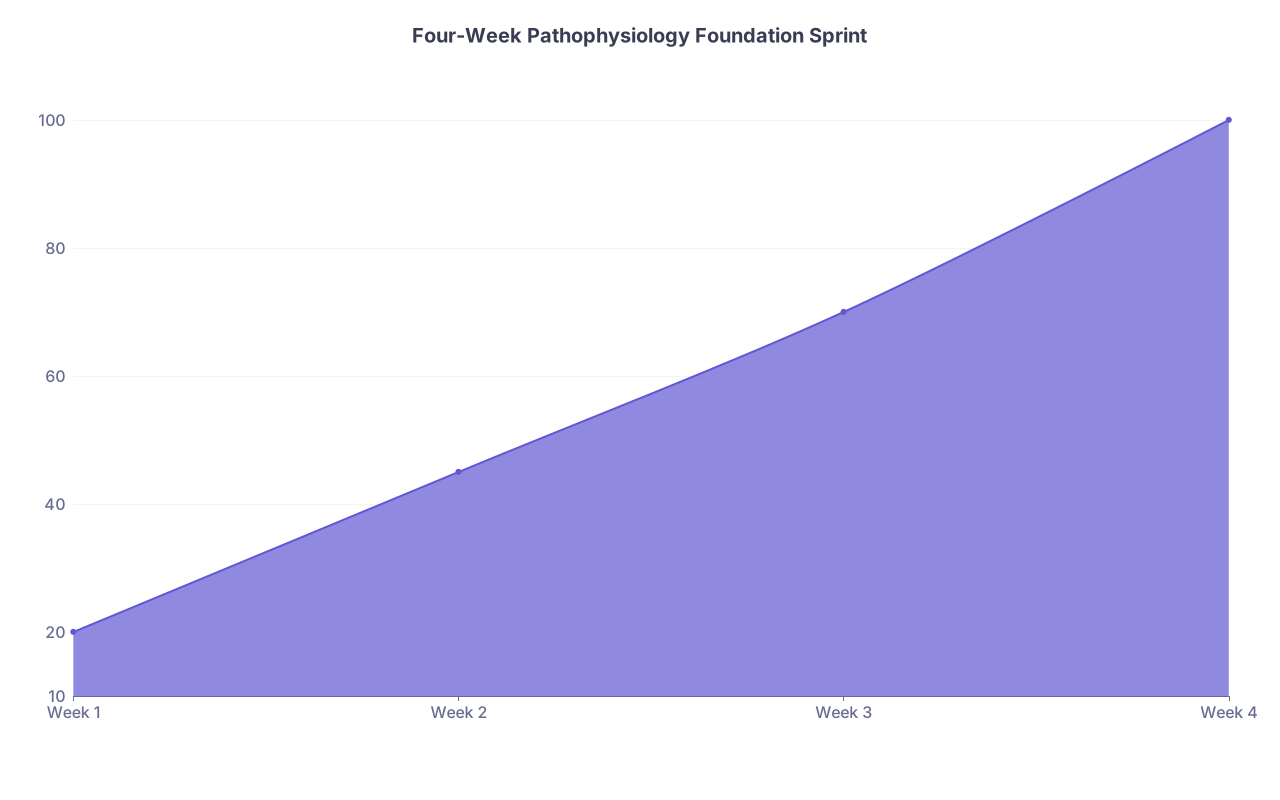
| Category | Value |
|---|---|
| Week 1 | 20 |
| Week 2 | 45 |
| Week 3 | 70 |
| Week 4 | 100 |
Each week:
2–3 “anchor” lectures or resources
- One core physiology explanation
- One or two pathology/clinical pathophysiology talks
3–4 one-page mechanism maps:
- Example for heart failure:
- Cardiac output equation
- Systolic vs diastolic dysfunction
- RAAS and sympathetic activation
- Treatment rationale
- Example for heart failure:
80–120 targeted UWorld/AMBOSS questions:
- Tag the questions by mechanism (e.g., “shock – distributive vs cardiogenic”)
- After each, write a single sentence that summarizes the key pathophys insight
1 explanation session:
- Record yourself explaining:
- The four types of shock and their hemodynamics
- Or: respiratory failure types and causes
- Re-listen 3–5 days later. Fix gaps with another 20–30 minute focused review.
- Record yourself explaining:
You will be stunned how much more confident you feel on wards and in Step 2 prep if you do even one month of brutally honest “do I actually understand this” work.
11. The Future of Medicine: Why This Matters Even More Going Forward
Medicine is not getting simpler.
- More biologics with very specific pathway targets
- More complex ICU-level management algorithms
- More multimorbidity in aging populations
- More cross-talk between specialties (cardio-renal-hematology-immunology cases are everywhere)
The only durable defense you have is deep mechanistic understanding. Everyone will have access to UpToDate and guidelines. What differentiates you is:
- How quickly your brain builds a first-pass model of what is going on
- How efficiently you update that model as new data arrives
- How well you can justify your reasoning to colleagues, consultants, and patients
The P/F Step 1 era is going to produce two types of physicians:
- Those who view it as license to do the minimum.
- Those who use it as cover to build uncompromisingly strong foundations without the distortion of point-chasing.
You want to be in the second group. They will feel “overprepared” on paper. And strangely calm in real clinical chaos.

FAQs
1. If Step 1 is pass/fail, how hard should I actually study for it?
You should study hard enough that:
- You would be competitive if the score were reported,
- And your understanding still feels solid 1–2 years later on wards.
That usually means using a full Step 1 prep structure (videos, questions, Anki) but targeting depth and retention over marginal trivia. You do not need to grind yourself into the floor for a hypothetical 260, but you do need to avoid “just enough to pass and forget.”
2. How do I balance Anki with deeper concept study without burning out?
Cap Anki. For example, 60–90 minutes max per day. Protect a separate 45–90 minute block specifically for concept build where you:
- Draw mechanisms
- Explain processes out loud
- Work through a small set of high-quality questions slowly
If Anki is eating all your study time, you are training recognition, not reasoning.
3. What should I do if my school’s lectures are heavy on detail but light on mechanisms?
Treat school as a “detail overlay,” not the backbone. Build your backbone from:
- A strong physiology text or video series
- A pathophysiology-oriented resource (e.g., good systems videos, case-based discussions)
Then slot school details into that scaffold. When you encounter some obscure fact, ask: “Does this connect to mechanism, or is this a disconnected label?” Prioritize the former.
4. How can I tell if my pathophysiology is actually strong enough before clerkships?
Use three checks:
- Pick 10 core topics (HF, COPD, DKA, cirrhosis, PE, septic shock, etc.). Can you explain each in 3–4 mechanistic steps from cause to symptoms to treatment?
- Do 40–60 clinically oriented questions on a mixed Qbank block. Notice whether wrong answers come from not knowing the mechanism vs simple recall slips.
- Ask a resident or attending to grill you on 1–2 topics on a whiteboard or scrap paper. If you crumble quickly, you have work to do. If you can hold a structured explanation with follow-up questions, you are on the right track.
Key points:
- Step 1 going pass/fail did not shrink the importance of pathophysiology; it just moved the consequences later.
- Strong pathophysiology is built by deliberate mechanism-first study, not by passively watching videos and blasting flashcards.
- Use the lower exam pressure to go deeper now, so you are not exposed later—on Step 2, on wards, or when your decisions actually matter to a living patient.