
The most common Step 2 CK mistake in the ERAS era is not a low score. It’s bad timing.
You can crush the exam and still hurt your application if your score releases after programs screen files, after interview invites go out, or after rank lists are built. So let’s walk this in order—month by month—so you know exactly when to test and when to release scores.
Big Picture: What Step 2 CK Timing Actually Controls
At this point, you need to be very clear about what Step 2 CK timing changes for ERAS:
- Whether programs see a Step 2 score at initial screening
- Whether you can rescue a mediocre Step 1 before interview season
- Whether you can apply on time or have to delay submission
- How much study time vs. rotation performance you sacrifice
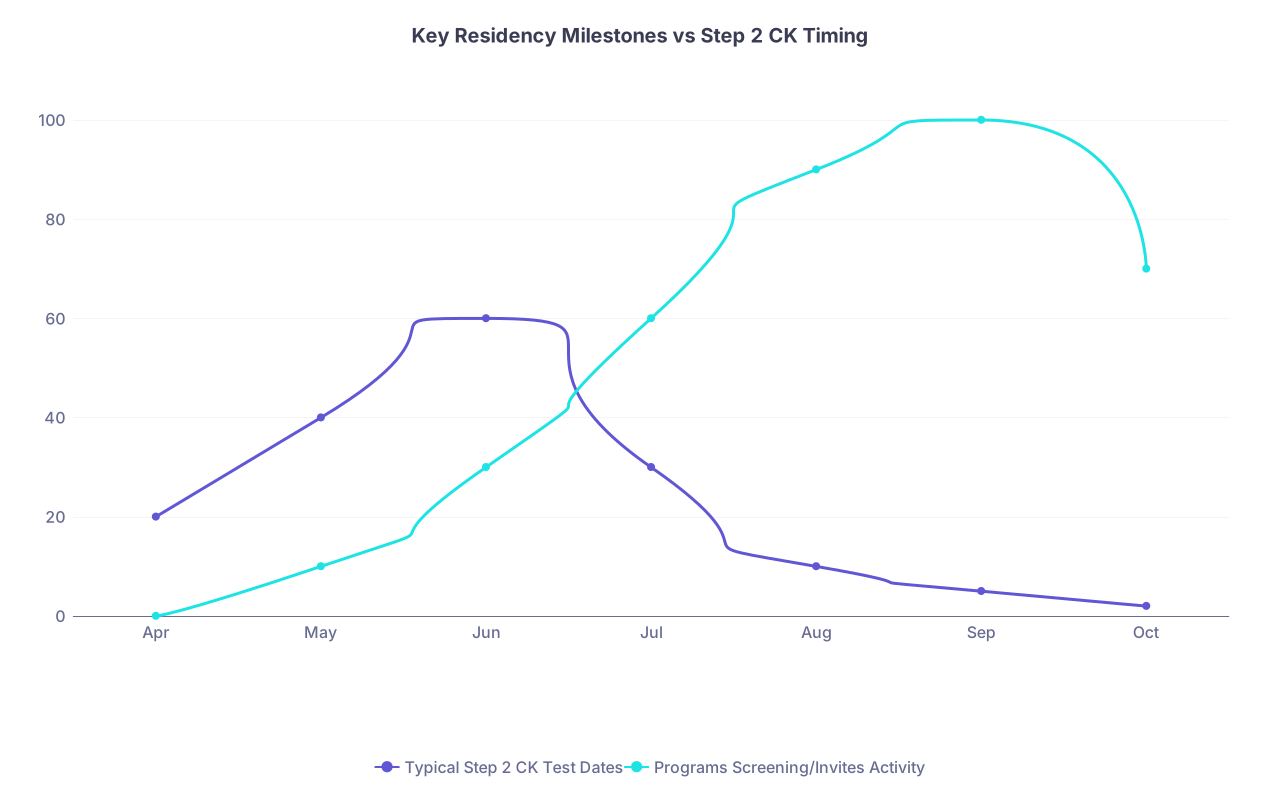
| Category | Typical Step 2 CK Test Dates | Programs Screening/Invites Activity |
|---|---|---|
| Apr | 20 | 0 |
| May | 40 | 10 |
| Jun | 60 | 30 |
| Jul | 30 | 60 |
| Aug | 10 | 90 |
| Sep | 5 | 100 |
| Oct | 2 | 70 |
Here’s the general rhythm of a typical application year (MD/DO, no major acceleration):
- January–March (MS3) – Core clerkships + maybe start light Step 2 prep
- April–June (MS3) – Last core clerkships, heavy prep, early test takers
- July–August (End MS3 / Start MS4) – Most people test here
- September (MS4) – ERAS submission, programs start screening
- October–January (MS4) – Interviews
- February – Rank lists due
- March – Match Day
Your Step 2 CK date is a lever. Pull it too late and your score never gets to do its job.
Month-by-Month: Ideal Step 2 CK Timing Scenarios
Let’s do this chronologically from January of MS3 through September of MS4. I’ll call out what you should be doing at each point, depending on your situation (strong Step 1, weak Step 1, competitive specialty, etc.).
January–March (MS3): Positioning Yourself
At this point you should:
Know your Step 1 situation:
- Pass/Fail only? Then Step 2 becomes your de facto “board score.”
- Low Step 1? Step 2 is your lifeline.
- Strong Step 1? Step 2 is for maintaining your trajectory.
Decide your rough testing window:
- Competitive specialties (Derm, Ortho, ENT, Plastics, Rad Onc, IR)
Target: late May–mid July - Moderately competitive (EM, Anesthesia, Gen Surg, Rads, Neuro)
Target: mid June–late July - Less competitive / primary care (IM, Peds, FM, Psych)
Target: late June–August (with more flexibility)
- Competitive specialties (Derm, Ortho, ENT, Plastics, Rad Onc, IR)
Start light prep:
- 10–20 questions/day on UWorld or AMBOSS during rotations
- Flag weaknesses from clerkships that will hurt for Step 2
No need to set the exact date yet, but you should know what month you’re shooting for.
April: Lock in a Target Date
By early April you should:
Look at your clerkship calendar for April–August:
- Front-loaded heavy rotations (Surgery, IM, OB/Gyn)?
- Any lighter blocks or electives?
Decide on:
- A target 4-week study window (if you’re taking a dedicated period)
- Or how many weeks you’ll do half-day studying + rotations
Book a tentative test date:
- Strong students / strong Step 1 / competitive fields:
Aim for late May–late June - Average students or big gaps in knowledge:
Aim for late June–late July - Needing a big bounce back from Step 1:
You might need late July–mid August, but that’s already risky for ERAS.
- Strong students / strong Step 1 / competitive fields:
Do not wait until May to schedule unless you like empty Prometric calendars and terrible dates.
May–June: Dedicated vs. Integrated Study
Now the fork in the road: how you stack study time vs. rotations.
At this point you should decide between:
Option A: Classic “dedicated” block
- 3–5 weeks mostly off clinicals
- Test by late June or early July
- Pros:
- Higher score potential
- Score definitely back by ERAS
- Cons:
- Lost elective time
- Some schools don’t allow long breaks
Option B: Study alongside rotations
- 6–10 weeks, 3–4 hours/night + weekends
- Test mid July–early August
- Pros:
- No gap in clinical work
- Easier to keep knowledge fresh from shelves
- Cons:
- Risk of burnout, lower peak score
- Late test dates can push score report close to ERAS deadlines
If you’re aiming to help a weak Step 1, Option A is almost always better. You need that score early so programs actually see the improvement.
Week-by-Week: Test Date vs Score Release vs ERAS
Here’s where timing stops being theoretical and becomes pure math.
Scores usually release on Wednesdays, roughly 2–3 weeks after your test date. Sometimes 4. Rarely longer, but I’ve seen it happen.
Key ERAS/NRMP Anchors (typical ACGME cycle)
These vary year to year by ~a few days, but the structure holds.
| Event | Typical Timing |
|---|---|
| Step 2 CK score release lag | 2–3 weeks post-exam |
| ERAS opens for applicants | Early June |
| ERAS submission allowed | Early–mid September |
| Programs receive apps | Mid–late September |
The logic you need:
- To have your Step 2 CK score visible on Day 1 of program review:
- You want your score released before mid-September.
- Which means you should test no later than mid–late August at the absolute latest.
- If you’re using Step 2 to fix Step 1, you want to be much earlier than that.
Target Test Date Windows Based on Use-Case
At this point (picking the actual date), use this as your guide:
You have a weak Step 1 and need Step 2 to rescue you
- Goal: Score is available when programs first screen
- Test window:
- Ideal: June 1 – July 15
- Acceptable: July 16 – August 1
- Risky: After August 1 (you’re asking programs to reconsider you later—some will, many won’t)
Step 1 is strong; Step 2 is just confirmation
- Goal: Don’t tank it, have it by interview season.
- Test window:
- Ideal: late June – early August
- Acceptable: up to mid-August
- Risky: Anything that releases after October (some programs won’t bother to check)
Step 2 may hurt you (practice scores borderline, Step 1 strong)
- Goal: Protect your floor. Avoid a glaring drop before interviews.
- Test window options:
- Option 1: Test early (June/early July) so any damage is fixed by adding context in the personal statement and MSPE.
- Option 2: Test after ERAS is submitted, aiming for a release in late October/November so interviews are already rolling. This is controversial but sometimes strategic.
If you’re in that third category, you need honest input from advisors, not cheerleading.
When to Release Scores in ERAS: Timing & Strategy
You don’t just control when you test. You also control when you send scores through ERAS.
Here’s the sequence:
- You take Step 2 CK.
- A few weeks later, NBME generates a score report.
- Through ERAS, you authorize release of USMLE/COMLEX transcripts to programs.
- After that, every new score gets auto-updated to programs you’ve applied to.
Early Release vs. Delayed Release
At this point, you need to decide:
- Do you authorize transcript release before Step 2 is taken?
- Or do you wait for your score and then click release?
Scenario 1: Weak Step 1, Counting on Step 2
- You should:
- Authorize release early so Step 1 and Step 2 flow as soon as they exist.
- Test before late July if possible.
- Logic: You want programs to see the whole story immediately when they open your file. Hiding transcripts while you “wait for Step 2” just means some programs filter you out on Step 1 alone.
Scenario 2: Strong Step 1, Unsure on Step 2
You have two reasonable strategies:
- Conservative:
- Do not authorize release until after Step 2.
- Check score. If catastrophic, some specialties and programs will already have screened/interviewed you based on Step 1 alone.
- Then decide whether to release knowing it might drop your perceived trajectory.
- Balanced:
- Authorize release, but:
- Time your exam so the score drops closer to October, after the first wave of invites.
- You’re not hiding; you’re just not letting a borderline score kneecap you during the earliest screening phase.
- Authorize release, but:
Scenario 3: Step 1 Pass/Fail Only
- You should:
- Authorize early. There’s nothing to hide.
- Focus on testing by mid-July–early August so that:
- Your Step 2 CK is in place when many programs finalize interview lists.
- Here, Step 2 is essentially your “Step 1” for selection.
Timeline Flow: From Test Day to Interview Season
Here’s the step-by-step timeline aligned to a July 15 test date as an example.
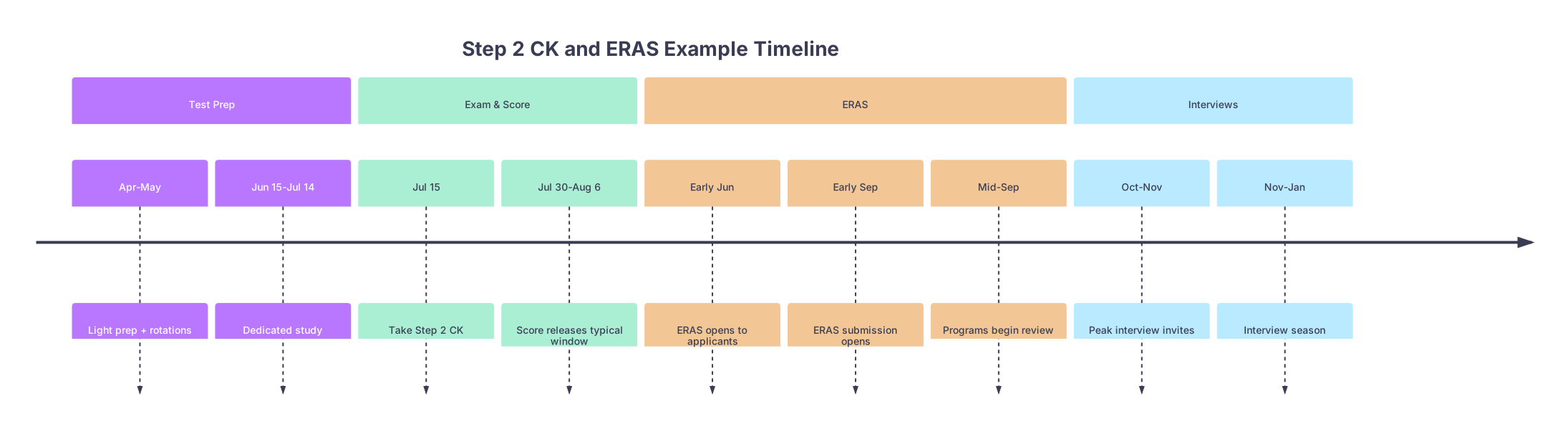
| Period | Event |
|---|---|
| Test Prep - Apr-May | Light prep + rotations |
| Test Prep - Jun 15-Jul 14 | Dedicated study |
| Exam & Score - Jul 15 | Take Step 2 CK |
| Exam & Score - Jul 30-Aug 6 | Score releases typical window |
| ERAS - Early Jun | ERAS opens to applicants |
| ERAS - Early Sep | ERAS submission opens |
| ERAS - Mid-Sep | Programs begin review |
| Interviews - Oct-Nov | Peak interview invites |
| Interviews - Nov-Jan | Interview season |
With that July 15 test date:
- Score likely releases late July / early August
- You submit ERAS on time in early September with Step 2 already in
- Programs see:
- Step 1
- Step 2
- MSPE + letters rolling in
- A clean, complete file at first glance
That’s the sweet spot for 80% of students.
Specialty-Specific Timing Nuances
Not all fields weigh Step 2 CK the same way. Here’s how timing pressure shifts by specialty.
| Specialty Tier | Typical Pressure on Step 2 Timing | Recommended Test Window |
|---|---|---|
| Ultra-competitive | Very high | Late May–early July |
| Moderately competitive | High | Mid June–late July |
| Primary care / Psych | Moderate | Late June–August |
Ultra-competitive (Derm, Ortho, Plastics, ENT, IR, some Rad Onc)
At this point you should:
- Treat Step 2 CK like a front-loaded requirement, not an afterthought.
- Plan to:
- Finish core clerkships by April/May
- Take shelves seriously—they double as Step 2 prep
- Test by late June if possible
- Reason: These programs often screen early and hard. Strong Step 2 gives you a chance when research/letters are still in progress.
EM / Anesthesia / Rads / Surgery / Neuro
- You can push slightly later:
- Late June–late July is usually fine.
- But if you’re fixing Step 1 or applying from a mid/low-tier school:
- Earlier (June) helps you more, because PDs see that score when they sort the initial pile.
IM / Peds / FM / Psych
- More flexibility:
- Late July–August is workable.
- But:
- Do not push so late that your score releases after October. Programs start filling interview spots early, even in these fields.
Red Flag Timelines and How to Fix Them
Let me be blunt about a few bad patterns I see every year.
Red Flag #1: “I’ll Test in Late August and Submit ERAS Once I See My Score”
What happens:
- You test August 25
- Score releases mid-September or later
- You wait to submit ERAS until your score is in
- Programs have already started reviewing files that arrived on Day 1
- You look late, even if your file is excellent
Fix:
- Do not delay ERAS submission for a Step 2 score.
- Submit on time. Let Step 2 update later.
- Only exception: catastrophic Step 1 you’re trying hard to hide (and even then, talk to an advisor before trying this).
Red Flag #2: “I’ll Just Take It in October During Interview Season”
What happens:
- You’re trying to juggle 8–12 hours of interview prep + travel + Step 2 studying.
- Score releases after many rank lists are mentally formed.
- If Step 2 is low: it confirms every doubt.
- If Step 2 is high: too late to really help.
Fix:
- If you absolutely must take it late:
- Aim for early September, not October.
- Or push to after interview season if your school and specialty allow and you already have enough strength elsewhere. But know some programs require Step 2 before ranking.
Red Flag #3: “I’m Going to Hide My Step 2 Score Entirely”
This usually happens when:
- Step 1 was strong
- Step 2 practice tests are low
- You’re hoping programs never notice you didn’t send Step 2
Reality:
- Many programs will require Step 2 CK before ranking.
- They will start pinging you in December/January asking for it.
- If they see you’re dragging your feet, they assume the worst.
Fix:
- Better approach:
- Take the exam early enough that if the score is lower, it’s not derailing the whole cycle.
- Be ready to explain the dip in interviews if asked (bad timing, illness, life event, etc.—but it has to be credible).
Quick Decision Guide: When You Should Test
Here’s the stripped-down version.
If you’re MS3 now and:
Step 1 was below average or just a pass with concerns
- At this point, plan to:
- Start real prep by April
- Take Step 2 CK June–mid July
- Authorize transcript release early
- At this point, plan to:
Step 1 was strong and you’re aiming high (top programs/competitive field)
- At this point:
- Aim for late June–July
- Consider a short dedicated period
- Decide whether to delay transcript release until you see your Step 2
- At this point:
Step 1 pass/fail and you feel average
- At this point:
- Use each clerkship shelf as Step 2 prep
- Test July–early August
- Have score in by early September if possible
- At this point:
FAQ (Exactly 4 Questions)
1. If my Step 2 CK score isn’t ready by ERAS submission, should I wait to apply?
No. Submit ERAS on time. Programs start reviewing on Day 1, and there’s no bonus for going in late with a completed Step 2. Let your score update electronically when it’s ready. The only real exception is a severely low Step 1 where you and an advisor decide delaying submission a week or two might materially change how you’re screened, but even that’s a gamble.
2. How late is “too late” to take Step 2 CK for this application cycle?
If you want the score to influence interview offers, testing after early September is usually too late. The score may still arrive before interviews end, but it won’t impact the earliest waves of invites. For some less competitive specialties, a late September exam can still be okay, but I wouldn’t push it if Step 2 is meant to help you.
3. What if I fail Step 2 CK before applying? Should I still submit ERAS?
If you fail before ERAS submission, pause. Talk to your dean’s office and a trusted advisor. Retake planning and timing around MSPE release and program review gets messy. Many applicants in this situation delay application by a year to avoid a mid-cycle disaster. If you’ve already submitted and then fail, retake as soon as you’re stable and communicate honestly if programs ask—hiding it just makes it worse.
4. How many weeks of dedicated Step 2 CK study do most successful applicants use?
Most solid Step 2 scores come from 3–5 weeks of focused prep, either as a true dedicated block or as a hybrid (lighter rotation + heavy evenings/weekends). High performers who crushed shelves sometimes get away with 2–3 weeks. But if you struggled on Step 1 or shelves, I’d budget at least 4 weeks equivalent of real study time, even if it’s spread over 6–8 calendar weeks.
Key points to remember:
- Work backward from when you want programs to see your score, not just when you want to take the test.
- Don’t delay ERAS submission for Step 2 unless a very experienced advisor tells you to—and even then, be skeptical.
- For most people, a June–July Step 2 date hits the best balance between preparation, score impact, and ERAS timing.