
It is about one month before ERAS opens for submission. Your personal statement is “mostly done,” your letters are “probably coming,” and your spreadsheet has 40+ programs highlighted in yellow. You feel like you are either slightly ahead or dangerously behind, depending on the hour.
This is the month where people quietly tank their cycles with sloppy mistakes and last‑minute chaos.
Let’s not do that.
At this point you should be:
- Locking down every section of ERAS with a structured, line‑by‑line review
- Hunting for red flags (content, professionalism, timeline, strategy)
- Making final, deliberate decisions on programs, letters, and story
I am going to walk you through this chronologically for the final month, then zoom into a week‑by‑week, and finally a 7‑day submission sprint.
4 Weeks Before Submission: Global Audit and Strategy Lock
At four weeks out, you stop “building” and start auditing and stress‑testing your application.
1. Lock Your Overall Strategy (Specialty, Backup, Program Count)
If you are still wobbling on specialty choice one month before submission, that is a red flag by itself. You need a clear plan now.
You should have answered:
- Primary specialty?
- Backup specialty (if any)?
- How competitive are you realistically?
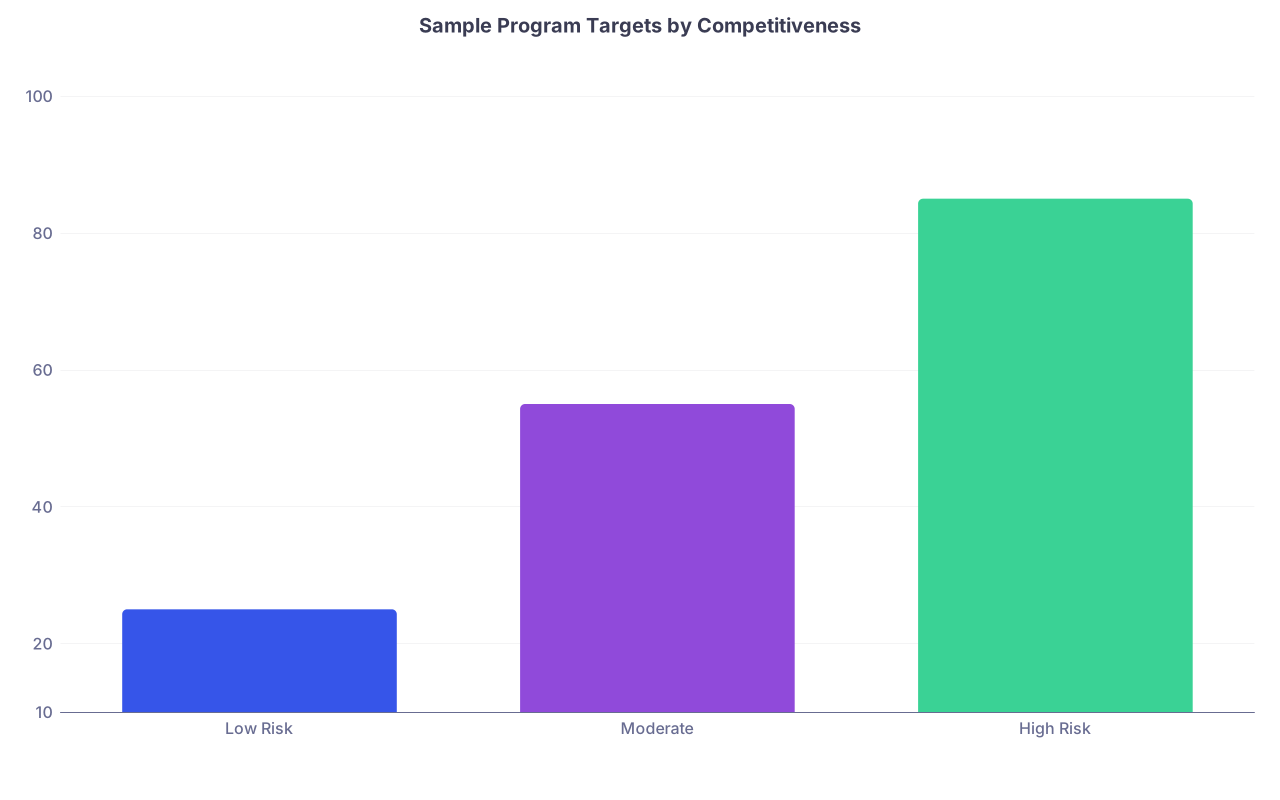
| Category | Value |
|---|---|
| Low Risk | 25 |
| Moderate | 55 |
| High Risk | 85 |
As a rough rule (single specialty, US MD):
- Truly strong applicant (high Step scores, honors, good letters, home program support): ~25–40 programs
- Solid but not stellar: 40–60
- Risk factors (lower scores, red flags, no home program, IMG): 70–100+
Red‑flag sweep here:
- You are only applying to “top 20” places because your mentor did and “it worked for them.” Bad idea.
- You have no geographic flexibility (e.g., only applying to coastal cities where your partner “might maybe want to live”). Dangerous.
- You have obvious risk factors and no backup specialty or expanded list.
Fix this this week. Not later.
2. ERAS Content Freeze v1: Everything Entered, Nothing Final
By 4 weeks out, every ERAS text box should be filled:
- Education, experiences, publications, presentations
- Personal statement draft uploaded (even if you will swap later)
- LoRs listed with correct specialties and request forms sent
- Program list imported and roughly categorized (reach / target / safety)
If anything is still “I’ll add that later,” it usually becomes “I forgot.”
Red flags to hunt:
- Blank “Hobbies and Interests” section because you think it “does not matter.” Programs do read this.
- Overloaded experiences (35+ entries) of tiny, meaningless items. Signal-to-noise problem.
- Wildly inconsistent date ranges (e.g., one activity ends after med school graduation date).
At this point you should schedule a full 60–90 minute block just to click through every ERAS section once, no edits, just awareness.
3. Letters of Recommendation – Status Check and Backup Plan
One month out, the question is not “Did you ask them?” but “Are they actually going to submit on time?”
You should have:
- 3–4 LoRs per specialty planned
- At least one strong letter in your chosen field from someone who knows you
- Requests in ERAS already sent
| Letter Writer | Specialty | Status | Backup Available? |
|---|---|---|---|
| Dr. A (Chair) | Home Field | Promised | Yes |
| Dr. B (Away Rotation) | Home Field | Drafting | No |
| Dr. C (Research PI) | Same/Related | Submitted | N/A |
| Dr. D (Subspecialty) | Same Field | No Reply | Yes |
Red‑flag sweep:
- Any letter writer who has not replied to your request at all. That is almost always a “no.”
- Anyone who seemed lukewarm in person but you still asked because of their big name. Risky.
- Depending on a “maybe I can write something” from a PD who is known to be slow.
At this point you should:
- Send a polite, specific follow‑up:
“I am finalizing my ERAS application to submit on [date]. I wanted to check if you anticipate being able to upload a letter by [1 week before]. If not, I completely understand and can adjust my plans.”
If they waffle? Assume no and activate backup.
4. Personal Statement – Content, Not Commas
By four weeks out the personal statement should be structurally done. You are not still reinventing your story.
You need to confirm:
- 1 primary PS per specialty (no mixing EM and Derm in one letter…)
- Opening paragraph: clear, grounded in a real scenario, not a cliché (“Ever since I was a child…”)
- At least 1–2 concrete clinical examples that show how you think, not just “what I did”
Red flags:
- Generic “I like working with my hands and my mind” for surgery or “I like continuity of care” for IM with zero proof.
- Name‑dropping specific programs in a generic PS that you plan to send everywhere.
- Multiple people editing your PS into bland committee-speak. Losing your voice is just as bad as leaving in a typo.
At this point you should ask one or two trusted readers (preferably in the specialty) to tell you:
- Does this sound like me?
- Do you remember any stories / traits of mine that are missing?
Then stop asking more people. Too many cooks.
3 Weeks Before Submission: Deep Content and Red‑Flag Scrub
Now you move from global to line‑by‑line. This is where you catch the stuff that costs interviews.
1. Experience Entries – Substance, Not Fluff
At three weeks out, you sit down and review every single experience entry like a PD would: bored, skeptical, scanning fast.
For each entry:
- Is the title specific and honest?
- Bad: “Volunteer”
- Better: “Clinic Coordinator – Free Student-Run Clinic”
- Are you using the 3 “most meaningful” boxes wisely? Those need your best, not just the most hours.
- Does each description answer: “What did you actually do?” and “What changed because of you?”
Red‑flag sweep:
- “Shadowing – 600 hours” with a vague description and no real role. Looks padded.
- Vague leadership: “I was president and helped organize events.” Which events? Outcomes? Scope?
- Overly dramatic language: “I revolutionized the clinic workflow” when you tweaked a spreadsheet.
You want concise, concrete bullets. For example:
- “Led a 6-member team to redesign intake forms, reducing average wait time from 90 to 55 minutes across 4 clinic nights per month.”
- “Precepted MS1 volunteers in basic triage, creating a 3-page orientation guide now used by new members.”
If you are reusing old CV descriptions, they are usually weak. Rewrite them as if a cynical senior resident is reading.
2. Research and Publications – Clean and Verifiable
Programs will Google you. Or at least check PubMed.
At this point you should:
- Confirm every publication, poster, and presentation is accurately labeled:
- Published vs accepted vs submitted vs in progress
- Ensure author order is correct
- Match journal / conference names and dates with reality
Red flags:
- Listing something as “published” that is actually “manuscript in preparation.” That is lying.
- Vague “Smith et al., submitted” with no journal listed.
- Inflating your role: calling yourself “co‑investigator” when you did data entry as a student.
Better to under‑sell and be honest than to get burned in an interview when someone asks, “So what exactly was your role?”
3. Red‑Flag Content Check: Professionalism and Judgment
This is the part almost no one does properly.
You need to scrutinize:
- Hobbies and interests
- Volunteer work descriptions
- Social media (yes, really)
- Any mention of personal challenges, illness, or mental health
You are looking for judgment errors, not just typos.
Red flags:
- Hobbies that sound concerning: “High‑stakes poker,” “competitive drinking games,” “crypto trading” as a personality trait. You think I am joking. I have seen them.
- Angry or unprofessional public tweets / posts tied to your real name.
- Oversharing trauma or mental health details that do not connect clearly to growth and stability.
Clean, honest, but mature is the target.
If you have actual institutional actions or leaves of absence, this is also when you:
- Check the wording in the “Institutional Action” section
- Make sure your explanation is factual, brief, and takes responsibility without extra drama
Overly defensive explanations are a red flag. So is vague evasiveness.
2 Weeks Before Submission: Program List and Application Customization
You are now moving from content to aim. Where you send this thing matters.
1. Finalize Program List – Reality Check
By two weeks out, the program list should be 95% final.
You should:
- Cross‑check every program’s website for:
- Visa policies (if IMG or need sponsorship)
- USMLE minimums / requirements
- Step 2 CK deadlines (some want it before ranking)
- Filter obvious mismatches. If their site says “no IMGs” and you are IMG, stop wasting money and hope.

Red‑flag sweep:
- 80% of your list in one ultra-competitive region (NYC, California) without ties.
- Ignoring strong community programs because “I only want an academic center.”
- No realistic safeties if you are below average or have red flags.
Use three simple categories in your spreadsheet:
- Reach – you would be happy to get even one interview
- Target – where your stats and experiences match the current residents
- Safety – where you are clearly above their typical resident profile
You need a decent spread, not 90% reach programs.
2. Application Customization – Personal Statements and LoRs
If you are applying to more than one specialty, or tailoring for a specific niche (e.g., primary care tracks), now is when you set up variants:
- Different PS for different specialties
- Different LoR combinations per specialty (and sometimes per program, in rare cases)
| Track | Personal Statement | LoR Set (3–4) |
|---|---|---|
| Categorical IM | IM PS | 2 IM + 1 Research |
| Primary Care IM | IM PC PS | 2 IM PC + 1 Community |
| Backup FM | FM PS | 2 FM + 1 IM |
Red‑flag sweep:
- Sending a clearly specialty‑specific PS (e.g., “Emergency Medicine drew me…”) to your backup IM programs by accident.
- Using letters from other fields that make no sense for the program (e.g., Ortho letter for Derm).
- Forgetting to assign your best letter to some programs. It happens more than you think.
At this point you should:
- Open ERAS → Program → “Assign Documents” for at least 10 random programs and confirm:
- Correct PS assigned
- Correct set of LoRs assigned
- USMLE transcript and MSPE set to release (when available)
3. CV and ERAS vs Dean’s Letter Consistency
You do not want a PD seeing three different versions of you:
- ERAS experiences
- CV attached to a visiting rotation or emailed
- MSPE / Dean’s Letter language
You cannot control MSPE content, but you can make sure:
- Dates generally match
- Major roles and honors appear consistently across documents
- You are not inflating anything that will contradict the MSPE
Red‑flag sweep:
- “Graduated with honors” on ERAS when you did not.
- Leadership titles that do not match what the MSPE or your school lists.
- Different stories about leaves, delays, or remediation.
If in doubt, under‑state rather than exaggerate.
1 Week Before Submission: The 7‑Day Final Sweep
Now it is execution. You are not adding, you are tightening.
Here is how I would structure the last week.
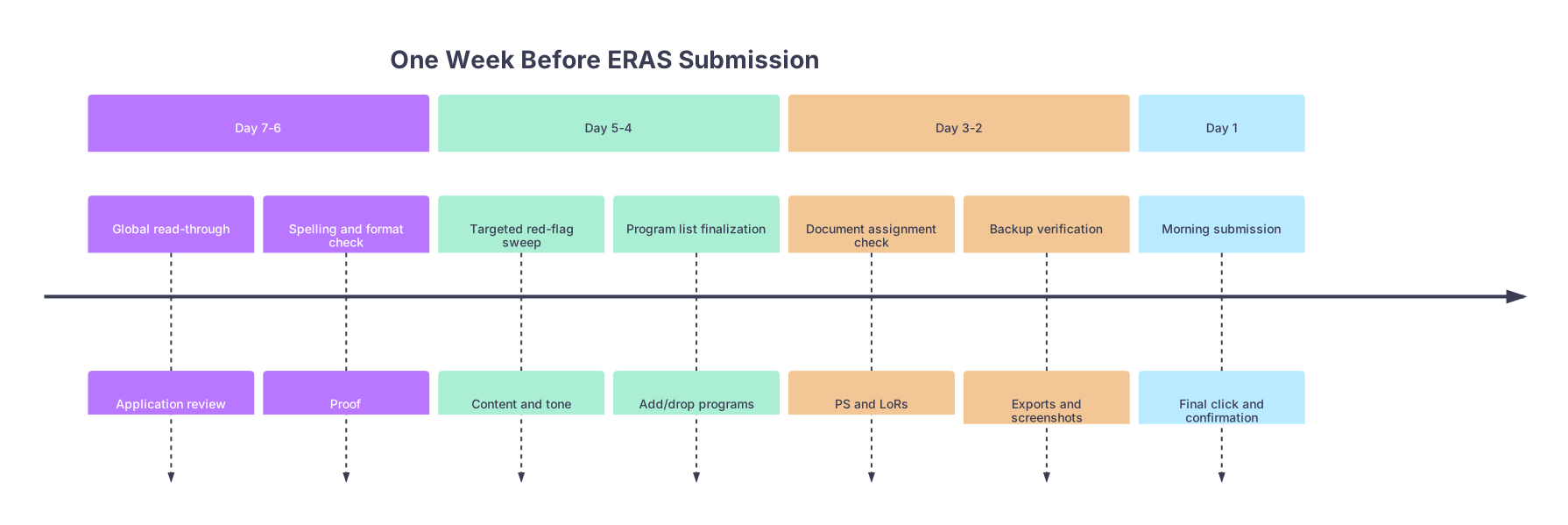
| Period | Event |
|---|---|
| Day 7-6 - Global read-through | Application review |
| Day 7-6 - Spelling and format check | Proof |
| Day 5-4 - Targeted red-flag sweep | Content and tone |
| Day 5-4 - Program list finalization | Add/drop programs |
| Day 3-2 - Document assignment check | PS and LoRs |
| Day 3-2 - Backup verification | Exports and screenshots |
| Day 1 - Morning submission | Final click and confirmation |
Day 7–6: Full Application Read‑Through
At this point you should:
- Export or print a PDF of your entire ERAS
- Read it top to bottom as if you were a PD seeing it fresh
You are looking for:
- Spelling errors, inconsistent capitalization (e.g., “Internal medicine” vs “Internal Medicine”)
- Awkward repetition of the same phrase in multiple entries
- Overly long paragraphs in descriptions that will be skimmed, not studied
This is not editing by line in the browser. This is “read it like a story.” Make a list of fixes, then go back into ERAS once and apply them.
Day 5–4: Focused Red‑Flag and Risk Pass
Now do a very specific, ruthless sweep:
- Tone check
- Anywhere you sound arrogant? Bitter? Overly self‑deprecating? Fix it.
- Red‑flag areas
- Institutional action explanations
- Gaps in training
- Board failures or dramatic score swings
You need short, factual, non‑defensive language. Example structure for an IA:
- 1 sentence: What happened, in neutral terms.
- 1 sentence: What you did in response.
- 1–2 sentences: What changed since, with concrete evidence of stability / growth.
Not an essay. Not an emotional confession.
Day 3–2: Program List and Document Assignment Final Check
Now you go program-by-program.
At this point you should:
- Open each program entry (yes, all of them) and verify:
- PS = correct version
- LoRs = correct selection, no missing checkboxes
- USMLE transcript requested
- COMLEX transcript, if applicable
- Confirm “apply to this program” is selected only for the ones you truly intend to apply to
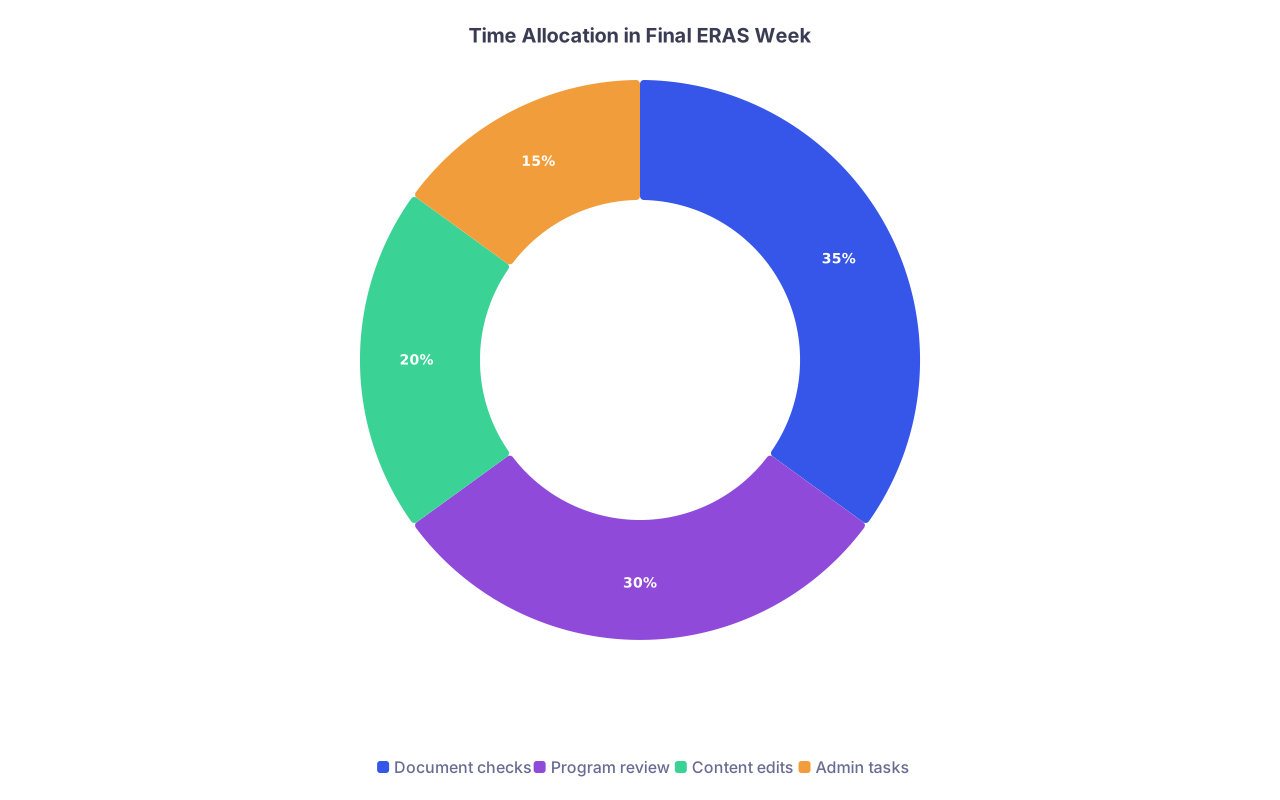
| Category | Value |
|---|---|
| Document checks | 35 |
| Program review | 30 |
| Content edits | 20 |
| Admin tasks | 15 |
Red‑flag sweep:
- Unassigned PS to even a single program. That can absolutely cost you an interview.
- Assigning an incomplete LoR set to some programs because you added them late.
- Applying to programs you know you would never attend. That wastes your time and theirs.
Take screenshots or a screen recording of a few representative program assignment pages. If anything glitches, you have proof of intent.
Day 1: Submission Day – Calm, Early, Deliberate
Submission day is not the day for big changes.
Your job:
- Wake up rested
- Do one final skim of:
- Personal statement
- Experience entries (titles only)
- LoR status (are all the letters you care about at least “pending”? That is fine.)
- Confirm payment method works (seriously—expired cards at 11:30 PM are a real thing)
Submit earlier in the day, not at 11:59 PM.
After submission:
- Verify confirmation email
- Take a PDF or screenshots of the submitted application for your records
Then stop. Do not obsessively log in and out looking for mistakes you cannot change.
Quick Red‑Flag Master List (One‑Minute Scan)
If you remember nothing else, run through this checklist the day before submission:
- Strategy: Specialty choice and program number realistic for your profile
- Letters: At least 3 solid letters per specialty, no unreliable writers in critical slots
- Personal statement: Specialty‑specific, concrete stories, no clichés or mismatched programs
- Experiences: Honest dates, clear roles, no padded shadowing or vague leadership
- Research: Publication status accurate; no “manuscript in prep” listed as “published”
- Professionalism: No questionable hobbies, ranty social media, or oversharing without clear growth
- IA / gaps: Concise, factual explanations with evidence of stability
- Program list: Good spread across reach / target / safety, geography not absurdly narrow
- Document assignments: Correct PS and LoRs for every single program
- Final proof: Spelling, capitalization, and formatting consistent across the application
FAQ (Exactly 3 Questions)
1. How fatal is a typo or small formatting error in ERAS?
One typo will not kill your cycle. A pattern of sloppiness might. A single missed comma in your personal statement or one inconsistent date is human. Half a dozen obvious spelling errors, inconsistent capitalization, and run‑on sentences across the application suggest poor attention to detail. Fix what you see, do one structured proofread, then move on. Do not waste hours chasing theoretical perfection.
2. Should I delay submission to wait for a stronger letter of recommendation?
Usually no. Submitting on time with a solid but not “perfect” letter set beats submitting late waiting for one superstar letter that may never arrive. Programs can see new letters as they come in. If the missing letter is from a crucial away rotation in your specialty and the writer is reliable, you can cut it closer, but do not push past your specialty’s typical early review window. Timeliness signals professionalism.
3. Is it worth tailoring my personal statement to individual programs?
For almost everyone, no. You will not have the time or energy to do it well for 40–80 programs, and generic name‑swapping is obvious. What is worth doing: having one strong, general PS per specialty and maybe a variant for a specific track (e.g., primary care, research‑heavy track). If you feel compelled to show interest in specific programs, save it for well‑written emails after you receive an interview or for how you answer “Why our program?” during the interview itself.
Key points:
- One month out, you shift from building your application to auditing it for risk and coherence.
- Red flags are usually about judgment and honesty, not just scores. Clean those up now, not later.
- The final week is about systematic checks, not anxiety‑driven tinkering. Submit early, submit clean, and then let the application do its job.