
It’s late August. Your dean’s office is blasting reminder emails about ERAS certification. Your classmates are flexing their “submitted on day 1” screenshots. And you’re sitting there with:
- A Step 1 pass (or maybe a score)
- A Step 2 CK pending
- Programs opening their application floodgates in days
And the question that actually matters:
Do you submit ERAS now without your Step 2 CK score, or wait a few weeks until it posts?
Let me be blunt: this decision can help you, hurt you, or do absolutely nothing. The trick is knowing which bucket you’re in.
Here’s the answer you’re looking for, with a clear decision algorithm you can literally follow line by line.
The Core Rule: Everything Depends on These 3 Things
You don’t need a 20-variable regression model. The decision really comes down to:
- Your Step 1 situation
- Your realistic Step 2 CK expectation
- Your specialty competitiveness + program expectations
If you get those three right, the delay vs. submit-now decision becomes pretty obvious.
Let’s build the algorithm from those.
Step 1: Know Which Category You’re In
Start here. Be honest with yourself — this is where people lie to themselves and screw up.

A. Your Step 1 Status
Pick the one that fits:
Step 1 – Pass/Fail (no numeric score)
- You’re from the pass/fail era. Your Step 2 CK is now your primary standardized metric.
Step 1 – Low score / barely passed
- Below or near your specialty’s typical range
- Or a near-fail. Anything that would raise eyebrows.
Step 1 – Average for your specialty
- Not amazing, not terrifying. Middle of the road vs your target specialty data.
Step 1 – Strong
- Clearly above the average of matched applicants in your specialty.
If you don’t know what’s “average” or “strong,” that’s a problem. Fix it:
| Specialty Tier | Examples | Typical Step 2 CK Aim |
|---|---|---|
| Ultra-competitive | Derm, Plastics, Ortho, ENT | ≥ 250+ |
| Very competitive | Rad Onc, Neurosurgery | ≥ 245–250 |
| Competitive | EM, Anesth, Gen Surg, Neuro | ≥ 240+ |
| Moderate | IM, OB/GYN | ≥ 235–240 |
| Less competitive | Psych, Peds, FM, Path | ≥ 230–235 |
These are directional, not absolute. But they’re good enough for this decision.
Step 2: Estimate Your Realistic Step 2 CK Score
“Realistic” doesn’t mean “my dream number.” It means based on actual data:
- UWorld % correct (last 800–1200 questions)
- NBMEs and UWSAs
- How you’ve historically tested vs practice (some people always overperform, some always underperform)
Use this quick frame:
- Likely ≥ 245+
- Likely 235–244
- Likely 225–234
- Worried about ≤ 224 or failing
If your last practice exams are scattered all over the place, use the most recent two, weighted slightly toward the most recent.
Step 3: The Actual Algorithm (Delay vs Submit Now)
Here’s where you get your answer.

| Step | Description |
|---|---|
| Step 1 | Start |
| Step 2 | Delay ERAS 1 3 weeks for strong score |
| Step 3 | Submit now to not lose invites |
| Step 4 | Submit now, do not delay |
| Step 5 | Submit now, upload score when ready |
| Step 6 | Step 1 pass fail era |
| Step 7 | Realistic Step 2 CK >= 240? |
| Step 8 | Step 1 weak for specialty |
| Step 9 | Expect Step 2 CK >= 10 15 pts higher |
| Step 10 | Step 1 strong or average |
| Step 11 | Applying to highly competitive specialty |
| Step 12 | Programs require Step 2 CK early |
Now I’ll break down each branch in plain language.
Case 1: Step 1 Is Weak (Or Only “Pass”) And Step 2 Will Be Clearly Stronger
This is the main group that truly benefits from waiting.
You should strongly consider delaying ERAS 1–3 weeks to include Step 2 CK before programs download your application if all of this is true:
Step 1 is:
- Pass only and you’re in a competitive specialty or
- A low numeric score for your target specialty
Your realistic Step 2 CK is:
- At least 10–15 points higher than what your Step 1 “looks like”
- Or, in pass/fail Step 1 world, clearly at/beyond the competitive range for your specialty
You’re applying in:
- A competitive or very competitive field
- Or you have other red flags (remediation, gaps, weak school reputation)
Why this group should wait:
- For you, Step 2 CK is not just “one more score.” It’s your rescue score.
- Programs often auto-screen on the first standardized number they see.
- If that number is weak or missing, some doors close immediately.
Concrete example:
- Step 1: Pass (no score), mid-tier school
- Specialty: Anesthesiology or EM
- Practice exams: UWSA2 247, NBME 12 243
If your score is due out Sept 20 and applications open Sept 18, I’d absolutely support submitting after the score posts, especially if your school isn’t punishing you for not being day-1.
Case 2: Step 1 Is Strong, Step 2 Unknown or Slightly Lower
You’re in better shape than you think.
You should NOT delay ERAS if:
- Step 1 is already strong for your specialty
- Step 2 CK might be:
- Similar
- Slightly lower
- Or you just don’t know
Why you submit now:
- You already have what programs want: evidence you can test well.
- Delaying risks you getting filtered out simply because your file arrives later in the review queue.
- If Step 2 ends up lower but still passing, most programs won’t magically tank your application over a small difference.
Example:
- Step 1: 245
- Specialty: IM or OB/GYN
- Step 2 practice: UWorld in the mid-60s, UWSA1 239, UWSA2 243
Submit ERAS on time, don’t wait. Your narrative is already good.
The only major exception: ultra-competitive specialty (derm, plastics, ENT, ortho) where everyone is stacked. In those fields, if Step 2 might be significantly higher (e.g., hitting 255+), there’s an argument to wait a short period. But you’d better be very confident in your practice scores.
Case 3: You’re Genuinely Worried About Failing Step 2 CK
This is a different problem. You’re not in a “wait for a great score” universe; you’re in a “avoid a disaster on your transcript” universe.
If you’re worried about failing:
- Do not delay ERAS for a hypothetical good score.
- Do focus on passing Step 2 CK, even if it means:
- Taking it later
- Adjusting your specialty list
- Adding more safety programs
If Step 1 is a pass and you’re at real risk of failing Step 2, your timing question flips:
- It’s often better to submit ERAS on time, Step 2 “pending,” then:
- If you pass: update programs proudly
- If you fail: you at least had some applications looked at before the failure shows up
This is nuanced and worth a 1:1 discussion with your dean or advisor. But as a general rule: chasing an unlikely “great score” at the risk of a fail is not worth it.
Case 4: Pass/Fail Step 1 Era – Step 2 Is Your First Real Number
If your Step 1 is just “Pass,” Step 2 CK becomes your main standardized metric. Here’s the rule:
- If your realistic Step 2 CK is solid or strong for your specialty, it’s often worth waiting a short time (1–3 weeks) to have it in the initial download.
- If your realistic Step 2 CK is average at best or you’re not sure you’ll be ready, then:
- Submit ERAS on time
- Let Step 2 CK come in when it comes in
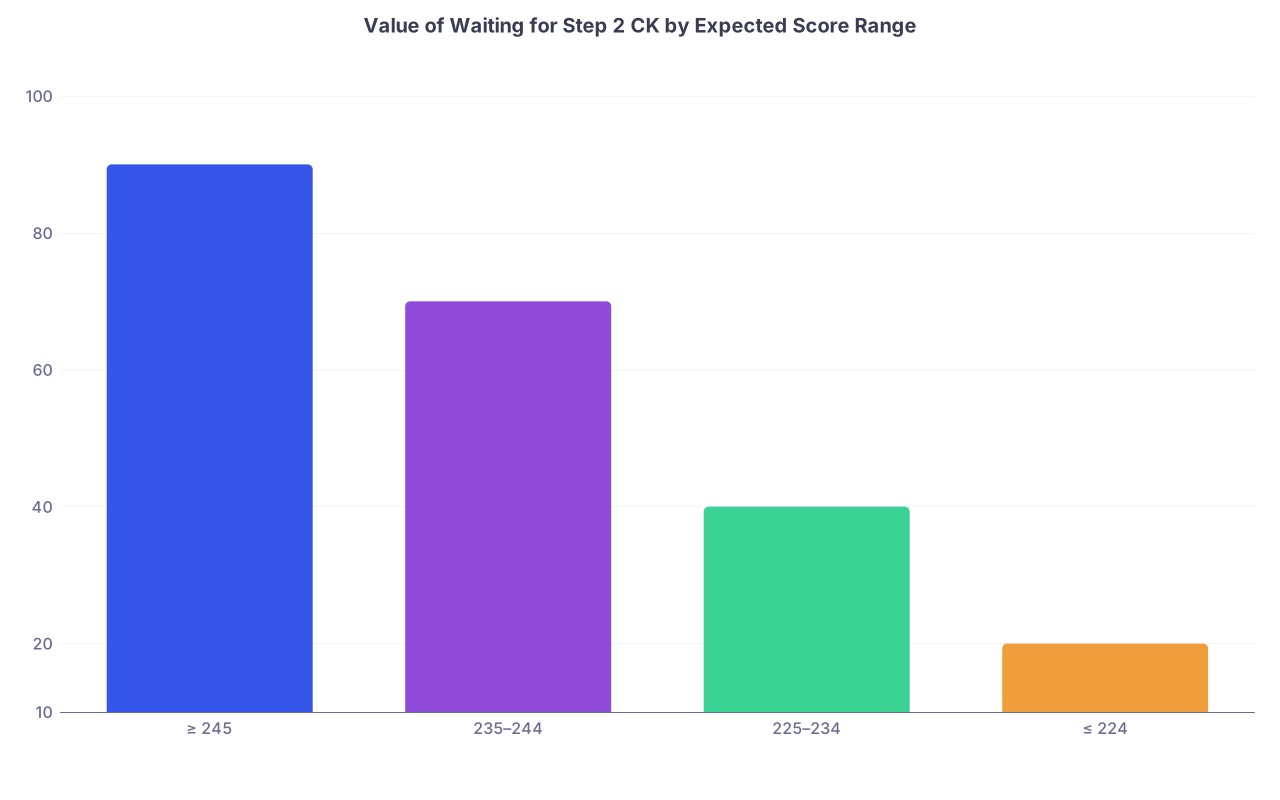
| Category | Value |
|---|---|
| ≥ 245 | 90 |
| 235–244 | 70 |
| 225–234 | 40 |
| ≤ 224 | 20 |
(Percentage = rough “chance that waiting meaningfully helps you” — not real data, just a mental model.)
High expected score? Waiting can sharpen your first impression.
Borderline or low expected score? Waiting doesn’t fix the underlying problem and just makes you late.
Specialty-Specific Considerations
Some specialties are more “Step 2 sensitive” than others.
| Specialty | Step 2 Importance | Timing Sensitivity |
|---|---|---|
| Derm / Plastics / ENT / Ortho | Extremely high | High |
| Neurosurg / Rad Onc | Very high | Moderate–High |
| EM / Anesth / Gen Surg | High | Moderate |
| IM / OB/GYN | Moderate–High | Moderate |
| Psych / Peds / FM | Moderate | Lower (but not zero) |
Bottom line:
- Competitive fields: A strong Step 2 early can get you through screens. Delaying a short time is often rational if you expect a strong score.
- Less competitive fields: Your letters, fit, and clinical performance matter as much or more. Don’t overthink a 1–2 week Step 2 timing issue.
How Long Is “Okay” To Delay?
This is where people get anxious.
Here’s the reality:
- Submitting ERAS on day 1 vs. day 5–10? Almost no meaningful difference.
- Submitting 3–4 weeks later? Now you’re late enough that some interview slots may already be given away, especially in competitive specialties.
- The “reasonable delay window” is usually up to ~2 weeks after apps open, maybe 3 weeks max if:
- Your Step 2 CK is a major strength
- And you know the score release date
- And you communicate clearly with your dean if they track timing
If your score won’t be out for 4–6+ weeks after ERAS opens, stop overthinking: submit now. You can’t sit out half the early review period hoping for one number.
How to Communicate This in Your Application
If you decide to wait for Step 2 CK:
- Make sure your MSPE, letters, and personal statement are ready to go. Don’t be the person who delays and then also has missing documents.
- Once your score posts, submit immediately. Don’t sit on a 248 because you’re “waiting to perfect your experiences section.”
If you submit before Step 2 CK is back:
- You don’t need an essay about it. Programs know timelines.
- If Step 2 comes back strong:
You can email select programs you’re most interested in with a short, clean update:
“I recently received my Step 2 CK score (247) and wanted to share this update as it wasn’t available at the time of my ERAS submission. I remain very interested in your program.”
Don’t spam 80 programs with this. Be strategic.

Quick Scenarios (So You Can See Yourself)
FM applicant, Step 1 pass, Step 2 CK likely 230–235
- Decision: Submit on time. Waiting doesn’t change much. Use Step 2 when it posts as a positive note, but don’t delay.
Derm applicant, Step 1 pass, Step 2 CK practice 255–260, score in 10 days
- Decision: Wait for the score. That number will help you get past screens. Submit as soon as it hits.
IM applicant, Step 1 = 218, Step 2 CK likely 238–242, score in 2–3 weeks
- Decision: If you’re targeting mid to higher-tier academic IM, a short delay (1–2 weeks) is reasonable. That 20+ point bump is your narrative.
Psych applicant, Step 1 = 235, Step 2 uncertain (practice exams all over)
- Decision: Submit on time. Your Step 1 is fine. Don’t overengineer this.
EM applicant, Step 1 pass, Step 2 CK borderline ~225
- Decision: Submit on time. You can’t bet the season on a maybe-score. Focus on SLOEs, rotations, and a smart program list.
FAQ: Delay ERAS vs Wait for Step 2 CK
1. Is it bad if my ERAS is submitted without a Step 2 CK score?
No. Thousands of applicants submit every year with Step 2 pending. Programs are used to it. It only becomes a problem if your Step 1 is weak and Step 2 is your main rescue, and you miss the chance to have that strong score in the initial review.
2. How late is “too late” to submit ERAS?
Once you’re 3–4+ weeks past the opening date, especially in competitive specialties, you’re late enough that it can hurt. A few days or 1–2 weeks? Usually fine, especially if it’s to include a clearly strong Step 2 CK.
3. Will waiting for Step 2 CK reduce my interview chances?
It can, if:
- You wait too long (weeks after others are reviewed)
- Your eventual score is only average and didn’t justify the delay
It can increase your chances if you:
- Have a weak/unknown Step 1
- And get a strong Step 2 score
- And only delay a short, strategic window
4. Do programs really screen based on Step 2 CK?
Yes. Many do. Some use combined filters (Step 1 + Step 2). In the pass/fail Step 1 era, more programs are leaning heavily on Step 2 CK as the objective metric. That’s why your first visible score matters a lot if you’re near cutoffs.
5. What if my Step 2 CK comes back lower than Step 1?
If both are passing and not catastrophically low, most programs won’t obsess over a small drop. They’ll look at the whole packet: letters, MSPE, clinical grades, fit. Strong Step 1 + slightly lower Step 2 is usually better than the reverse. And no, you don’t need to explain it in your personal statement.
Key Takeaways
- Don’t delay ERAS just because you “want everything to be perfect.” Delay only if a clearly strong Step 2 CK will materially improve how your application is screened — and even then, only by 1–3 weeks.
- If Step 1 is weak or just “Pass” and Step 2 will be clearly strong, a short delay can help. If Step 1 is already strong, submit on time and stop gaming the system.
- Your specialty, your realistic Step 2 range, and your Step 1 context decide this, not anxiety. Make the call logically, then move on and focus on letters, personal statement, and your rank list — the rest of the game.