
The short answer: Yes, a strong Step 2 CK can absolutely compensate for a mediocre Step 1 pass — but only if you use it strategically and understand its limits.
Let’s be blunt: Step 2 CK is now the workhorse exam for residency selection. Step 1 is pass/fail, and a bare pass doesn’t impress anyone. Programs need a number to separate you from the pack. That number is Step 2 CK.
You’re not doomed. But you also don’t get a free pass just because you crush Step 2. You have to build around it.
How Program Directors Actually View Step 2 CK vs Step 1
Here’s what most students get wrong: they still think Step 1 “defines” them. It doesn’t anymore. It screens them.
Here’s the typical thought process I’ve seen from program directors in IM, EM, and even a few surgical programs:
- “Did they pass Step 1 on the first try?”
- “What’s the Step 2 CK score? Is it at or above our usual resident profile?”
- “Does the trend make sense? Any concern for test-taking or knowledge gaps?”
- “Does the rest of the app (clerkships, letters, MSPE) match the exam performance?”
Step 1 is now more like a background check. Clean? Good. Not clean? They investigate.
Step 2 CK is the performance metric. That’s the one they quote in meetings. That’s the one they compare across applicants.
So if your Step 1 is “mediocre but passed” and your Step 2 CK is strong, most programs will lean heavily on Step 2 to judge your academic horsepower.
What Counts as “Mediocre” Step 1 and “Strong” Step 2 CK?
Let’s be real with numbers. People hand-wave this all the time. You need anchors.
Mediocre Step 1 (in the current, pass/fail era):
- Bare pass on first try
- History of marginal basic science performance or barely passing NBME CBSEs
- No USMLE failure, but not the kind of transcript that screams “star”
Strong Step 2 CK:
- Competitive for your specialty’s usual range
- Shows clear upward trajectory from your preclinical/basic science performance
- Rough ballpark (these are not hard cutoffs, but they’re reality-based):
- Family med, psych, peds, IM: 240+ is solid, 250+ is excellent
- EM, anesthesia, OB/GYN: 245+ is solid, 255+ is excellent
- Gen surg, radiology, some competitive IM programs: 250+ is solid, 260+ is excellent
- Derm, ortho, plastics, ENT: even 255–260 might be “average” for their pool
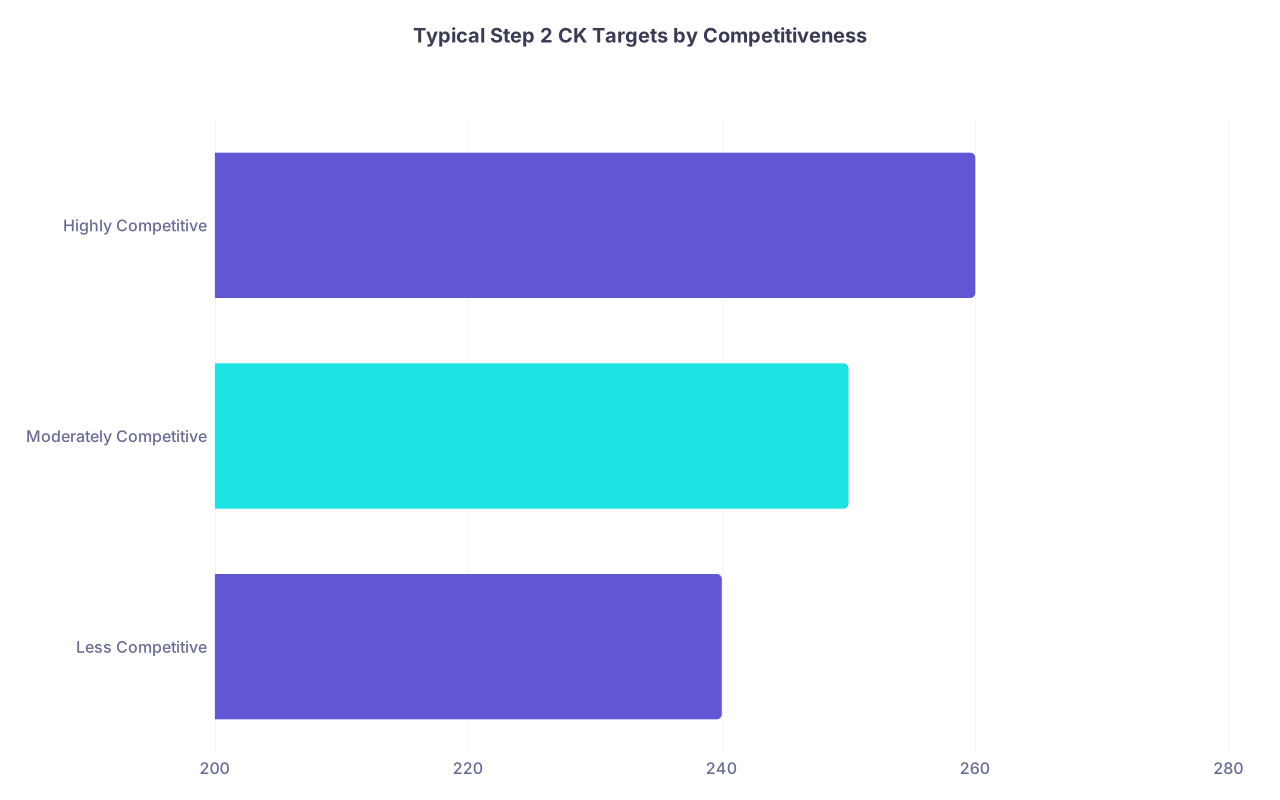
| Category | Value |
|---|---|
| Less Competitive | 240 |
| Moderately Competitive | 250 |
| Highly Competitive | 260 |
No, you don’t need these exact numbers to match, but this is the ballpark where a PD stops worrying about your academic strength and starts asking, “Is this someone who fits our program?”
When a Strong Step 2 CK Does Compensate for a Mediocre Step 1
Here’s where Step 2 CK really pulls its weight.
1. You Passed Step 1 on the First Attempt
If you passed Step 1 (even barely) on the first try and then post a strong Step 2 CK, most PDs will say:
“OK, their basic science foundation was adequate, and they really came into their own clinically.”
That narrative is acceptable. Especially in:
- Internal medicine
- Pediatrics
- Family medicine
- Psychiatry
- Neurology
- PM&R
- Many community programs across specialties
If you’re aiming for these areas and you hit a strong Step 2 CK, your Step 1 “mediocrity” largely becomes background noise.
2. Your Clerkship Grades Support the Step 2 Story
If your Step 2 CK is strong and you have:
- Mostly Honors/High Pass in core clerkships
- Strong comments about clinical reasoning and work ethic
- Solid narrative in your MSPE
Then your Step 2 CK isn’t just a lone number. It’s evidence that you thrive with real patients and real medicine.
That’s what most PDs care about. Can you be a safe, smart intern? Step 2 CK + strong clinical grades says yes.
3. You’re Applying Reasonably for Your Profile
If you’re sitting on:
- Step 1: Pass
- Step 2 CK: 250
- Decent but not world-class research
Don’t aim only for derm, ortho, or neurosurg and then act shocked when the interview pool is thin.
But if you aim for:
- Solid academic IM programs
- Mid-tier anesthesia
- Competitive but realistic EM or OB/GYN programs
- Strong community programs in many fields
Then yes, your Step 2 CK can legitimately carry you. You won’t be the unicorn in the stack, but you’ll be a perfectly competitive candidate.
When a Strong Step 2 CK Is Not Enough By Itself
Now the part people don’t like to hear.
A great Step 2 CK helps a lot. It doesn’t erase everything.
1. A Step 1 Failure Changes the Conversation
One failure on Step 1 plus a strong Step 2 CK is better than one failure and a mediocre Step 2. But it’s still a red flag. PDs will ask:
- What went wrong?
- What changed?
- Will this happen again on Step 3, in-service exams, boards?
Here’s what a strong Step 2 can do in this setting:
- Move you back into the “consider” pile for many programs
- Make you viable for less competitive specialties and community or smaller academic programs
- Help you if your personal statement and MSPE clearly explain the Step 1 issue and show real improvement
But no, a 260 on Step 2 does not magically make a Step 1 fail invisible. Anyone who tells you that is lying or hasn’t sat in a ranking meeting.
2. Hyper-Competitive Specialties Still Want the Whole Package
For things like:
- Dermatology
- Orthopedic surgery
- Neurosurgery
- ENT
- Plastics
- Integrated vascular or cardiothoracic
A strong Step 2 CK is necessary but not sufficient.
You still need:
- Strong letters from big names in the field
- Meaningful research (often in that specialty)
- Honors-level clinical performance, especially in relevant rotations
- A compelling story or niche (like advanced degrees, strong publications, etc.)
If your Step 1 history is just “passed and forgettable,” that’s fine. If it’s “barely scraped by and almost failed multiple things,” then even a great Step 2 may not fully save you at the top programs. You may still match — but likely in smaller or less name-brand places.
How to Use a Strong Step 2 CK Strategically in Your Application
If you’re going to rely on Step 2 CK to offset Step 1, you can’t be passive. You need to show programs the story you want them to see.
1. Time Your Exam and ERAS Submission
Ideal positioning:
- Take Step 2 CK early enough that your score returns before you apply (June–July for a typical cycle).
- Do not wait until after applications go out unless you absolutely have to.
If your Step 1 is nothing special, submitting ERAS without a Step 2 CK score is asking programs to assume the worst. They often will.
2. Use Your Personal Statement (Briefly, Not as an Apology Letter)
If you had real struggles around Step 1 or early med school, you can do a light explanation:
- One or two sentences about the challenge (illness, adjustment, poor study strategy)
- Clear description of specific changes you made (NBME use, question banks, scheduling, mentorship)
- Point out that Step 2 CK and clerkship performance reflect that growth
Don’t write a three-paragraph sob story. Programs are busy. They want growth, not drama.
3. Make Sure Letters and MSPE Align with the “Improvement” Narrative
If your Step 2 CK is much better than they’d predict from your preclinical work, good programs will look for:
- Comments about you being strong clinically
- Mentions of improvement, resilience, or upward trajectory
- Evidence that you handle complexity and responsibility well
You don’t have to script your attendings, but you should select letter writers who’ve seen you at your best, especially late in third year or early fourth year when you were already performing at that Step 2 level.
Example Scenarios: How This Plays Out
Let’s walk through a few realistic combinations.
| Step 1 | Step 2 CK | Target Specialty | Overall Outlook |
|---|---|---|---|
| Pass, marginal | 255 | Internal Med | Very competitive |
| Pass, marginal | 250 | EM | Competitive for many programs |
| Pass, marginal | 245 | Psych | Strong candidate |
| Pass, marginal | 260 | Gen Surg | Competitive at many places |
| Step 1 Fail | 255 | FM | Matchable, with explanation |
Scenario 1
Step 1: pass, mediocre preclinical
Step 2 CK: 255
Specialty: Internal Medicine
You’re absolutely fine. You’ll be competitive at many academic IM programs, including some university hospitals and maybe even big-name places depending on your LORs and school.
Scenario 2
Step 1: pass, just above the line
Step 2 CK: 248
Specialty: EM
You’re right in the fight. Plenty of EM programs will interview you. You’re not locked out because your Step 1 didn’t shine.
Scenario 3
Step 1: fail once, then pass
Step 2 CK: 252
Specialty: Family medicine
You’re OK. You’ll need to explain the Step 1 failure, but a 252 makes it much easier for PDs to believe your story and trust your current level.
How Much Does Step 2 CK Really Move the Needle?
Here’s the honest breakdown:
If your Step 1 is pass with no failure:
- A strong Step 2 CK can:
- Move you up a “tier” of programs
- Neutralize earlier academic mediocrity
- Make you stand out in moderately competitive fields
- A strong Step 2 CK can:
If your Step 1 has a failure:
- A strong Step 2 CK can:
- Get you back into contention
- Make less competitive specialties and community programs very realistic
- Help PDs feel safer ranking you
- A strong Step 2 CK can:
If you’re going for hyper-competitive specialties:
- A strong Step 2 CK is required, not a bonus
- It can differentiate you but won’t replace research, letters, and the right home/saway rotations
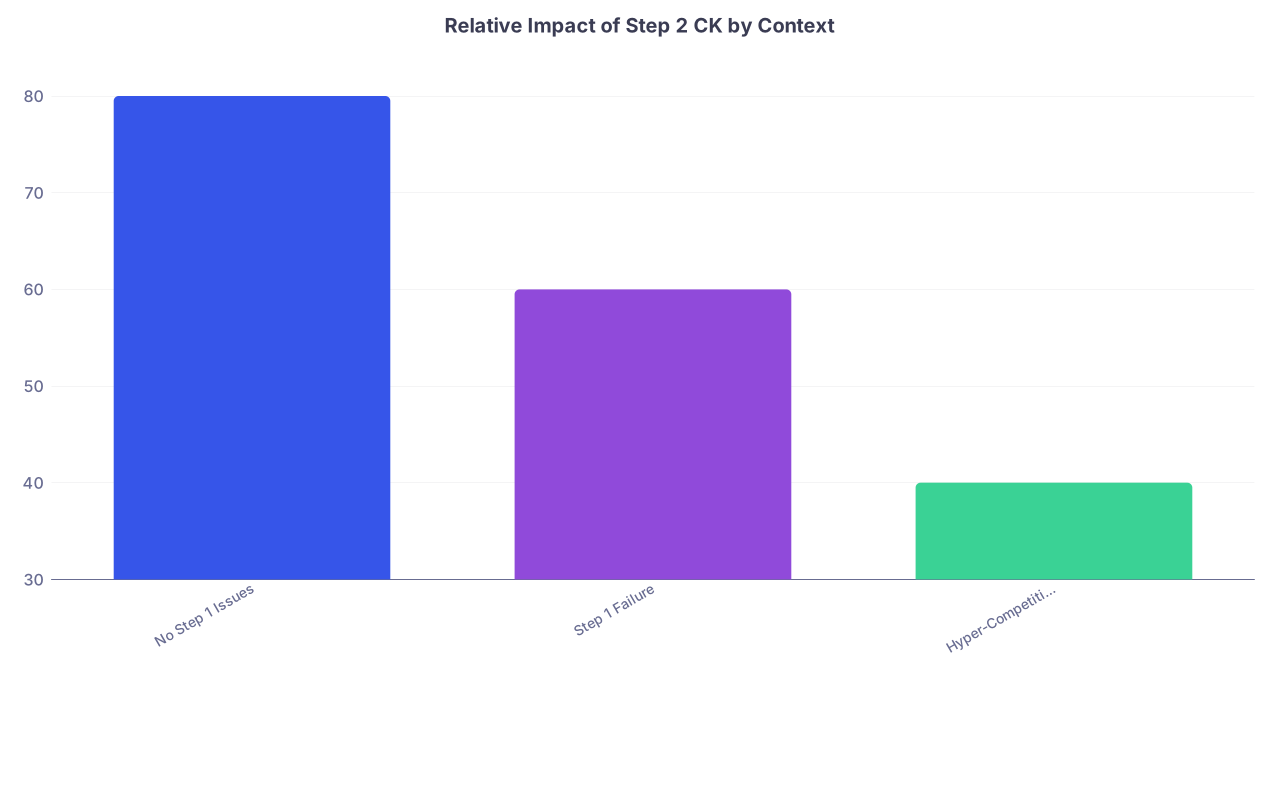
| Category | Value |
|---|---|
| No Step 1 Issues | 80 |
| Step 1 Failure | 60 |
| Hyper-Competitive Specialty | 40 |
(Think of these as “how much Step 2 can help” out of 100. Not science, but a useful mental model.)
Practical Game Plan If You’re Banking on Step 2 CK
Here’s the framework you should follow if your Step 1 is unimpressive and you want Step 2 CK to carry more weight:
- Decide your specialty before you schedule Step 2 CK. Your target score changes depending on the field.
- Treat Step 2 CK like your last big lever. You don’t get another major exam before ERAS.
- Use question banks (UWorld, AMBOSS) like they’re your job. Two full passes if you can, with mixed, timed blocks.
- Take enough NBMEs to predict your range. Don’t go into the real deal under-tested.
- Schedule it so your score posts before applications go out.
- Be brutally realistic in your program list. Combine reach, solid, and safety programs. Don’t only apply to your “dream” places.
FAQ: Strong Step 2 CK vs Mediocre Step 1
1. Can a high Step 2 CK completely erase a Step 1 failure?
No. It can soften it, but not erase it. Programs will still see and consider the failure. A high Step 2 CK tells them you learned, adapted, and are now performing at a higher level. That can absolutely get you interviews and a match, especially in less competitive specialties and at community or smaller academic programs.
2. If my Step 1 is just a pass, should I delay applying until my Step 2 CK score is back?
If you think you can score at or above your target range for your specialty, yes — it’s usually better to have the number in hand. Submitting with only a “pass” on Step 1 and no Step 2 score forces programs to guess. They rarely guess in your favor. Just don’t delay so much that you become a late applicant.
3. What if my Step 2 CK is only slightly better than my Step 1 performance?
Then it doesn’t really change your narrative. It says, “This is who I am academically,” which is fine if you’re aiming for less competitive fields and realistic programs. But you can’t pitch it as some massive comeback or growth story. Programs will see it as stable, not transformed.
4. Do program directors actually care about “upward trend,” or is that just applicant talk?
They do. I’ve heard PDs say things like, “Yeah, their preclinical stuff wasn’t great, but look at that Step 2 and those clerkship grades.” They don’t ignore the earlier weakness, but a strong upward trend makes them more comfortable you’ll pass boards and handle residency. It’s not magical, but it matters.
5. How much does Step 2 CK matter compared to letters and clerkship grades?
Step 2 CK is usually in the top 2–3 factors, especially now that Step 1 is pass/fail. But strong letters and outstanding clerkship narratives can absolutely push a slightly lower Step 2 CK into the “we should interview this person” category. Weak letters and so-so clinical comments can sink even a great score.
6. Should I address my weak Step 1 directly in my personal statement?
If it’s just a low pass and nothing else in your record is concerning, you don’t have to. If you failed or had major academic struggles, a short, specific explanation plus a clear description of what changed is useful. Don’t center your whole statement on your USMLE trauma. One concise paragraph is enough.
7. What’s the one thing I should do right now if I’m depending on Step 2 CK?
Open a blank document and set a target Step 2 CK score range based on your specialty (e.g., “I’m aiming for 245–255 for EM”). Then list the concrete things you’ll do in the next 4 weeks to move toward that number: number of UWorld questions per day, NBMEs scheduled, and your exam date. If you don’t write it down, you won’t train for it like it matters.
Open your Step 2 CK study plan right now and ask yourself: “Is this actually designed to get me the score I need, or am I just ‘studying’ and hoping it works out?” Then fix it.