
Is It Better to Take Step 2 CK Before or After Sub-Internships?
What actually happens to your residency chances if you push Step 2 CK until after your sub-I… and then score lower than you hoped?
Let me give you the blunt answer up front:
If you’re applying in a reasonably competitive field, it’s usually better to take Step 2 CK before your core sub-internships if you can realistically score well. But it’s absolutely worse to rush and bomb it just to get a number in early.
So the real question isn’t “before or after sub-I?”
It’s “where do you get the highest, safest Step 2 score without tanking your application timeline?”
Let’s walk through this the way program directors and deans look at it—not the way anxious MS3 group chats talk about it.
First: What Programs Actually Care About Now
Since Step 1 went pass/fail, Step 2 CK became the main standardized number on your file. Programs use it for:
- Screening (hard cutoffs or soft thresholds)
- Comparing you to peers from schools they don’t know well
- Risk assessment: “Will this person pass our boards and in-service exams?”
Here’s the rough reality by specialty:
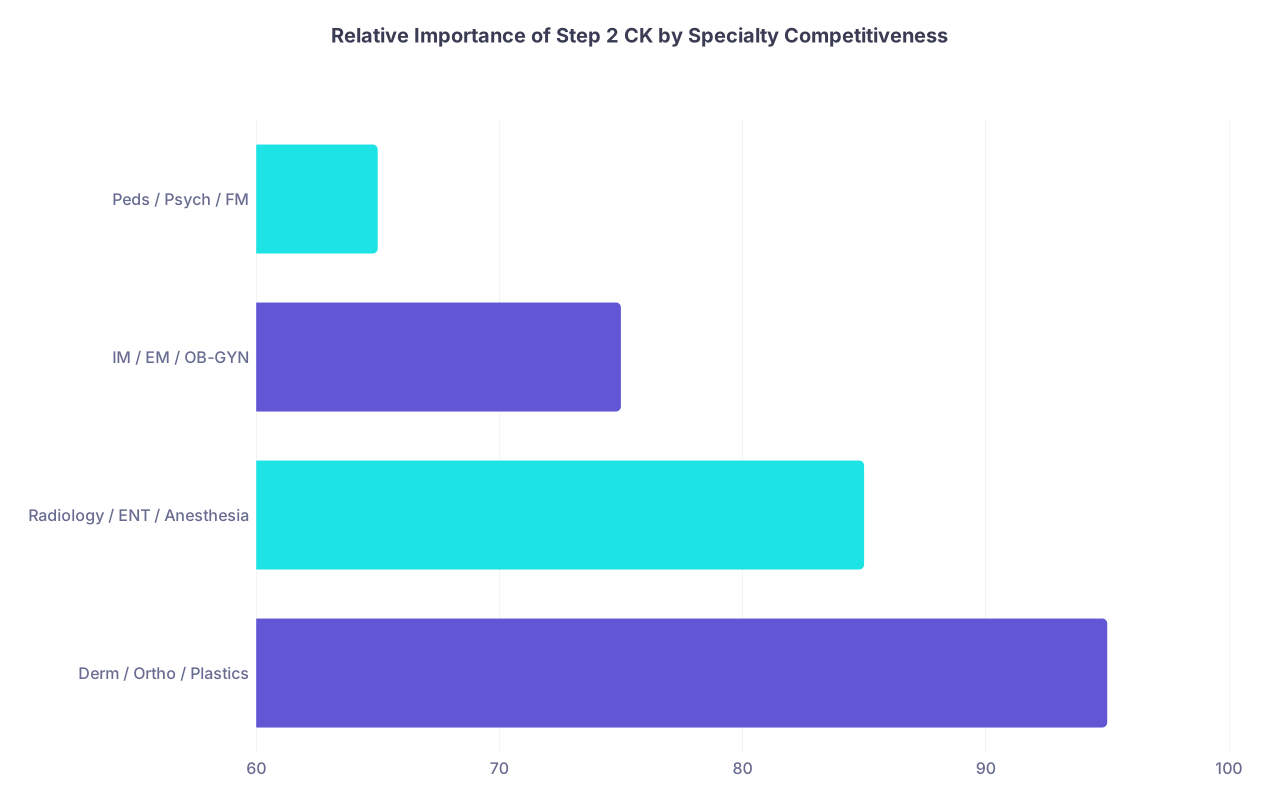
| Category | Value |
|---|---|
| Derm / Ortho / Plastics | 95 |
| Radiology / ENT / Anesthesia | 85 |
| IM / EM / OB-GYN | 75 |
| Peds / Psych / FM | 65 |
This isn’t exact data, but it reflects how heavily programs tend to lean on Step 2 CK.
So timing Step 2 CK around your sub-internships isn’t a scheduling puzzle. It’s a strategy problem: how to give programs the best possible number at the right time.
The Three Real Options (And Who They’re Good For)
Forget the dozens of edge cases. You’re basically choosing between three paths.
| Option | When Step 2 Is Taken | Best For |
|---|---|---|
| A | Before any sub-I | Strong test takers aiming high |
| B | Between sub-Is / early 4th year | Average scorers, moderate competitiveness |
| C | After main sub-Is (late) | Need big score jump or major remediation |
Let’s break them down.
Option A: Take Step 2 CK Before Sub-Internships
This means: dedicated prep at the end of M3 / very early M4, then sub-Is afterward.
Who wins with this plan:
- You did okay or better on Step 1 and your shelf exams
- You’re applying to competitive specialties (derm, ortho, ENT, rad onc, plastics, neurosurg, etc.)
- You can carve out 4–6 solid study weeks without getting crushed by rotations
Why this is powerful:
Stronger application at ERAS submission.
Your Step 2 is already in. Programs don’t have to guess. Screening becomes your friend instead of your enemy.Freedom to shine on sub-I.
No Qbank in the call room. You can actually focus on:- Showing up early and staying late
- Knowing your patients cold
- Impressing residents and attendings who might write you letters
No Step 2 shadow over away rotations.
Especially for surgical fields, you don’t want to be the student worrying about UWorld blocks between cases. People can tell when you’re distracted.
When this backfires:
- You try to squeeze Step 2 between a heavy M3 schedule, underprepare, and underperform
- You rely on “I’ll improve 25+ points from Step 1” with no evidence you can
If you’re going this route, be honest: can you really give Step 2 your full focus for a month?
Option B: Take Step 2 CK Between Sub-Is / Early 4th Year
This is the “middle ground” that most students actually end up in. Some sub-I early, Step 2 after one or two, then more rotations.
Who this fits:
- You had average Step 1 and want a modest but real Step 2 improvement
- Your shelves were solid but not incredible
- You’re going into moderately competitive specialties (IM with academic aims, EM, OB/GYN, anesthesia, etc.)
Pros:
- You get a few advanced rotations under your belt before Step 2. Clinically, you’re sharper, which can help.
- You see what your actual 4th-year schedule and energy look like instead of guessing in M3.
- If one early sub-I doesn’t go well, a strong Step 2 can help steady the picture.
Cons:
- You’re now juggling: finishing sub-Is, possibly working on letters, plus studying.
- Depending on exact timing, your score may or may not be back before ERAS applications are downloaded.
- It becomes easier to push the test “a little later” and suddenly you’ve drifted into Option C.
This is the safest default if you’re already on track to be a solid test taker and you’re disciplined about not letting the date slide.
Option C: Take Step 2 CK After Your Main Sub-Internships
This is what a lot of people want to do: crush sub-I’s, get letters, then worry about Step 2 later.
Let me be direct: this is only a good idea for a small group of students.
Who might benefit:
- You had a weak Step 1 (pass but low percentile) and need real clinical growth to boost Step 2
- You struggled with shelves and need more time and repetition with patients
- You’re applying in less competitive specialties or mainly to your home/state programs where they know you well
But you pay a price:
Score may not be available when programs first filter applicants.
If you test in, say, late September, many programs will have already started screening and issuing early interviews.Some programs quietly assume late = liability.
I’ve heard PDs say, out loud: “If Step 2 isn’t in by the time we’re ranking our first interview invites, we move on.” Not fair, but real.You’re studying during prime interview season and sub-I’s.
Juggling Step 2 with audition rotations and interviews is a fantastic way to be mediocre at all three.
So when is Option C just wrong?
- You’re going into a competitive specialty
- You need Step 2 to rescue a weak Step 1
- Your school or dean’s office is strongly advising an earlier date
If every advisor who knows you is saying “do not push it that late,” listen.
How Programs See Timing: A Simple Framework
Put yourself in a program director’s chair. You open ERAS and see:
Scenario 1:
- Step 1: pass
- Step 2 CK: 250, taken June
- Strong sub-I comments in July/August
Scenario 2:
- Step 1: pass
- Step 2 CK: pending, test date October
- Same sub-I comments
Who gets the earlier look? Obviously Scenario 1.
Now flip it.
Scenario 3:
- Step 1: low pass
- Step 2 CK: 230, taken in October
- But now it’s a clear improvement and shows growth
For Scenario 3, that late test might be the only way they trusted you’d improved enough. In that specific case, late can help.
So the judgment call is:
- If your Step 2 is likely to be a strength, take it before or early.
- If your Step 2 is risky and you genuinely need more time and clinical seasoning, later might save you—as long as you still get it in by the time most programs review.
How Your Sub-Internships Fit Into This
Sub-I’s are not just “harder rotations.” They’re where:
- You get your most impactful letters
- You build in-person reputation with attendings and residents
- You show, “I can function like an intern”
Here’s the tradeoff:
If Step 2 is done early →
You can treat each sub-I like a performance: pre-round well, stay late, own your patients, make it obvious you’re ready.
If Step 2 is hanging over you →
You’re tempted to do UWorld at night instead of reading about your patients. Your focus is split. Residents notice.

| Step | Description |
|---|---|
| Step 1 | Review Step 1 and Shelf Performance |
| Step 2 | Plan Step 2 Before or Early 4th Year |
| Step 3 | Need More Time and Clinical Growth |
| Step 4 | Target Step 2 Before Main Sub Is |
| Step 5 | Step 2 Before or Between Sub Is |
| Step 6 | Delay Step 2 But Test Before ERAS Screening Peak |
| Step 7 | Strong or Average? |
| Step 8 | Competitive Specialty? |
| Step 9 | Can You Improve by Dedicated Prep Now? |
So don’t sacrifice your sub-I performance for Step 2 unless your test score is the bigger liability.
Concrete Timing Examples (So You’re Not Guessing)
Here are sample schedules that actually work in real life.
| Plan Type | Step 2 Timing | Sub-I Timing | Comment |
|---|---|---|---|
| Aggressive Early | Mid-June | July–Sept | Great for strong test takers in competitive fields |
| Balanced | Late July | One sub-I June, rest Aug–Oct | Common, works if disciplined |
| Risk-Managed Late | Early Sept | 1–2 sub-Is June–Aug | For those needing extra prep but still early enough for many programs |
If you’re aiming for a really competitive specialty, your target should usually be:
- Step 2 CK taken by late July / early August
- Scores in ERAS by the time programs start serious screening (often mid-September)
If you’re going into less competitive fields and your school strongly supports you, you get a little more flexibility. But “I’ll take it in October or November” is rarely a power move.
How to Decide in Under 10 Minutes
Grab a sheet of paper. Write:
- Step 1: score/percentile (or honest pass level if pass/fail with internal data)
- Shelf exams: mostly above average / average / below average
- Target specialty: highly competitive / moderately competitive / less competitive
- Honest available dedicated time: 2–3 weeks / 4 weeks / 6+ weeks
Then use this:
If Step 1 + shelves = strong AND specialty is competitive
→ Aim to take Step 2 before or just as sub-Is start.If Step 1 = average, shelves = average, specialty = moderate
→ Take Step 2 between early sub-Is, but no later than early September.If Step 1 = weak or shelves consistently low
→ Ask: “Can I actually be ready with 4–6 weeks now?”- If yes → take it before sub-Is; you need the number.
- If no → do 1–2 solid sub-Is, consider extra clinical time, but schedule Step 2 before mid-September if at all possible.
Then run your plan past someone who knows you: a dean, advisor, or resident in your field. Not just your class group chat.
FAQs
1. If my Step 1 was low, should I always delay Step 2 CK until after sub-internships?
No. That’s one of the most common mistakes. If your Step 1 is low, you usually need Step 2 earlier, not later, so programs see the improvement when they first screen applications. The only time a delay makes sense is if you’re genuinely not ready and a rushed attempt would likely produce another weak score. In that case, a short delay can help—but we’re talking weeks, not half a year.
2. Will programs think badly of me if I take Step 2 CK late?
Some will, some won’t—but many will quietly downgrade or screen out applications without a Step 2 score when they first review. They may not “think badly” of you, but they’ll move on to people with complete data. That’s the real risk. If your school or specialty expects Step 2 in by ERAS submission, you’re better off aligning with that unless there’s a very clear reason not to.
3. Is it okay to study for Step 2 CK during a sub-internship?
Technically yes; practically it often goes poorly. Sub-I’s are demanding, and if you’re doing them right you’re exhausted. Squeezing in high-quality Step 2 prep after 12–14 hour days is hard. If you must overlap, pick your lightest or most predictable rotation, and be deliberate: fixed daily question goals, focused weak-area review, and protect at least one full day off weekly for heavier studying.
4. I already scheduled Step 2 CK after my sub-Is. Should I move it earlier?
Ask yourself two questions:
- If I moved it earlier, would my score likely be higher, the same, or lower?
- Will my current date mean my score comes back after most programs start screening?
If moving it a few weeks earlier gives you the same or better score and helps you be “complete” earlier in the cycle, it’s usually worth rescheduling. If an earlier date will clearly hurt your performance, keep the later one but make sure you’re not drifting into very late testing (October/November) unless your specialty and advisors say it’s acceptable.
5. What’s one sign I’m planning Step 2 timing wrong around my sub-I’s?
If your plan requires you to “just power through” a heavy sub-I while simultaneously doing 4–6 hours of studying daily for Step 2, you’re lying to yourself. One—or both—will suffer. That’s your warning sign. Either carve out a real dedicated period for Step 2, or accept that it will be a slower-burn prep and schedule accordingly so you’re not sabotaging your clinical performance.
Open your calendar right now. Block out a realistic 4–6 week window where you can give Step 2 CK your full attention and still have space for at least one strong sub-internship before ERAS. If there’s no such window, adjust something—rotation order, away plans, or your test date—before the year steamrolls you.