
The Step 2 CK score you need for a competitive residency is higher than most people are comfortable admitting.
If you want dermatology, plastic surgery, orthopedic surgery, ENT, neurosurgery, integrated vascular, or similarly competitive spots, you’re usually looking at 250+ to be broadly competitive. For the top tier of those programs? Realistically 255–260+. Harsh, but accurate.
Let’s break it down specialty by specialty, number by number, and then I’ll tell you what to do if your score isn’t where you want it.
First: The Big Picture – What Does “Competitive” Really Mean?
“Competitive” doesn’t mean “hard.” It means there are way more good applicants than positions.
That’s why Step 2 CK suddenly matters more than ever now that Step 1 is pass/fail. Program directors needed a new filter. They picked the obvious one: the last remaining 3-digit exam.
Here’s the simplified reality:
- For less competitive specialties (FM, psych, peds, IM at non-elite places): 230–240+ is workable.
- For moderately competitive (OB/GYN, EM, Anesthesia, most IM programs): 240–250+ keeps many doors open.
- For the classic “competitive” ones (derm, ortho, ENT, plastics, neurosurg, integrated surg): 250+ is the floor for many programs, not the ceiling.
Do people match below these numbers? Yes. All the time. But they usually had something else that was exceptional: home program, research, connections, away rotations where they crushed it, AOA, etc.
Concrete Numbers by Specialty: Where Step 2 CK Needs to Land
These are target ranges, not guarantees. They’re based on recent NRMP data trends and what programs actually say and do.
| Specialty Level | Example Specialties | Target Range (Typical) |
|---|---|---|
| Ultra-Competitive | Derm, Plastics, Ortho, ENT, Neurosurg | 250–260+ |
| Highly Competitive | Rad Onc, Integrated Vascular, IR, Urology | 245–255+ |
| Moderately Competitive | EM, Anesthesia, OB/GYN, Strong IM programs | 240–250+ |
| Less Competitive | FM, Psych, Peds, Neurology, Pathology | 230–245+ |
Ultra-Competitive (Derm, Plastics, ENT, Ortho, Neurosurg)
If you’re aiming here, you’re playing in the deep end.
Realistic Step 2 CK targets:
- “I want lots of interviews” target: 255+
- “Competitive at my solid home / mid-tier programs”: 250–255
- “Need serious compensatory strengths”: below 250
Programs in these specialties often:
- Screen out below 245–250 automatically.
- Use 250+ as their “we’ll definitely take a look” zone.
You’ll always find exceptions, but you can’t plan a career on being the exception.
Highly Competitive (Rad Onc, Integrated Vascular, IR, Urology)
These are small specialties with limited spots and usually strong applicant pools.
Step 2 CK targets:
- Strong position: 245–255+
- Reasonable shot with good application: 240–245
- Under 240: harder, but possible with heavy research or strong mentorship
These fields also care a lot about:
- Research in the specialty
- LORs from known faculty
- Demonstrated commitment (electives, away rotations)
But Step 2 is still the first thing many PDs see.
Moderately Competitive (EM, Anesthesia, OB/GYN, Many IM Programs)
Here’s where nuance matters.
For EM and anesthesia especially, 240–250 is a healthy zone. Top programs will like to see 245–250+, but many community or mid-tier academic programs are comfortable taking strong applicants in the high 230s if the rest of the file is good.
Rough Step 2 CK ranges:
- “I can be competitive at many programs”: 240–250
- “I’ll need stronger non-score factors”: 230–239
- “I’m fighting upstream”: <230, unless you have powerful support or special circumstances
For Internal Medicine:
- Community IM / lower-tier academic: 225–235+ is usually enough if your application is solid.
- Top academic IM (think MGH, UCSF, Hopkins, Duke): 245+ is much more typical of matched applicants, even though there’s no “official” cutoff.
Less Competitive (FM, Psych, Peds, Neurology, Pathology)
“Less competitive” doesn’t mean “no standards.” It means there’s more flexibility and more weight on your overall fit.
Typical Step 2 CK ranges:
- “Comfort zone” for most programs: 230–240
- “Still workable, be smart about your list”: 220–229
- Below 220: you need:
- No failures
- Good clinical evals
- Thoughtful, realistic program list
Do you need a 250 to match family medicine? No. If you have one, great, but it’s overkill. Focus that effort on building a smarter app instead of obsessing about inflating a 248 to a 252.
How Programs Actually Use Step 2 CK Now
Most applicants underestimate how ruthless the first pass of application screening is.
Here’s how it often works behind the scenes:

| Step | Description |
|---|---|
| Step 1 | ERAS Applications |
| Step 2 | Auto Screen Out |
| Step 3 | Secondary Review |
| Step 4 | Interview Invite |
| Step 5 | Lower Priority or Reject |
| Step 6 | Meets Step 2 cutoff? |
| Step 7 | Strong clinical and letters? |
Key points:
- Many programs set a hard Step 2 CK cutoff (e.g., 230, 240, 245). They won’t read anything below it.
- Some use soft cutoffs: below X score goes into a “maybe later” pile.
- In competitive fields, they still filter a huge pile of “good” scores (245–250) just because they’re flooded with 250–260+ applicants.
And yes, now that Step 1 is pass/fail, plenty of programs have quietly raised their Step 2 expectations. They won’t blast this on their website, but applicants see it in interview patterns.
Step 1 vs Step 2 CK: How Much Does an “Increase” Matter?
Here’s a common question: “My Step 1 was X, what Step 2 do I need to show improvement?”
If your Step 1 was scored (older cohorts), this is the rough rule:
- Flat or slightly up (≤ 5 points): fine, doesn’t hurt you.
- Up 5–10 points: looks reassuring, especially if Step 1 was a bit low.
- Up >10 points: programs notice—in a good way.
If Step 1 was pass/fail (newer cohorts), your Step 2 CK is the metric. Programs don’t care if you “improved”; they care how you compare to your peers now.
A simple mental model:
- Below 230: you’ll need to be extremely realistic with specialty and program selection.
- 230–240: competitive for many specialties except the very competitive ones.
- 240–250: strong for most fields; borderline for the ultra-competitive without other hooks.
- 250–260: puts you in a strong position almost everywhere.
- 260+: rare, and it will get attention, but it doesn’t compensate for a bad personality or weak clinical performance.
Here’s a quick visual on how different score zones tend to affect interview chances (roughly, not literally):
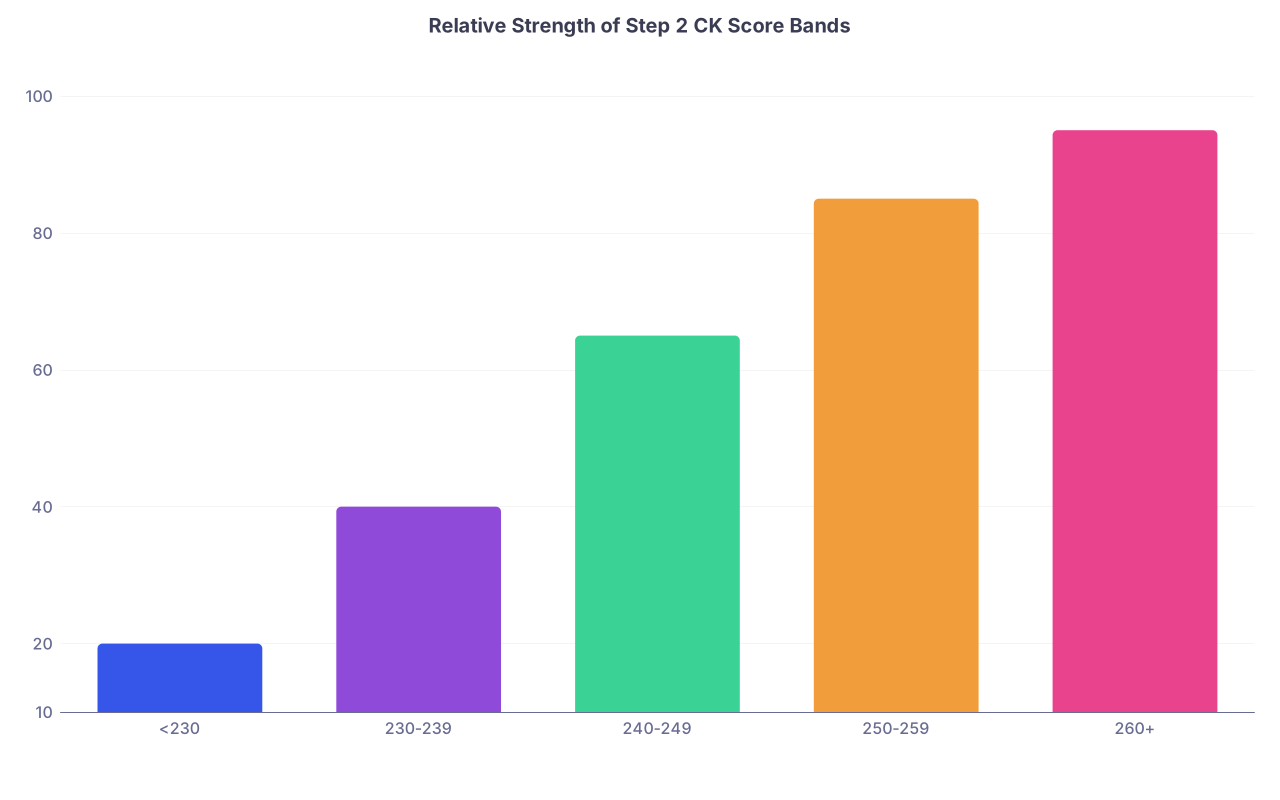
| Category | Value |
|---|---|
| <230 | 20 |
| 230-239 | 40 |
| 240-249 | 65 |
| 250-259 | 85 |
| 260+ | 95 |
What If Your Step 2 CK Is “Too Low” for Your Dream Specialty?
This is the part nobody wants to hear, but you need someone to say it straight.
There are three basic scenarios:
You’re slightly below the “ideal” zone
Example: You want ortho, and you got a 245.You’re not dead. You’re just not “auto-invite” material at the top places.
What you do:
- Dominate your ortho rotations (home + away).
- Get strong, detailed letters from known attendings.
- Apply broadly, including community and lower-tier academic programs.
- Make your application obsessive about commitment to the field (research, experiences, narrative).
You’re significantly below the typical range
Example: You want derm, and you got a 233.Now you’re in “exception range.” Can it still work? Yes—if:
- You have major derm research (posters, pubs, maybe a research year).
- You’re at a school with a strong derm department that knows you well.
- You’re willing to:
- Do a research year, or
- Consider prelim/transitional years and reapplying, or
- Pivot specialties if needed.
You’re below most specialty averages, period
Example: Step 2 in the 210–220 range.At this point, the strategy is:
- Be brutally honest about your competitiveness in ultra-competitive fields (it’s near-zero).
- Focus on specialties where your score is not a deal-breaker (FM, psych, peds, path, some IM).
- Crush your sub-Is and interviews. Programs in these fields absolutely rank applicants with mid/low scores if they like working with them.
What About IMG and DO Applicants?
If you’re an IMG or DO, the honest bar is higher for competitive and even mid-tier specialties.
You’re often compared separately, and programs use Step 2 CK as “proof” you can handle their training and pass boards.
Rough rule of thumb:
- For IMGs/DO applicants in less competitive specialties (FM, psych, peds): try to be at least 235–240+.
- For moderately competitive (anesthesia, EM, OB, IM at strong programs): you really want 240–250+.
- For ultra-competitive fields as an IMG/DO: you typically need 250+ plus stellar research and connections, or you’re fighting odds that aren’t in your favor.
Here’s a snapshot comparison of what often counts as “solid”:
| Applicant Type | Less Competitive Fields | Moderately Competitive | Ultra-Competitive |
|---|---|---|---|
| US MD | 230–240+ | 240–250+ | 250–260+ |
| US DO | 235–240+ | 240–250+ | 250+ plus extras |
| IMG | 235–245+ | 245–255+ | 255+ plus major extras |
Is it “fair”? No. Is it reality? Yes.
How Much Above the “Cutoff” Do You Actually Need?
This is a question I get constantly: “If a program lists a minimum Step 2 of 230, is 231 enough?”
Technically yes. Practically, no.
Programs publish minimums so they don’t look insane. Internally, they often:
- Set their ERAS filter at or a bit above that number
- Prefer applicants clustered around their usual matched scores
If they say:
- “Minimum 230” → You want 235–240+ to be comfortably in the pile.
- “No minimum listed” → Assume:
- Less competitive fields: 220–230 informal cutoff
- Moderately competitive: 230–240 informal cutoff
- Ultra-competitive: 240–250+ informal cutoff
Strategy: Using Your Step 2 Score the Smart Way
Here’s how to think about your score strategically, not emotionally.

| Step | Description |
|---|---|
| Step 1 | Get Step 2 CK Score |
| Step 2 | Apply broadly within specialty tier |
| Step 3 | Strengthen non score factors |
| Step 4 | Reassess specialty and program list |
| Step 5 | Focus on letters, rotations, PS |
| Step 6 | Consider adjacent specialties |
| Step 7 | Score >= target for desired specialty? |
| Step 8 | Close to target? |
If your score is:
At or above typical target
- Don’t get cocky. A 255 doesn’t fix a bland personal statement or mediocre letters.
- Use your score to justify aiming high, but still include a realistic spread of programs.
Slightly below target
- Triple down on clinical excellence and letters.
- Fix everything that’s still in your control: sub-I performance, personal statement specificity, advisor involvement, smart program list.
- Apply broadly. Very broadly.
Far below target
- Have a direct conversation with someone who knows your full file (dean, trusted attending).
- Decide if you:
- Adjust specialties,
- Take a research year, or
- Accept that your match goals need to change.
One Last Point: A High Step 2 CK Score Doesn’t Guarantee Anything
I’ve watched 260+ applicants get burned because they assumed the score was the golden ticket. It isn’t.
Programs also care about:
- How you work on the team
- Your letters (and the subtext in them)
- Interview performance
- Fit with the specialty and program culture
- Red flags (failed exams, unprofessional behavior, poor clerkship comments)
Think of Step 2 like a key. You need it to open the door. But once you’re in the room, it doesn’t win the game for you.
What You Should Do Today
Pull up your current or projected Step 2 CK score and do this now:
Make a 3-column list:
- Column 1: “Dream” specialties/programs
- Column 2: “Realistic but strong” options
- Column 3: “Safety but still acceptable” options
Then, next to each specialty or program tier, write the Step 2 CK range from this article that matches it. Compare that to your actual or expected score.
If the gap is big, don’t wait for someone to sugarcoat it. Adjust your strategy today—either by aiming for a higher score with better prep, or by recalibrating your target specialties and programs before you waste a year and thousands of dollars.
Open a blank document right now and write those three columns. Your future Match result is going to follow that plan more than your wish list.