
It’s early September. ERAS is open on one screen, your personal statement draft on the other. You finally got your Step 2 CK score back. Now you’re hovering over one line you just typed:
“On Step 2 CK, I scored a 25X, reflecting my commitment to clinical excellence.”
You’re asking yourself: Do I leave that in? Or delete it?
Here’s the answer you actually need: most of the time, you should not put your Step 2 CK score in your personal statement. But there are specific situations where you absolutely should – and a few where it would be a real mistake.
Let’s walk through it like a decision tree, not hand-wavy “it depends” nonsense.
Quick Rule of Thumb: When To Mention Step 2 CK in Your Personal Statement
Use this as your baseline:
Do not mention your Step 2 CK score in your personal statement if:
- Your score is average or slightly above average for your specialty
- There’s nothing unusual about your score timeline or performance
- Your application already has the score visible in ERAS
Consider mentioning your Step 2 CK score in your personal statement if:
- You had a low Step 1 (Pass/low performance) and Step 2 CK is a big jump
- You failed a previous exam (Step 1 or Step 2 CK) and then did well on the retake
- You took Step 2 CK late and you are using the PS to clarify your timeline
- You are applying to a more competitive specialty with a very strong Step 2 CK and also tying it to a story (not a flex)
Definitely mention scores elsewhere (not PS) if:
- Programs specifically ask for explanation of exam performance in a supplemental form
- There’s a formal “adversity” or “academic concern” section – that’s where data belongs
Your personal statement is not your ERAS “score comment box.” It’s the worst place to lead with numbers.
What Program Directors Actually Do With Your Step 2 CK Score
Let’s ground this in reality.
Most program directors are going to see your Step 2 CK score in one of two ways:
As part of the initial screen
- They filter or sort by Step 2 CK (especially after Step 1 went pass/fail)
- Many have internal cutoffs or “comfort zones”
As context during ranking
- Once you’re in the “interviewed” group, your score becomes part of a global impression
- It matters, but it’s rarely the deciding factor alone
Do they need you to write “I scored 247 on Step 2 CK” in a paragraph? No. They already have the PDF or at least the number.
What they actually want from the personal statement:
- Why you chose this specialty
- How you think about patient care
- Evidence of maturity, insight, and judgment
- Signals that you will not be a problem at 2 a.m. on a Saturday
Exam scores are data points. The personal statement is narrative. When you mix them clumsily, you weaken both.
When Including Step 2 CK in Your Personal Statement Helps You
There are a few cases where writing about your Step 2 CK performance is smart and strategic. Key difference: you’re not “announcing” a number, you’re explaining a trajectory or story.
1. Low Step 1, Strong Step 2 CK (Redemption Arc)
This is probably the most common justified scenario.
Example:
- Step 1: borderline pass or low
- Step 2 CK: significantly above average for your specialty
If you say nothing, some PDs will quietly wonder:
“Was that just luck? Different exam? Did they actually fix their study habits?”
If you briefly connect the dots, you control the narrative.
How to do it well:
- Own the weak performance on Step 1 without drama
- Describe one or two concrete changes you made (study structure, resources, test-taking approach, life stability)
- Connect that to the Step 2 CK result and, more importantly, to how you show up clinically
Bad version:
I scored poorly on Step 1 but redeemed myself with a 25X on Step 2 CK, which reflects my true potential.
Better version:
I underperformed on Step 1 after an unfocused and inefficient study approach. Before Step 2 CK, I restructured my prep: dedicated question blocks daily, weekly review of wrong answers, and regular feedback from residents on the wards. The improvement in my Step 2 CK performance reflects those changes and mirrors what attendings later saw in my clinical reasoning.
Notice: the actual number isn’t the point. The pattern is.
2. Previous Failure, Then Clear Improvement
If you failed Step 1 or Step 2 CK once and then passed comfortably with solid performance, you should address it somewhere. If there’s no other required narrative section, you can touch on it in the personal statement – but keep it short and grown-up.
What PDs want to know:
- What actually went wrong (in one or two sentences, not a life story)
- What you changed
- Why they can trust your future exam performance (and general reliability)
Again, the score itself matters less than your explanation and subsequent pattern.
3. Timing Concerns or Late Step 2 CK
If your Step 2 CK score is not available at application submission, and it will be crucial for your candidacy (e.g., weak Step 1, applying to competitive specialties), you can:
- Use your personal statement to reassure programs that:
- The exam is taken
- You expect the score by a certain date
- There were specific, reasonable timing reasons
Keep this to one or two sentences. You’re not writing a memo; you’re giving context.
Example:
I completed Step 2 CK in late August due to overlapping responsibilities on a required sub-internship and a family commitment. My score is pending at the time of application submission, and I will release it as soon as it becomes available.
If the score then comes back strong, you’ve teed it up nicely.
When Mentioning Step 2 CK Hurts You
Now let’s talk about the missteps I see every year.
1. Using Your PS as a Flex Sheet
I’ve read personal statements that were basically walking CVs:
“I ranked in the top decile of my class, scored 26X on Step 2 CK, and honored 8 of 9 clerkships…”
Programs already see all of this in:
- Your MSPE
- Your transcript
- Your ERAS “Scores” section
Putting it in your personal statement doesn’t make you look stronger. It makes you look insecure and oddly obsessed with numbers.
2. Calling Attention to a Mediocre Score
If your Step 2 CK is average relative to your specialty, mentioning it in the PS only highlights it. You’re spotlighting something that would otherwise just blend into the background.
A PD reading:
“I scored 235 on Step 2 CK, showing my dedication…”
…is more likely to think, “Why are they drawing attention to this?”
If there’s no story, skip it.
3. Long Excuses or Emotional Over-Sharing
Explaining a failure or low score is good. Turning the personal statement into a three-paragraph trauma narrative about Step 2 CK is not.
That looks like:
- You’re still emotionally stuck on the score
- You view yourself primarily through that lens
- You might not have the coping skills they want in a resident
Mention it. Explain the change. Move on.
Smart Ways to Weave Step 2 CK into a Personal Statement (If You Should Mention It)
If you’ve decided Step 2 CK belongs in your personal statement, keep it:
- Short
- Contextual
- Focused on what changed and how that shows up clinically
Here are a few examples, adjusted for tone and specialty.
Example 1 – Redeeming a weak Step 1:
My Step 1 performance did not meet my own expectations. Before Step 2 CK, I changed my approach completely: I treated questions like clinical problems, reviewed missed items weekly, and used each ward month to test myself on real patients first, then on UWorld. That shift in preparation and mindset led to a significantly stronger Step 2 CK performance and, more importantly, more confident and efficient patient care during my sub-internships.
Example 2 – Failure and growth:
I failed Step 2 CK on my first attempt during a period when I was balancing full-time caregiving responsibilities at home with clinical rotations. That failure forced me to reassess my systems: I sought support from faculty, used structured daily study blocks, and offloaded responsibilities that I could not realistically sustain. On my second attempt, I passed with a score consistent with my clerkship performance, and I carried those more sustainable strategies into my sub-internship, where I performed at a level that matched my potential.
Example 3 – Very strong Step 2 CK, used sparingly:
The structured, analytic approach I used on Step 2 CK is the same one I bring to the wards: define the problem, generate a focused differential, and identify the key piece of data that moves the plan forward. Attendings on my medicine and surgery rotations echoed this in their feedback, noting that I often anticipated next steps in diagnosis and management.
Notice: you can sometimes refer to what Step 2 CK represents without even quoting the number.
Where Your Step 2 CK Score Should Live
Step 2 CK is already baked into multiple parts of your application.
| Location | Good Use of Score |
|---|---|
| ERAS Score Section | Always list official score |
| MSPE / Dean's Letter | Context and class standing |
| Program Supplements | Explanation if requested |
| PS (rare cases) | Trajectory / growth story |
| Interview | Brief verbal clarification |
You don’t get bonus points for repeating the same number in every section.
A Simple Decision Flow: Mention Step 2 CK in PS or Not?
Use this as your sanity check:

| Step | Description |
|---|---|
| Step 1 | Do you have an unusual exam story? |
| Step 2 | Do NOT mention Step 2 CK |
| Step 3 | Did Step 2 CK show clear improvement or recovery? |
| Step 4 | Probably do NOT mention it |
| Step 5 | Can you explain it in 2-4 sentences max? |
| Step 6 | Use another section or leave it out |
| Step 7 | Mention briefly in PS with focus on growth |
If you’re forcing it, you’ll feel it. And so will the person reading.
Visualizing How Often It Actually Belongs in the PS
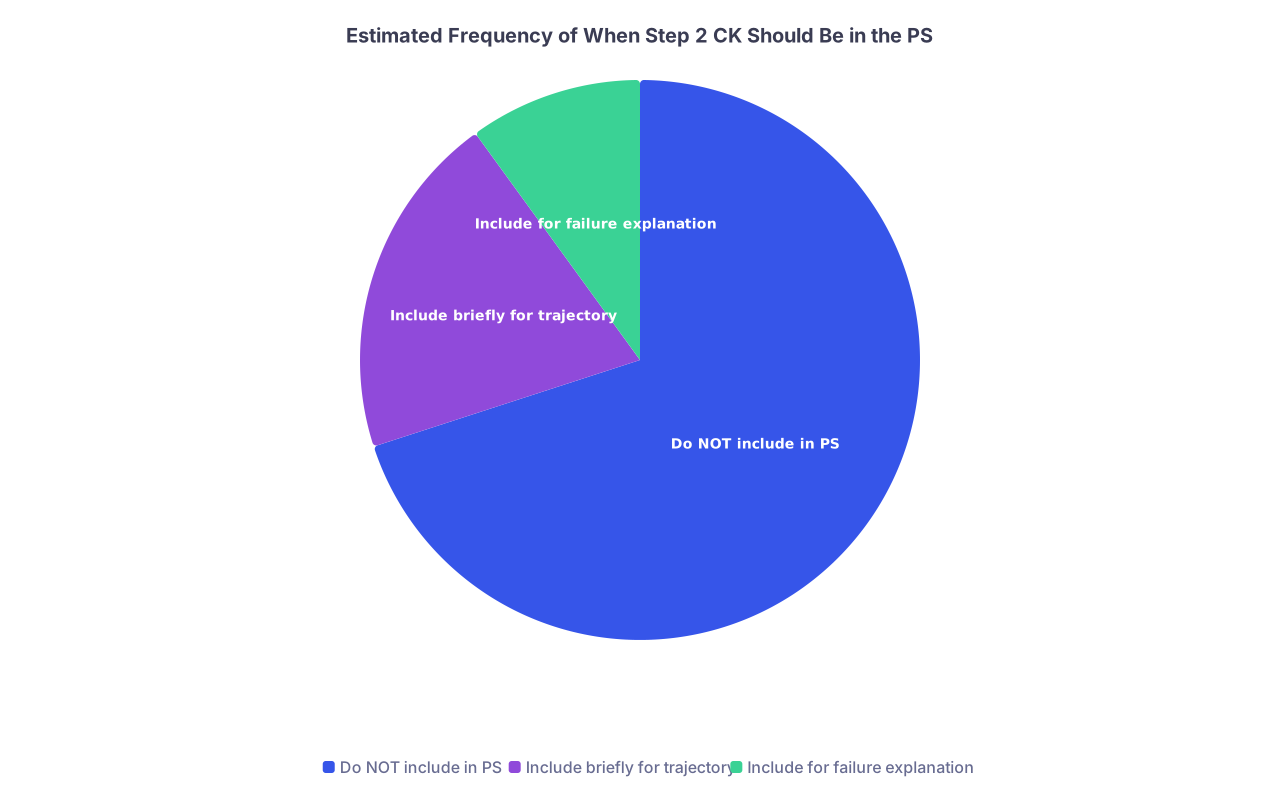
| Category | Value |
|---|---|
| Do NOT include in PS | 70 |
| Include briefly for trajectory | 20 |
| Include for failure explanation | 10 |
Roughly speaking, most applicants fall in the “don’t mention” group. You are not missing a secret trick by leaving it out.
How Step 2 CK Fits Into Your Overall Application Strategy
Step 2 CK is now a heavier hitter since Step 1 went pass/fail. But it’s still just one piece. Programs will look at:
- Clinical grades and narrative comments
- Sub-internship performance (especially in your chosen specialty)
- Letters of recommendation
- MSPE language (watch for “requires close supervision” vs “works at intern level”)
- Research, interests, signals of fit for the specialty
Your personal statement’s main job is to answer three silent questions:
- Why this specialty?
- What kind of colleague will you be at 3 a.m.?
- Are you thoughtful and self-aware or just listing achievements?
Only bring Step 2 CK into that conversation if it clarifies something important about you. Not just because you’re proud of the number.

FAQs: Step 2 CK and Your Personal Statement
1. My Step 2 CK score is very high for my specialty. Should I highlight it in my personal statement?
Probably not. Programs will see the score immediately in your ERAS file. If you mention it at all, it should be in the context of how you think or work, not as a brag line. One short sentence tying your exam approach to your clinical performance is plenty. Anything more starts to look insecure or tone-deaf.
2. I have an average Step 2 CK and a low Step 1. Should I mention the Step 2 CK number?
You can mention improvement without quoting the exact number. For example: “My Step 1 performance was below my expectations. For Step 2 CK, I changed my study structure significantly, leading to a result more consistent with my clinical evaluations.” That signals upward trajectory without pinning yourself to a borderline number.
3. I failed Step 2 CK once. Should I address this in my personal statement or somewhere else?
If ERAS or a supplemental form gives you a specific “academic concern” or “challenge” text box, use that first. If not, you can briefly address it in your personal statement. Keep it tight: one sentence on what happened, one or two on what you changed, one on how you’ve sustained that improvement. Then move on. Do not turn your entire personal statement into an exam autopsy.
4. My Step 2 CK score won’t be available before ERAS submission. Should I mention that?
Yes, one short sentence is reasonable, especially if your Step 1 was weak. You’re telling programs you’re aware this matters and that the score is coming. Something like: “I completed Step 2 CK in late August; my score is pending at the time of application and will be released as soon as it is available.” Do not speculate on how you think you did.
5. Can a strong Step 2 CK score “make up for” bad letters or poor clinical comments if I emphasize it in my personal statement?
No. Strong Step 2 CK helps, but it does not erase red flags in your MSPE or letters. If your written feedback suggests concerns about professionalism, work ethic, or clinical judgment, no amount of score talk in your personal statement will override that. Use your PS to show maturity and insight, not to wave a score around as a shield.
6. If I talk about Step 2 CK in my personal statement, should I repeat the same explanation in interviews?
You should be ready with a consistent but shorter version for interviews. If you addressed a failure or big improvement in writing, your spoken version should match the facts and tone: concise, matter-of-fact, no self-pity, clear about what you changed. You don’t need a new story. Just a calm, practiced, honest explanation that lines up with what you wrote.
Key points to walk away with:
- Default: do not put your Step 2 CK score in your personal statement unless it explains a clear trajectory or addresses an anomaly.
- If you do mention it, keep it brief, contextual, and focused on growth, not the number itself.
- Use the personal statement primarily to show who you are as a future resident, not to reprint data that programs already see in your ERAS file.