
The specialties that care about Step 2 CK the most are exactly the ones you’d expect—and a few you probably don’t. And Step 1 going pass/fail has only made their obsession louder, not quieter.
You’re not crazy for stressing about this. Programs are quietly using Step 2 CK as the new primary filter. Let’s walk through who’s doing it, how aggressively, and what that means for your strategy.
The Short Answer: Who Lives and Dies by Step 2 CK Right Now
Here’s the blunt hierarchy.
The specialties that currently emphasize Step 2 CK the most:
- Dermatology
- Plastic surgery (integrated)
- Orthopedic surgery
- Neurosurgery
- Otolaryngology (ENT)
- Diagnostic radiology & interventional radiology
- Anesthesiology
- Emergency medicine
- Internal medicine subspecialty tracks (particularly cards, GI pipeline)
Then you have:
- “Middle group” (care a lot, but will flex for strong fits): General surgery, OB/GYN, urology, ophthalmology, PM&R, competitive IM programs.
- “Context group” (score matters but rarely defines you alone): Pediatrics, psychiatry, family medicine, neurology, pathology.
If you want a surgical subspecialty or a highly competitive lifestyle specialty, Step 2 CK is functionally your Step 1 now.
Why Step 2 CK Suddenly Matters So Much
Step 1 went pass/fail. Programs lost their easy numeric filter. Nobody is pretending otherwise.
Here’s what program directors are actually doing:
- Replacing their Step 1 cutoffs with Step 2 CK cutoffs.
- Using Step 2 CK to “validate” a weaker or pass-only preclinical story.
- Using Step 2 CK timing (taken early vs late) as a proxy for confidence and planning.
And they like Step 2 CK for three reasons:
- It’s more clinically relevant. It feels closer to what you’ll actually do as a resident.
- It predicts in-training exams and board pass rates pretty well. Programs are judged (and funded, and embarrassed) on those.
- It creates separation in a field of pass/fail transcripts, vague MSPE language, and inflated clerkship honors.
Most PDs won’t say “we screen by Step 2 CK” on record. Off the record, in every meeting I’ve sat in, there’s someone scrolling down ERAS lists filtered by Step 2, saying, “Let’s start with 250+ and see how many that gives us.”
Specialty-by-Specialty: Who Emphasizes Step 2 CK the Most
To make this concrete, let’s look at where Step 2 CK is a central pillar vs just one data point.
| Specialty Group | Step 2 CK Emphasis |
|---|---|
| Derm, Plastics, Ortho, ENT | Very High |
| Neurosurgery, Radiology, IR | Very High |
| Anesthesia, EM, Gen Surgery | High |
| OB/GYN, Urology, Ophtho, IM | Moderate–High |
| Peds, Psych, FM, Neuro, Path | Moderate |
1. Dermatology
Derm is score-driven. Always has been. Step 1 going pass/fail just moved the pressure to Step 2.
Why they lean so hard on it:
- Ridiculous application volume per spot.
- Almost everyone applying has research, strong letters, honors. Step 2 CK becomes a cheap tiebreaker.
- Some programs are quietly using 250+ as a practical soft floor to screen.
If you want derm and you aren’t at a top med school with a derm department that knows you well, Step 2 CK is one of the only objective levers you still control.
2. Plastic Surgery (Integrated)
Integrated plastics is cutthroat. They want:
- High Step 2 CK (often >250 in matched cohorts).
- Strong surgery rotation performance.
- Heavy research, often in plastics.
Why Step 2 CK? They see it as a proxy for raw horsepower and test endurance. And they do not want residents failing boards after a 6-year investment.
If your Step 2 CK is below ~240, you’re swimming upstream here unless the rest of your app is stellar and connected (home program, known mentors).
3. Orthopedic Surgery
Orthopedics has traditionally loved big scores. Nothing changed.
- Step 2 CK is now the primary test signal.
- Many programs are quietly filtering around 240+ as a starting point.
- High Step 2 CK helps offset average preclinical performance or a non-name medical school.
Low 230s doesn’t sink you automatically, but it forces you to lean on: letters from ortho attendings, away rotations, evidence you can function in the OR without being a liability.
4. Neurosurgery
Neurosurgery programs are small, intense, and long. They want proof that you can handle:
- Cognitive load.
- Lifelong test-taking (boards, subspecialty exams, etc).
Step 2 CK becomes a quick “is this person in the ballpark?” check. They still care more than most about research and fit, but if your Step 2 CK is clearly below their typical resident profile, it will hurt.
5. ENT (Otolaryngology)
ENT sits right with ortho in how it treats scores:
- Highly competitive.
- Strong preference for high Step 2 CK to replace what Step 1 used to show.
I’ve watched ENT selection meetings where a great letter got someone a second look—but only because their Step 2 CK wasn’t in the “auto-decline” band.
6. Radiology & IR
Radiology (especially at academic and coastal programs) leans heavily on Step 2 CK now:
- They want strong standardized test-takers; board exams in radiology are no joke.
- Applicants come from all over—Step 2 CK is one of the only consistent metrics.
Interventional radiology (independent and integrated) also skews high. It pulls from the same competitive applicant pool as neurosurgery/vascular.
7. Anesthesiology
Anesthesia used to be a mix of mid- and high-tier programs, but in many places it’s trending more competitive.
- Academic anesthesia programs use Step 2 CK as a real filter.
- Community and smaller programs still care, but are more forgiving.
If you’re aiming for places like MGH, BWH, UCSF, Duke, you should treat Step 2 CK almost like you would for radiology.
8. Emergency Medicine
EM is in flux because of changing job markets, but most PDs I’ve talked to still like Step 2 CK:
- It’s their main standardized test metric now.
- They use it to predict passage of ABEM exams.
Is EM as score-insane as derm? No. But a strong Step 2 CK (245+) definitely makes you stand out and helps cover an otherwise average transcript.
9. Internal Medicine (Top Programs & Subspecialty Track Mindset)
IM as a whole is broad. Community IM? They’ll take a wide range of Step 2 CK scores if the rest of the app fits.
But:
- Top academic IM programs (MGH, BWH, Hopkins, UCSF, Penn, Columbia) care a lot.
- Applicants already talk about “cards or GI later,” and PDs know they’re future fellowship candidates.
Strong Step 2 CK helps in three ways here:
- Gets you through initial screens.
- Signals you can handle IM in-training exams and ABIM boards.
- Puts you in a better position later when you apply to competitive fellowships.
How Programs Use Step 2 CK Behind the Scenes
Let me demystify what actually happens when they open ERAS.
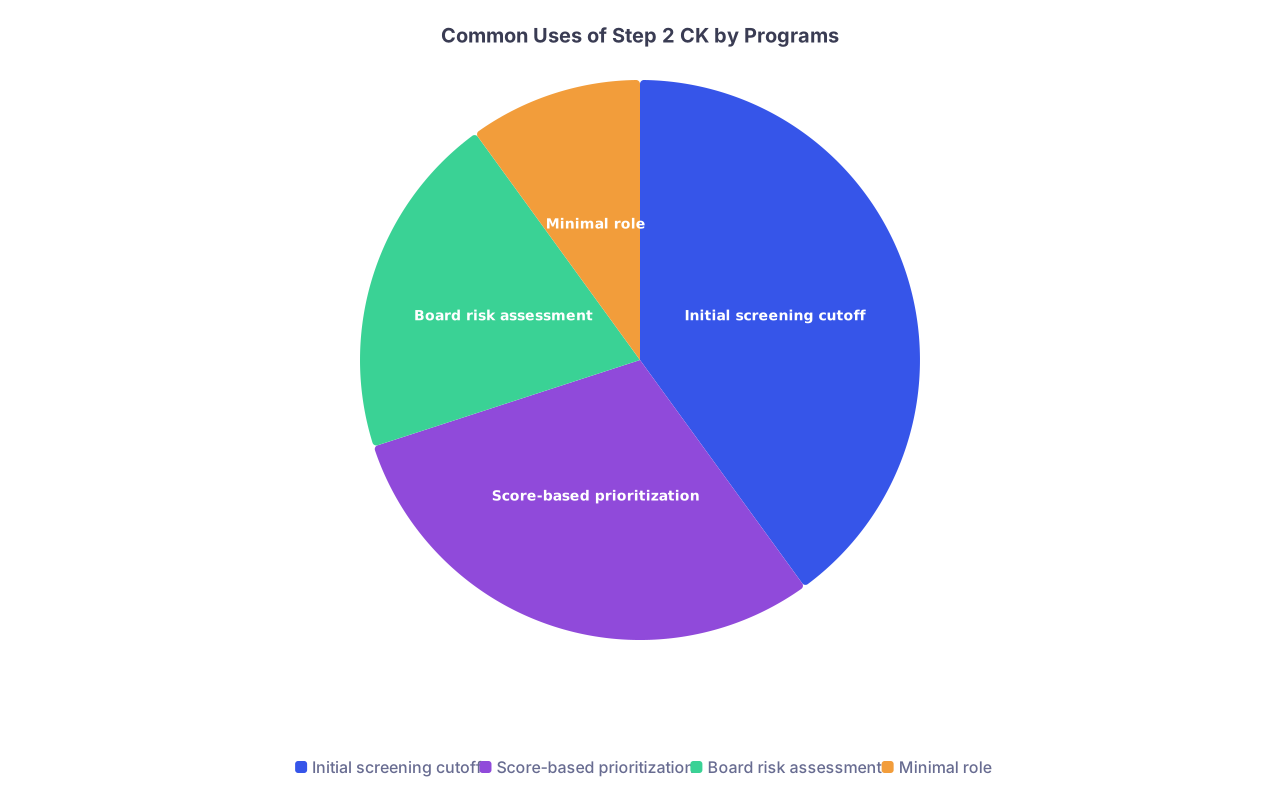
| Category | Value |
|---|---|
| Initial screening cutoff | 40 |
| Score-based prioritization | 30 |
| Board risk assessment | 20 |
| Minimal role | 10 |
In committee rooms, I’ve seen Step 2 CK used four ways:
Hard or soft cutoffs for interviews
“Filter out everyone below 230.” Or 240. Or 250. Depends on specialty and program.Ranking within a tier
Once they like 30 applicants for 12 interview spots, they’ll bump people with higher Step 2 CK up a bit, all else equal.Red flag detection
Big Step 1–Step 2 discrepancy? Late Step 2 with a weak score? They’ll ask why. You need a story if that’s you.Board risk paranoia
Programs with previous board failures become very sensitive to lower scores and marginal trends.
Why Some “Low-Score” Specialties Still Care More Than You Think
You’ve heard people say, “Psych doesn’t care about scores.” That’s too simplistic.
Do these specialties usually demand a 250? No. But Step 2 CK still plays roles:
- Psychiatry: Massive application growth. Good programs use Step 2 CK to thin the pile. A 260 in psych gets attention; a 215 in an oversubscribed cycle can hurt.
- Pediatrics: More holistic, but a solid Step 2 CK reassures them you’ll pass boards and not burn out from test stress later.
- Family Medicine: Very forgiving, but academic FM still flags very low scores as risk.
- Neurology & Pathology: Often mid-range in competitiveness; Step 2 CK is one practical tool among many.
So no, you don’t need a 250 for pediatrics. But a strong Step 2 CK can pull you toward better programs, more academic options, and a smoother ride.
Step 2 CK Timing: A Subtle but Real Signal
When you take Step 2 CK matters more now.

| Step | Description |
|---|---|
| Step 1 | Plan Specialty Early |
| Step 2 | Take Step 2 by July |
| Step 3 | Take Step 2 by Aug-Sep |
| Step 4 | Score in ERAS at submission |
| Step 5 | Score available before most interviews |
| Step 6 | Competitive specialty? |
Here’s how PDs react:
- Step 2 CK done by June/July with a strong score: reads as organized, confident, likely high performer.
- Step 2 CK in September/October: they assume either (a) your school forced it, or (b) you were worried about the number.
If you’re aiming for a top or competitive specialty and your Step 1 is pass/fail, the smartest move is usually:
- Take Step 2 CK early enough that your score is in ERAS by application opening (or close).
- Only delay if you know you’re not ready and staying in your target specialty matters more than one cycle of applications.
Strategic Takeaways by Applicant Type
Let’s cut the theory and talk tactics.
If You Want a Hyper-Competitive Specialty (Derm, Plastics, Ortho, ENT, Neurosurg, IR)
You should:
- Treat Step 2 CK as your centerpiece metric.
- Build your entire 3rd-year schedule and studying around scoring as high as possible.
- Take it early enough that programs see it on day one.
A mediocre Step 2 CK doesn’t end your chances, but it dramatically shifts you into the “needs strong connections and exceptional other metrics” category.
If You Want a Competitive but Not Insane Specialty (Rads, Anesthesia, EM, Top IM, General Surgery, Urology, Ophtho)
You should:
- Aim for “solidly above national mean” as a baseline, then higher if you can.
- Understand that a strong Step 2 CK can almost single-handedly offset a non-name med school or average Step 1 (if scored).
If You Want a Less Score-Driven Specialty (Peds, FM, Psych, Neuro, Path)
You should:
- Still respect Step 2 CK—do not treat it casually.
- Use it as a “stability signal” that says: I will not be your board problem.
- If you underperform, tighten everything else: letters, personal statement, genuine program fit.
Quick Visual: Competitiveness vs Step 2 CK Pressure
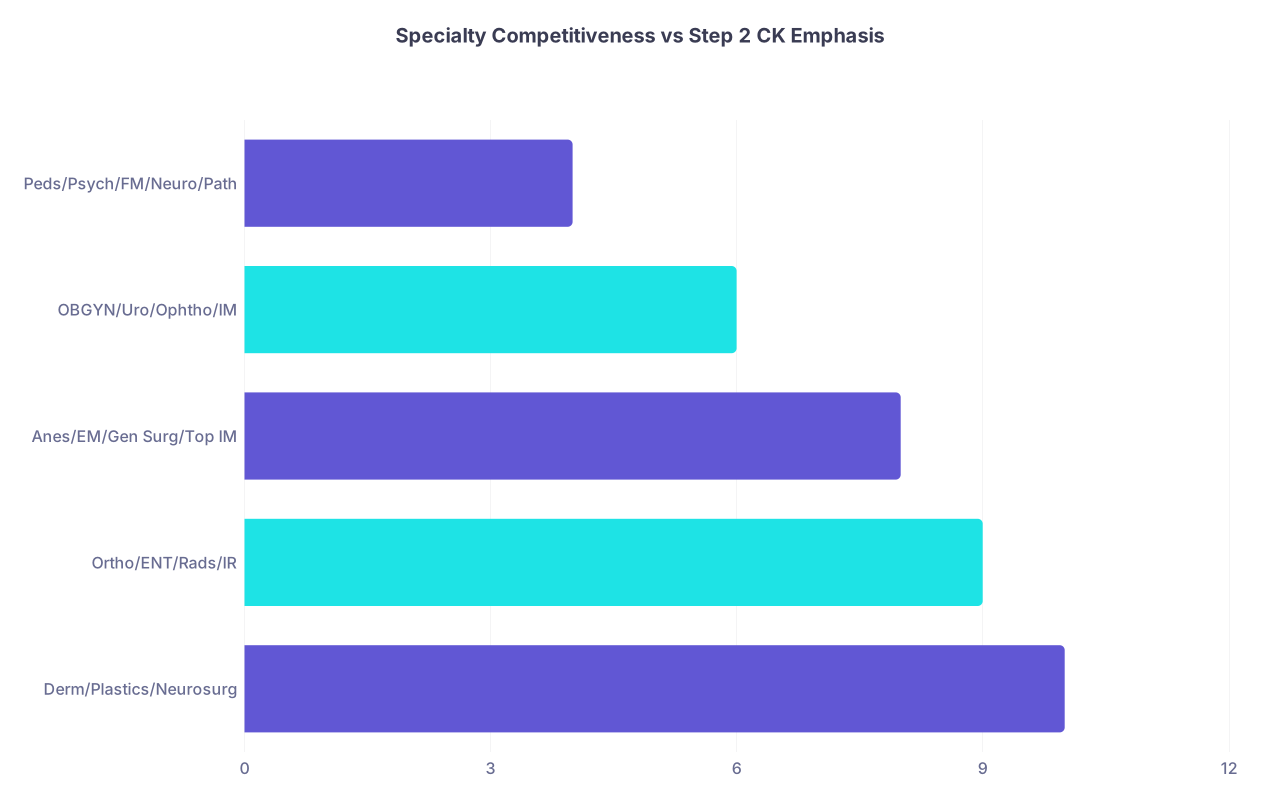
| Category | Value |
|---|---|
| Derm/Plastics/Neurosurg | 10 |
| Ortho/ENT/Rads/IR | 9 |
| Anes/EM/Gen Surg/Top IM | 8 |
| OBGYN/Uro/Ophtho/IM | 6 |
| Peds/Psych/FM/Neuro/Path | 4 |
(10 = Step 2 CK is heavily emphasized; 1 = minimally emphasized)
FAQ: Step 2 CK and Specialty Emphasis
1. What Step 2 CK score is “good enough” for competitive specialties?
For derm, plastics, neurosurgery, ENT, and ortho, you should realistically be targeting 245–250+ to be broadly competitive across many programs. People match below that, but they usually bring big extras: strong home program, research, away rotation performance, or advocacy from known faculty.
2. Can a strong Step 2 CK compensate for a low or pass Step 1?
Yes—up to a point. If your Step 1 is pass only (new system), Step 2 CK becomes your primary test signal. If your Step 1 is a low 2-teens and your Step 2 CK jumps 20–30 points, programs will often view that very favorably. They’ll assume growth, better test prep, and less risk moving forward.
3. How late is too late to take Step 2 CK for residency applications?
For most competitive specialties, if your score isn’t back by early to mid-October, you’re handicapping yourself. Many programs start sending interview invites in October, and if your score isn’t there, some will pass you over or push you to a later review batch. For less competitive specialties, October/early November is usually still acceptable, but earlier is still better.
4. Do community programs care as much about Step 2 CK?
Generally, less—but they still care. Many community programs don’t have the volume pressure that forces strict cutoffs, but they still use Step 2 CK to assess board risk. Extremely low scores can be a barrier even where “we’re holistic” is the party line.
5. If I did poorly on Step 2 CK, should I change specialties?
Not automatically. First, look at your target specialty’s typical ranges and how strong the rest of your application is. If you wanted derm and scored in the low 220s with no other differentiators, yes, you may need a reality check or a pivot. If you wanted EM, IM, or peds and you’re near the national mean, you’re very much still in the game—just be more thoughtful about your program list.
6. How much do fellowship-aiming residents care about their Step 2 CK in hindsight?
A lot more than students think. When you apply for competitive fellowships (cards, GI, heme/onc), your Step scores are back in play. No one is rejected solely for a mid-220s Step 2 CK, but that 255+ you got as an MS3 will quietly help you later when everyone’s CVs look similar.
7. Does a very high Step 2 CK guarantee interviews at top programs?
No. It opens the door but doesn’t walk you through it. I’ve seen 260+ applicants get passed over because they had generic personal statements, weak or generic letters, or no evidence of commitment to the specialty. Step 2 CK is the price of entry at the top end. Not the whole game.
Key points to walk away with:
- The more competitive and procedure-heavy the specialty, the more Step 2 CK is effectively your new Step 1.
- Even “holistic” fields quietly use Step 2 CK to screen for board risk and differentiate in big applicant pools.
- Timing and context matter: a well-planned, strong Step 2 CK score, visible early in the season, is one of the highest-ROI moves you can still control before the Match.